LnP
-
Posts
386 -
Joined
-
Last visited
-
Days Won
1
Everything posted by LnP
-
@JamesPA bit off topic but what software did you use for the drawing? It looks good.
-
I am also figuring out the same thing. Your best bet is to talk to an installer even if not's the one you plan to use. That's what I've done and that way you'll get real world advice.
-
I'm starting a new thread after seeing comments in this one about the risk of fire from PV panels. I'm planning an in-roof system on timber frame. There were some interesting concerns raised in that thread and I'm interested to learn more. I shared a link in that post to guidance from the Fire Protection Association on fire safety with PV installations. It's mostly aimed at commercial installations and doesn't give much specific guidance. There's also a guidance from the IEC but it's quite expensive and I haven't bought it. One of the things the FPA guidance says is that PV panels should be mounted on a non-combustible surface. On-roof would be better in that respect as it's on top of tiles or slates, but would there be any benefit in putting cement fibre board under the panels for an in-roof installation? Any other suggestions to manage this risk?
-
Guidance on PV panel fire safety from the the Fire Protection Association here RC62 RECOMMENDATIONS FOR FIRE SAFETY WITH PV PANEL INSTALLATIONS
-
Balcony leading to flat roof....does it need fall protection?
LnP replied to Thorfun's topic in Flat Roofs
It was on the planning drawings but for building regs I didn't do a Full Plans Submission, just a Building Notice. You're right that if I'd submitted building regs drawings they might have commented. But this was a renovation of a dilapidated Victorian coach house and there was a lot of uncertainty what problems we'd find and how we'd solve them. Building Notice seemed like the right way to go. This was the right decision albeit that the balustrade caused some head scratching. -
Balcony leading to flat roof....does it need fall protection?
LnP replied to Thorfun's topic in Flat Roofs
There's a lesson here which I wish I'd known before I built our roof terrace. If you're planning a balcony or roof terrace, think about the balustrade. How will you mount it? I think it's a bad idea to bolt it to the roof and penetrate the roof covering and have to rely on sealing around the bolts. Also I wasn't happy to bolt it to the copings. Their function is to keep water out of the wall so not a good idea to penetrate them. Also, for strength I'd have been relying on the mortar bond between the copings and the GRP cap across the top of the wall which I wasn't happy about. How will you achieve the required 1100 mm height required by building regs? Doing it the way I did passed BC, but I do take the point that somebody could step onto the parapet. If I had my time again, I'd build that roof without a parapet and just take the GRP across to the edge and down onto a fascia board. It would have saved me a lot of money in building the parapet (bricks, copings, GRP flashings, rain outlets) and I could have used an off the shelf balustrade system rather than having to fabricate something. I didn't realise the parapet would be a hassle it was and was convinced by others it would look nice! -
Balcony leading to flat roof....does it need fall protection?
LnP replied to Thorfun's topic in Flat Roofs
I didn't like the idea of penetrating the GRP or the copings with the balustrade brackets so I used fascia mounts.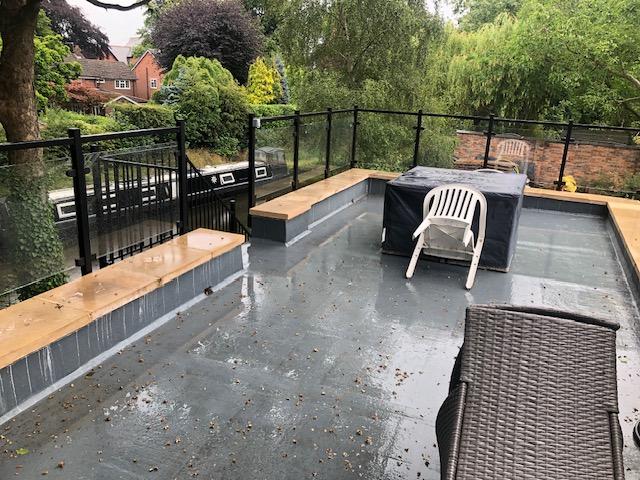
-
Balcony leading to flat roof....does it need fall protection?
LnP replied to Thorfun's topic in Flat Roofs
That's not my experience. I have a balustrade around the outside of a terrace on a flat roof which has a parapet wall round the edge. The parapet is about 350 mm above the level of the terrace flat roof. I asked BC if I needed to consider somebody stepping up onto the parapet. They said no. Otherwise the balustrade would have been 1450 mm above the floor of the terrace. It would have been like being a monkey in a cage. The BC final certification visit was by a different person and he also had no issues with the balustrade - 1100 above the terrace floor level and therefore 750 mm above the top of the copings on the parapet. Comment from the BCO was that you don't need to cover every eventuality - you could have a chair against the balustrade and somebody could climb on it. -
If you're replacing the slates with new artificial ones, you should follow the manufacturer's advice on nails. I re-roofed a house with Redland clay tiles and they recommended aluminium nails. I suppose they're thinking about the roof being there for the next 100 years and galvanised ones won't last that long, especially as they'll get scratched as they're driven in. Here's the Redland guidance.
-
@Gus Potter What kind of things are you finding wrong?
-
I'm a bit confused here. Seems like on the one hand you're recommending to run pipes over the whole floor area .... but on the other hand not....? Please clarify what you're recommending be done under fixed kitchen units! I don't understand! Thanks 😊
-
I routed rainwater into the pumping station to help to keep it flushed out of the nasty stuff!
-
I installed it next to the outbuilding, in fact in the middle of where we now have a patio. I was a little bit worried we might get smells but we don't. The waste from the outbuilding falls by gravity into the pumping station and there's a level switch in the tank which turns the pump on. It's about 25m to the sewer chamber it connects it into. I looked into macerators, talked to builders and got advice that a pumping station was more of a "proper job". Also my mother-in-law had a macerator when she had a downstairs toilet installed, to get the waste a few meters to the sewer connection. It was unreliable. We're going to be living in this outbuilding during the build so it needs to be up to regular use. You have to dig a hole in the ground for the tank, but we had a digger on site anyway for the trench.
-
I installed this pumping station in a similar situation, from Drainstore. It's been in a year and works fine so far. Completely silent. Single Sewage Pumping Station - 610mm x 1000mm 292 Litres - up to 10m head plus 2 year warranty on pump - Include High Level Alarm
-
I've a friend who's an acoustics engineer. His company get called in when disputes arise. Local authorities are unlikely to police it, but the risk is that a neighbour complains. Even if you have planning permission, neighbours can allege that the noise is a statutory nuisance. His experience is that local authorities are not well equipped to handle those cases which leads to uncertainty.
-
I'm about to submit a planning application for our new house. I'm thinking about putting the ASHP on the opposite side of the house from the plant room. This would keep it away from neighbours and be less visible for us. The house will have UFH and the connections to the ASHP would run under the kitchen/family room, about 14 m. Is there anything wrong with that? Where should the flow and return pipes sit in the foundation build up? Insulated obviously but also in a conduit? Any watch outs? Thanks
-
Interesting. I'm at the design stage for my self build and do want active cooling but still thinking how to do it - heat pump or multi-splits. According to my cheap electronic air quality analyser (CO2, temp and rel humidity), the air in the room right now is 20oC and 65% relative humidity. A psychrometric calculator or chart indicates that the dew point is 13oC. So I'd be getting condensation if I was running the HP with a flow temp of 12oC. Using the heat pump for cooling is attractive, but I'm worried about condensation in hidden places - mould, rot etc.
-
The fact that you get condensation under your rads must mean you're running the HP flow temp colder than the dew point in the house? Are you concerned about that at all? Do the fan coils collect the condensate and drain it somewhere? What is type Q insulation, does it keep the moist air away from the cold pipes?
-
Do these conical filters fit into any 125 mm extract point or do they require a particular fitting?
-
Is that a standard fitting, an extraction point with a filter pad in it, or did you fab it your self?
-
I think I recall Andrew Jones (The VATMAN) cautioning against this. IIRC his advice is that the name on the invoice has to link directly to your build.
-
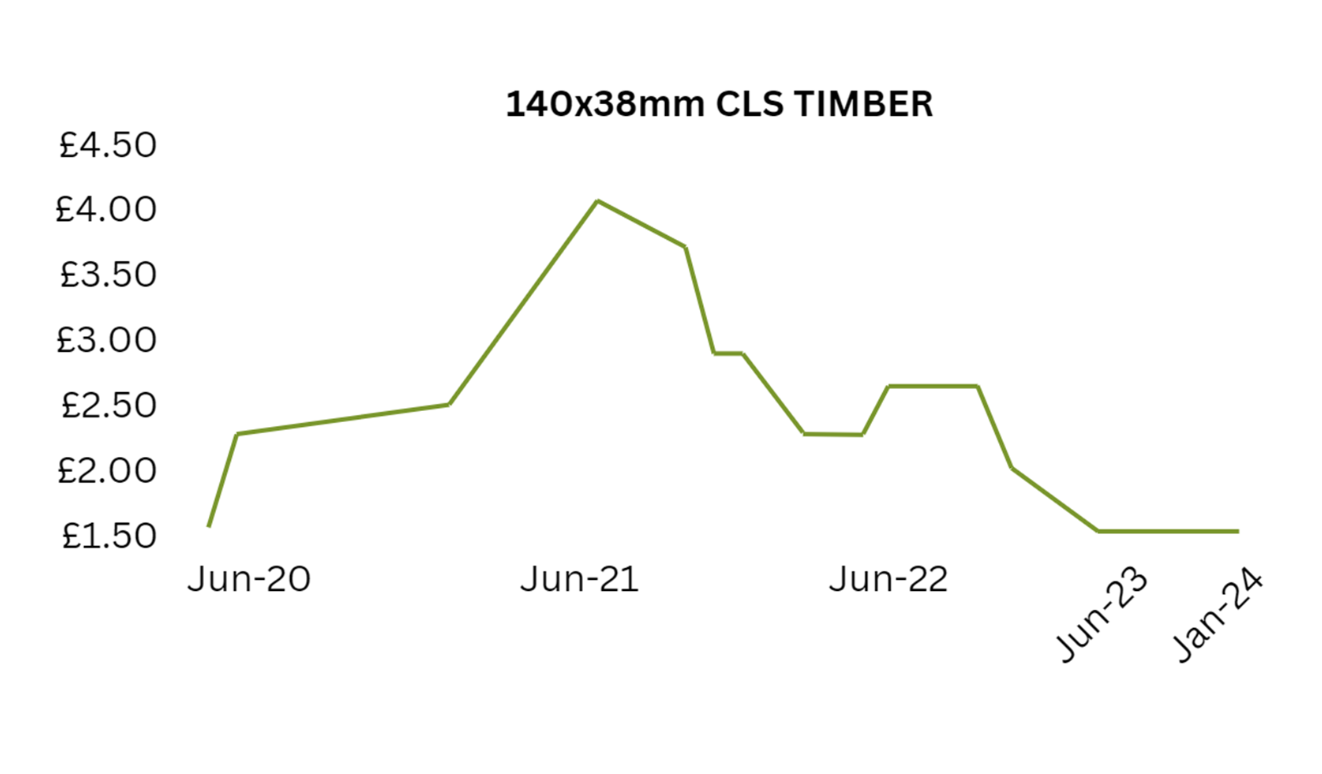
This graph was presented by a timber frame company at a recent demo day. Prices of CLS timber are back to where they were 4 years ago.
-
At my last house, I got my kit from the Electric Gate Shop and installed it myself. I was happy with the tech support. I had imy installation checked for electrical safety by a proper electrician. mains voltage motors photocells on the posts inductive loop in the driveway preventing the gates from swinging open onto a parked car The motors sense if they’re closing on an obstruction, e.g. trapped body part, and you can adjust the force they close with telephone cable back to the house with a button inside the front door so we can open the gates from the house and also lock them open (switch wired in series with photocells). Handy when you have guests As well as the usual remotes, a GSM module which opens the gates when it receives calls from pre-programmed phone numbers. Very handy as you can call it from your car as you approach the house so the gates are open as you arrive. Also handy for allowing access for friends, relations etc. no stops for the leaves when they’re open, but a clever stop which grabs them when they’re closed an electric lock (similar to remote door access in apartments) which is activated automatically by the controller and locks the gates together when they’re closed. This is to stop anyone from forcing the gates open. Works a treat and very reliable.
-
If a qualified ecologist says an emergence study is not required, it's hard to see how the LPA could argue with that. Do you have a planning consultant to argue your case?
-
This company was recommended by my planning consultant, as he had had good experience with them - Rachel Hacking.