


ruggers
-
Posts
335 -
Joined
-
Last visited
Everything posted by ruggers
-
I've been using some heat loss calculation software that many heat engineers use & I've accurately included all of my data & exact U-values. I've tried altering certain room temperatures from 21°C to 19C to see how it affects things room by room and the total. The software defaults the ACH per hour but I don't see any option to include the MVHR unit I'm choosing to use & include its efficiency. Zehnder Q350. Looking at an MMVHR estimate I received, it states some nominal air changes 1/h. I input one of them to a small second bathroom, overriding the default and i had to increase the ACH from 2 to 3.47 if this is correct? to see how it would affect the heat loss. It increased it much more than expected, so I'm now wondering how much this is going to negatively affect my overall loss. The standard heat loss for 235m2 is 6.4kw with 10% extra added on due to exposed area setting. How should MVHR be included into the ACH section once I have a detailed design? We know with UFH/radiators and weather compensation that its very important to get accurate heat losses to size the emitters. I was also hoping for a good heat loss result.
-
U value calculation help required - Data sheet provided
ruggers replied to ruggers's topic in Boffin's Corner
Thanks, I might give them a call tomorrow. If 150mm can get down to 0.11/0.12, it's possible that the 100mm slab under the insulation adds a small amount of value to the 150mm insulation and brigs it to 0.10W/m2K. Eco therm and quinn therm were always cheaper than kingspan. -
U value calculation help required - Data sheet provided
ruggers replied to ruggers's topic in Boffin's Corner
Thanks JohnMo I have a ground floor SAP target of 0.10 W/m2K and the plans state, from the ground up. 1. Min 150mm sub base 2. 50mm sand blinding 3. DPM 4. 100 Concrete slab 5. 150mm PIR insulation 6. 50mm Liquid screed (With UFH pipes embedded) Someone said that I'd require 170mm of PIR to achieve 0.10 for the floor so I wanted to check if 150 was going to do it or not. -
U value calculation help required - Data sheet provided
ruggers replied to ruggers's topic in Boffin's Corner
An after thought question on this.... If W/mK is for a thickness of 1m, is W/m2K always based on 100mm? -
U value calculation help required - Data sheet provided
ruggers replied to ruggers's topic in Boffin's Corner
Thanks @SteamyTea I wasn't sure whats a figure worth caring about and what's insignificant and just looks better on paper. 0.17 vs 0.18 vs 0.19 @Temp I missed the surface effect from the calculation both sides and see you have reduced the dab gap to 10mm from 15. Boffin of the night award for you tonight 🏆. I'll keep my dunce hat on, brains cooked for the night. Hopefully now I have enough figures to input everything as rockwool provided the partition walls, loft and intermediate floors values. I did look at the examples again & used the formula you provided and now understand how close it makes it. Thanks again both of you. -
U value calculation help required - Data sheet provided
ruggers replied to ruggers's topic in Boffin's Corner
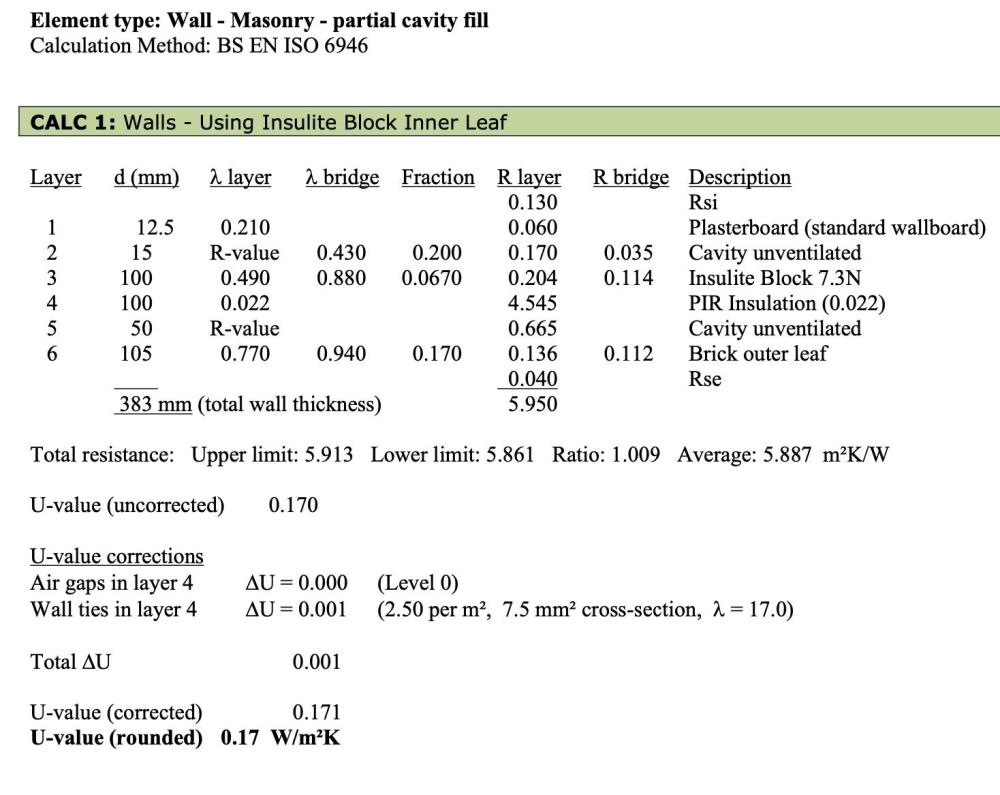
I still thought it would affect the end result because the insulite R layer says 0.204 and the dense is 0.085 so once totalled and then divided the answer couldn't be the same considering as a bare block one is twice as good as the other. Is my example ok to use? 12.5mm plasterboard R 0.060 + 15mm air gap R 0.170 + dense block R 0.085 + 15mm air gap R 0.170 + 12.5mm plasterboard R 0.060 = 0.545 Then U = 1/0.545 = 1.84W/m2K -
U value calculation help required - Data sheet provided
ruggers replied to ruggers's topic in Boffin's Corner
If i'm applying your methods correctly, looking at these two further examples attached & using the R values they've used, I'm getting 1.84W/m2K for plasterboard - air gap - dense block - air gap - plasterboard. And for the insulite it's 1.5W/m2K? I'm still baffled how both blocks equate to the same U value when combined with other materials.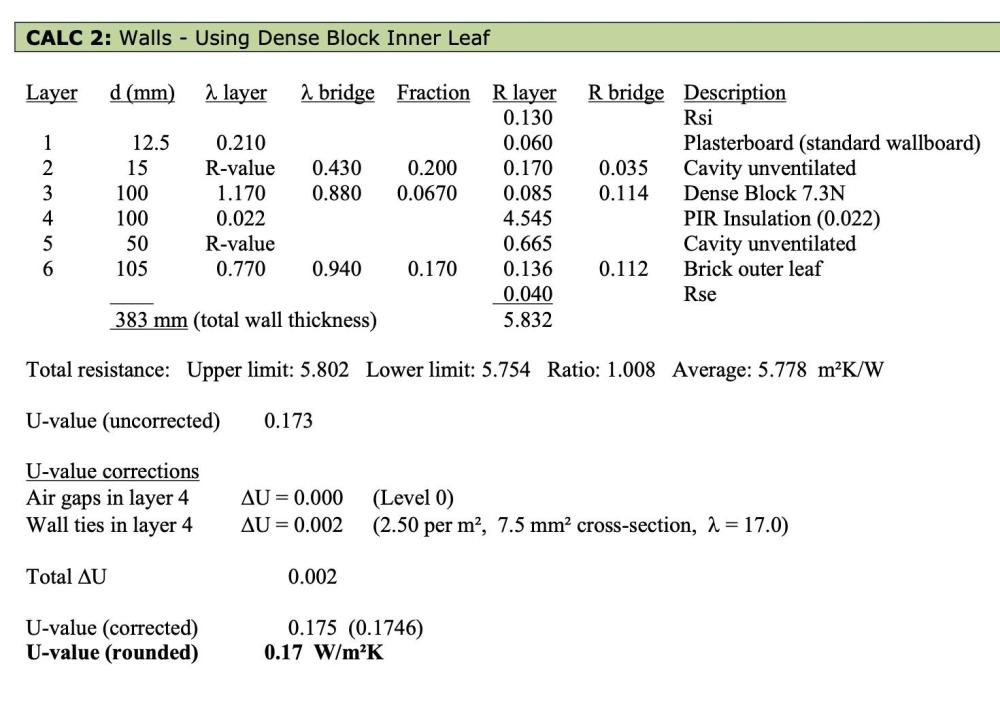
-
U value calculation help required - Data sheet provided
ruggers replied to ruggers's topic in Boffin's Corner
Thanks Temp for clearing this up. So to obtain U, I require the R value of the material? So on it's own, the insulite is is twice as good at preventing heat transfer compared to the dense? I'm not sure if this is of benefit for internal walls or not, I'm only losing heat to another room but the insulites sandwiching 100mm PIR are 0.01W/m2k better between my house and attached unheated garage if thats worth bothering about. Insulite are around 20p per block more expensive. I was going to use them for my inner leaf of the cavity wall until i found out they are just the same as dense when combined with the PIR. -
Can anyone help me with obtaining some material U values to input into the heat engineer software I've been using. I'm not smart enough to complete the calculations required when looking at the formulas 😚. I have attached two data sheets for the blocks I'm going to use. One for a dense block and one for an insulite block. Dense is showing as 1.17W/m2K and the insulite is 0.49W/m2K. I would like to know what the U value would be for each type of block if used on their own for internal ground floor load bearing partition walls with a 12.5mm plasterboard (0.210W/m2K) dabbed onto each side. Am I correct in thinking that as a bare block with no plasterboard, the U value for internal use would just be as per data sheet being 1.17 and 0.49? For a little info. for anyone else - A member of the brick company provided me with some personalised data & an explanation for each when used in a cavity wall situation with PIR and strangely they both equal the same U-value. With both blocks used in the below layout, a U-value of 0.17W/m2K was obtained. 12.5mm plasterboard (0.210W/m2K) - 15mm dab cavity - 100mm block - 100mm PIR (0.22W/m2K) - 50mm air gap - 100mm concrete brick - Total = 383mm Without the cavity air gap having the PIR sandwiched between the blocks made the insulite at 0.18W/m2K and using the dense block was 0.19W/m2K. DENSE Datasheet - WEB July 17.pdf INSULITE Datasheet - WEB July 17 2.pdf
-
How to ensure walls all level for intermediate floor?
ruggers replied to ruggers's topic in Brick & Block
@Canski Thanks for the advice. If the intermediate walls were laser marked like previously described 1m below, it could work out better, but due to the posi joists being 253mm not 225 or 300, I'm thinking it's a bummer for someone to cut 28mm off each block and wouldn't end up very tidy. 2 bricks and a 47mm could make it a lot easier to tie back in with the cavity courses. It's all mathematical and the real world doesn't work this way especially if blocks are cut with bolsters rather than saw cut. -
Thanks for the replies. Strange how my plans were passed with no mention of it and very little detail about windows. I will make enquiries. I couldn't find much mentioning if it also covered the glass which seems a big benefit if it does. Uprated locks seem a benefit in a rural area. There seems to be a few types of glass. Standard Toughened Laminated. Other?
-
I'm looking to build a house next year and have had my plans and building regs accepted pre June 15th. I've been obtaining some quotes for UPVC double glazed windows and came across some questions from the various suppliers. 1. I was asked if I need PAS24/DOC Q specified windows. So one company is quoting without saying they don't make a great deal of difference and if someone wants in they'll get in but it does add a lot onto the price. Another has said it's a new build you will need them and quoted for it. My regs/plans don't specify that it was required and have been passed. Is PAS24 part of DOC Q or are they two separate things? 2. Do these standards just relate to the locks and frames or to the glazing also? Is it worth is or in reality no? I once seena video showing a standard lock being broken into vs an ultion lock. Standard was broke in under 10 seconds.
-
How to ensure walls all level for intermediate floor?
ruggers replied to ruggers's topic in Brick & Block
So i sense a level or sarcasm but are you suggesting posi joist do or don't get blocked up between. Bricking between will help prevent cross travel of sound but services don't just run in one place so there would be a good few missing. I worked out then the 253mm joists if they on hangers would sit well mid span on a 100x47mm timber underneath to tie in with the brick courses but this means you definitely cant brick between. -
@TonyTAs in a standard vent slate that just fits into a pitched roof? I've seen the mushroom type on flat roofs but theres others that look much better. It's why I added this post incase others had tried similar things. I could add lots of vents and they don't even work, its a bit of trial and error. I don't mind fitting a vent on each gable or a couple of slate vents up near the ridge on the North side if it helps, I was just unsure if it makes any difference or not with them being so small compared to the size of the roof. A velux is a significant opening size so it will let a lot of heat out compared to a few vents. @TempI think unless I'm going to fully insulate the underside of the roof to keep heat out as per comments above which isn't very cost effective for my use of the room, My best bet will be to add some vents to get the air moving and consider a radiant heat barrier to the underside of the rafters to prevent as much entering and leave a gap at ridge level where the vents are to help steer it in this direction. The rest of the heat reduction will have to rely on the loft insulation on the floor.
-
How to ensure walls all level for intermediate floor?
ruggers replied to ruggers's topic in Brick & Block
Handy little trick. If the joists are blocked up in between them over internal walls, there won't be any space for running the services in the floor void between rooms? Cables, pipes, MVHR ducting. -
How to ensure walls all level for intermediate floor?
ruggers replied to ruggers's topic in Brick & Block
I agree with you that for ease of installation and air tightness this is the winner, i had a post about these options a few months ago, ledger board vs masonry hangers vs tony tray vs just built in as standard. Because the ledger board sitting tight to the inner face of the wall prevented all of my services reaching the consumer, it meant that the ledger would need packed off the wall by 25mm or so which I don't see as an issue. But I struggled to get certain people to agree because it wasn't something they've experienced before, my plans were 'well' over due completion and I just needed them complete to get on with it. They are passed now but it might be worth me checking with a structural engineer to ask if we can change it. It doesn't affect the plans. Trying to hope the mid span walls tally up in height with the underside of the masonry hangers won't be easy at all. Thanks Canski, I will meet up with the builder and ask what they do and suggest this option. What is classed as a long line, my largest span will be 12m. When posi joists are supported at each end via masonry hangers, any mid span load bearing walls they cross over and rest on, do the joists rest directly onto the block work, or would a timber wall plate be bedded on, the same as you do at the top wall plate for the trusses? -
I was meaning the panels sitting over that area of roof slate means that the slate behind doesn't take the full impact of the heat so the radiant heat is reduced within the loft whilst also creating energy via the PV absorbing sunlight. But most panels sit off the roof on rails with an air gap behind them causing a shadow and separation from the slates. An inline PV system fixes direct to the battens via plastic panels so i think the heat stored in the black PV panel will again travel back into the loft space as radiant heat. Thinking about it now, anything fixed to the underside of the rafters to try and divert or radiate the heat back outwards from the loft space probably won't work unless it's sealed from edge to edge like the rest of the thermal envelope being airtight. Using the foil type VCL to the underside of the rafters would have been a nice way to achieve this but unless sealed it would have no where to redirect it too. As it's not a habitable loft with expensive attic trusses, It would cost me probably £5k extra to do it properly. The slates will get very hot on sunny days, we can't stop that, so it's finding the most cost effective solution to diverting that radiant heat back outside.
-
I wasn't aware of this, so for all upstairs rooms this would be pointless then, except the bathroom if I batten the ceiling to create a gap for down lights into a upvc ceiling to maintain airtightness between loft and bathroom. Are we saying PIR does or doesn't prevent the transfer of heat into a building? If it holds the heat in when it's cold outside, I'd expect it to prevent it from allowing the outside blocks transferring the heat inside on warm days. If I can afford it, I will be adding some solar panels to the South facing front roof, but they will be the inline type so won't have the air gap behind them which shades that part of the roof. The total of panels spread gable to gable will only cover 20% of that half of the roof. I don't feel the need for aircon up North with 2 weeks of heat wave per year but it doesn't take a heat wave to heat the loft space enough to possibly affect my lagged MVHR ducts supplying rooms.
-
How to ensure walls all level for intermediate floor?
ruggers replied to ruggers's topic in Brick & Block
I'm aware of bedding a timber wall plate onto cement at the top of the build to sit the roof trusses onto. But wasn't aware its done at intermediate floor level. So some of my joists ends will be supported by sitting into a masonry joist hanger which will bed down between the courses of the inner block work with the opposite end of the joists resting on on my load bearing internal partition walls also constructed from blocks. I'm not sure if they sit direct onto these inner walls or there also needs to be a 100 x 50mm wall plate too? I wouldn't of thought there would be, and so the internal walls and the cavity wall inner skin wall courses need to match up in courses. I will also have some joists 11.45m long that will span the full house width and each end will be secured into a masonry joist hanger, but mid way along this span will be two internal walls and if the top of these walls were, lets say 10mm higher or lower than the masonry hangers, then the long joists would be bowed. -
Do you have an example of the wood fibre or products your referring to that could be used in a loft situation? I always thought that foil backed insulation like PIR was supposed to be as effective at keeping the summer heat out as it is at keeping the heat in when its winter, although my experience has always been as you described, it works in winter but still gets too warm in summer and asking what else can be done to prevent this. Because PIR is basically insulating foam sandwiched between two layers of foil, does that not mean that reflective foil alone on the undersides of the rafters would be a complete waste of time? I was looking at this for example. https://www.toolstation.com/construction-insulation/foil-insulation/c626
-
So the issue I want to try and control is the over heating of the non-habitable loft space where my MVHR ducts will pass between the unit to the rooms. I can try making a an insulated cabinet around the unit. The radial ducting will be insulated and it will also be under the 400mm of mineral wool. The ceiling between the upstairs bedrooms and the loft I will use PHS Hi-Thermia membrane as a VCL. https://passivehousesystems.co.uk/wp-content/uploads/2020/05/PHS-hi-thermia-membrane-2020.pdf The roof orientation will be North facing rear, South facing front with East West gable ends. It's actually rotated 20 degrees clockwise from North. I wasn't going to continue the PIR insulation up above the first floor but the S.E side brickwork might warm up a lot more than I think. The roof slates are what seem to bring in most of the heat. Looking at your suggestions has made me think that the fans or vents won't be too effective if the thermal mass keeps transferring the heat into the loft again. Standard trusses have braces all over the place making it extremely hard to make a neat job of sealing any foil to the underside of the rafters from eaves to ridge level, but if it doesn't need to be completely sealed and will still be effective, I don't mind adding some to the South Facing side. I don't want it to be like fitting a VCL & then having gaps between all of the joints & it's an expensive waste of time.
-
Delaying Rendering Until After The Winter?
ruggers replied to Johnny Jekyll's topic in Brick & Block
I built a dense block outside shed with a slate roof, single skin and had no problems with water ingress for a number of years before I decided to cover it so I think it will be fine over the winter, I'm assuming your PIR full fill will have a small gap to the outer skin (10mm), if correct it's not incontact causing any issues. -
Looking to start a self build brick construction. How do I ensure that all of my internal load bearing walls match up in height with my inner leaf cavity walls so that the posi joists are supported correctly without bows/dips. A couple of my Posi joists also span the full width of the build and rest on a couple of internal room dividing walls. Not all builders work to the same standard, some might use lasers for this, what should i be looking for to ensure the best results possible? The ends of the joists will be supported by internal masonry hangers, joist depth is 253mm which isn't ideal to tie in with brick/block course very well.
-
What are the best options for reducing the summer heat that builds up in a 'cold' loft space on sunny days which comes from radiant heat heating the roof slates? Is air movement the most important, preventing the heat from entering or both? I'm planning to start a self build & will be siting my MVHR unit in the loft on a gable end so I'm looking at ways to reduce the heat up there. There will be 400mm of rockwool but the roof construction will be standard trusses which can make it harder to insulate to the underside of the rafters. I was wondering if adding something like a superfoil roll to the undersides of rafters would help reduce radiant heat, or be a waste of time if it's not a complete taped and sealed envelope. Possibly adding an extract fan controlled off a switch or thermostat.
-
Storage combi or UVC choices for new build
ruggers replied to ruggers's topic in Boilers & Hot Water Tanks
Can ASHP's modulate down as low as a good condensing boiler or does short cycling affect them more if zones were applied? Does rising electricity prices affect COP?


