SimonD
-
Posts
1942 -
Joined
-
Last visited
-
Days Won
10
Everything posted by SimonD
-
Variable temperature boiling water tap
SimonD replied to SimonD's topic in Kitchen & Household Appliances
Thanks, for moment when I looked at it I'd hoped the combi could've done it but alas. -
Variable temperature boiling water tap
SimonD replied to SimonD's topic in Kitchen & Household Appliances
You know I hadn't considered that one at all 😉😁 nor had I thought about letting the water cool for a while in the pot 😉. I had singularly, and maybe unreasonably for £1.5 - £3k or more for a Quooker, wondered whether there wasn't some bright spark of an engineer that might have considered that when it's possible to provide an all in one tap that gives you hot/cold water, boiling water, chilled sparkling filtered and normal filtered - something that's sold as doing it all - it isn't also a decent idea to design one that also provides a thermostatic control for the boiling water coming out of the tap. 😉 I can't be the only one that would like water between 70 - 100 degrees when spending that kind of money. 🙄 It's not just green tea, even good coffee needs to be brewed at less than boiling temp. Maybe I shall just have to stick with my low tech variable temperature kettle as I reckon there's a design oversight here 🤔😉 -
I've been looking around at the boiling water taps, specifically looking for one where I can adjust the outlet temperature of the water between 70-100 degrees. I've found some where I can do this on the tank but none that have controls at the tap. I mostly drink green tea which needs 70-80 degrees and everyone else normal teas and coffee at full temp so tank adjustment of temp is impractical. Anyone know of a solution available here?
-
Yup, I've now got twice the number of alerts from both google photos and microsoft one drive photos. I think they're both mocking me. I look at the photos and often wonder what I've done in the last year yet it feels like I haven't stopped! I'm currently at double the anticipated time, probably, and still have no idea when it'll be finished. Yeah, meet a few of them that consider this self-build. It's such a relief when chatting to a couple of friends who have been through the process and understand the challenges beyond, one asking me the other day whether I wasn't overcome with decision fatigue, the other saying frustrating it is when apparently small jobs end up taking days! I've seen a few near us where they've finished and gone. There's one project I drive past regularly however, that still puts me at ease because the developers started building works before we even got planning and it's still going on (and it's only one large georgian style town house new build and one existing cottage renovation). I'm hoping I might just beat them to it 😁 Like you, I've felt like I've been in a miserable hole with the building work for at least the last year and now the sun has come out as I start to make the kitchen and have a functioning bathroom in the house. It's starting to feel real... well almost. Doing it all myself with not a lot of prior experience, the one thing that I did not anticipate was the amount of time I'd have to spend doing research and learning new things. In all honesty, I think this has been the biggest delay factor beyond the supply problems due to covid. Put this together with a tendency to go round in circles a bit and overthink decisions and it's a recipe for slowing progress. I'm also a bit of a perfectionist - so much so the others on a plumbing course I took a while ago were taking the piss out of me for it. However, people I know are now starting to call me for advice and it's so nice to be able to answer the questions knowledgeably off the top of my head, or like the other day help someone out sorting a problem and fixing it with ease - at least someone can benefit from the learning! 😊
-
Standing Seam Roof
SimonD commented on Patrick's blog entry in Timber Portal Frame - but stick built
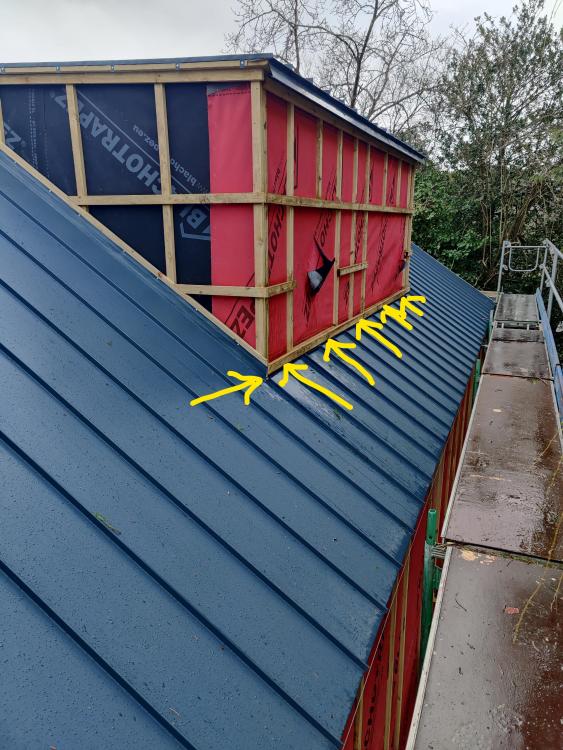
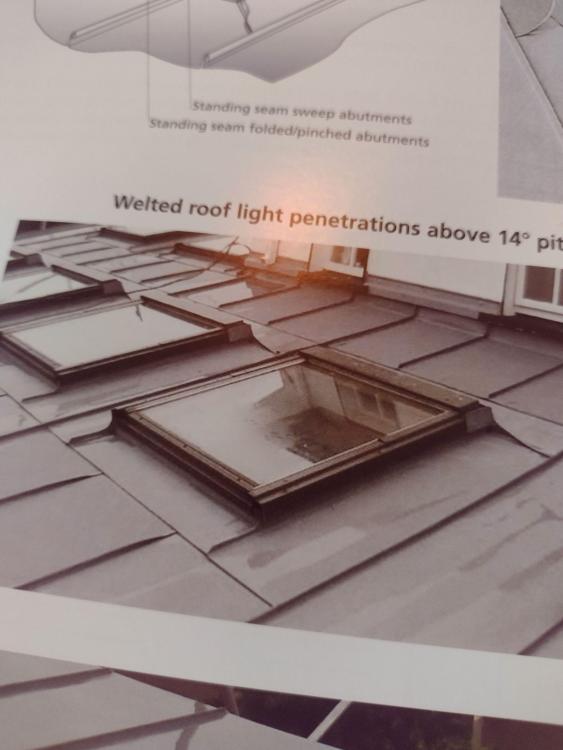
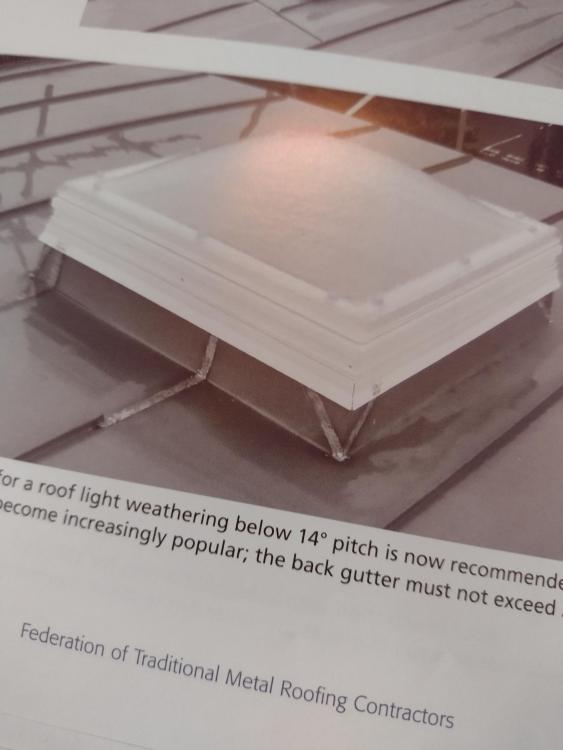
These are the areas I was referring to, especially the external corner, but the upstands at the junction between the roof and the bottom of the dormer are too low .
-
Standing Seam Roof
SimonD commented on Patrick's blog entry in Timber Portal Frame - but stick built
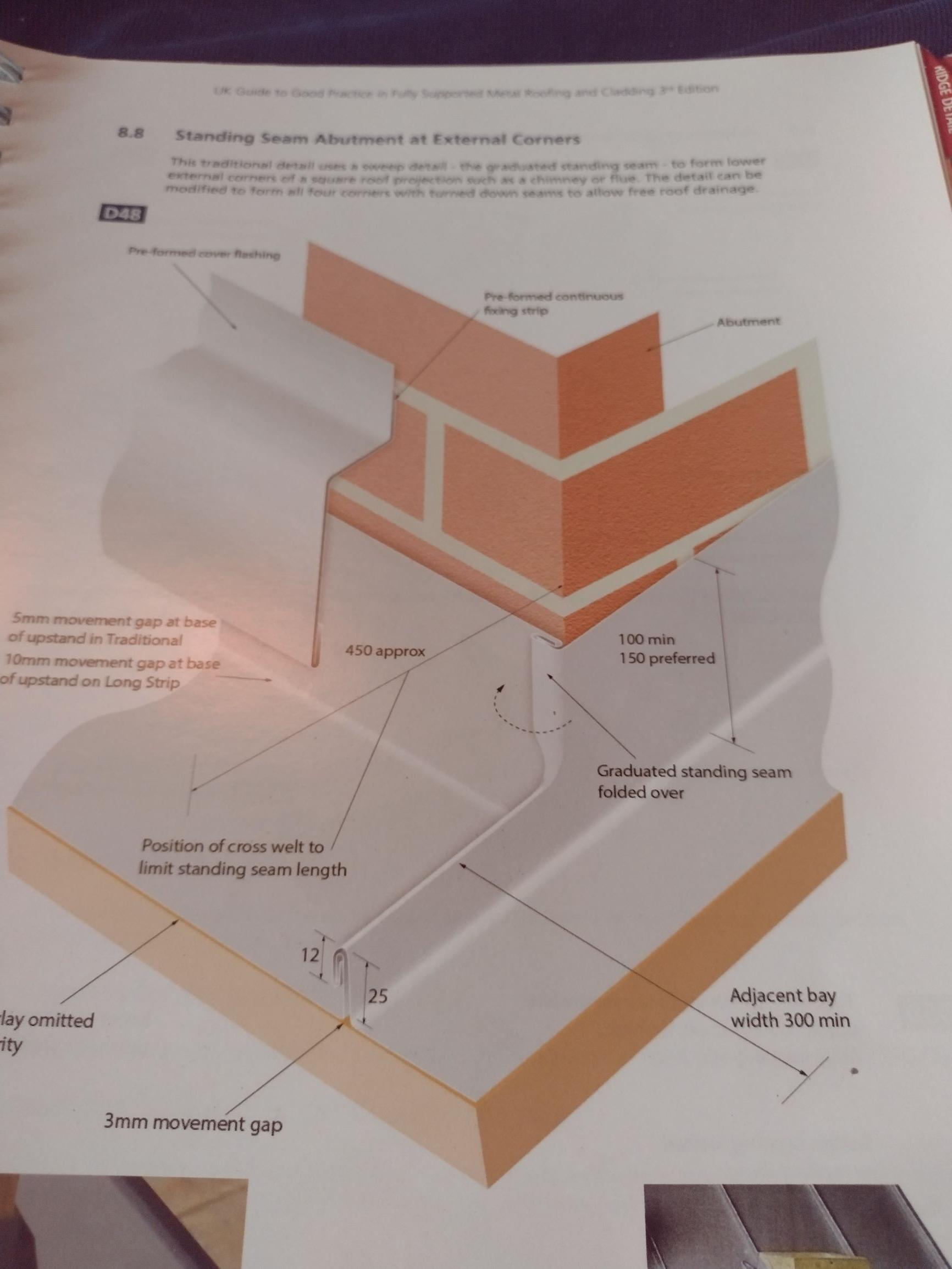
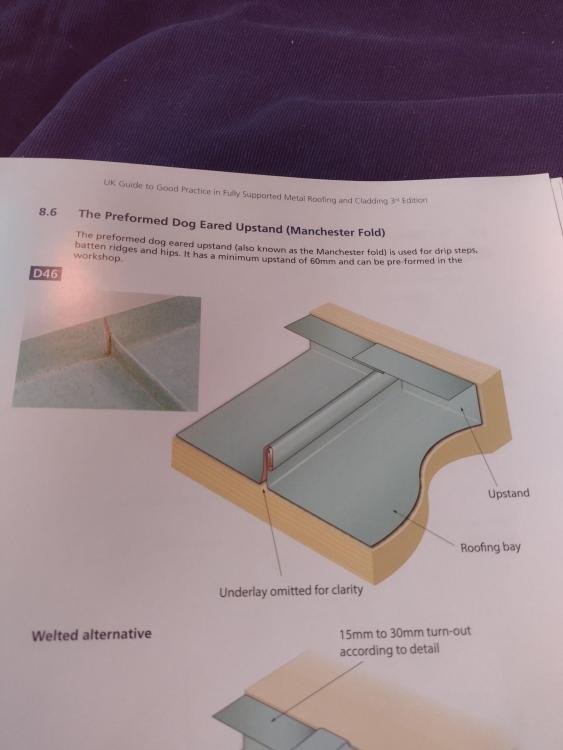
Who did the detailing on the external corners and upstands for your dormers as they're incorrect and leave you exposed to weathering. . Ideally, you're going to need some flashing over the corners and upstands to resolve this. Here are the recommended details together with examples of upstand and welted/soldered corners: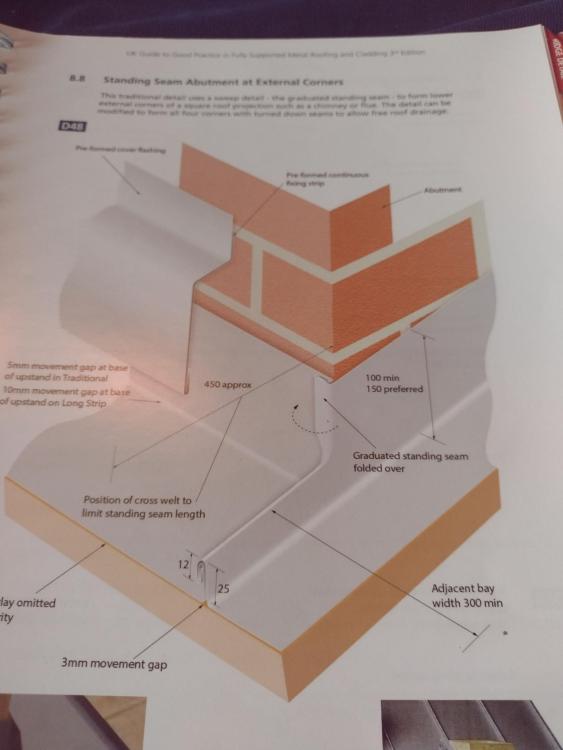
-
Where is the kWh price heading in 2022?
SimonD replied to epsilonGreedy's topic in General Self Build & DIY Discussion
For me the issue is that we actually have no idea what's going to happen. The global climate is so complex, we still don't know how it works and it's impossible to predict which way it's going to swing. Usually, when we humans get involved to try and fix or change something in the environment, we inevitably make it worse through unintended consequences, because we don't understand the systemic complexities of what we're dealing with. In this light, I'm a great believer in that we have to reduce consumption of both energy and resources and develop a mutual relationship with the natural world instead of thepillage we've been undertaking for the last 400 or so years since the enlightenment. In a positive light, there is much happening to develop our knowledge & change this but it's still early days. -
No surprise there. Yes, huge amounts of Birch ply supplied by Russia, but tbh supplies of certain grades of plywood has been difficult and eye wateringly expensive for the last couple of years. Speaking to one of my plywood suppliers a couple of months ago they said that they're were seeing a lot of their buyers who make high-end bespoke kitchens switch from ply to mdf. In December I bought the plywood for my kitchen at about £84 per sheet all in. It's now listed on the supplier's website at £120 per sheet. MDF is less than £50. In reality I do think there is some profiteering going on within the distribution chain as prices tend to rise ahead of the real world shortage, just like oil has done.
-
Where is the kWh price heading in 2022?
SimonD replied to epsilonGreedy's topic in General Self Build & DIY Discussion
Yup, the UK has been poor at investment in most if not all national infrastructure for far too long. And it still doesn't realise the importance here as even with the Net Zero transition, it's relying on 'the market' for said investment. and what is good about this challenge is that our beloved engineers and scientists are having to use their imaginations to find and create sustainable replacement materials. Plastics from funghi is just one small fascinating area in this. It's actually leading to a better understanding of the world. -
Where is the kWh price heading in 2022?
SimonD replied to epsilonGreedy's topic in General Self Build & DIY Discussion
Sounds like a new management technique. -
Engineered vs solid wood Sycamore flooring
SimonD replied to KRIP18's topic in Wood & Laminate Flooring
Does that price include the adhesive and laying of the solid wood floor? Another thing to consider is full floor buildup as if the engineered floor is installed as a floating floor you'll gain additional acoustic benefits between floors. -
As a general rule, check directly with any manufacturer. Vapour diffusion is typically indicated using an SD value or similar. Ask the manufacturer for this value and test results before putting anything on your wall. From the looks of it a hydrophobising 'creme' that Remmers make is called Funcosil FC. In the technical data sheet it says It says it But this is a pretty meaningless term and there is no Vapour diffusion test value. I'd be approaching use of this with great caution. A quick net search throws this up which does provide test results and certificate http://www.stormdry.com/articles/breathable-damp-proofing-for-older-buildings But still, it's worth bearing in mind how long the existing masonry has lasted and thus how long your renovation is likely to last without treatment under those harsh conditions. It seems to have done pretty well under the circumstances.
-
For my temp construction stairs I laminated some plywood sheets and cut into 36 x 300 stringers like this. I used three stringers across an 800mm wide staircase. It's strong enough but bouncy! Although it is entirely unsupported between floor and landing. I may keep these stairs and finish with a veneer as I'll be building some understair cupboards which will be framed to support staircase. You're probably best routing or as @tonyshouse has suggested, glue some triangles for risers and treads if you want a solid staircase.
-
I just had to buy one. Surprisingly satisfying to use. Well... unless you accidentally turn the mag off and it drops on your head. It has been known to happen ? There's a strap you're supposed to wrap around the steel to stop this happening...
-
Friendly and helpful too. I had an exhaust partially fall off a car when I was up there once and the kind guys at Kwikfit made a temporary repair for me to get me where I need to go - Cape Wrath - and back to London. Took them a good hour or so and didn't charge me a penny.
-
Or use a mag drill on the steels where you've got access.
-
Frustrating. Builders can be masters of avoidance, that's for sure. A local carpenter/joiner can perhaps sort it all out for you without bothering the builder. Might be a relief for him if he's just got to make the new rough opening.
-
That's a price that says I don't want to do it if ever I saw one. Have you looked to find some local restorer that's better set up to do it? Last time I needed something like this I walked into a few local antique furniture places and asked who they used. You could also ask at your local reclamation yard. But I'm sure google could help too. You're really looking at a doorset then as it'll be built to function as a unit. Otherwise you're into weatherstrips etc. and fitting the door to a separate frame - your builder would probably want 450 to do this properly by the sounds of it. Would be a shame to throw away a good door in favour of something that probably wouldn't get close in quality, or be cheap.
-
Those wood wool boards are rough as they're specifically designed to carry plaster or render. You'll also find that they're not acoustically rated. The acoustic rated ones are a lot more expensive. You can get some nicer panels with both fire and acoustic ratings from Troldtekt or Celenit but they will cost significantly more .
-
I've certainly seen a lot of examples, including here on BH, where the professional input is undervalued and people try skimp on it. I'd agree this is counterproductive and often has a detrimental effect on the project as a whole, especially when you aren't experienced in house construction. However, there are some of us that are aware of the benefits of this upfront investment and are willing to pay for it. One thing I did before even getting any architect involved was to pay for a topographical survey so it was already on hand when looking for an architect. Something I used to great effect in understanding costs associated with some designs as I was able to get quotes from groundworks companies based on the survey (we're on a significantly sloped site). The problem as I see it is that despite having the will to pay for these services and put the time into the design decisions, there remains what I see as a gap in the satisfactory provision of those services in construction. For example, we tendered and met with about half a dozen architects, all of whom visited our site. I paid some of them a fee to make the initial visit to talk about our plans. When receiving their proposals, not a single one of them met our brief. Both my wife and I wondered whether we had dreamed up the meetings we'd had because they were so far off. In desparation we then engaged the services of an architectural technologist based on a recommendation, but even then the design proposals that came back were underwhelming at best, totally impractical at worst, so we paid him for his time and went in search for someone else. I won't even begin to describe the atrocious service we received from the first structural engineer we appointed (introduced by the architect). He even had the gall to bill us for an incomplete scheme and when I went back with a list of what was missing, he still didn't respond and his company chased the invoice. Needless to say, I got rid of him and eventually found someone else, who did turn out to be good. I disagree with this. If you're a professional dealing with a layperson as a client, it is up to you to ask the questions to elicit and grasp the requirements from the client. It is not for you to expect the client deliver those requirement as the client cannot be expected to know how to articulate them adequately or know the extent required (or even the potential ramifications). If an architect, for example, after 7 years of training is still unable to do this, then I'd have to wonder what is missing from their education as it is clearly essential to a good design process. It is also up to those professionals involved to manage effective communication, with their client, and also everyone else involved in the project so that the necessary questions are resolved and accounted for ahead of time. The architect we chose in the end was excellent at eliciting our design requirements and at the same time was able to enhance those with his experience. It took me a while to appreciate this side of his service. However, his biggest and most unacceptable failing was that he wasn't honest about where his technical limitations lay and instead proceeded to advise us incorrectly in this regard. However, there were several other aligned professionals who also provided poor technical advice. It's this incorrect advice that has cost us significant money, not changing our minds about sockets, or other such design elements. My own experience could simply be dismissed as poor decision making or bad luck on my part but there are enough stories on here and from people I've met to suggest I'm not such an anomoly.
-
I'd agree with that approach and followed it. We had full budget plus a little over 20% contingency. What we didn't know beforehand was how badly advised we'd been by the professionals we'd engaged to help with the project. As a consequence our project ended up almost double in size. Then we were hit by various global crises that saw our budget shrink even more and so everything was far more expensive than originally priced. And believe me, I'd nailed down the prices before even commencing with the work. This is what has led me to believe that you have to beware professionals in the construction industry, as I've generally found the service we've had to be particularly below par. I don't seem to be the only one that's had this problem either.
-
It's a known predicament of human nature sadly. Lao Tzu said over 2000 years ago that you should always prepare for a journey to be much harder than you imagine. I wonder if he'd built his own house. Isn't that just the case. You get to the point where you just have to carry on. However, on the bright side, it is a major achievement to build your own home, just like it's a major achievement to start a successful business, be a successful athlete, or achieve anything of note really. All of those things take their toll and demand some hardship, it's just the flavour of the hardship. I myself am far less stressed about the building game and running out of money, being delayed and seeing my boys growing up in a caravan than I used to be when working at a senior level in a large company, having to deal with all the associated BS and living subject to the whims of the firm, so to speak. Definitely no regrets here for me.
-
+ 1 Yes, the brace is diagonal. The dropping depends on how well the ledges have been fitted together with the quality of the wood as the door structure puts a shear load on the nails/screws, but there is also some friction between the ledge and planks, but not very much. Ideally you want the hinges fitted on the ledge too. Overall, I don't think it's a particularly complicated job to cut a rectangle, insert a frame, insert a pane of glass and bead on both sides, plus fit the lower brace.
-
Looks like a ledge & plank/ledge & braced door which means this would have to be reconfigure to retain the structural intengrity of the door, but definitely doable. Here's one example: https://authentic-reclamation.co.uk/stock-item/ledge-braced-door-with-glass-panels/
-
It's a tough ask. But I reckon there are a couple of strategies you can use. You can get a 50mm stud wall built up for about 54db reduction using a type of sound board resulting in a total wall thickness of about 95-100mm. Buildup is sound plasterboard/50mm stud with either air or mineral wall insulation/acoustic board (30mm), then you've got either a plaster skim/tape & joint over those. One of the problems is your studs which should ideally be staggered to reduce sound transfer. If you left your wall at 140 and used stagger 38 x 89 studs with zigzag acoustic insulation you'd probalby be fine. Another strategy is slightly more complex, which would be to build your stud wall with sound plasterboard and some acoustic mineral wall insulation and then measure your sound spectrum with the washing machine and other appliance within the new space. Based on your results, put in some measures to attenuate the troublesome frequencies, in particular the fundamental frequency. You can use soft furnishings, cork wall boards and other sound deadening materials for this, even a simple helmholtz resonator in the corner of the room can work very well. Doing this would mean that the spl affecting the walls would be significantly reduced and therefore less problematic. With this approach you can also reduce the sound coming through the doors too. Part of the problem as I see it with acoustic wall design is that in the designs, the acoustic properties of the adjoining rooms is never considered, which is a bit of an oversight if you ask me.