


Bramco
-
Posts
796 -
Joined
-
Last visited
-
Days Won
1
Everything posted by Bramco
-
How low a U value is good enough?
Bramco replied to cbk's topic in Insulated Concrete Formwork (ICF)
We decided on the timber frame route and selected the company we wanted to go with which gave us the U vals for the slab, walls and roofs. We're now selecting the window supplier and have a target U value based on making sure that we can achieve an SAP 'A' rating. Turns out to be 1.2. Now the issue is what type of window, Alu-cald, alu, etc. combined with which glazing. I guess this is what the OP is done but the other way round, select the windows and then work out what U value you need for the walls. Simon -
Device to Monitor Electricity Use
Bramco replied to canalsiderenovation's topic in Electrics - Other
I didn't say Rasp Pi - I said emonPi. It has a Pi in it with everything set up. Simon
-
Device to Monitor Electricity Use
Bramco replied to canalsiderenovation's topic in Electrics - Other
An emonPi would give you more granularity and the possibility of tailoring it to your requirements, but hey, it's horses for courses. There are many ways to do this - was just suggesting one we've found very useful. For example Simon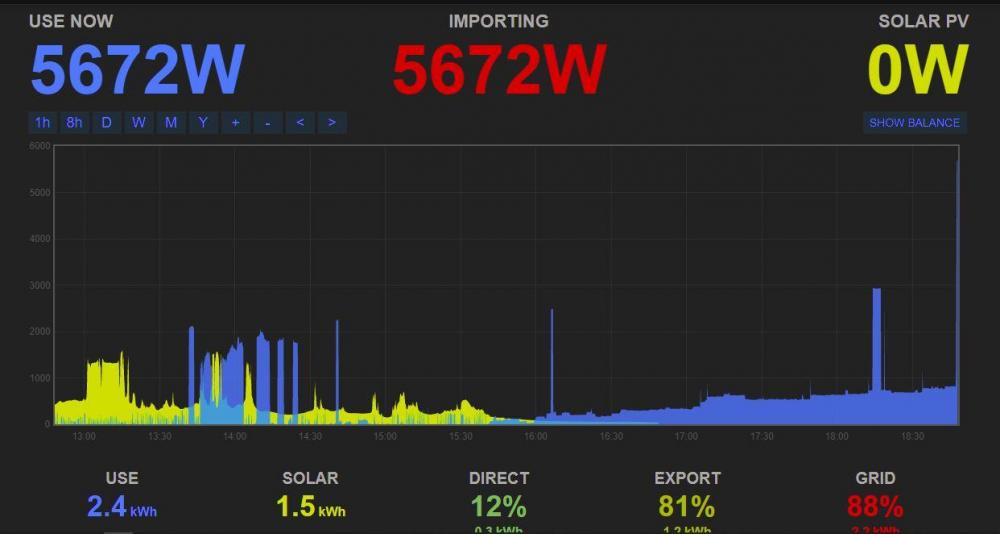
-
Device to Monitor Electricity Use
Bramco replied to canalsiderenovation's topic in Electrics - Other
If you want more detail and some history get an emonPi from the open energy crew in Wales - great kit. You can set up as many dashboards as you want and also measure temperatures. https://shop.openenergymonitor.com/emonpi/ I should add I'm nothing to do with them, except from being a member of the forum there. It's all open source, so we set up our own system on a spare Rasp Pi and also built a Solar PV diverter following guides. There's a huge amount of info on the forum. Simon -
Has anyone got around the Openness issue in Green Belt?
Bramco replied to Paul Leigh's topic in Planning Permission
If it is, he should be home and dry. Simon -
Has anyone got around the Openness issue in Green Belt?
Bramco replied to Paul Leigh's topic in Planning Permission
Just a further thought - if it is a garden plot, why isn't it being considered under the infill in a village clause - this, as I said earlier has case law that says that 'openness' does not need to be considered. Simon -
Has anyone got around the Openness issue in Green Belt?
Bramco replied to Paul Leigh's topic in Planning Permission
The only thing the Local Plan might do is to add some restrictive conditions over and above the NPPF - for example development should be concentrated in a specific list of villages, or there may be restrictive clauses about preserving the 'countryside'. You have to jump the NPPF hurdle first and then jump the Local Plan hurdle. Simon -
Has anyone got around the Openness issue in Green Belt?
Bramco replied to Paul Leigh's topic in Planning Permission
Interesting one that. It's a catch all to deny permission. But there are ways round it. The NPPF states there are 5 purposes of a Green Belt, including things like preventing towns merging etc. para 134. If your land was previously developed then it can't be said to be contrary to the 'purpose' of your local Green Belt. Always a good starting position. Para 145 gives 6 exceptions, including limited infill in villages and replacement of a building so long as the replacement isn't larger than the original and also extending existing dwellings (up to 50% is allowable). If you qualify as an exception then there is case law which sets out that being an exception means that the question of openness need not be considered by the planning authority - I can dig out the actual case if you need it. The issue for you is that the exception you might qualify under (g) has a restrictive clause about the openness. To quote '....not cause substantial harm to the openness of the Green Belt, where the development would re-use previously developed land and contribute to meeting an identified affordable housing need within the area of the local planning authority'. So the key word is 'substantial' and you should search for any housing needs survey the Parish Council may have conducted or even the Borough Council. That would help to identify the contribution to the need. In addition, if the Council doesn't have a 5 year housing plan then all bets are off for them because according to an earlier para in the NPPF they should grant permission. Another way round this is to show 'exceptional circumstances' but this is v hard to do and has to rely on an architecturally special design. I bought a book on all the case law on the NPPF - I'll find it later and edit this with the title and author - it's expensive but well worth it if you find something to support your case. Also a LOT of googling of planning appeals should turn up some cases that support you. Simon EDIT - the book on NPPF case law is 'Interpreting the NPPF' by Alistair Mills QC. Bath Publishing. https://www.amazon.co.uk/Interpreting-NPPF-National-Planning-Framework/dp/1916431526 But be careful, as this was published in 2018 and the NPPF has been revised since then. You might need to check back on the NPPF to see if the specific clause on redevelopment in the Green Belt has changed. -
I know @joe90 has worked out how to set the hysteresis on his stat to 1' but ..... What simple stats are out there without all the programmable stuff which have 1' or lower hysteresis. Just simple old fashioned stats. Simon
-
Car Crash of a Parish Council Planning Meeting via Zoom
Bramco replied to AliMcLeod's topic in Planning Permission
I suppose it does give an outlet for the pent up anger and indignation a lot of people seem to carry around - therapy for some? Simon -
Car Crash of a Parish Council Planning Meeting via Zoom
Bramco replied to AliMcLeod's topic in Planning Permission
The really hilarious thing is they don't approve anything - they can only comment on planning applications - and their collective misinformed idiotic comment carries as much weight as any other comment from a parishioner or whomever. Our PC hasn't got anyone with any idea about planning - so their comments are ridiculous - and of course the Council can only take into account comments that raise planning issues, i.e. points of planning law. So basically they ignore everything the PC says.... Simon -
Kitchen design app.
Bramco replied to Russell griffiths's topic in General Self Build & DIY Discussion
IKEA Then if you want to throw money away take that to someone with a flash showroom... Simon -
In the old house (current) we have no BT and dropped the Virgin phone line and now only have mobile numbers - but then you're in Derbyshire, so probably need either BT or Virgin for a land line and maybe the other as backup!! On the new build, we're also only lekky and water. The Virgin line can come in via the conduit already laid by the brother in law next door. Simon
-
But as my son the architect pointed out - you could build a transparent house. Wouldn't the planners have a field day with that. Son #1 - a scientist - mentioned the appalling ecological consequences of the production process. Simon
-
Anyone have any experience of Duration Windows
Bramco replied to Adsibob's topic in Windows & Glazing
I phoned today and they promised a quote by the end of the day - we'll see... Simon -
Anyone have any experience of Duration Windows
Bramco replied to Adsibob's topic in Windows & Glazing
How long did it take to get a response - I sent our window schedule the other day but haven't even had a 'thanks for your enquiry, we'll get back to you' email. Simon -
https://uk.finance.yahoo.com/news/transparent-wood-lighter-stronger-glass-090419778.html Given the DIY nature of the forum, I'm sure this could be perfected as a DIY glass in a month or two...... Few chemicals, a former, some plastic goop and a trowel - easy peasy ..... Simon
-
Or take a look at the emonPi which is a system from the open energy monitoring lot in Wales. Emonpi in their shop -> https://shop.openenergymonitor.com/emonpi-energy-monitor-solar-pv-bundle/ Very good kit - and if you don't want to buy a ready made system it's all open source so you can roll your own. They're also doing some good stuff with the Octopus tariffs and EV charging. Simon
-
Round our way going to committee isn't the answer - they end up following the planning recommendation - or at least the chairman does. And the cttee btw know nothing about planning law - it's just how they take on what planning are telling them. We had 2 goes at ctte (local councillor owns adjacent land so it had to go there) both times it was a draw and the chairman voted with the planning advice - which was obviously wrong and we'd pointed it out to them. Maybe that's what did it.... Anyway, at appeal the inspector essentially said - no idea what the council are doing in this case it's obvious it's OK - permission granted. So I'd go with stick to your guns but all the rest of the crap beforehand, I'd fast fail - we wasted a LOT of time trying to do the right thing. We started over 3 years ago and we're only planning to break ground in a few months time. Years you can't get back. Simon
-
Zinc angled standing seam.
Bramco replied to Makeitstop's topic in House Extensions & Conservatories
Havre you looked at aluminium - not as long lasting but probably cheaper £130 per sq m sounds astronomical. We spoke to a local standing seam co and aluminium is as versatile as zinc apparently - again you'd have to be careful about making sure you don't get bi-metalic corrosion. Simon -
That's the conclusion we came to too. We're on an acre plot so would have had the room and initially GSHP was the plan until we looked at things and for the reasons above it's just not worth the investment. Simon
-
A decent sized contract - I'd quote for it but then....
-
We also had a quote direct from Velfac last year. I wonder if it depends on how many windows you need? Simon
-
Resubmission after dismissed Appeal - Help!
Bramco replied to Mrsmedhurst's topic in Planning Permission
On a more serious note... Search the Web for similar applications and appeals. We had to do this for our infill appeal in the green belt. Your search should turn up some agents or solicitors who have handled cases like this. Give them a call - they'll be helpful - they'd like your business!! If you can find someone out there that seems to have won a similar case and you think they are ok, then work out with them how they would go about winning an appeal for you. And be patient - planning an appeals are marathons not sprints. Simon -
Resubmission after dismissed Appeal - Help!
Bramco replied to Mrsmedhurst's topic in Planning Permission
Indeed. Equestrian is agriculture in Europe but then .... And that's not a Brexit comment it's gastronomical... Simon



