


Bramco
-
Posts
796 -
Joined
-
Last visited
-
Days Won
1
Everything posted by Bramco
-
Don't tell them. If you want to use your cheap rate for heating, have the DHW immersion on in parallel. It's up to you how you use the system once installed. Afaik, all HPs have priority for DHW over heating, so if you are running yours on E7, then if the DHW needs topping up, this will happen first and it could mean you get to the end of the E7 period with the HP not having serviced the heating demand (or not enough of the heating demand). And if you run the DHW outside the E7 window, even with the COP, it will cost more than using E7. In our case on Octopus Go, the cheap rate is 9.5p and the normal rate of just under 30p. So the HP needs to be at at least a COP of 3 which on a cold winter's night will be hard to acheive. Simon
-
We could show that the cylinders were man enough through the Newark specs, plenty of spare square meterage. As I said, it did take me a while and quite a lot of emails before they came to the same conclusion as us - the reason that the HP hit it's internal maximum working temperature and threw the error was because the sensor was telling it the tank wasn't up to temperature, so it just carried on pumping heat in, raising the temperature until the tank was at the HP internal maximum temperature. Fortunately I had some sensors monitoring things, so could use that as evidence as well. Simon
-
Yes, that's exactly it. Righto, off in search of a bypass valve..... 😄 Thanks for a great tip. I think you're right, and reading some information on the web, it can happen in smooth coils as well - something to do with non laminar flow kicking it off. Even though we're using PV and the cheap rate Octopus Go for the DHW boost, it would be good to make sure this is fettled for the future, just in case. Simon
-
That sounds like fun!! What was maddening about our situation was that I had to set out the logic of what it was doing before they'd row back from the sucking teeth and 'you need a new cylinder'! A lot of people that hadn't informed themselves would have simply gone along with the replacement cylinder at another 3 or 4 grand. Simon
-
Yes - the issues were to do with one of their guys who decided after talking to our sparky that we only wanted UFH connecting, so didn't bring a 3 way valve. They also didn't bring the correct parts to connect to the UFH tank, even though they'd done a site visit, so on the day I had to get out to a plumbers merchant to fetch the parts. I wasn't happy that day. He'd also somehow not got the connections to the temperature sensors right - end result, the ASHP thought things were cooler than they were and kept running. But because the tanks was actually hot enough and getting hotter and hotter, the ASHP finally cut out when the HP internal temperature limit was reached which spits out an alarm and shuts down. Several emails later where they were blaming the tanks and telling me I needed to replace the tanks, they finally accepted my analysis and came and rewired the sensors and things are now working fine. We'd installed Newark ASHP tanks. We do though get some dynamic resonance which is mainly on the DHW tank - a result I think of the fact that Newark use corrugated coils. I need to get to the bottom of this sometime.... Simon
-
And this has been discussed ad nauseum - is this necessary if the DHW is completely enclosed, i.e. unvented? As an aside, we actually only use the HP for the UFH. I worked out it was still cheaper to use the immersions on Octopus Go as we wanted to run the HP for UFH for as much of the 4 hour cheap Go window as possible, which would mean the HP for DHW working at the expensive rate. Like most HPs DHW seems to have priority over UFH. Simon
-
We had a full M+E report which has the heat loss analysis. See reply above. It wasn't a part-complete project. (as above). It was an installation prepped for an ASHP. Simon
-
Sorry should have been clearer. Ours was a self build BUS application, so no rip out of a gas boiler. The DHW and UFH cylinders were already installed as part of the build contract by the builders plumber. So as I said in the first post, the contract was simply to connect up to the existing cylinders. We hadn't intended to install an ASHP until we'd had things up and running for a while, so we were using the immersions (2 in each) in the cylinders and Octopus Go low overnight rate for heating and hot water. The house is almost Passiv Haus. But when we realised self build was also covered by the BUS, we decided to see if we could get a decent price. And at £250 it was a kerching moment!! Simon
-
Probably but it seems a bit odd. Simon
-
Unit plus install... 😄 We did spend a lot of time looking around and came across the Cool Energy units via this forum. And don't forget it was only supply and install except for the MCS paperwork. Simon
-
Interestingly, we received an email from MCS checking the information on our install. I'll copy the email below but first for context, our install was done by Nationwide who seem to be the in house installers for a Cool Energy 9kW ASHP. The hot water cylinder and UFH buffer tank were already installed, so it was simply installing the ASHP and connecting things up to the existing tanks etc. Total cost £5250, so with the grant it cost us £250. Also, we already had all the heat loss calcs, so this wasn't needed in our case. It really was just a plumbing and electrics job - oh! and the MCS paperwork. Took a day to do the install. We did have some issues...... but that's another story. We also had a hard time getting the MCS documentation - in fact it took a threat to report them following the MCS guide with a formal letter. Funnily enough the documentation turned up by return of post. Anyway, here's a copy of the email we received from MCS (I'm disinclined to reply as surely they have all this information and if their records aren't correct - who cares?). ___________________________________________________________________________________________________ We’re contacting you regarding your recent MCS certified renewable installation as part of the boiler upgrade scheme. MCS is a standards organisation. We create and maintain standards that allows for the certification of products, installers, and their installations. MCS is a mark of quality. We’d like to confirm with you that the information your installers have provided for your MCS certificate in your handover pack is correct. Can you please respond to the questions below so we can update our records. 1. Was the installation completed using the Boiler Upgrade Scheme? 2. Date installed/commissioned? 3. Your full address: 4. Air Source, Biomass or Ground Source installed? 5. Installers company name: 6. Heat pump location? E.g., Rear of property, side of property etc. 7. Water tank/cylinder location? E.g., Utility room, airing cupboard etc. 8. Handover pack received? 9. Are you happy with your installation? 10. The £5000.00 grant, was this discounted from your bill, or paid in full and refunded later? ________________________________________________________________________________________________ Strange?
-
Look at geberit rimless. There's one with no indentations. And go soft close. Simon
-
You see an awful lot of Geberit flush panels in public places, pubs restaurants etc. Does this mean they are more robust or have they just beaten Grohe on discounts. We have Geberit now but Grohe in the last place. The Grohe one used to sometimes stick and continue running, never got to the bottom of that, sold the house and moved on 😄 But that's just one data point. I guess also, it depends on which flush plates you want. For the new build the Geberit black plates where what we wanted, so we went Geberit for everything. On price, we found a parallel import site which was reasonable, as in not so much of a rip off as the UK merchants. Before the B catastrophy, you could order from Reuter Badshop for example and buy at a 30 to 40% discount on the crazy UK pricing. Delivery was on pallets and very quick. If you know anyone in the EU and you're likely to visit them, you could get stuff delivered to them and sling it in the back of the car/van - think you're allowed up to £600 of goods without paying tax. Our son lived in Holland when we were doing our build, so I had all the taps delivered to him and we picked them up when we were across. Saved a lot!! Simon
-
Mitigating Risk With Upfront Payments To Timber Frame Companies?
Bramco replied to thefoxesmaltings's topic in Timber Frame
Yes but they're only as good as their parts. So the factory may be running smoothly but when ours was erected 18 months ago they had a team of cowboys doing the erections. They sacked them off soon after ours was completed, so not sure how they are managing the erections now. They may be young here but afaik, Joe started during the Irish housing boom, then moved here. The good guys doing the erections are all part of his Irish squad - they were amazing when it came to the airtightness and squaring up the mess the erectors had made. Like almost anything, it's like a curate's egg - good in parts. If I were to use them again, I'd employ a PM on site to QC the slab layout and the frame erection - it would be worth paying someone to ensure that the build matches the design. But we would use them again, except, our build was a forever home we built in retirement. Simon -
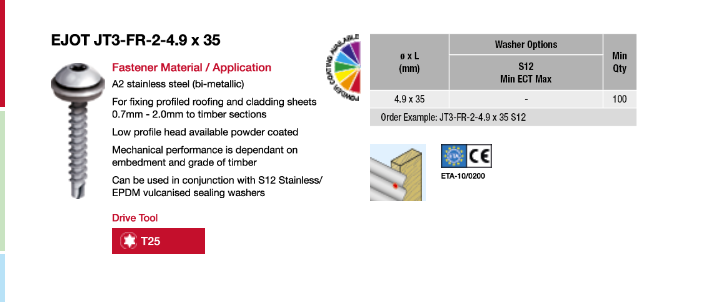
Or a nibbler as @Iceverge mentioned. Our new build has wrinkly tin roof and cladding on the 2 storey part. The professionals who were contracted for the work used nibblers. Lidl actually had both battery and mains nibblers in the middle aisle earlier this year. I bought a mains one which were on offer before the battery ones. It's actually quite hard to go in a straight line, so best to use a guide clamped on, especially across the wrinkles. The corners of our build have right angle profiles but I guess you could bend the tin round. EJOT do a fastener which has a smaller domed head instead of the big hex heads on most fasteners - these would look much better on a smaller project like yours. They will colour code them to any RAL colour. Simon
-
The manual says that it does that automatically. You maybe need to experiment with the settings. V difficult to work out what's needed from a distance.
-
Which one? You can leave the setting for the collector where it is. As above, turn on collector cooling (p30 in the manual). This will mean that if the tank has reached it's set point and the collector is getting too hot, the system will run, cooling the collector but warming the tank. Eventually, this will hit the maximum tank temperature of 95C and then the collector temperature will continue to rise. So if you've set up collector cooling, the system will automatically adjust things if too much heat is being generated by the collector. Sounds like the collector array has been sized to give you good output in the spring and summer but maybe a bit too much for the tank in the height of the summer. Simon
-
From those manual pages, it looks like you can let the tank temperature run up to 95C - collector cooling - but after that it hits the same problem but with everything a bit hotter. Store cooling sounds like a non starter as you'd be cooling the tank off at night in anticipation of another sunny day, so if you didn't get that, the tank wouldn't have enough heat. Maybe what you need is a hot tap you can turn on using a temperature controlled switch. Just run off some of the excess heat when the tank reaches the point you feel safe at. Or you need a bigger tank, or a secondary tank. In the old house ours used to get pretty hot but never that hot. Simon
-
+1 I could have written that reply myself.
-
Same here - we left a duct over a culvert but didn't bother digging the trenches - eventually dumped the cable and manholes on a neighbour who is just starting building. 4G modems are less than £150 we use a GL-X750 Spitz (excellent) - look it up on Amazon. EE seem to have better download speeds than 3. Why not try this to see if it is enough before starting your trenches. If you want to test the signal from 3 and ee, then buy a £10 payg data sim and check the signal with an app - try Mastdata or Cellmapper. And you need to walk round the site to see where the best spots are. Simon
-
Is 0.18 still a requirement? We're at 0.22 from the electrical certificate from the build. So quite a bit above 0.18. Simon
-
Be interested - assume you'll report back. I've got 1 string of ours functional, so under the 4kW limit but will hopefully have the 2nd string working in a week or so - the last panle on the pallet was smashed, so trying to get a replacement.... Simon
-
Not exposed at all - and there's a couple of big ash trees not too far away to the north. But if we'd balanced the array on a 16m pole, then it would be a little more exposed - but I'd be questioning what to do about stability in a gale... 😄 Simon
-
Lightning protection. Simon
-
It's a diy install, hence the question. From the panel spec sheets, the frames need to be earthed. So it's really this aspect and they are connected very firmly to the frame which is mounted on the poles in the ground. They're only a metre long, so no ladders needed but I did slip one of the builders a few quid for him to wield his massive sledgehammer. Think as a pensioner, I'd have managed a couple a day.... He had it done in 15 minutes - he did look knackered towards the end! Simon

