


Alan Ambrose
-
Posts
3392 -
Joined
-
Last visited
-
Days Won
15
Everything posted by Alan Ambrose
-
SWMBO returns!!
Alan Ambrose commented on BotusBuild's blog entry in South East Cornwall Low Energy build
This maybe? https://www.structuralsupplies.co.uk/product-page/newton-hydrobond-2k-flex -
SWMBO returns!!
Alan Ambrose commented on BotusBuild's blog entry in South East Cornwall Low Energy build
>>> sticky bitumous layer, what I refer to as an egg tray with geotextile layer Possible to give us the product names for the ones you chose? -
Timberlok vs Coach Screws. is there a difference?
Alan Ambrose replied to Thorfun's topic in General Joinery
Well if you can somehow subtly determine beforehand, and he/she says yes, then you'll end up paying for the SE anyway. It does all sound a bit formal... https://www.cross-safety.org/sites/default/files/2019-12/structural-safety-glass-balustrades.pdf BTW here are the loads from BS 6399 - they don't seem too onerous, there's some additional detail on fixing etc in :6180 ...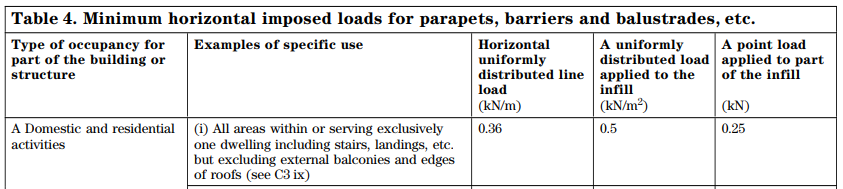

-
This is for a basement, so probably 6m down and in clay.
-
Maybe you can 'train it' a bit by sticking a bit of insulator on the case where you don't want sparking. Try with electrical insulation tape and then use a bit of polycarb sheet if that works? See e.g. https://www.curbellplastics.com/materials/applications/good-electrical-insulation/
-
Timberlok vs Coach Screws. is there a difference?
Alan Ambrose replied to Thorfun's topic in General Joinery
Are you sure your BC won't require SE calcs anyway? BTW this is the thread and post I was thinking about, you'll see Gus has highlighted the zone that will likely fail first - (different style of fixing, but similar problem): Also a few posts down, Gus says "These types of barriers / stairs are designed to resist the prescribed loads in BS 6399 part one and BS 6180 for example". So, there's your loading requirement. -
Timberlok vs Coach Screws. is there a difference?
Alan Ambrose replied to Thorfun's topic in General Joinery
I think Gus did a similar calc for someone a few month’s ago on BH. Is one possibility to put it together and check that it supports the load that I believe he specified then … with a safety factor… -
Heat loss, why calculate...
Alan Ambrose replied to waxingsatirical's topic in Other Heating Systems
Another badly thought out regulation/rule, why am I not surprised? At least they might have included a sense-check of the current consumption... -
Wrong measurement for skylight
Alan Ambrose replied to Oceanjules's topic in Skylights & Roof Windows
Congrats, I look at this also as an education for the supplier which may help future customers who deal with them - the supplier might be less likely to try and deny/cast doubt/stall next time. -
>>> My understanding of things is you shut the inverter down before switching any isolator so there's unlikely to be any power flowing in the DC or AC side. That's sort of true i.e. no current will be flowing, but bear in mind that there will be the PV voltage (say, 400V DC) between the two plugs from the PV panels, so treat with caution.
-
Wrong measurement for skylight
Alan Ambrose replied to Oceanjules's topic in Skylights & Roof Windows
Or look at it at 'helping them come to the right decision for ethical and business reputation reasons'. -
Timberlok vs Coach Screws. is there a difference?
Alan Ambrose replied to Thorfun's topic in General Joinery
I can't quite imagine the exact set-up, I'm sure an SE can calculate the exact loads, pull-out forces etc, if safety critical. If not, think I would take the chippie's advice, as they often have a good intuitive sense of screw forces built up over the years. Bolts would probably have better holding but you might not have the opportunity. -
Wrong measurement for skylight
Alan Ambrose replied to Oceanjules's topic in Skylights & Roof Windows
Yeah, keep pushing. Keep walking up the organisation to the CEO if it's not tiny - often the juniors won't want to admit mistakes to their bosses and the bosses might take the longer term customer service / reputation view. -
Timberlok vs Coach Screws. is there a difference?
Alan Ambrose replied to Thorfun's topic in General Joinery
Well they are what they are. Suggest coach screws are often bigger flat square head and thicker diameter and thread nd often used with washers under the head, Timberlok are a bit countersunk and therefore not used with washers. I think timberlok sometimes has coatings to resist the corrosion effects of some wood. I've used both though to hold big-assed bits of wood together. -
How about this thought experiment? Imagine 3 cubic blocks, say 5mx5mx5m sitting on a lovely building plot somewhere with no shade. One block has concrete walls, say 30cm thick, one PIR with the wall thickness set for the same U-value, one say, cellulose fluff held within very thin inconsequential surfaces, again with the same U-Value. No windows or other penetrations. Assume the PIR and the cellulose box are painted the same grey as the concrete (with the same reflectivity etc) and all are airtight - so the only environmental effects are air temperature / radiant heat from the sun / the cooling effects of wind. Which box has the higher air temperature variation inside?
-
Building plot conveyancing fees?
Alan Ambrose replied to flanagaj's topic in General Self Build & DIY Discussion
Actually I think there is more work required for a plot. The lawyer doesn’t really need to worry about services, drainage, sewage etc with an established dwelling and not worry so much re covenants. That’s because it’s just possible there might be a gotcha there for a plot which might stop you building. No such problem with an established dwelling. We had ours done by the commercial part of a local solicitors and although more expensive, I think they were much more thorough. You could check exactly what they’re offering for the money. Plot has planning permission already? You’ll come out ahead on stamp duty on a plot vs an established dwelling, so the net cost might be similar. -
Yes, agree this is worth addressing up front. Suggest discuss with neighbour and also see if you can come up with any mitigations e.g. piling grid, and assure that you will pay to reinstate any damage. You don’t have a right to drive over the neighbour’s land and presumably there would be nothing to stop them installing gabions if they wanted.
-
>>> Peak Rate 0.43 Off Peak Rate 0.19 Export rate 0.21 Standing Charge 0.51 <<< For these calcs I guess you need to use something like ‘average rate expected over your payback period’ and be aware that you’ve excluded inflation from the pricing. My average import rate using Agile was 18p in Jan and I suspect due to reduce. I believe the highest export rates are 15p atm but likely going down sharply as the market normalises a bit this year. Now it’s anybody’s guess what electricity prices are over the next 15-20 years but my thoughts are summer prices going much lower with greater grid PV and hopefully normalising once the current conflicts are resolved. Of course, the installers want to paint a positive picture, but you don’t want it too skewed.
-
Does your ISP provide speed history stats? Might make interesting reading. We had, what turned out to be a branch rubbing against the cable about 10m away. Speed got worse and worse and eventually stopped altogether. OR man came with quite a comprehensive test set-up. I think he measured the distance to the break with a tdr type setup. He called in another man with a cherry picker and a ‘bandage’ kit and all is good now.
-
Don’t we have a 24h wave sitting on a 365 day wave plus a bunch of randomish noise?
-
I guess it also depends on what heating and cooling control systems you’re looking at. Very fast acting systems might keep the internal environment comfortable despite materials and structure (e.g. loads of glazing) which would tend to make the internal conditions jump around.
-
Well it’s an interesting area, maybe called ‘building dynamics’ rather than ‘building statics’ which 95% of the other modelling is - part O / PHPP etc. I’m not sure I understood all your assumptions or model and I don’t get a 100% intuitive model in my head either - but I feel it’s an important area to explore because it might contribute understanding to some of the design choices we have to make. I guess this comes into play when making decisions e.g. masonry vs. timber frame / wooden deck vs. beam and block / conventional tile vs. metal roof?
-
>>> I'm 35 and tired of building materials being faux, fake and mock and made from thin laminated of plastic with low quality effect printed on and really not offering much of a savin yeah, +1
-
Ah for bathroom, Vuba epoxy floor screed works well with UFH. I laid it myself, and having done that, I would probably get a professional in next time .
-
Solid oak is not too expensive and wears well.

