Alan Ambrose
-
Posts
3130 -
Joined
-
Last visited
-
Days Won
13
Everything posted by Alan Ambrose
-
Single storey, so 250m^2 total. Plan is to use permeable, I just have to convince the SE that the tank doesn't need to live under the driveway. It is fairly wet in the winter 😀 - I think that has a lot to do with the ditch at the back of the plot being converted to a piped culvert years before we got the plot, so it can't drain right now. On my to do list is to sort out land drainage to the culvert.
-
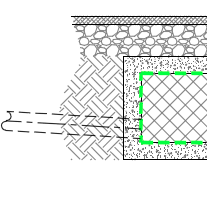
@saveasteading - yep, that sounds a reasonable assumption. @Dave Jones >>> so flow can be top or bottom to suit. So, you think this detail into crates will work OK? I'm concerned about the inlet pipe getting backed up as the tank fills and causing the inlet flow rate to diminish a lot.
-
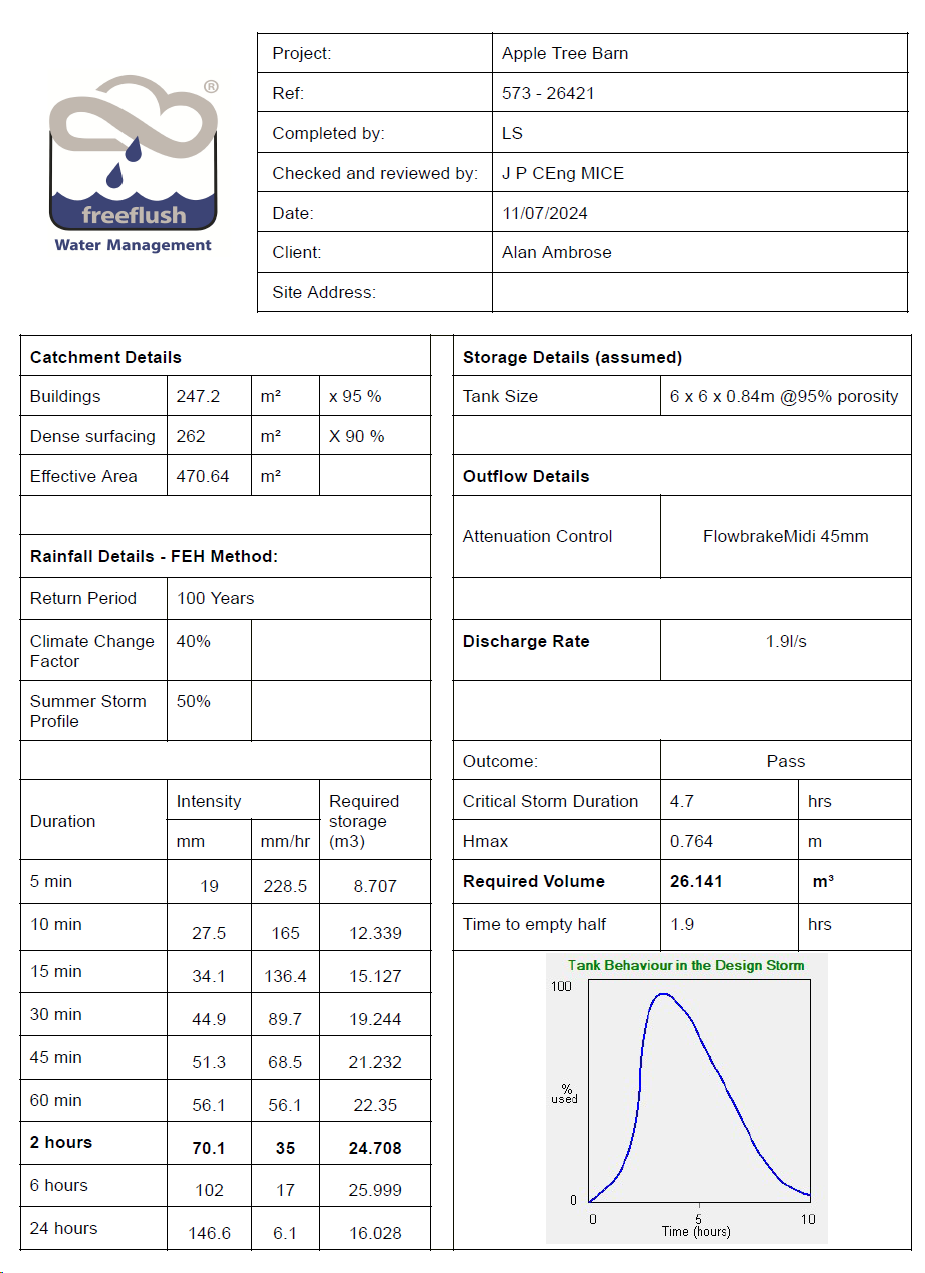
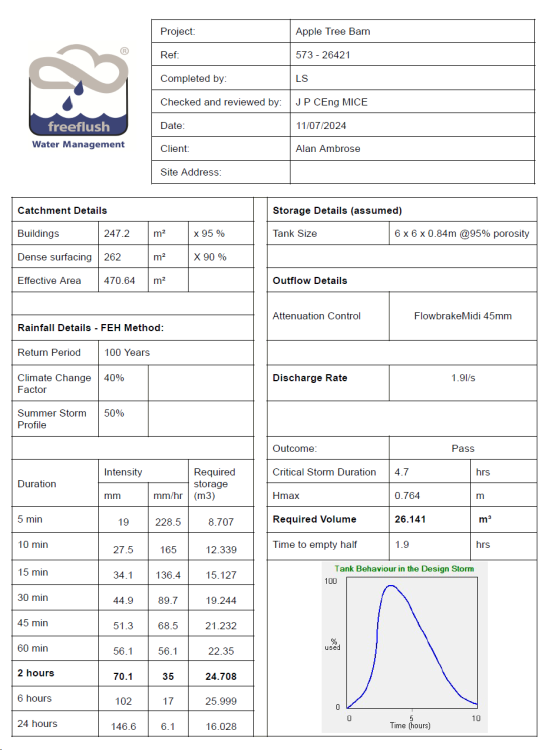
Well this is topical as I'm hoping to put most of my surface water drainage to bed today. I'll add to the thread if the OP is willing as it's on topic. >>> 27 cube ! Is it for a block of 25 flats ? Thats mad, so your 'SE' is saying you need 27 thousand litres of storage to catch the water that used to fall on the footprint of your building ? The 'SE', as you put it, is a fairly well known firm of SEs. I suspect that many SEs use an external web service anyway as it's a specialised calc. Of course, to be able to compare houses & attenuation tanks you need to know the catchment areas (roof & hard surfaces e.g. driveway), the ground conditions & the allowed nozzle rate. The location, and therefore storm rates, will make some difference too. I'm on clay with an apparent high GW level so similar to @SBMS. I thought my SE's number sounded high and I was interested in how it was calculated, so I had another calc done by Freeflush (dumb name I think) for £100. I should say that I am very inquisitive and interested in how everything works and am treating the house build as a big learning exercise. I was also looking for clues in order to modify the SE's proposed design a little. I supplied the roof and drive areas and the location, Freeflush did the rest. As it happens I also had the FEH13 & 22 numbers from WHS which I puchased for £7. Freeflush came up with 26 m^3 and used the FEH13 numbers - so very similar to the SE. The FEH22 numbers will be a little different. Freeflush's calc sheet below and I've also added the FEH13 numbers from WHS for anyone who is curious. The big result I got back was that both the SE and Freeflush had treated the permeable driveway and patio as impermeable as @SBMS suggested above. @SBMS - do you have your areas for comparison? It would be good to bottom out why we have such different attenuation volumes. FEH_Point_Rainfall_FEH13_AM (anonymised).xlsx
-
>>> It's weird that if they are policy documents, they are not publicly available... Actually, they are, the inspector is just being 'thorough' or lazy. >>> Inspectorate have come back to me asking that I attach the relevant plans from the refusal notice Just send those to the inspector even if they're not correct, explain why they're not correct and also supply the correct ones? >>> I have now had to go back to the planning department and ask what the process should be. It's likely they have no idea, so suggest as above. This is the 'validation' stage of your appeal?
-
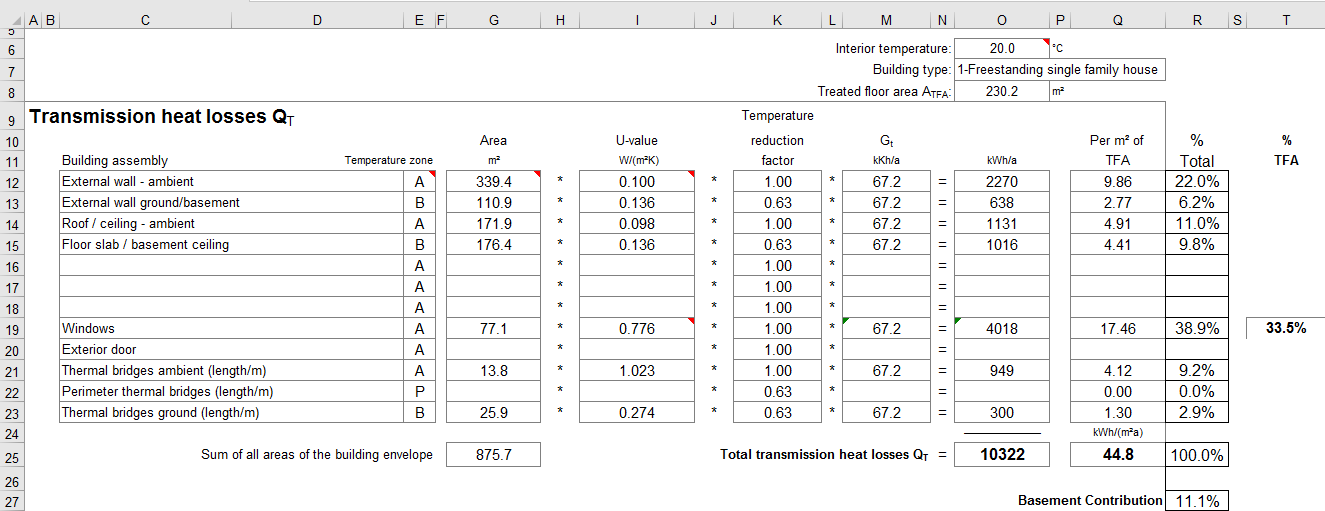
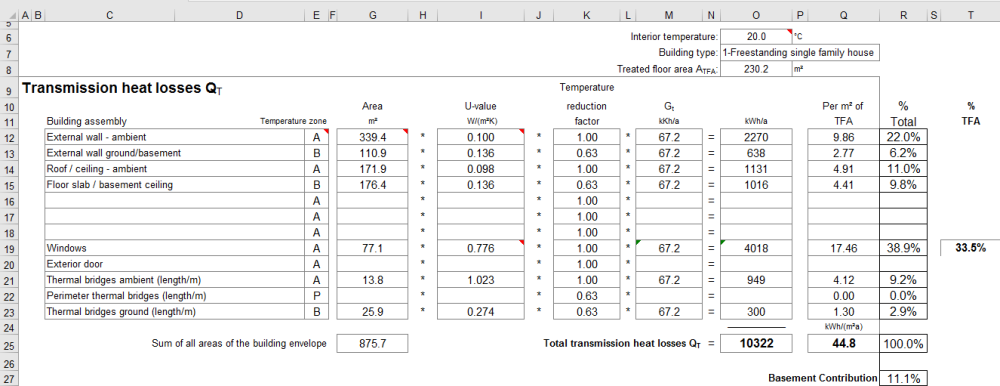
Jeremy was (he no longer posts here) a Buildhub 'living treasure'. See here: https://forum.buildhub.org.uk/applications/core/interface/file/attachment.php?id=18333 Like the design a lot If the architects are sniffy anout giving you the whole PHPP analysis ask for a printout of the section down to cell Q25 at the top of the 'Annual heating' tab. e.g. (this is ours which has an inadvisable amount of glass)
-
Looks like a nice design, have some elevations? And a good compass orientation - in fact, similar to ours, which was chosen for PV & solar gain reasons. The 'high' heat demand is probably just a function of the glass area - we also made similar choices. You can get great heat demand results if you don't have any windows at all . You could ask for a copy of the spreadsheet and play around with variations and drill down to see where the bulk of the energy use is. Or you can start with the J Harris spreadsheet, which is 3% as complicated, and will get similar-ish results to PHPP for heat calcs.
-
>>> it's probably just that the Inspector can't locate them. Yes, because the LPA didn't supply them, so they are supplying them only on request of the inspector a mere 1 year after the appeal was lodged. My question was rhetorical - would I be allowed to do this in a similar way to the LPA? Or would I be penalised by having that part of the evidence ignored or a similar penalty. That is, is the LPA getting more lenient treatment than the appellant might? And to avoid any doubt - yes, I think they are. Similarly for following the Procedural Guide.
-
Sorry, I meant I assumed none of it would be exposed.
-
Ah thanks, interesting.
-
That's an interesting approach, each ring would be ~2T. >>> how much of it has to be exposed? I assumed all of it, but the designer should have figured this out along with the levels, falls etc. In essence, you need minimum 1:100 fall from the furthest away source along the length of the pipe and into the tank inlet, which is usually towards the top of the tank. As others have said, that's around 3.5m^3 of tank. Is that enough? - my SE is coming up with 27m^3 for mine.
-
Planning Appeals - Statement of Case Examples
Alan Ambrose replied to phykell's topic in Planning Permission
Ah interesting, maybe I'm mixing 'subordinate' and 'subservient' - the latter always reminds be of some forelock touching in the middle ages. Coming from the peasant classes, it always grates 😀. -
@Havkey100 Not any obvious ones. Final comments were in March, the same as two other appellants that have posted here on BH and have their decisions already. So, from 3 the appeals I've been tracking, the timescale is (1) varying delay of ~3.5-5 months before the inspectorate decides to 'validate' ... then the appeal 'starts', (b) a fixed schedule of ~7 weeks for statements, comments etc, (c) a variable delay of ~5 months why they decide. However, I received 5 very similar curious and slightly baffling emails from the inspector yesterday. It appears that nearly a year later, and despite 'validation', he asked about a week ago the LPA to supply some policy documents that they have refered too in their statement of case. The inspector has asked for my comments. He didn't actually say why, but I assume this is because these docs are nominally 'new evidence'. Would I be allowed to supply new documents at this late stage or would I be penalised for failing to provide them? I'll leave you to judge. The LPA also blatently ignored the Procedural Guide doc which lists a couple of things the LPA 'must' do ... and that the LPA simply ignored. When I queried this, the inspector said the equivalent of 'oh well, we can't make them'. So, the good news is that there is some action, the bad news that it's not certain how far they have actually got.
-
It does seem odd - generally a quick temperature rise should be proportional to energy input. I would guess the correct number should be 5 or 6. What temperature does it get to in both cases and what was the inlet temperature? Could it be this is unvented and the pressure increase causes a bunch of hot water to exit via the tundish? 40 kwh in the small space where a tank is normally kept would have the room at unbearable temperature. How long is it meant to stay at top temperature?
-
@JohnMo >>> Doing mine again I would miss out the GSE flashing and do lead instead For a better look, or is there a functional reason too?
-
Where to get Oak Sleepers...
Alan Ambrose replied to machtucker's topic in Landscaping, Decking & Patios
Local merchants or fencing suppliers may have stock or be able to order in. For example, travis perkins. -
I hope your appeal is processed swiftly. Mine is coming up to 1 year on Friday.
-
So, it’s fairly obvious that the windfall profit should be shared with the state, maybe 1/3rd landowner and 2/3rds state? The profit to the council can be used for social housing and streamlining the planning process. Not rocket surgery, And yes, compulsory purchase for land in and around towns or villages. The profit to the landowner (say, £150K an acre) will be ample for them to purchase more ag land if they want.
-
At the moment, planning is a lovely windfall lottery for landowners, turning £10K of ag into £500K of ag with planning permission. Wonderful if you’re a landowner. The profit comes straight out of the pockets of the new house buyers but is 100% enabled by the state. By and large, landowners are part of the elite who get to make the laws which are so delightfully in their favour.
-
Planning Appeals - Statement of Case Examples
Alan Ambrose replied to phykell's topic in Planning Permission
In planning officer speak ‘subordinate’ means ‘size’. They used about 9 synonyms for size in response to one of my applications. Without specifying what an appropriate ot acceptable size is, of course. All part of the usual planning cat-and-mouse guessing game. -
Exterior ideas needed!!
Alan Ambrose replied to Bournbrook 's topic in New House & Self Build Design
Not so much if you use freelancers from fiverr or similar. -
I think similar situation to my plot. It doesn’t get residential stamp duty until it becomes … an actual residence. So, I think you have (presumably) ag land with an ag barn on it. So £2K stamp duty on £250K. No extra 3% as not residential property. A lot of residential solicitors / conveyancers are not familiar with this. Land agents and commercial solicitors are though.
- 1 reply
-
- 1
-

-
Sharing Fee Proposal with other Architect
Alan Ambrose replied to flanagaj's topic in Surveyors & Architects
I think it is a little unprofessional to share the whole proposal without explicit permission. You could briefly describe the scope so the other architect can check you’re not mistakenly comparing apples & oranges. I accidentally copied a proposal from one SI specialist to another when emailing an SE. I was really embarrassed and apologised to both. -
I feel a little more cautious than some here. If the land isn’t actually residential curtilage then using it for garden-ish activities and workshop sounds not so legal. If you’ve been doing that for 7 years without challenge you may be able to claim it’s now residential. But, if not, you might not want to alert the LPA.
-
Planning Appeals - Statement of Case Examples
Alan Ambrose replied to phykell's topic in Planning Permission
Yeah, I think it’s a matter of taste whether you hand over the whole thing to ‘trusted professionals’ or diy a bit. I generally do the latter, but sometimes that’s probably not the right course. Be aware that appeals seem to be taking forever right now. I’m not sure whether ldcs are householder or ‘other’, but I think other are the slowest - probably over a year. One strategy might be to run the appeal but put in a slightly changed application but this time badger the LPA into saying what they *will* allow. Or maybe a pre-app and push hard for a meeting. You might get a bit more traction once they figure you’re not just going away. -
Planning Appeals - Statement of Case Examples
Alan Ambrose replied to phykell's topic in Planning Permission
You’ll find examples i.e. actual cases (probably) on your LPA’s portal (there are on mine). Both appellant’s and LPA’s cases. May take a while to find similar circumstances to yours as (at least my) LPAs search facilities aren’t the greatest. Not sure why you’ll want to write one though if you’re using a planning consultant - as that’ll be their main skill.