


Alan Ambrose
-
Posts
3129 -
Joined
-
Last visited
-
Days Won
13
Everything posted by Alan Ambrose
-
You can get ply with a known face quality and material - sapele etc - the kind of thing that boatbuilders use for cabins. I wouldn't order online unless I had seen the quality before. The best shed I've found for standard ply is Wickes - at least you can see what you're getting. Wouldn't 12mm do - 18mm is awful heavy? Also 'exterior' ply to deal with damp well. You can also protect any bits you're worried about getting too hot with thinnish (say 1 or 1.5mm stainless sheet).
-
Space needed for truck deliveries and turning?
Alan Ambrose replied to Alan Ambrose's topic in Project & Site Management
Thanks for taking the time to post those. Bit tricky to see what space is needed tho. I even googled gate and a bit sizes - and found out they'll make you what ever you want. -
I've always been a cynical xxxxxxx and a glass half empty kind of guy The benefit of that (!) is you assume everything that can go wrong will go wrong and you don't trust anybody to do a good job
-
My build is off a single track road, with entrance to the plot through a farm gate sized entrance. I'm trying to figure out how much space on site I need for truck unloading / turning. Anyone have a rule-of-thumb? Ta, Alan
-
>>> MBC are spitting out houses at a fantastic rate, so I doubt they’d need to steer their business off its current model. May be a different story if they were struggling to make ends meet, but I guess they’re not. Yeah, I get that this requires persistence, but if all of us asked suppliers for protection against default where large amounts of money are being lodged on trust - then they will slowly get the hang of it. Some - the more grown-up ones - might figure that it's an additional benefit that they can sell. OTOH if we all just take it on the chin without making a fuss when a supplier goes bust, then nothing will change. Your choice.
-
Good you spotted it. I reckon it will be fine - it's built to withstand a bit of mishandling on site.
-
>>> MBC have rejected my requests for an escrow facility, and also for any arrangement that assigns ownership of materials to me when stored on their premises. The only protection they will consider is the insurance company route. I haven't see the terms but it seems that it would provide the protection that customers want. There are plenty of trade credit insurers, but for private punters is appears for less well developed and therefore more expensive. I'd only need protection for 6 months, so a cost of 6% is an annual risk premium of 12% - that sounds expensive for a cash rich company. <<< Well it needs a few potential customers to walk away and then they might decide to spend more time on the subject. It's not unreasonable for clients to be protected against 'surprise bankruptcy'. The 'risk premium' of 12% isn't just an interest rate - it contains the likelihood of default, so maybe it's not so bad. I still think my solution of the client lodging the money with a lawyer/escrow agent up front with later staged payment to the supplier is the best / cheapest / fairest. Yes, it requires a little work to administer and an inspector-type to sign-off each stage and maybe mark the materials / work-in-progress. But there you are. And it'll probably cost less than 6%. I'm seeing 0.9% from escrow.com just for the escrow service (I mention them as I happen to have used them to sell a domain name back in 2005). To that you would have to add, say, QS costs to validate the stage has been reached. Say £1K for less than a day's worth of travel / inspection? So, for a £150K transaction divided into 4 stages that might be 0.9% plus £4K i.e. around £5K or 3.5%.
-
The appeal landscape is a crap shoot?
Alan Ambrose replied to Alan Ambrose's topic in Planning Permission
You can ask. You can also submit a FOI request. Be interesting to try. -
We meed an off-the-shelf solution to this problem - it's come up several times before. Like every time a supplier goes bust. Staged escrow and contract terms like 'raw materials / work in progress belong to customer once that stage has been paid for' etc. I pointed out before that escrow.com offers this kind of service. I'm sure their are others.
-
Of course, it's not how long your RSJ is, it's how you use it...
-
The appeal landscape is a crap shoot?
Alan Ambrose replied to Alan Ambrose's topic in Planning Permission
>>> What you do is force ( not push or ask politely ) for exact definitions of these points in context. Except these are appeals - presumably by written representation for small stuff like ours. So that's it, and I assume you're not going to the High Court for a single BuildHub-style dwelling. -
The appeal landscape is a crap shoot?
Alan Ambrose replied to Alan Ambrose's topic in Planning Permission
That's a 'yes' then. Clearly I am over-sensitive . A good job the proper courts are a bit more disciplined. It does change my calculus a bit, having to choose between two capricious processes . -
>>> Mechanical fixings. Black Torque screws. Wasn't worth the gamble relying on tape/adhesives. Well steel is heavy - about 16 kg per m^2 at 2mm thick and I'm guessing you have 10s of m^2? It strikes me that thinner steel would be easier to support. I rather liked @markocosic 's idea of supporting all the weight on a top fold though. Your SE has OKed the fixings? As, say, 20m^2 (i.e. 320 kg) on typical timber battens sounds a bit iffy. There's a structure at Snape Maltings btw which doesn't have obvious fixings, I always assumed it was carefully welded along the seams. I will have a closer look next time I'm there: https://www.dezeen.com/2010/02/14/the-dovecote-studio-by-haworth-tompkins/ FYI: "the steel was welded together to form a watertight box"
-
Inverter behind inverter
Alan Ambrose replied to Pocster's topic in General Alternative Energy Issues
>>> My experience with installers varies - at the current inflated prices they charge I’d like to know what to ask - as sometimes you get rather different answers . Yeah understand. An alternative is just to alight on a likely inverter/charge controller supplier and ask them (or read their specs in detail) to see whether their 3.6kW inverter boxes can also handle charge/discharge on 20 kWh of batteries. -
Inverter behind inverter
Alan Ambrose replied to Pocster's topic in General Alternative Energy Issues
>>> My objective is to charge 2 x 10kw batteries simultaneously at 3.6kwh - but with only 1 inverter grid connected . Hence this so called inverter behind inverter theory. OK you have single phase and therefore a 3.6kW / 16A export limit. You probably have a 100A main fuse which is primarily a protection against 100A draw down / import e.g. caused by a bad short. Otherwise you can take / draw / import up to 100A i.e. 23 kW. Note that the battery charging function is really a separate function compared to the power inverter function (i.e. taking the battery output and generating 230V AC.) - although the functions often have basic coordination. In principle, you can charge your batteries as fast as the battery pack / inverter allows - usually faster charging means shorter life. So, you could charge 20kWh of batteries at say 5kW and it will take 4 hours (i.e. 20/5=4) or at 2kW and it will take 10 hours (20/2=10). Now, a typical 48V battery (e.g. Pylontech) has a recommended charge/discharge current of 25A suggesting the fastest charging/discharging you should be doing is 2 hours to full charge/discharge. That's the fastest - you can charge/discharge as slow as you like. In short, yeah, I agree, you just need a reasonably smart battery charge controller. Keep the max inverter output to 3.6kW to keep your DNO happy. Maybe you need to catch up on some PV/inverter operation details - it can be a bit involved as you can see. The relationship between power, voltage and current is a good start, as is the difference between kW, kWh and kWp. Or just decide what you want to do at a high level, and then ask an installer. -
Inverter behind inverter
Alan Ambrose replied to Pocster's topic in General Alternative Energy Issues
>>> Master inverter can output 3.6kwh I.e draw from grid That doesn't make much sense. An inverter takes power ('draws') from your PV panels and generates 230V power. You may use that to power your house and/or send power back to the grid. Now some inverters control battery modules too and can then 'draw from the grid' and 'charge a battery'. Is your objective to get round the DNO export limits? Nothing wrong with that, but maybe you can clarify? -
How to estimate self-build costs before starting
Alan Ambrose replied to selfbuilder91's topic in Costing & Estimating
>>> In reverse logic....what will your finished project be worth to sell? Add 200k to that to get an idea of budget required. Hilarious, but true often I suspect. >>> Get a detailed construction drawing pack from them, which will be full off errors like odd window/door sizes that don't work brick and add cost, then get it QS'd so you know ballpark what its going to cost. Depending on how hands off (costing you ££££££) you want to be tender and engage a builder, paid in arrears to a written contract. Pay a quantity surveyor to visit each month to determine what the builder is going to be paid against the contract QS schedule. The fees you save doing this method instead of buying the architect another BMW will sort at least a bathroom. <<< Nice, super-valuable advice I believe. thanks. -
Hi, I read through a bunch of recent appeal decisions yesterday for my local area, East Suffolk. I was slightly surprised that the inspectors seemed to be as non-fact-based, opinionated and capricious as my LPA - which suggests to me that appeals are a bit of a crap shoot. I had hoped that they would be more evidence-based than the LPA. I see stuff like: (1) I acknowledge that a brick wall abuts the back edge of part of the pavement along this side of the road, however the proposed development would have a greater scale and massing and therefore would be more visually prominent. i.e. Yeah, introducing a new garage is 'a greater scale and massing' - that's the nature of new buildings duh - but I am going to use that fact to turn down the proposal. In reference to the main issue, the proposed development would cause harm to the character and appearance of the surrounding area. i.e. That's just my opinion, of course, and I'm not going to explain why - but I am going to turn down the proposal. (2) I consider that the proposal would appear dominant in the streetscene and harmful to the setting of the locally listed Puddingmoor Place. i.e. That's just my opinion, of course, and I'm not going to explain why - but I am going to turn down the proposal. The imposing position is not matched by the design, which is neither modern nor reflective of the quality of the buildings that are typical of the conservation area. i.e. I like either modern or pastiche, and I won't allow anything else. (3) Although I note the willingness of the appellant to provide the Suffolk Coast RAMS payment, a financial contribution towards mitigating the effects of the proposal on the Protected Sites, I have no evidence before me to demonstrate that such a payment has been made. I am, therefore, unable to complete the AA favourably and, as such, I must conclude that, following Appropriate Assessment, the proposal would cause harm to the Protected Sites. i.e. The applicant has given an undertaking that they will make the RAMS payment, but I am going to ignore that. Any thoughts? I don't expect anyone will read through the appeal decisions, but they are attached if anyone is interested. Alan APPEAL DECISION 3284215.pdf 3306433 Appeal Decision.pdf 3306824 Appeal Decision .pdf
-
>>> Are there any downsides. Yes, they're very expensive.
-
>>> at the Warmstar ones from eBay that others have on here. Just a warning - these are, of course, a bug... nuisance if they fail. Buy the best quality ones. How do I know that?
-
30kW PV, All electric heating, is this mad?
Alan Ambrose replied to DevonBarn's topic in Photovoltaics (PV)
>>> actually with respect the aim isn't to use less energy, it's to generate as much as we use (in £) OK I see - so the grid power you use in the winter, you're planning to pay for with exported power in the summer. Makes a certain amount of sense. So you'll be 'net zero' electricity over the year. Probably not the most economic set-up though ... you can take a stab at calculating the benefit of each incremental panel - either as actual calculations/estimates or just in concept. The first panels get great payback, the last panels get fairly marginal payback. Panels are not that expensive though - so if that's want you want, there's no reason why not. -
30kW PV, All electric heating, is this mad?
Alan Ambrose replied to DevonBarn's topic in Photovoltaics (PV)
>>> I would definitely pursue having a 3 phase supply, even if it costs you a bit more, as it will future proof your supply. It's becoming the norm now to have 3 phase. Yeah, I respectfully disagree with that. The object of the exercise is to use less energy, no? 3-phase let's you use loads of energy (and pump loads back, but you're probably not making any money on that). It's a bit like having a 8L engine Bugatti Veyron - great fun I'm sure, but it won't help reduce your petrol consumption much . Yes, on 3-phase you'll be able to run 3 fast car chargers, 3 ovens and ASHP on full blast - all at the same time, and you won't be using any fossil fuels (at least directly), great! Just like doing 267mph in your Veyron - theoretically you can, but you never will. Add a bit of extra complexity for monitoring, PV feed-in etc, a bit of extra danger for having 400V around, and I don't get the hankering for 3-phase (and I do have 3-phase). -
30kW PV, All electric heating, is this mad?
Alan Ambrose replied to DevonBarn's topic in Photovoltaics (PV)
Here's a graph for our little 100m m^2 medium-insulated barn from when I was figuring PV numbers...consumption is total energy use and we have electrical heating (well backed by a log burner). This is 15 kWp limited by roof area. Generation in winter is about 20% of summer generation. Are you figuring that you want to run your full electrical needs including heating totally from PV in the winter?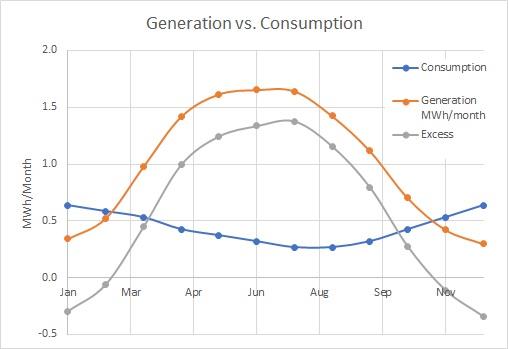
-
I think that inverters are generally of the 'fails fully or not at all' variety of equipment. I suggest a single panel could be damaged or something more subtle. Check connections carefully and see if anything is hot that shouldn't be. Scan the roof with binoculars etc. And yeah, you need to provide more information... Output slowly reduced over many months? Suddenly dropped one day? Multiple strings? How many panels? Any shaded? Graphs, pictures etc. We're not clairvoyant you know...you need to do some of the work too.
-
Yeah, I don't agree with the 50 year lifetime thing. We need building methods which are not just 'build once' - that is houses should be designed to be taken apart and re-built. Our barn conversion was built several hundred years ago for agricultural use and therefore not expensively. But because it had an OK oak frame structure, it was a fairly easy job to strip off the boarding, roofing etc and re-clad it using some proper insulation etc. So, build houses with good 'bones' that can be re-built on easily.

