Adsibob
-
Posts
3604 -
Joined
-
Last visited
-
Days Won
10
Everything posted by Adsibob
-

Viessmann Vitodens 200-w - initial impressions
Adsibob replied to larry's topic in Boilers & Hot Water Tanks
So which Vaillant and Baxis do you recommend to supply hot water to a 300L tank, heat 5 towel radiators across the three bathrooms and a couple of rads on the loft floor and do about 100m2 of underfloor heating? Modulation abilities and efficiency are key, as heating and hot water demand is variable in our house. -
Viessmann Vitodens 200-w - initial impressions
Adsibob replied to larry's topic in Boilers & Hot Water Tanks
@larry I was also attracted to the Veissman because of its superior modulating abilities. We need to heat a largish 5 bed house with 3 bathrooms (although only two bathrooms will be in use regularly). Hot water demand is going to be HIGH because I just bought a ridiculously large bath from Lusso Stone and plan to use it regularly, so a Combi Boiler is not feasible. All the boilers I've ever had have been Vaillant Combis. They are okay, but they do fail. It's a shame Veissman is that much more complicated. I did originally go through a Veissman approved company to get the whole heating and hot water system designed, but I was put off by the sales tactics and they were also unreliable. @Nickfromwales are your negative comments about the Veissman based on real world experience of it, or is it just a theoretical aversion to it based on what you've read about it? I have just googled Protec following on from @PeterW's recommendation and they seem focused on Wakefield and the surrounding areas. No good for me as I'm London. The Alpha E Tec seems to be a combi boiler, so that won't work for me either as I need a system boiler really. My builder has recommended Keston, but my father in law has had bad experiences. Obviously this is all subjective opinions formed on anecdotal evidence. Which magazine purports to provide more independent and scientific views, but actually much of their "best buy" recommendations is based on limited survey data as opposed to thorough tests. Any further thoughts welcome, anecdotal or not. -
I've decided on a Kinetico or Harvey water softener system, but I don't know where to buy one from and looking online there seem to be a lot of suppliers peddling myths like "you should only use our salt tablets because other suppliers might dilute the strength of theirs with fillers". I also rather not pay for installation as I've already agreed for my builder's plumber to install a water softener and I just have to supply it - or do all Kinetico and Harvey water softener systems need to be installed by an authorised installer. Any recommendation as to where I can get impartial advice on which specific model is going to be best for me and at a fair price, please share. Thanks
-
What are you planning on putting on the floor that is heavy? Any cast iron bath, for example?
-
@pocster I will pray for you and your stairs. When you achieve this feat, do update us on your success story as I'd love to know what you end up doing. I have a 140kg stone resin bath coming next month and no idea how the builder will get it from the kerbside delivery point to the first floor bathroom.
-
Thanks for the quick reply. They do do a switched version, but we like the aesthetic simplicity of the switchless one. Is it a safety thing then? I note that in continental Europe one hardly ever sees a switch on a socket. Same in the US I think.
-
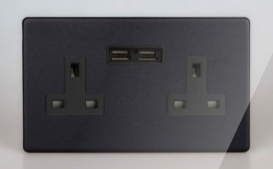
I'm considering installing these as our main sockets: They are made by varilight, so I'm hoping the quality is okay. But is the absence of on/off switches an issue, whether from a Buildings Regs or safety point of view? The only place where I think it would be safer to have a switch might be where we plug in kitchen appliances like blender, toaster, food processor... just in case there's an accident/fire one can switch it off. Although in those circumstances presumably one could just pull the plug out from the socket almost as quickly. Maybe @ProDave or one of the other electrically gifted members can weigh in on this...
-
@Mikey_1980, just wondered how you feel about your floor 5 years on? We are considering designsinresin and would be good to know whether you still like it and how it has aged/weathered with five years of use.
-
Thanks @Nickfromwales. I can only guess that the reason they've put them on top is that that way the immersion heater can be removed for servicing/replacement without having to drain the cylinder. Is it a pain to drain the cylinder when you service one like the one you've photographed? What does the annual service actually involve?
-
@Nickfromwales looks impressive, but didn’t you need to leave more space above the cylinder for removing/servicing the heating element? I’m looking at a horizontal Telford Tempest which requires 11 inches clearance above it for that purpose.
-
Wow. I would love to see a photograph of that!
-
Viessmann Vitodens 200-w - initial impressions
Adsibob replied to larry's topic in Boilers & Hot Water Tanks
@larry this is good to know; I am also considering this very boiler. Which size Vitodens 200W did you go for? Did you consider setting up with a Tado system to control it rather than the ViCare app? What other boilers were you considering and why did you go with this one? Are you still happy with your choice? -
No, but neither do the measuring cups.
-
+1 for Alexa. I also use it to call my wife when I'm out and I know she is in but won't hear her phone. We don't have a landline, but I can just "drop in" to the Alexa. Also useful for weather forecasts, telling the time (in any city), setting reminders, adding to my Ocado shop, checking my diary. It really is a personal assistant.
-
But that's not the same as building regs. Building Regs = the law. NHBC = an optional home warranty and insurance service.
-
We are renovating and extending an old 1930s house. Regulation 3 of the Building Regulations defines ‘building work’ as including: the erection or extension of a building the provision or extension of a controlled service or fitting the material alteration of a building or a controlled service or fitting. Part of our renovation includes the knocking down of an old wooden porch with a ceramic tiled roof and building a new porch out of brick with a ceramic tile roof. We've had to serve a building regs notice in respect of the whole project anyway, as we are basically doing everything to the house so the project overall is easily caught, but I'm trying to work out if our new front door which is going on the external part of the porch (we're not having an additional door between our hallway and the porch) needs to comply with Approved Document Q. This is what Approved Document Q says: "Regulation 4 states that building work should be carried out in such a way that, when work is complete: For new buildings or work on a building that complied with the applicable requirements of the Building Regulations: the building complies with the applicable requirements of the Building Regulations. For work on an existing building that did not comply with the applicable requirements of the Building Regulations: (i)the work itself must comply with the applicable requirements of the Building Regulations (ii) the building must be no more unsatisfactory in relation to the requirements than before the work was carried out." Building work was defined in Regulation 3, as set out above, so our new porch is definitely "building work" in that it is the extension of our original building (the wood porch structure we are replacing was an addition). But this part of Approved Document Q is just so badly drafted! On the one hand, we are plainly not in the situation described in category (1) of Regulation 4 as we are not a new build or doing work on a building that was previously compliant. So we must be in category 2. In that case, is all that i have to do improve on the security of the flimsy front door that was there before, in which case all the stuff about non-timber doors having to either comply with PAS24 or comply with similar or better performance to PAS 24, including the follwowing is just non-applicable to my situation. STS201Issue5:2013 • LPS1175 Issue7:2010 securityrating 2 • STS202 Issue3:2011 burglaryrating 2 • LPS2081 Issue1:2015 securityrating B Is that right? Don't get me wrong, I'd love to have a PAS24 door, but I'm finding a lot of companies say "we can provide you with a door that has both laminated glass and multipoint locking, but we can't give you a PAS24 certification because we haven't had our doors tested."
-
Have you considered Pergo laminate flooring. It is probably the best laminate plank out there that is the best approximation to real wood. Go to the pergo website and request samples - they are all free, even postage. It costs about £30 a square metre and even comes in wide plank if you like that. It will basically look like a brand new wooden floor for the life of the product. The only way you can tell it is not real wood is that it is slightly colder to the touch to real wood and it obviously doesn't "age" in the way wood does. It comes in hundreds of varieties/colours/widths/finishes so you will definitely find something that you like aesthetically. The one we went for in our last place was 9.5mm thick and required an underlay of about 2mm. Really easy to install too. I was going to install it in my new place but the architect keeps banging on at me that for a house that I plan to live in for the rest of my life I should really get a product that will "age beautifully". Pergo basically doesn't age. It's virtually indestructable. We once thought it scratched, but it was actually the leg of a plastic chair that had scratched off onto the pergo. Easily cleaned off with a damp cloth.
-
Hi @Temp which regulation are you referring to here? Presumably this only applies if one is using the the engineered board as the structural floor?
-
Engineered Wood Flooring Float or Glue?
Adsibob replied to revelation's topic in Wood & Laminate Flooring
I was advised by Cellecta, the company supplying our extruded polysterene UFH boards that anything you put down between that and the finished floor would slow down the heat transfer time. Engineered wood is already going to slow down the responsiveness so if you are going down that route then definitely avoid slowing it down further. Just put a 6mm layer of rubber matting, such as the one shown here, underneath the UFH boards. That will still absorb sound from impact of footsteps, without compromising your heating. If you don't have space for 6mm of rubber, they also do a thinner cork version, but I've not tried that. -
Cost benefit analysis of thermally broken front door
Adsibob replied to Adsibob's topic in Heat Insulation
Thanks @Conor. I’ve asked for the u value comparison, and am waiting to hear. They seem to only have the values for the glass to hand. I looked at aluminium, but the frames are far too thick to look anything like Crittall. RK doors for example can’t do anything thinner than 75mm. Although MetTherm have a beautiful thermally broken option in Aluminium that has only 26mm thick frames, they won’t sell them as a front door. No idea why, as they offer pas24. -
Thanks @PeterW. Which pump do you recommend? I need something very quiet.
-
I’m trying to work out whether it is worth spending extra on a thermally broken steel double glazed crittal style front door with side lights and top lights into our 1930s semi that we are in the process of upgrading. The alternative is to get the exact same door, with the same glass units, but the steel frame will be shallower as it won’t have a thermal break. Aesthetically, both alternatives look identical, except when the door is open the thermally broken one is about 40mm thicker. The dimensions of the opening which im glazing is about 1925 wide and 2400 high. Of that, 925 by 2025 is the door and the rest is fixed. It is almost entirely of double glazed glass, except for a steel kick plate occupying the bottom two fifths of the door. By the time we are done with it, the house will be very well insulated. Not passive haus standard, not close, but pretty good for a house that was built almost 100 years ago. We are putting quite a bit of insulation in, throughout the house, thermally broken double glazing which is A+ rated, whatever that means, insulating the loft, under the floors, insulating externally, putting in MVHR etc. Whether we get it thermally broken or not, the door comes with built in draft excluders and is pretty airtight. Given about 80% of it is double glazed glass, the thermal break/no break impacts only 20% of the area. The difference in cost is staggering. Something like £2.5k! I will never make that back will I, or is a non thermally broken door and window this big really going to make that much difference?
-
Thanks @PeterW that’s helpful. All showers and baths will have thermostatic valves. At the end of the day, a lot of this is going to depend on £ costs vs savings. If the boiler is at the other end of the house from the hot water tank, say 16 to 18m away in total length, with about half of that being vertical, but I insulated the pipes properly, what £ will I lose per year? The rest of the house is pretty well insulated, not passive haus, not even close, but still 100mm of Celotex over the cement slab, 40mm of insulation on the exterior of all the external walls, plenty of insulation in the loft, all windows and rooflights at least double glazed with thermally broken frames, MVHR, etc. With all of that, if I take this one short cut and put the hot water tank 16m to 18m from the UHWC, what £ will I suffer, but I’m heat loss and pump running costs? How do I work this out?
-
No idea about pipe size, what would you recommend? i will make sure all pipes are insulated with whatever is recommended here - any suggestion? DHW would probably be set to 63C or 64C. I guess I could set it to 65C on the basis that there will be some heat loss that will mitigate scalding risk, but rather not. I like my baths hot; I’ve never checked the temp, but I’d be surprised if it was hotter than 45C, so let’s call that 70% of the 64C HWC temperature.
-
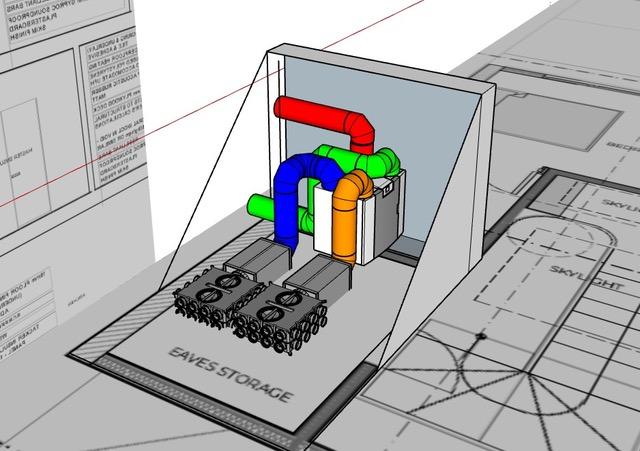
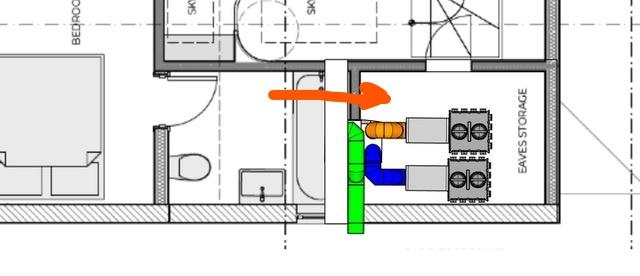
This is partly an MVHR post but mainly a HWC/secondary loop/boiler post, so hopefully I've picked correctly in posting it under hot water cylinders and boilers. The house we are refurbing will have its two principal bathrooms on the first floor, with the utility room centred below them at ground floor. On the second floor there will be a further shower room, which is directly above one of those bathrooms. I had originally planned to site the hot water cylinder also on the second floor in the eaves space directly above the other bathroom. As the three bathrooms, the kitchen and the utility are all on the same side of the house, this would have resulted in nice and short pipe runs from the cylinder to each bathroom: approximately 0.5m, 1.5m and 2.25m and maybe 5m to the utility, 8m to the guest WC and 10m to the kitchen sink. For the kitchen sink and guest WC we were going to have a secondary loop to give instant hot water. Our MVHR designer has worked out that the eaves storage can just about fit our Flair 400 unit, he has suggested it will look as shown in this drawing: This drawing actually doesn't make it look like it will fit, but it's because it shows an older version of our eaves storage area - we are actually extending it by 25cm or possibly a fraction more, so instead of the cross section being a right angled isoceles triangle which is only 168cm on each side, it will be a right angled isoceles triangle which is 193cm on each side. The width of the space is 170cm. Because of the 45 degree angle of the roof space, as one gets x cm away from the highest point in the room, one loses x cm of head height, so whilst 193cm sounds nice and high 56cm away from that, which is the approximate diameter of a 300 litre cylinder one only has 137cm of height. It is looking unlikely that I will be able to fit a 300 litre hot water cylinder here as well. The Telford Tempest unvented one I was looking at is 56cm in diameter and 1650 in length as a horizontal. Whether I do it as a horizontal one or a vertical one, i can't see how I can make it work without blocking the access to the eaves storage (which is shown by the orange arrow in this diagram: - we are doing away with that bathtub in the adjacent bathroom and making it a shower room instead, with a waterproof door/hatch that will lead from the shower area into the eaves storage area). So I think my only option is to site the HWC elsewhere. There is an eaves storage area on the other side of the stairwell (the stairwell is in the middle of the house). If i were to site it there, I would add at least 4.25m to all of my pipe runs to the outlets, so pipe run lengths for hot water would be: 4.75m bathroom 1 5.75m bathroom 2 8m shower room 9.25 to the utility room 6m to the guest WC and 15m to the kitchen sink Water pressure from the street is approximately 2.7 to 3.1 bar depending on the time of day, but probably safest to assume 2.7 bar. My flow rate is about 15l a minute, but this might increase slightly when we widen the connection to the water supply. Two questions please: Will a secondary loop with a timer that runs the water for 1 minute every 20 minutes during the day (and switches off whilst we're asleep) still give me instant hot water in all my bathrooms, guest WC and kitchen, or are these distances problematic? Where would you site the gas boiler that heats the HWC? Originally this was going to go in the utility room, some 5.5m directly underneath the HWC. But if the HWC moves to the other side of the stairwell, we will have about 10m between them and so maybe it makes sense to move the boiler up into the eaves storage space right by the HWC, with the flue going straight up and out the roof?