


Adsibob
-
Posts
3609 -
Joined
-
Last visited
-
Days Won
10
Everything posted by Adsibob
-
 Thanks. So I pointed out to my builder that he could change the hoardings so that they are 1m set back. (This isn’t mentioned in the legislation, but is mentioned in the Council’s guidance.) He said he would charge me for the work and that it would cost more than the £195 licence fee. At the time, I thought it was a simple case of paying the licence fee, but this was before I discovered the requirement for £10M public liability insurance. I feel like the builder should have done better for me here. He is experienced enough to know about the licensing regime so really he should have known about this. When I challenged him on this, he said he had never worked in this London borough and that he thought the licence was only required in more central London boroughs. But googling other council’s websites, I think it is a fairly common requirement in many London boroughs. It just feels so unfair.
 -
I received a letter today from my local Council telling me that I had breached section 172 and 173 of the Highway Act 1980 by not applying for a licence from them for my hoardings. The letter closed by pointing out that "Any hoarding erected without a licence is an offence... If a person contravenes this section, he is guilty of an offence and liable to a fine not exceeding level 3 on the standard scale which is currently £1,000; and if the offence is continued after conviction he is guilty of a further offence and liable to a fine not exceeding £2 for each day on which the offence is so continued." Having now read those statutory provisions, it is my firm understanding that if I don't remedy the situation I could be charged and convicted of a criminal offence. That is obviously a very serious matter. I had no idea one needed a licence to erect hoardings. Reading into the history of the legislation, it appears to have been enacted following some scandals in the 70s about children who got terribly injured, sometimes fatally, by trespassing on building sites that didn't have hoardings. The landowners weren't held liable because under the Occupier's Liability Act one is not liable for losses arising from trespass. These provisions of the Highway Act were therefore enacted to prevent that happening. Fair enough, makes sense, and even though I didn't know I had to have hoardings as a matter of law, common sense told me to put them up anyway. I've done 2.4m all the way around the perimeter of my front yard, with a heavy security gate that is clad in timber. All the timber is painted with weatherproof paint and the builder has put his contact details and various health and safety notices up on it for all to see. Unfortunately, he did that only after the inspector visited the property and took a photo which has now been appended to the Council's rather menacing letter. The letter has a deadline for applying for a "retrospective licence" by 13 May 2021. I received the letter today. The Council's licence application form requires me to jump through various hoops. None of those hoops are mentioned in the legislation. This is just Council Policy, not law. The law just says I need to erect hoardings to the Council's "satisfaction... so as to separate the building from the street", and there is then a separate provision that says that I have to add certain bells and whistles, if they require it, such as a handrail and lighting during the hours of darkness. Whereas the Policy says I have to apply for a licence, provide evidence to the Council, as part of the licence application that I have £10 million public liability insurance and also pay the Council the licencing fee of £195 and a deposit which is the minimum sum of £593.86 but subject to their say so depending on their assessment of "the risk to the integrity of the highway". So if they deem the deposit should be more, they can. Again, that aspect of the Policy is not legislation. I have discussed the matter with a former colleague (who is a criminal barrister) and I also happen to be legally trained, so I know that legally they are entitled to interpret this to mean that they can force me to go through a licencing scheme and they can also specify what hoardings they want and how lit up they should be etc. BUT, beyond that, they are basically trying their luck and it's 50/50 as to whether those additional licensing requirements are reasonable and proportionate to the object of the legislation, which is to protect trespassers from injury. My question is, has anybody dealt with a Highways Inspector on a matter like this or similar? I don't want to push this to Court in that the only way to do this is: risk a conviction and a £1000 fine - no thanks; or jump through the hoops and then sue the Council for Judicial Review - which would be time-consuming and I only have a 50/50 chance of winning. But at the moment I can't actually satisfy the requirements of the licence application form. I and my builder only have £5M public liability cover. (He also has £10M employer's liability cover, but this is not relevant here.) It just doesn't seem reasonable that I or my builder has to pay for additional insurance cover when we are actually already complying with the main purpose of the legislation which is to have safe hoardings that effectively separate the building site from the street. Oh, and I wrote to the Council today to ask for an extension to their deadline of 7 days from the date of their letter, and they said "no." W@nk!r$ !!!! And the other thing I find amusing is that the Council Policy is that hoardings must be at least 2440mm high. Mine are 40mm shorter than that!!!
-
My sliding door papers has come back following site survey and I'm asked to sign off on a contract note that specifies the following for the "external weather seal": "silicone ARBO range or compriband 7-12" Presumably I should specify Compriband, but is 7-12 the right type? Didn't realise there were different types.
-
Maybe I'm looking at this with too much of a London perspective, but in London there's not a chance in hell you could do all that for £120k. But I guess it depends on spec really. E.g.: What kind of glazing are you thinking of? £3k kitchen or £30k kitchen? Is your staircase going to be complex or bespoke? If so, you're looking at £20k plus. If you can buy off the shelf, then it's a fraction of that. Will you self install the MVHR or get a professional to do it, as that could be a big saving/cost.
-
I think it depends what aesthetic one is trying to achieve. If, for example, one wants to have continuity between the inside and the outside, for large summer parties (and since lockdown for all year socially distanced gatherings < 6!), then having a wide opening with a flush threshold and trying to match the external finished floor covering to the inside finished floor covering, as well as the threshold material, it can work really rather well. But that requires enough space for furniture not to get in the way, etc. It won't work in every layout so it won't be worth going to all that trouble in every situation. It also depends what the external environment and view is like. We ended up only having 60% of our rear elevation covered with sliding doors
-
So with a steel goal post, is this not an issue at all? We have a steel goal post, but the full weight of the roof (which contains a couple of heavy-ish skylights) won't be going on for a while, and so the sliding door survey was done before the full weight is on. Architect thinks there's unlikely to be any deflection in the steels, but I guess I should check with the SE.
-
Just a small correction to the above: we thought Planning would NOT be an issue. We were wrong.
-
I’m going to go against the grain here and say it’s better to get planning first. You could go to all this trouble of costing a project that you never get Planning for. We thought planning would be an issue because we were doing something very similar to what our immediate neighbour had done and what many others in our street have done. We don’t live in a conservation area, yet has a real rough ride with the planners. Lost two appeals and made 4 applications in total. Eventually got something really good, but completely different to our initial design. Has we costed that initial design, it would have not been very relevant to what we’ve ended up building. RIBA has standard guidance for costs per m2 to build different types of things, in different grades. I would use that as a starting point (I’m sure that’s what your architect has done). Get prices for the big ticket items like I folding/sliding doors, glazing, kitchens and appliances. Price up your bathroom suites by surveying the internet shops.
-
Interesting insights @craig. Incidentally, my sliding door survey was done today, but the roof isn’t quite finished yet. The rafters, insulation and steels (to support a large roof light) are up, but the green roof (which is just an extensive one, unlikely to weigh more than 75kg/m2) and the rooflight itself, are not. The opening where we are fitting the sliding door is 2300 high by 4300 wide, 4 panels. There is so much steelwork and the footings were poured about 10 weeks ago that I can’t see deflection being an issue, but I’m not the expert whereas you clearly are! What questions should I be asking the sliding door company that did the survey today to make sure they have taken into account deflection when the roof is finished and the skylight is fitted?
-
I think you need to get a copy of that report. Write a letter to manufacturer's registered office (which you can look up on Companies House for free)giving them the background and in writing and politely, but firmly, threatening legal proceedings unless they provide you with a copy. The basic points you need to make in your letter are: logic dictates that either the manufacturer is responsible or the installer is responsible; if they, as the manufacturer, are not responsible then there is nothing for them to hide and there is no good reason for not sharing the report with you; in circumstances where they are refusing to give you the report, the logical inference is that the report must implicate them and therefore you can only infer that actually they are liable; accordingly, if they don't provide you a copy within 21 days of the date of the letter, you will make an application under civil procedure rule 31.16 for pre-action disclosure of a copy of the report. This should rattle their feathers a bit and may get you the report. The report won't necessarily be the gospel truth as its author is probably biased, but it is likely to be relevant to your determination of who is at fault. Your only alternative at this stage is to hire a expert in sliding doors and sliding door installation to assess them and write your own report which you can then use to cajole the responsible party into fixing the issue. If you go down that route, be sure the expert complies with Civil Procedure Rule 35 and the Civil Justice Council's guidance on experts to be used in Court proceedings. I'm not suggesting you actually go to Court, but doing these things and threatening the sliding door company with a discrete Court application that just gets them to give you the report may help in making it look like you are willing to take that step, and that might be enough to prod them into action, get you the report and then use that to take matters forwards.
-
Apologies if this has been discussed on the forum before, but reading through the various results for "pipe diameter" didn't answer my question. I'm laying wet UFH throughout the house. On the ground floor it will be embedded in 55mm of screed, whereas on the first and second floors we are laying Cellecta XFLO Micro Foil Faced boards in the bedrooms and XFLO Micro TB in the bathrooms. These boards are made from very dense extruded polysterene and have the advantage of allowing the finished floor to be laid/tiled directly on top, with no spreader plates or gypsum boards required. I attached the spec for both if anyone is interested. You will see they come in different thickness, with the pipe channels already drilled out. Cellecta advise using the 25mm board for 15mm pipes and the 20mm board for 12mm pipes. In either case, Pipe centres are 150mm apart. My question is what is the difference between running 12mm and 15mm pipes? Presumably the larger the pipe, the more water and therefore the higher output, so am I right in thinking that a thicker pipe gives me the option of running: a less responsive system at a lower temperature; or a more responsive system at a higher temperature? In terms of floor finishes, on the first floor we are having 9mm pergo laminate in the bedrooms and tiles in the bathrooms. The tiles vary between 1cm thick in our bathroom and 2cm thick in the family bathroom. We were planning on having a separate thermostat for each zone, but only using one manifold for each floor, which i understand will mean i will have to use the same temperature water across the floor. On the ground floor, we will have: engineered wooden board 15mm thick glued directly onto the screed in one room; and everywhere else, Topcret Baxab (which is a type of extra strong microcement that is only 3mm thick) laid directly on to the screed. Because of the dramatic differences in conductivity of these two floor finishes, we plan on having a separate manifold for each, as well as them being on separate zones. I've only got room for 100mm of PIR under the screed. The house is an upgrade 1930s semi, so good insulation and windows throughout, but nothing close to passive standard. XFLO Micro FF & XFLO Micro TB.pdf
-
it should be comparable or possibly even better. Torfloor just uses a “foil diffuser” on top of an insulated panel that looks rather thin and certainly thinner than the 50mm insulation I suggested. The amount of insulation is probably the determinative factor of performance here, so i can’t see the system I suggested (which is a pretty standard detail for in between the joists UFH) being any worse than torfloor which is so much thinner. i presume this is not for a ground floor? If it is, you need much more insulation than 50mm.
-
It’s a decent product but expensive for what it is. If you need to keep the build up low, why don’t you lay a between the joists UFH system: Aluminum spreader plates are fixed to the joists using screws or nails, the plates have 16mm preformed groves in them set at 200mm centers to accommodate the pipes. A standard installation for this system assuming the joists are deep enough would be to fix batons to the sides of the joists (about 70mm from the top of the joist) then a 50mm foiled faced insulation like celotex/kingspan is cut and placed onto the batons, the pipe work is then clipped directly into the spreader plates. A bit more labour intensive, but cheaper and just as effective, and no increase in floor height.
-
Bit concerned about my posi joist installation
Adsibob replied to Adsibob's topic in Floor Structures
Interesting idea. Although the gap is small enough that I don’t think the glue would get very far down it. The posis are the small ones (size 8 from memory), which I think are 20cm or 22cm high. So glue would probably only get down the first 1cm or 2cm tops. -
Bit concerned about my posi joist installation
Adsibob replied to Adsibob's topic in Floor Structures
That’s reassuring. Maybe I am being OTT/OCD as I just read the notes to the mitek installation instructions and they say: “Joists should have a full bearing with no more than a 5mm gap between the end of the joist and the face of the hanger.” So the 1mm or less that I’m worried about is nowhere close to 5mm. But part of me still wants to insist he hammers some packers in to fill that gap, as surely gaps at the end are not good. Builder says it’s all screwed into the joist hangers anyway. I’m bring a bit crazy aren’t I? -
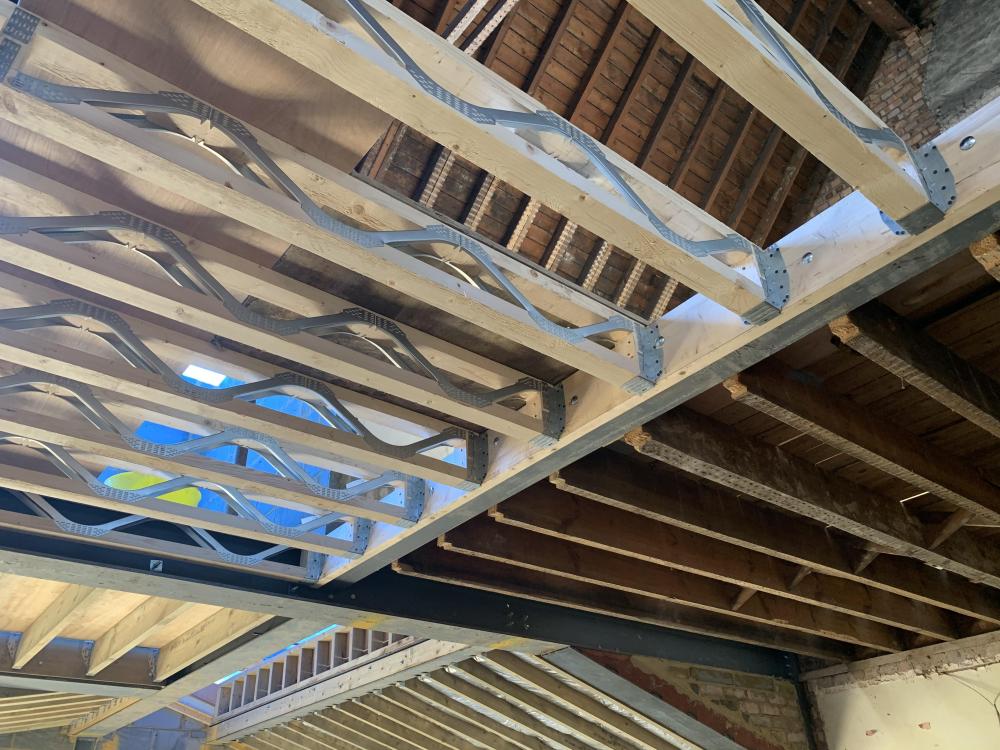
There is a small gap of about 1mm, possibly less, between the end of the posi joists my builder has installed and the perpendicular wooden beam he has attached to the perpendicular RSJ to facilitate installation. (Ie wooden beam and RSJ are parallel to each other and posis are perpendicular to those). I told my builder this wasn’t good, and will result in too much deflection. Walking across the posi joists with heavy footsteps (I weigh about 100kg) did cause some deflection. I couldn’t feel it, but I could see it when my builder did the same and I observed. Maybe 3mm of deflection, difficult to tell. he’s had already installed about a fifth of the posis for the whole house. Is it too late to do anything about this? Builder says I’m unnecessarily worried as he thinks once the 22mm caber deck is glued on top there won’t be any movement as that will help spread the load. i attach a photo, though it doesn’t show the 1mm or less gap at the edges I’m worried about. posis are at 400mm centres.
-
If so, what cistern did you install it with and are you happy with how it works? The website I'm looking at says it's not suitable for use with a "flush valve" because it is a rimless toilet, but I have no idea what that is. It recommends their compatible V&B cistern and frame, but the cost of the flush plate I like on that range of of cisterns/frames is a complete rip off, compared to the rip off the the Geberit Sigma01 costs.
-
Plus 1.
-
Cheaper options for bespoke Crittall-style interior doors?
Adsibob replied to jack's topic in Doors & Door Frames
Well I’m having crittall style sliders, but there you go. Is a bit like American style cheese, is usually not American at all! -
Cheaper options for bespoke Crittall-style interior doors?
Adsibob replied to jack's topic in Doors & Door Frames
Yes, your original post didn't specify whether you were after sliders or regular french doors and I must have assumed the former when you meant the latter. Good luck with it. 2700mm high french door would look awesome in my opinion. You could also try MetTherm as they do a profile which although aluminium, is very thin, particular for internal doors which only need single glazing. -
Cheaper options for bespoke Crittall-style interior doors?
Adsibob replied to jack's topic in Doors & Door Frames
So why not have superheight french doors? They would probably work even better than sliders. -
I can definitely associate with that!
-
If it said “Forgery” on it, I think you would have difficulty. But “Copy” will be fine.
-
What's the shortest concealed cistern you can get?
Adsibob replied to Roz's topic in General Plumbing
Thinking about this further, I'm now having a little doubt about the higher cisterns as isn't there a risk with rimless toilets that water flushing with too much force might come out of the toilet bowl and splash onto the floor, or does the rimless flush system account for this? If it is genuine problem (and not one imagined in my OCD head) Grohe's Rapid SLX has a solution to this which they call "flow manager", but not sure this is an option on Geberit or other Grohe models. The Grohe Rapid SLX is quite deep as well in that it is 230mm deep, so not really something you can easily fit into a standard depth stud wall. -
What's the shortest concealed cistern you can get?
Adsibob replied to Roz's topic in General Plumbing
gravitational potential energy, which equals mgh (where m is mass, g is the gravitational constant and h is the vertical distance). In other words, the higher up the cistern, the more force the water will hit the bowl with, because the water will have had a longer height with which to accelerate (as F = ma).



