


Adsibob
-
Posts
3609 -
Joined
-
Last visited
-
Days Won
10
Everything posted by Adsibob
-
 Thanks @PeterW. Which pump do you recommend? I need something very quiet.
 -
I’m trying to work out whether it is worth spending extra on a thermally broken steel double glazed crittal style front door with side lights and top lights into our 1930s semi that we are in the process of upgrading. The alternative is to get the exact same door, with the same glass units, but the steel frame will be shallower as it won’t have a thermal break. Aesthetically, both alternatives look identical, except when the door is open the thermally broken one is about 40mm thicker. The dimensions of the opening which im glazing is about 1925 wide and 2400 high. Of that, 925 by 2025 is the door and the rest is fixed. It is almost entirely of double glazed glass, except for a steel kick plate occupying the bottom two fifths of the door. By the time we are done with it, the house will be very well insulated. Not passive haus standard, not close, but pretty good for a house that was built almost 100 years ago. We are putting quite a bit of insulation in, throughout the house, thermally broken double glazing which is A+ rated, whatever that means, insulating the loft, under the floors, insulating externally, putting in MVHR etc. Whether we get it thermally broken or not, the door comes with built in draft excluders and is pretty airtight. Given about 80% of it is double glazed glass, the thermal break/no break impacts only 20% of the area. The difference in cost is staggering. Something like £2.5k! I will never make that back will I, or is a non thermally broken door and window this big really going to make that much difference?
-
Thanks @PeterW that’s helpful. All showers and baths will have thermostatic valves. At the end of the day, a lot of this is going to depend on £ costs vs savings. If the boiler is at the other end of the house from the hot water tank, say 16 to 18m away in total length, with about half of that being vertical, but I insulated the pipes properly, what £ will I lose per year? The rest of the house is pretty well insulated, not passive haus, not even close, but still 100mm of Celotex over the cement slab, 40mm of insulation on the exterior of all the external walls, plenty of insulation in the loft, all windows and rooflights at least double glazed with thermally broken frames, MVHR, etc. With all of that, if I take this one short cut and put the hot water tank 16m to 18m from the UHWC, what £ will I suffer, but I’m heat loss and pump running costs? How do I work this out?
-
No idea about pipe size, what would you recommend? i will make sure all pipes are insulated with whatever is recommended here - any suggestion? DHW would probably be set to 63C or 64C. I guess I could set it to 65C on the basis that there will be some heat loss that will mitigate scalding risk, but rather not. I like my baths hot; I’ve never checked the temp, but I’d be surprised if it was hotter than 45C, so let’s call that 70% of the 64C HWC temperature.
-
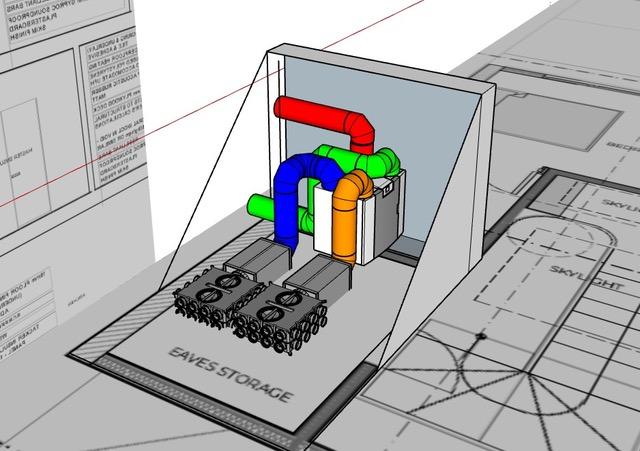
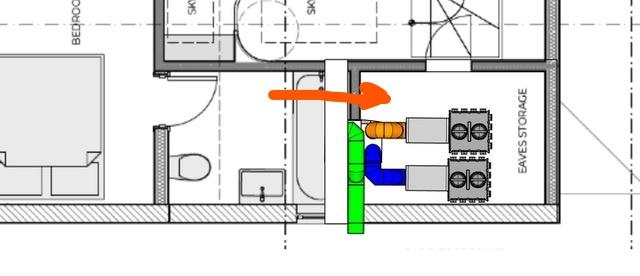
This is partly an MVHR post but mainly a HWC/secondary loop/boiler post, so hopefully I've picked correctly in posting it under hot water cylinders and boilers. The house we are refurbing will have its two principal bathrooms on the first floor, with the utility room centred below them at ground floor. On the second floor there will be a further shower room, which is directly above one of those bathrooms. I had originally planned to site the hot water cylinder also on the second floor in the eaves space directly above the other bathroom. As the three bathrooms, the kitchen and the utility are all on the same side of the house, this would have resulted in nice and short pipe runs from the cylinder to each bathroom: approximately 0.5m, 1.5m and 2.25m and maybe 5m to the utility, 8m to the guest WC and 10m to the kitchen sink. For the kitchen sink and guest WC we were going to have a secondary loop to give instant hot water. Our MVHR designer has worked out that the eaves storage can just about fit our Flair 400 unit, he has suggested it will look as shown in this drawing: This drawing actually doesn't make it look like it will fit, but it's because it shows an older version of our eaves storage area - we are actually extending it by 25cm or possibly a fraction more, so instead of the cross section being a right angled isoceles triangle which is only 168cm on each side, it will be a right angled isoceles triangle which is 193cm on each side. The width of the space is 170cm. Because of the 45 degree angle of the roof space, as one gets x cm away from the highest point in the room, one loses x cm of head height, so whilst 193cm sounds nice and high 56cm away from that, which is the approximate diameter of a 300 litre cylinder one only has 137cm of height. It is looking unlikely that I will be able to fit a 300 litre hot water cylinder here as well. The Telford Tempest unvented one I was looking at is 56cm in diameter and 1650 in length as a horizontal. Whether I do it as a horizontal one or a vertical one, i can't see how I can make it work without blocking the access to the eaves storage (which is shown by the orange arrow in this diagram: - we are doing away with that bathtub in the adjacent bathroom and making it a shower room instead, with a waterproof door/hatch that will lead from the shower area into the eaves storage area). So I think my only option is to site the HWC elsewhere. There is an eaves storage area on the other side of the stairwell (the stairwell is in the middle of the house). If i were to site it there, I would add at least 4.25m to all of my pipe runs to the outlets, so pipe run lengths for hot water would be: 4.75m bathroom 1 5.75m bathroom 2 8m shower room 9.25 to the utility room 6m to the guest WC and 15m to the kitchen sink Water pressure from the street is approximately 2.7 to 3.1 bar depending on the time of day, but probably safest to assume 2.7 bar. My flow rate is about 15l a minute, but this might increase slightly when we widen the connection to the water supply. Two questions please: Will a secondary loop with a timer that runs the water for 1 minute every 20 minutes during the day (and switches off whilst we're asleep) still give me instant hot water in all my bathrooms, guest WC and kitchen, or are these distances problematic? Where would you site the gas boiler that heats the HWC? Originally this was going to go in the utility room, some 5.5m directly underneath the HWC. But if the HWC moves to the other side of the stairwell, we will have about 10m between them and so maybe it makes sense to move the boiler up into the eaves storage space right by the HWC, with the flue going straight up and out the roof?
-
I see that Hwam's stoves come with a "semi autopilot" system as standard and then you have to pay an extra £600 or so to upgrade to the fully automatic version, which gets you the temperature sensor that links to your phone/wifi etc. I'm thinking the full autopilot partly takes out some of the old world beauty of a wood burning stove, in that relying on your phone to message you when you need to load more fuel into the stove is a gizmo that just gets in the way of my idea of relaxing by the fire... ie phone off! We don't plan on running the stove every night. It will be more of a two nights a week kind of "special" thing for us. In your recommendation @Trw144 were you referring to the semi autopilot or the upgraded with bells and whistles version?
-
Just giving this a bump in case 2.5 years later someone has an answer to it.
-
Best spec for high pressure hot water to multiple outlets?
Adsibob replied to sendu's topic in Boilers & Hot Water Tanks
I am looking at the Veissman Vitodens-200W, which is described as “The boiler's special design ensures the very low operating noise of 39 dB(A) maximum (26 kW)”. -
Best spec for high pressure hot water to multiple outlets?
Adsibob replied to sendu's topic in Boilers & Hot Water Tanks
Thanks @volcane. Yeah, to be honest that put me off as well, particularly most decent gas boilers come with a 7 or in some cases a 10 year warranty now. What did you go for in the end? -
Best spec for high pressure hot water to multiple outlets?
Adsibob replied to sendu's topic in Boilers & Hot Water Tanks
Yes, an Ochsner. Includes installation of the unit externally and compressor internally. Only unit I know of to operate very quietly, extremely efficiently and have a build quality that means it will last and last. I'm very much open to cheaper alternatives, but I don't want to install something that I'm going to hear, whether in my house or in my garden. -
Best spec for high pressure hot water to multiple outlets?
Adsibob replied to sendu's topic in Boilers & Hot Water Tanks
Alas, no. For what I wanted it was either £3k for a gas system, or £17k for a green system. I just can’t make that fit my increasingly strained budget. It’s a shame because I just don’t think the government’s announcement yesterday about hitting C02 abatement targets by 2035 is realistic without introducing a hydrocarbon tax, and bringing in tax incentives for green energy. I just fear it’s too late for my project. Unless I install a gas boiler now and accept that I will have to change to something greener when it packs up in 10 to 15 years time, having damaged the planet in the interim. -
Looks amazing. That's exactly the look we are going for. We won't have curved glass (because alas there's no curve in our building) but otherwise that looks spot on! We might try and get a brass handle instead of black.
-
Thanks @pocster, i've reached out to them but looking at their website I think they are too contemporary for what we are looking for. We are trying to emulate the crittall style but with modern security. I had thought Fabco could help us as they do crittall style steel doors with multipoint locking and PAS24 certification, but for some reason their doors must open outwards, which is just weird for a front door.
-
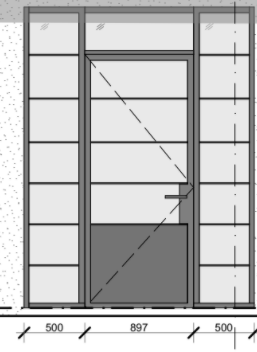
I'm looking to buy a double glazed steel door with sidelights and top lights that looks like this drawing. I've got a couple of quotes but none of them are PAS24 rated (although they can provide toughened - but not laminated - glass and they can also provide multipoint locking). Based on my reading of Approved Document Q, it doesn't have to be PAS24 rated but it does need to have one of the other security ratings mentioned as an alternative to PAS24 which are one these: STS 201 Issue 5:2013 LPS 1175 Issue 7:2010 security rating 2 STS 1175: issue 3: 2011 burglary rating 2 LPS 2081 issue 1:2015 security rating B. Does anybody know if toughened glass and multipoint locking is sufficient to satisfy one of these ratings? If it is is not sufficient, can anybody recommend a door company that could supply what I need? A few people here have recommended Lathams but they make doors with much less glass than steel, so not quite the style I'm looking for.
-
yes, the rear sliding door to the garden.
-
My front door entrance will be slightly raised above the external FFL of the driveway. How much has net yet been determined. Going to have an ACO drain all along the front of the house. What is optimal in terms of how the internal raised FFL relates to the external FFL? Should I just have a step down, or should I build a ramp sloping downwards that acts like a bridge over the ACO drain - or is this overkill? The reason I'm thinking of a ramp is that it's easier to get our son's pushchair in and out of the house. He'll be out the pushchair in a year or so, but even then could be useful for heavy luggage etc.
-
He’s fully bricked it up. BCO said “where is the cavity closer” builder said “whoops”. But architect says thatwe are putting a double glazed thermally broken sliding door unit there, there is no need for a cavity closer. Not sure whether BCO is being OTT.
-
So my builder somehow forgot to put cavity closers into the brick piers either side of a large gap where we are fitting sliding doors. The plan is to use an angle grinder to cut into the bricks to fit them. The scars from this operation will be concealed by the frame of the sliding door, which is almost 30cm thick, but I’m still wondering whether there is some less dramatic way of retrofitting the cavity closers. Any ideas?
-
Pull out spice rack? Pull out tray storage? Non-pull out tray storage? Pull out tea towel towel rack? In our situation, this is a 150mm gap right by the kitchen sink, so the towel rack would be most convenient , but does it properly dry when it is concealed within a unit? The other option is to make our sink bigger, but we’ve already allowed 800mm, any bigger seems enormous.
-
Has anyone tiled a wet room floor with R10 rated “anti slip” tiles and then regretted not using an R11 rated tile? We have never had a wet room before, so not sure how important it is to go for the higher anti slip rated tiles. We have found a tile that we really like and can afford, but it is only rated R10. The salesperson in the showroom said that is absolutely fine, but is it? Don’t want to slip!!
-
Further update: after a few days of vague info verging on pessimism from a leading stove supplier, I finally spoke to someone there who was more optimistic he could find a solution and hook me up with an experienced installer who would certify the installation. I will keep my fingers crossed he comes up with something soon, as builder wants to pour the concrete slab and start the floor build up next week, so if we do end up having to route the direct air supply under the FFL, i need to know asap!
-
It's a pitched roof, but the drawing just shows a section cutting through the lowest point of the roof (ie the air inlet would come out the rear first floor wall, 10cm or 20cm above the lowest point of the sloped roof covering the ground floor extension). I thought wind would help stoke the fire, but if I'm wrong about that am I better routing the air supply tube under the floor to the side of the house, which is basically the alleyway between two houses (where each house has it's side passage access from the front of the house to the rear garden)? I had originally discounted that as a possibility because it's some 8m away and although there would be nothing blocking the air supply vent, it's fairly sheltered so I assumed it would get enough air. But you know what they say about assumptions ...
-
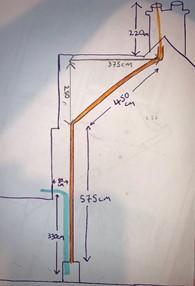
Yes, please see below. Since drawing this I've realised I need to either move the stove to the right so that it is closer to the Chimney, or create a new flue exit point for the exhaust, as this drawing shows the horizontal height of the exhaust flue that is diagonal as being more than 20% of the overall height of the exhaust flue, which i understand is not good. But the image helps show the general idea, particularly in respect of the (blue) direct air supply. Simple physics would suggest there should be no problem with having a supply of direct air coming from above if it is much smaller in height that the exhaust flue, but clearly Drugasar don't want to take the risk.
-
Thanks @Trw144. Funnily enough we've just had a look at the poujoulait system. My gut reaction is that with either the Schiedel or the Poujoulait it seems crazy to draw direct air downwards over such a long distance, and that my original idea of taking direct air from the external wall accessed by going up one level was always going to be better, but unfortunately I've yet to find a stove manufacturer that will happily confirm their stove would work that way. E.g. here is the response the vendor of a Dik Guerts I'm looking at received from Drugasar (the Dik Geurts UK importer)

-
So I've now heard back from Schiedel. The only option they can offer us for a standalone stove is to go for either a Sirius or a Sirius 3G. Both options described in the attached brochure. This is not really the look we had intended, though we are trying to see if it will work. The main issue is the stove is really quite high. But if it reviews well, we could probably be persuaded as it does solve a lot of issues for us, given how far our stove location is from an external wall to link up the direct air supply. @dpmiller I'm curious to know which stoves you opted for. It's a shame Schiedel don't sell their Permeter Smooth Air Chimney technology for use with any direct air supply stove. Does anyone know of a competitor who does? @Trw144 do you know? 940003846_Sirius_Stove_System_Brochure_16-12-20.pdf

