


Carrerahill
-
Posts
2132 -
Joined
-
Last visited
-
Days Won
10
Everything posted by Carrerahill
-
Consumer Unit + Loxone all-in-one
Carrerahill replied to BartW's topic in Consumer Units, RCDs, MCBOs
What you propose is done all the time in commercial and high-end resi installs. Typically what is done is rather than having your lighting circuits fed directly from a DB/CU, you will feed the Loxone board from a say 63A supply from your panelboard/DB/CU and that becomes the lighting supply, for example, then you have 6/10A breakers/RCBO's to protect the various circuits within the controls board. If your controls also has other mains circuits, say, boiler or pumps/fans, you just size the supply to the Loxone board suitability, usually a MCB supplying a SWA cable, then de-rate and protect all the outgoing circuits with suitable protection devices. I have just finished a Hilton hotel reception area design where I have just created a 63A SP supply from the main switch board, which feeds Mode lighting racks, within the Mode racks we use RCBO's. Don't worry about the BS7671 CU heights, if you have a board that is 1200mm tall then it stands to reason you cannot have all switchgear at the p[prescribed height. If this was an issue then every single large board would be non-compliant. I know BS7671 says the breakers should be within 1350-1450 but that just isn't happening 85% of the time. If you have a board, at a realistic height, fully accessible, 1000mm step back, then your laughing. -
I am looking to put Wifi in the garage, I have ethernet out there, I just want to extend the house Wifi for seamless connection - I have looked at a couple of Wifi Repeaters with ethernet but when you read the reviews you get mixed signals. Has anyone bought a little, inexpensive, easy to configure repeater, which is working via ethernet that they are happy with, robust, easy to configure etc.? Thanks.
-
Remember ventilation if you are creating habitable spaces. Quite a few M&E things to consider: fire alarms, emergency lighting, heat/vent etc. If you need assistance PM me.
-
Well done for admitting you were the blue line advocate, I think I would have stayed quiet!
-
Orange line. Every time you look out one of the end doors it will look out of alignment and annoy you. Or, use wall washers down the wall, and then stagger some others to the other side so you create a washed wall of light, which tends to be what creates the perception somewhere is well lit because we look at vertical surfaces most of the time, floor could be practically in darkness and your eye would still think the room was well lit.
-
I think the drainage is the least of your worries. Those slabs run right up to the house and almost at or maybe above DPC. I cannot see any tell-tale signs to suggest it is above these slabs. Anyway, looks like he is using excuses for lazyness/poor work. If I had been doing that I would have been lower for starters and I would have sloped the whole lot away from the house and hard up against the drain channel. He has screwed up the levels and now uses lame excuses to try and conceal his failings.
-
I would leave it all alone, and buy myself an access chamber, big enough to lower over the whole lot (notches cut to sit over, or undo and reconnect through the duct connection points on the chamber. That is also how that would be done commercially if it was already installed like that. We did this at my friends farm and it has made life so much easier for him over the years. That gives you no more pipework or cost, and leaves you with good future access to the whole lot. I cannot tell from that image the sizes involved but you can get all sizes, 600x600 - 1200 x 600 600 * 800 etc. chambers. Also far cheaper than Atlas chambers. Keep life simple, too short to mess with things like that when an easy option exists. https://www.plastics-express.co.uk/600mm-x-600mm-x-335mm-deep-access-box-p-pm445
-
There’s always someone who has done it worse
Carrerahill replied to Pocster's topic in General Self Build & DIY Discussion
Flippant. -
There’s always someone who has done it worse
Carrerahill replied to Pocster's topic in General Self Build & DIY Discussion
Why people buy new builds is beyond me. -
Octopus energy launch 'their own' Heat pump
Carrerahill replied to Post and beam's topic in Air Source Heat Pumps (ASHP)
Almost certainly will be, could be a Chinese model so we may not "know" it though. If images of it start to emerge I am sure people will soon work it out. -
I am going to guess, based on logic taken from plumbing and ventilation, that for each 45° bend you are adding a restriction in the flue, a restriction which I assume slows the passage of combustion gases, therefore adding more height allows a good tall straight run to create some vertical acceleration of the gases and thus create a good draw. Having seen plenty of stoves in cottages with all sorts of bends and joints, and terminating just above roof level, I cannot see that the extra 3.5m is really needed, but maybe on paper that is indeed what you need - ask them for the flue calcs and get them to show you the workings of it all. I also find a lot of these so called "experts" have misread regs and guides or want to sell you more than you need sadly. As an M&E consultant myself I see it all the time.
-
I am sure there is a joke there... I won't go there. I think it is just the PB/plaster shrinking, maybe a little flex in some timber that has caused the plaster to crack at the natural position for plaster to crack - along the joint. Can you detect any scrim tape in the joint? If it was done cheap they maybe just slapped on a skim coat with no scrim. Could also be that they did the works, then it sat about unheated, then you bought it, got some heat and the final dry out has now occurred - it can take a year or so for the fabric to fully dry out and settle. Stand and look at the crack and have someone jump a bit, as near to as, directly above it as you can - see if you can see any deflection - every SE's first "test" when it comes to checking an existing floor it would appear!
-
That is a new one on me! Smart. Thanks for showing me another option! However, having watched Skill Builder's videos, I am going for a Mira Flight shower tray. I think working in engineering I am too hung up on mm accuracy, to a point I cannot understand how the tray waste first fix works out. In my eyes I think it needs to be -+0.5mm to work out! Given laying a shower tray is like putting in slabs I must be overthinking the process. Buy the bits and go for it I think!
-
That is quite intentional. It puts most people off these days.
-
No that should be fine, if it was sitting cold - we had problems at 12°C - then that could cause it. What is above this ceiling?
-
Re-routing openreach cable underground
Carrerahill replied to MarkW1979's topic in Electrics - Other
Chainsaw? I assume, however it was setup, that there is no way to have them move it on the grounds you want it out your property and they have no actual right to have it there? I expect you have investigated all that? -
New log burner install-Cowl at chimney pot fixing !!
Carrerahill replied to Marcset's topic in Introduce Yourself
I think that looks good. I don't see it coming off, the mortar haunching round the top will lock it in well. Worry when the mortar starts to fall out in chunks in, hopefully, 25 years. -
In this situation it is unlikely to be structural. It can of course indicate issues but these just look like shrinkage/small movement cracks, daft question these days, but are you heating your house well enough? Years ago after we renovated a house we went on holiday in November and I left the heating on tick-over, well, that was not good enough, almost all rooms had cracks form around new plaster work and all sorts. As soon as we got real heat back into the house it was OK, but some needed catching on the new decoration. Our extension was quite different. Timber frame was up and dry all summer, it dried out well, was left till nearly December before it was boarded, and plastered in January not a single crack in 3 years.
-
Latex/acrylic caulk is the very stuff that is prone to cracking and shrinkage. OK for caulking when used properly, i.e. a deep fill without half of it removed with your finger leaving a thin bead. If you want to seal things and overpaint then a PU sealant is critical.
-
+1 on above. Ask him to use polyurethene sealant. Better than silicone in many ways and over paintable.
-
So, if I measure up and put the waste in, where does the adjustment come from. If I set the waste as needed, and measure for height, I am going to need, I assume, 4-6mm adjustment for the sand/cement or silicone bedding, do I run the risk of the waste being a bit too high or low then forcing it into position or is there enough give on the associated pipework that it is OK? I did the whole build in solvent weld so know there is some wriggle room. Does that sound about right? Impey, thanks.
-
Over what sort of footprint? 300kg over 0.25m² versus 300kg over 2m² are quite different. Un upright piano can weigh 250kg (some can weight in at 400 odd) - but each wheel may only be 62kg odd.
-
Surge adaptor for electric shower.
Carrerahill replied to saveasteading's topic in Electrics - Other
It's not actually "mandatory" - the reg is certainly open to a bit of interpretation. I could think of plenty instances you could make it compliant without. He asked about a surge device in fairness... -
Another day, another cock up & compromise
Carrerahill replied to crispy_wafer's topic in Consumer Units, RCDs, MCBOs
The DNO's, depending on which one, state 2m or 3m. The 3m probably stems from the positions of devices for protection against overload reg, 433.2.2 (ii) which states, and I paraphrase, that the protective device can be along the run of the conductor as long as it doesn't exceed 3m. In other words I can protect a 3m cable from overload at the 1.5m point if I want. If you wish to extend the supply from the DNO fuse/switchfuse some distance, i.e. greater than 3m, then you need to add a layer of protection before you head off into your property. This is often done with 25mm² SWA and a switchfuse or MCCB. The 25mm² SWA will carry a full 100A (probably pretty unlikely load requirement!) up to a max of 27m before voltage drop would be too great at max rated current, greater than 27m you would need to go 35mm². The 80A may be to discriminate, but, I'd just keep a spare fuse quietly somewhere in case! It's not that easy to blow a DNO fuse. Also, when you look at the breaking curve of a DNO BS88 80A and 100A fuse - there is not much in it... you could draw 100A through an 80A fuse for over an hour before it would blow.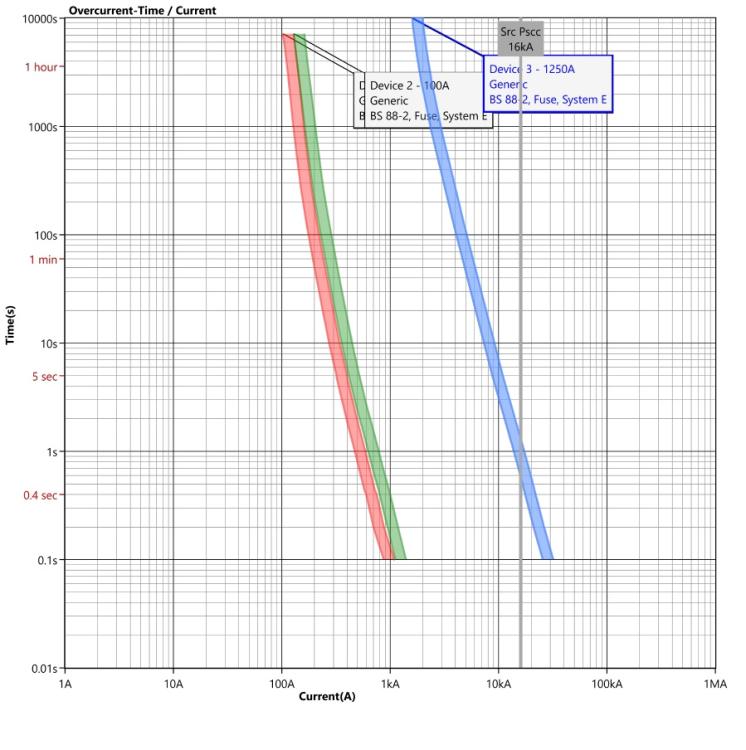
-
Do you get solvent weld ones? I don't like the idea of the compression union which I cannot really fully water test until its buried! Can you recommend a good waste? Anything McAlpine I assume? I am tempted to start ordering all the bits and putting them in the garage.



