


Gus Potter
-
Posts
2383 -
Joined
-
Last visited
-
Days Won
34
Everything posted by Gus Potter
-
Nick. As you know In used to be a contractor, went off to uni to reinvent myself as an SE at the age of 40, I got my bus pass this year. Now some of my mates say.. was it worth it financially?.. some said you'll never get through uni. In terms of pure money probably not. To get to uni I shut my business, flogged the house I had self built, dog died and wife departed.. I was lonely! I used to take home say 40 -50k a year 20 years ago. I got entry to Uni in second year as I had got an HND when I was a teenager. In the round I recon on the face of it my uni adventure cost me about £ 250k. However what uni did for me was to give me the tools to teach myself. I saw uni as a way to start a consultancy and fly a desk most of the time.. Deep down I knew that the years working on the tools were going to take a toll on my body.. need new hips in the future.. so now that £250k is not so bad and anyway it's an abstract concept as I would have still needed to work my arse off when instead I spent 4 years enjoying lectures and doing research. I used to employ about 6- 8 full time staff and then subbies.. lots of mouths to feed.. the stress can be hard at times.Now when I went to uni I thought once I get to learn about this SE malarky it will take me about another 5 years to build some kind of business that I can make a living from. It's actually taken me about 7 years where now I get lots of repeat business, have got a list of builders that I work with and get whacky jobs all over the UK.. the great fun part coming in. Now in that time I have landed for example a couple of Clients that are big business folk in and around Glasgow.. they have large industrial holdings, big retail business, own parcels of land and so on and they do self builds for themselves and importantly for family members. In summary they are quite happy to employ the likes of me and small builders to stick build some of their multi million pound houses! as they are in now rush and by not being in a rush they save a pile of cash.. and that is maybe why they are mutli millionairs! Bide your time Nick.. you work hard and funnily folk that work hard often get lucky! But one last word of warning.. work on 30 days payment, if in doubt proforma many genuine good customers will appreciate your good deal and pay on the nail. I have one Client at the moment that pays the same day! and in return I try to reciprocate in recognition. But Nick that is where you can make hay. You have the experience, the contacts. What I've noticed about you is that your range of knowledge is exceptional, play to your strenghts and play of a straight bat.
-
Do my simple sums make sense? A good self employed trades person costs taken on the UK average, if you do a deal say £250 - £300 a day. They need to run a van, replace their tools, maybe set aside to invest in their business, have some insurance and need holidays so they need to earn enough so they can take time off. As a basic rate tax payer you need to earn say 23% more so that equates to 1.23 * say average £275 a day * 1.2 = £330.00 to pay the trades person. Now just say you take twice as long to do the same quality of job, you'll make some mistakes.. cut timber wrong say at your own expense, so every day you work is a net gain of £165.00. But the more work you do the beter you will get at it and make less mistakes. Now if you put in one weekends work as a novice that is probaly worth having. Then you get the enjoyment of having done it yourself and that is hard to put a value on. If you scale that up to a self build you'll find that as per my previous post it equates to about a 15% saving.
-
Good comment John. Actually in Scotland we were at the forefront of bringing TF to the UK market. We are still at the forefront of insulation values I have to say. I work all over the UK but I'm just making a point that us Jocks know a bit about TF design! Main reason as always.. is money and that was backed up by us having some great family timber type merchants that got into TF design..they could be trusted to keep your money safe..up to a point.. no massive deposits up front in the early days. to cut a long story short. When I started in this business some 40 years ago as a builder (before I became an SE / Designer), I used to stick build the TF walls, maybe on site or in a farmer's shed and buy in roof trusses.. there was a saving and importantly there still is. The old rule of thumb and still applies it that if you split lots of things into small work packages then you'll build a house for about 15% less. @nod is a massively hard working and dedicated self builder and can achieve greater savings.. but let's say this is your first self build so expect a 15% saving. Now when I was a builder I obtained a Mitek licence to manufacture our own roof trusses. Here is what I learnt! There is very little money in manufacturing unless you are doing huge volume, the profits lie in what you can sell off the back of that. That might be say insulation.. or hidden things like inflating the fire stopping cost. What can you sell in terms of air tightness, the service you provide, smooth the way with say BC. The reality is that if you go to any TF outfit there is negligeable milage in it for them just selling you the timber nailed together.. it's the add ons where their profit lies. And once you add all that up it makes you ask why don't you just buy a new house off the shelf! But you'll still think you are a self builder. As an SE that knows a bit about insulated raft design. I'm sceptical as to whether some of these turn key TF packages actually offer best value.. In summary I would encourage folk to back to basics.. like real self builders.. expecting that you are going to make any significant saving by spliting a build into a few main work packages is like shopping at M & S.. it tastes good at the time but in the long run.. you be adding the oncost onto your mortgage. To make any reasonable comparison you need to look a simple stupid stick build cost and that will let you see if all the others are ripping you off or not! To be blunt thye all know how each other price.. but is the spread of prices actually reasonable. I can tell you that this is not always the case. I often work for Clients who build some high end houses, well insulated.. we find the right contractor and stick build it. Now here is a bit of a rub.. it's to do with the "art of the financial deal" and method of payment that can be more "flexible" than say dealing with MBC et al. @Nickfromwales catch my drift?
-
Pick a different tray. If you muck with the joist then to get an SE will set you back say £ 600.00 quid.. they will add a bit for your stupidity. If you don't pay for an SE and get caught.. you are in bother.. or you floor may fall down! Get a tray with the hole positioned to avoid the joist. Spend your saving on something you see and get enjoyment out of, towel rail, tiles, higher quality sanitary ware.
-
It is massively hard to get your head around this. I've been dabbling in UFH and stuff for 40 years and the learning curve is hard to keep up with. John makes a valid point about how much it costs (£75.00) to run a circulation pump. Now pumps give out heat. If they are inside the insulation envelope then it is fair game to count that heat in the calculation. To be pedantic.. say gas is 1/3 the price of electricity. Now your £75 quid is more like £50 quid nett, one problem is though.. you don't live in the boiler cupboard... I hope. @LnP earlier and on another thread put forward a proposal that certain publications were using flawed data to argue against climate change. Now what we are doing on BH is building our own houses and extending say. Over my adult life I've come to recognise that the political landscape changes a lot, at the moment with Reform UK this has the potential to be quite dramatic. Govenment policy could change a lot. No matter where you sit on the polical spectrum things won't stay the same as they are now. Research funds etc get directed to deliver certain outcomes. This landscape changes more frequently than the lifespan of the house and probably a mortgage. As a designer I would encourage Clients to think about energy policy and costs and recognise that they will change for good.. or bad and try and design for the long term. Design for durability, ease of part replacement and mitigate servicing cost. This is one key aspect that underpins sustainable and environmental design.
-
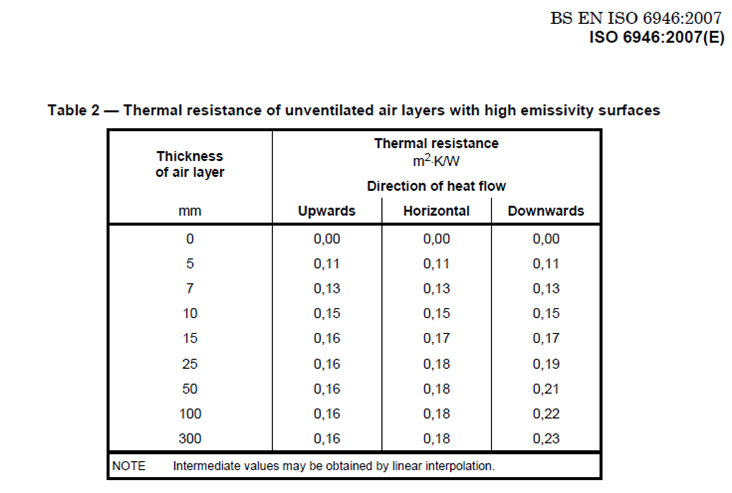
Quick pratical question. If you put your hot water cylinder in a modest cupboard with slatted shelves over the top to keep your linen dry and to get that "crispy warm towel effect" does it help prevent heat loss from the cylinder enough to make the excercise worthwhile? If you fancy a go at a fag packet heat loss calculation for a bit of fun! The cylinder and cupboard insulation coupled with the air gap effect in the cupboard changes the numbers as they work in series. Easier to do a fag packet calc as there is little cold bridging that you get with say repeating timbers in a stud wall. Yes I know you will get convection effects occurring in the cupboard, and so on, but to give you a flavour and to anticipate this question here is a copy of the table from BS.. 6946. The cylinder insulation, air gap, and enclosure all work in series. The question is how often do you open the cupboard, at what time and how many towels do you have? Seriously though. If you are tight for cylinder space then it's worth an ecclectic look. If you look at the table ( developed really for double glazing / secondary glazing) you can see that the horizontal resistance become constant once you exceed a gap of ~25mm. Or... if you are designer and have eh.. designed below the margin.. this might be a way of getting yourself out of trouble! When drowning you will grasp any straw!
-
A good "woodsperson.. woke" woodsman will always choose an axe head made from a steel that can be made reasonably sharp but also be durable. While they may not get the edge perfectly sharp and keen it will still out perfom a steel that can take a good edge but is not durable in the long run. There is little point in installing complex systems which on the face of it will work for a few years and then become difficult to service, suffer from a large drop off in performace or need replacement. Take a step back and use your common sense.
-
It would be a good idea to get an SE in to have a look at this. One thing that you need to look out for is when you muck about with the roof you can change the load paths on the floors below / any old beams and so on. This can become an issue. As a domestic Client you have a good bit of protection under the consumer protection act, the building regulations, CDM regulations and the HSE act 1974. Write to Oso and say that in the interests of fairness it would be appropriate to get a independent opinion. Say you are seriously concerned about the safety of the structure and give them 48 hours to respond. Point out that you have observed excessive deflections. Do this right away, don't delay! I agree with the other posters.. It does not look rosy as things stand and seeing the standard of workmanship gives me concern in terms of safety. You need to take the long view. At some point you will want to sell the house so best to get all your ducks in a row.
-
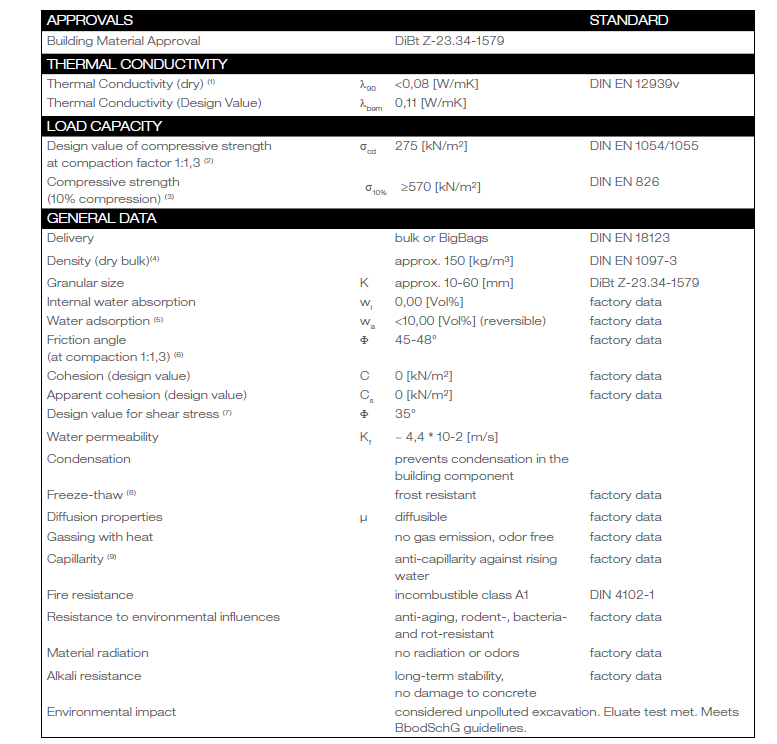
Hiya. If you click on the drawing that @Russdl has posted yesterday it takes you to his thread. There is a fair bit going on in the slab. Here is a bit of detail that works for a reasonable lightweight structure like this even with solid single story masonry walls above, which add a line load to the edge of the slab. Your pod will be pretty light but hopefully the below may give you some ideas as to how you can use Foamglass in other ways. If you are close to trees then you'll maybe have some swelling / shrinkage of the soil, thus you'll have some element of excavation to navigate around that. Rather than filling the excavation back up with say type one it sometimes works if you back fill with an insulating materail such as Geocell Foamglass. Below is a screen shot from a data sheet. On the odd ocasion if you have ground with a very poor bearing capacity you can make some headway by digging out the soil and replacing it with a lighter material. Just say the soil you dig out is 1800 kg/ m^3 and the Geocell Foamglass is 150 kg/m^3. Now stick a raft slab on top of that and you basically get some "free load". The excess load is then used in the settlement and bearing calculation.. you need to mindful of the water table for example as this can put a spanner in the works at times. On the drawing posted you'll notice that the slab is 150mm thick.. but it has an A252 mesh which has an 8.0mm bar size spaced at 200mm centres in both directions. It's not uncommon to use a thinner mesh, say A142, for a lightly loaded ground bearing floor slab, which has a 6.0mm thick bar. So why the A252? Using the thicker A252 mesh allows you to qualify the slab as a reinforced concrete slab. And now the mesh serves two purposes: 1/ It allows you to have less movement joints in the slab, within reason, depending on the slab size and it controls the drying shrinkage of the concrete more. 2/ The nuance is that if / when the wall loads induce too much bearing stress on the foamglass under the edge of the slab the A252 mesh starts to work by transferring some of the load back into the slab. This is a common technique used when we design raft founds for houses. You'll see that the mesh is bent down on site. This anchors the mesh which will be in tension. It's ok to bend this kind of low risk mesh on site provided you only bend it once (so as not to work harden the steel) and you must not have too tight a bend radius. In this case the bend radius is roughly twice the bar diameter. You can bend this mesh easily with a bit of steel 22 mm gas pipe offcut while applying some common sense. @mjc55 have fun exploring the pods design.
-
I think this is a great idea as it will give you a feel for the material. I've designed with foamglass before for an insulated raft slab. The foam glass is different to work with when you compact it. Basically you need to give it a bit of a "shoogle / shake about" and it needs careful surface preparation so as not to damage any DPM on top, all doable. It drains well. But roughly for it to work as intended the ground water needs to be below the foam glass or the water will just bypass the insulating effect. Now if you want to use it for your house then we need to know a lot about the ground water levels and what loads the superstructure are putting on say a raft slab for example. Foamglass can deliver a big advantage in that it is able to carry high compressive load with negligeable movement (settlement) and for a house seeking to achieve a good insulated slab this can be a card in your deck you can play, or at least look at as an SE and this can be the key for overall build cost. There are times when it can be a fabulous cost effective solution.. there is a time and place for it.. the stars need to align.
-
No I'm not! The building trade is not an exact science, ground conditions, setting out, making errors in detailing, fabrication and following the drawings. We are all human, mistakes happen. Mistakes happen.. it's a fact of life! It's often easier to navigate an implement a solution if you have local folk round about to help solve on site issues. Maybe you got very lucky and things went according to plan.
-
No, it needs to come out and be redone properly. Some reasons. I won't list them all. 1/ The lead is not pinned in. 2/ The chase in the masonry is not deep enough. 3/ The silicon is not appropriate. 4/ I doubt they have used panitation oil an all sides of the lead. One big thing is that the lower slope (pitch of the roof) looks too shallow for these roof tiles in the photo.. depends if you had the camera off level. This could cause you a very big problem further down the road. BC should not have passed this.. if they did. Hope you get it resolved.
-
Comparing Thermals of Laminate Flooring Underlays
Gus Potter replied to MortarThePoint's topic in Wood & Laminate Flooring
Hi Nick. Me being old school and all have this idea that UF pipes where buried in screed and inaccessible should be installed without joints. Make all your joints, ideally above the floor where you can get to them. If you are making joints during concreting it's sods law these will be the ones that fail as everyone is under pressure. I then think.. say twenty years down the road, various plumbers come and go but one lets some gunk get into the UF and that slowly makes its way along the loop until it catches on the spliced bit with the joint. Then you could end up chasing you tail diagnosing the problem. You might be able to blow it back with compressed air.. but that may over stress the splice joint. Just a thought! -
Comparing Thermals of Laminate Flooring Underlays
Gus Potter replied to MortarThePoint's topic in Wood & Laminate Flooring
And folks it's that little dent that can compromise the whole loop! -
Agree. From an SE view the roof will be restraining the old walls. Once you start to muck about you could break these established bonds and risk things starting to move. When working on old buildings we need to be careful that when we stengthen things we don't inadvertently cause harm.
-
@JamesSmith79 This is the great thing about BH when folk like you come up with ideas. It's not "crackpot".. it's just you asking a perfectly reasonable question. Ah.. but the building has probably settled a bit and the roof timbers are used to the loads.. you need to look at all the load paths and how they might change when you drop the timbers As a heads up.. it's an old roof, maybe the nails and fixings are corroded. You are going to change the load paths and change the stress pattern. While in principle your idea is good you need to look at the knock on effects. Your idea is elegant.. provide you can justify it is not overloading other parts.. call that unintended consequences. You mention "strong boys" For all on BH these tend to have a maximum working load rating of 350 kg or less.. which is not a lot! I can tell you as an SE that a lot of builders have no idea how llittle load these can carry! Always ask a builder if they know what they are doing when they mention strongboys!
-
Comparing Thermals of Laminate Flooring Underlays
Gus Potter replied to MortarThePoint's topic in Wood & Laminate Flooring
As I'm on a roll here is a question for @Nickfromwales as I want to tap into his boots on the ground experience. Nick. Ok say say we are setting out UF pipes. The manufacture gives us a minimum bend radius as we put in the loops. My own experience tells me that even with flexible pipes the centres are tight when we get to less than 175mm. The pipes start to oval if disturbed. I know that when we want to bend the pipe we smooth out the radius on site.. like driving a racing car.. we anticipate the bend. But for all.. you get a UF design, play about with loop cad and then the concrete workers turn up (100kg a man+ with big wellie boots).. they just might crimp a pipe? and then it all goes wrong. UFH pipes need to be designed for buildability and unless you do this then you are on a hiding to nothing. -
Comparing Thermals of Laminate Flooring Underlays
Gus Potter replied to MortarThePoint's topic in Wood & Laminate Flooring
Hiya. It's the unreconstructed philistine here in terms of UFH! So this may not help.. but a few comments. Maybe one way of looking at this is how the floor is going to be laid. Often I get asked to make houses open plan and maybe marry that in with an extension with a big glazed opening looking out into the garden. Imagine you have built a rear extension, you walk in from say the hall and look into this big space with glazing that lights it all up. Now if you lay the say laminate flooring perpendicular to the direction of view into the garden say it will do two things. 1/ Any bumps and undulations often show up due the dominant light direction, it cast shaddows. People are sensitive to changes in level when walking over longer distances and any shaddows alert them to these slight changes in level. If the flooring is laid perpendicular to your direction of travel it shaddows more. 2/ It makes the the room look smaller in perspective when looking outwards into say the garden. Summary: If you lay the flooring parallel to the main view direction it not only makes the room look bigger it also mitigates any bumps in your floor slab as folk walk into the room. Once they change direction say to sit on a sofa the mind is interested in getting seated / what food is on the table say and you are much less aware of any change in floor level as you may be having to navigate around a coffee table and thinking about where you are going to sit.. try it and see for your self. Now I've experimented with UFH over the years..I like to design my own systems from a practical and maintainable view point. My approach is.. let's see if I can make the UFH pipes last for say 50 years and make it cost effective to say maintain, even if folk want to connect fancy controls to the loops at least it give the next owner of the home a fighting chance to change the set up. On my current house I have a ground bearing concrete slab in the extension part of it with a good clay soil dumpling under the insulation which transitions to a suspended timber floor, it's one open plan space so lots of things are moving about. I also looked a tog values of underlay vs glueing the floor directly to the concrete. The dumpling size does influence the performance of UFH.. which is a story for another day.. but often ignored in standard calculations as it sits under the layer of insulation. At the end of the day I floated my parquet style oak flooring over a 2.0 mm thick poly underlay. I took the view that as the flooring is expensive I wanted to be able to fix it locally if it got damaged. Case in point.. a plant pot leaked and has stained the floor. If I get round to fixing it then the job should be easier as it floats rather than being glued down. Probably the main thing is that we have rugs on the floor and some big furniture that traps the heat. That said the furniture is always warm when you sit down. In the round I reckon that all this reduces the rate of heat emission by at least 20%. so this well outlays the tog value of the flooring and makes any detailed technical heat calculations and excercise in futility. But I know this as have done it before and it's partly a dark art coupled with basic engineering principle. @MortarThePoint that's my first go at responding to your post, do you fancy posting a floor plan so we can see the room size and so on? Can you tells us what your floor slab is sitting on.. clay or gravel and where the water table is and if you have a mobile water table? Or if not got the will to live on this.. just cart on and sleep well! @MortarThePoint "I'm nervous of something too thin as then it won't take out any small lumps and bumps in my screed which is pretty flat but does have the odd lump (max about 2mm high). Feels like 5mm would be a good option (thoughts?)." Maybe think about some of your friends houses that are old and look at their floors, take a bottle of wine, visit and walk about, get a feel for what 25mm of change in level feels like. Also remember that your SE might have designed your house to cope with 25mm of settlement over a 50 year period which is standard. It could be that you are over thinking this? As always all the best! -
@Great_scot_selfbuild Ok to add a bit. Let's look at this in terms of how the trees grow. I'll be simplistic but hopefuly this gives you insight. Trees need structural roots... stops then falling over. They also need water and nutrients... the Tertiary roots. Now imagine you are knocking in 70 screw piles and in doing so you will compact the ground! The structural roots of a tree go deep, the roots that capture the water and nutrients are close to the surface as they have to compete with the other vegitation. Your design is complex (as you have made it that way yourself!)and at the moment and I don't think your SE and you have understood all the implications.. you clearly don't understand how trees grow.. if you did then you and ergo your SE would not be posting on Build HUb!. My feeeling is that you are going to spend a pile of money and not actually achieve your design intent. Loom at concrete piers (these will often take care of the sideways wind load) say as a first go, not compact the ground, let the rain water moist the soil, under the building foot print|. On the face of it it's complex but once you get you head around the principles the solution is ofen remarkably simple.. I suspect that you have fallen into the trap of one foundation solution! Time to go back and review! I force myself as a designer to do this as it's part of my day job.. sometimes I find that I have followed the wrong path.. but this gives me time to correct and learn before I isued a design..
-
Good and interesting info. I'm not trying to poke holes in your design to be an arse.. but from what you have posted so far just it looks a bit bollocks and here is why..but let's start with the upside! I do like how your building sits in the trees, almost Canadian design.. love it! Often when I design I discuss with Clients some of my "whacky" options.. in design it's good to know what the rubbish ones are and the ones that could cost a lot... so you can rule them out. Good design is often about ruling out what you don't really want and then you focus on the things you do want.. and then this lets you focus in on the viable options... prevents you later thinking "we should have done that! after the fact. Your screw piles are a classic case in point.. I think you have not done enough work and plumped for screw piles! I think you might be making an expensive mistake! You don't need to take my advice but to be safe consider it and rule it out.. then you know you are making good decisions. You will kick yourself if you get it wrong and I turn out ot be right! It's not my money after all.. From time top time I act as a lead Engineer on a project.. it my job to make sure everything is safe (in the round but not checking everything roughly). but also that we control cost where I can, call that a soft skill! Now some Cients just want to "do their own thing" Is this you? @Great_scot_selfbuildand are you happy to pay for the privilege. I'll run with that as an SE provided it is a safe design. But this often commands a higher design fee... and the construction cost will go up exponentially! I suspect you have gone down one route and are blinkered! Take a step back and review! My gut feeling is that the design you describe is going to cost you a fortune once you get down to the detail. and getting folk to execute on site. Ok you might be in Scotland? and feel reassured the you have an SER Engineer.. not always my experience when checking their designs! Check the fine print is my advice! Look to see how they shed design and cost liability! OK to be be blunt.. being smart does not always increase the value of you property. In fact it can reduce the value! I think you are trying to be too smart! My gut feeling is that this will trip you up futher down the road and you will get totally pelted when the Contractors submit their prices! You will be lucky to find any good contractor who wants to take on your job! Look ahead and smell the coffee! Ok so you have posted a table of SPT results. When we are at the concept stage we say if in sand take the SPT"N" number and divide by 10! take the top left of the table and divide the number by ten.. look at the rest of the table.. it follows the same pattern! makes you wonder what you have paid for! What is not included is any mention of how the ground may perform when laterally loaded for wind bracing! Ok if that floats your boat and you have the money to indulge then fine. Feel free to spend! But I suspect your SE is playing along and giving you qualified advice. It may be because they percieve you to be an obstinate Client and not taking advice and not willing to pay for it! But further down the road you will need to put your hand and in your pocket for the pile wind bracing.. who signs that off.. who welds it.. @Great_scot_selfbuild you are heading for a hiding here! Give your SE a call and discuss some of my points. Ok but have they shown any connection, welding /bolting details.. Also Screw piles perform less well under lateral wind load as thy have a thin shank.. This is something I would check. It smells like lots of cost and frankly bollocks at my end! @Great_scot_selfbuildIn summary I think you need to go back and review your design and start asking your SE some questions! It all look decidedly expensive to me and loaded with risk (your risk) once you get into the detailed design! If you asked me to review this design I would want to look at the ground, the ground water, see where the tree roots are to provide the structural tree stability and where the finer roots go to get the nutirients. I can see the idea where you want a house in the woods.. that is your starting point. I think you need to understand this in more detail. your 70 piles with the bracing is going to be massively expensive and you'll struggle to find a builder who will do what you want... I would seek to understand the trees, the soil even if we need a heavier steel ring beam on piers the we need to look at piers / vs root damage etc. In summary my suggestion is pay someone 3.0 to 4.0k that can design this foundation for you properly so it performs structurally and protects the trees. If you pay that amount then the design will probably reduce the overall cost and in the round.
-
Hiya. There is not much for us enthusiasts to go on here.. I'm guessing as you have not told us much about the ground and so on. I've had a read through the thread and here are some of the things I am interested in. Screw piles.. ok but if you have an element of sand coupled with a high water table that could significantly reduce the performance. Now if you have investigated the ground, say carried out some cone penetration tests then with a refusal at say 2.5m you might have some competent ground. Why have you ruled out sitting your ring beam on concrete piers for example? These could often stop at ground level and then continue in steel if need be. Ok but you'll have wind (horizontal load) on the screw piles. How do you deal with that force? Screw piles are not that great when subject to horizontal loading. I wonder how your SE is dealing with this. Lastly always think about buildability, the labour / material cost and how many Contractors may want to put in a price. Unless you are going to do it all yourself then this can often be critical to the budget. It's a hard fact that while you may be an Engineer and want to go down one path you may have to pay more for the privilage.
-
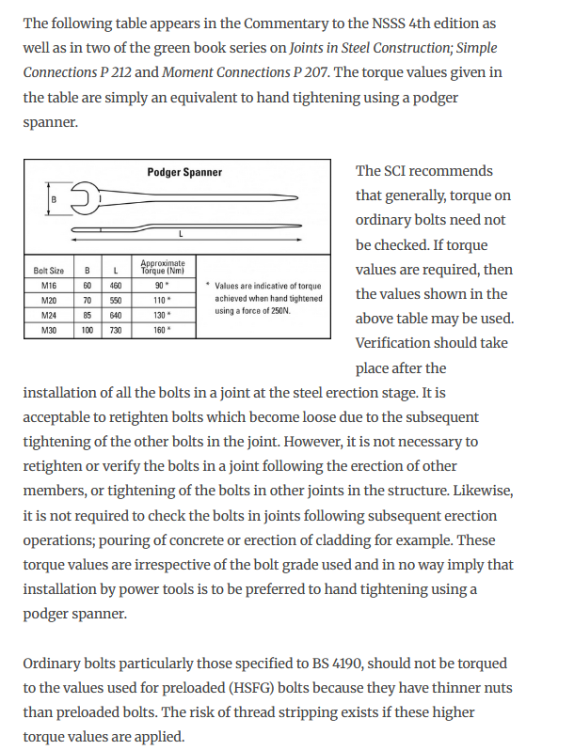
Hope this helps. If you are using ordinary bolts then here is a bit of info below: But if using resin anchors you'll often find the torque setting in the manufacturer's data, don't exceed these! The main thing is to apply common sense. Don't let the bolts get dirty or lose the manufacturer's oiled coating or store them badly for example, don't add oil either! Now in the table above we can see a typical torque for an ordinary bolt with a spanner 460mm long. For an M16 bolt we are looking at approximately 90 Nm. What does that mean on site? Ok roughly 100 Newtons is about 10 kg. If the spanner was 1.0metre long then we would need to apply 9 kg to the end of the spanner to generate 90 Nm on the head of the 16mm diameter bolt. But say your spanner is 460mm long (0.46 m) or 18 inches roughly. The sum is 10kg / 0.46 = 22 kg applied right to the very end of the spanner. So very roughly imagine you lift a 25 kg bag of cement with one hand... get a feel for that and then try and apply the same force when bolting up. For bolt groups you'll know that we tighten them in sequence, gently going round an tightening them in stages. All the best with the project and post some photos if you feel able.
-
Take this on board. Ensure your research is sound.
-
Good but it willl be a bit different as you have learnt a lot of stuff. It will come back to you as you go. I'm a big fan of stick building. The financialrisk is reduced, getting mucked about by TF folk, it is a flexible way to do it as often you can change your mind as you go. And this the great thing about this way of building, the flexibility and the ease of costing, it's just timber and almost a day rate for joiners to knock it up. The game has changed a lot. While you may be able to do the drawings someone will have to keep you right and that will cost more than a professional doing the drawings right first time. The biggy is finding someone who you can; work with, is flexible, do your panel drawings, your foundation design etc and do the SE stuff and works in Scotland. This is how I make my living. I'm nippping off on holiday but PM me if you fancy a blether.
-
Architecturally..but can you explain how that is going to work structurally when the SE has to then fix the stuff that you should know about! You can go chucking in DPC's, rocker bearings, thermal breaks at will! If you want to profess about changing stuff them maybe go onto explian how it impacts on the structure. Yes, I know life has got harder for Architects and the thermal regs but the same applies to SE's.. strart collaborating and learning.


