


JohnMo
-
Posts
13292 -
Joined
-
Last visited
-
Days Won
200
Everything posted by JohnMo
-

Is the party over (pt2) - End of high fixed price export tariffs?
JohnMo replied to -rick-'s topic in Photovoltaics (PV)
Why, they give you 15p, then immediately charge your next door neighbour nearly double that. Pretty good money making scheme. -
But that isn't fully correct, because it doesn't take into account the gas standing charge, which goes when you remove the gas meter. So if your house consumed 6000kWh of gas per year your pay £377 for the gas plus £125 standing charge. So your 6000kWh cost you 8.35p per kWh, based on standard prices. Electric is 26.35p per kWh. So real spark gap is 3.2, not 4.2. And the above doesn't account for the approximate 80-85% efficiency of nearly all gas boiler installs. So piss poor reporting by Nesta
-
Looks like the party is over....
JohnMo replied to Beelbeebub's topic in Air Source Heat Pumps (ASHP)
Not to any scale, drilling to tie back just keep existing facilities ticking over for longer. There is loads of oil out there and routing pipe back to existing back to an existing facility may not be easy or cost effective. It's playing at it -
Looks like the party is over....
JohnMo replied to Beelbeebub's topic in Air Source Heat Pumps (ASHP)
But "In the Autumn Budget, it was revealed that the current iteration of the scheme, ECO4, would end on 31 March 2026" So you have 4 months for Eco4, but the BUS grants stay in place for now. So don't seem to be affected. -
Looks like the party is over....
JohnMo replied to Beelbeebub's topic in Air Source Heat Pumps (ASHP)
Early bird, procrastination etc... -
There is a single pipe, between wall units and island not on drawing but on photo, floor temp is low - you don't notice it unless really cold outside, talking -9 for a day or 2. Then you only notice it, but only with feet at the kickboards. We have 100mm concrete screed, so the temperature spread is pretty wide away from the pipes. Very unlikely the rooms will get moved about as whole is there for the views, which disappear with the bed on a different wall or dining are at the other side of the room. I found it ok. You basically build the house in the software, so you need U values, window sizes etc. Its good for balancing floor outputs, I got mine to within a few Watts for each room, so system balance is good out the box. I found later wife had very different ideas to floor covering for bedrooms than me, as a result bedroom output is a little low than planned, but works ok. Nice wool carpet insulation.
-
I would work through 1 room in detail and check his calculations. A lot of plumbers will stick a finger in the air and use a rule of thumb, you definitely do not want that. Not sure what units he is using but seems to be BTUs, if so I suspect a rule of thumb is used..
-
Cheap sturdy vacuum cleaner for DIY cleanup
JohnMo replied to Gill's topic in General Self Build & DIY Discussion
I used a Henry attached to a concrete floor grinder, many bags later still going strong. Several years later still no issue. Get one with HEPA filter so no dust makes it's way to the motor. Several years ago used a Dyson to hoover up some plaster dust, 10 mins later it went bang. Not covered by warranty as it was being used for a DIY task! -
How can I salvage this flooring (should I?!)
JohnMo replied to Flora's topic in Wood & Laminate Flooring
I have renovated a couple of houses dating back to a similar period of yours. I have done a DIY floor renovation and got the professionals in. If you want good wooden floors get a professional in, he will get the job done, make a good job of it, but seek recommendations or view his work elsewhere. If you are going to carpet And if the ground floor is a suspended floor, be careful just having a wooden floor as you may just get a lot of cold drafts coming from all the gaps in the floor boards. So good high tog underlay and carpet will save on your bills for heating. -
Yes No it may not reduce it, gas boiler efficiency may increase, but downwards heat losses may wipe those gains out, plus a little more. I would find a local heat geek engineer or someone used to low temperature heating systems and get him to quote for installing or designing an efficient system, based on the boiler you have.
-
Sorry a miss type, should have been loop flow rate. Text should have read - see bold correction "If all room are not warm enough trim flow temperature up. If you get to temp really quickly and it overshoots trim temps down a little at a time. If the odd room is too warm decrease flow rate of loops in that room - opposite in cool rooms." Explanation of what is happening. A floor heat output is governed by the means flow temperature, so the difference between flow and return temperature. Adjusting a loop flow alters the differential temperature (dT). Reducing the flow increases dT, example. Start point dT 5, flow 35 return 30, mean flow temp is 32.5 degs Flow reduced, dT increases to 6. Flow is still 35, but return temp is now 29. Mean temp is now 32. So floor out is reduced and room temp comes down
-
Fixing ASHP Anti Vibration Feet
JohnMo replied to BadgerBadger's topic in Air Source Heat Pumps (ASHP)
Mine just sat on the feet, but on gravel, we have 70+mph wind nothing moved. -
Simple science is Heat moves to cold, the room is say 20 and the heating pipes 35. There is a 15 temperature difference. The only insulation will be the flour covering and any air gaps if you don't screed. Downwards the pipes are still 35, the ventilation gap will be atmospheric temp plus any warming gained from above, so say a cold design day close to zero. So now you have temperature difference of 35, resistance to heat flow is provided by about 25mm of insulation. You can easily calculate out the downward losses. Now if you consider radiators the room is 20, your underfloor ventilation gap is still zero. Your radiator downward heat loss is 20, a reduction of more than 30%. If you added 25mm of insulation to the floor and had radiators your calculation would be the same but the heat losses 30+% lower. Picking up the points made by @ProDave, low and slow is the way for UFH, but low temperature radiators will work in a similar manner, but take up wall space.
-
Condensing boiler.
-
I would heat trace the pipe that freezes. And insulate it will. Kits are available - this is the first I came across, look for similar and compare https://www.frostprotection.co.uk/pre-made-frost-protection-kits
-
Somethings to think about UFH will need a well insulated floor to perform well and at reasonable flow temps with a suspended floor, all doable but not a small amount of work. A simple overlay system will work also, but downwards heat losses could be pretty large, so may not be a cheap to run solution. Boiler efficiency - this comes from boiler return temperature below 54 degs. This promotes condensation of the flue gases which increases boiler efficiency. About condensation point boiler efficiency be mid 80, get a good low low temperature your efficiency jumps to mid 90s and higher. I would do a room by room heat loss, stick with radiators, design radiators to run as low a temp as practical. Install a boiler that either runs opentherm or weather compensation. Size boiler to house heat loss, not a big one because it's a big house. Look at boiler modulation and the minimum output, the lower the min output the better. Select a boiler that does priority domestic hot water, this will then flow one temp for cylinder heating and another for central heating. Install with a heat pump cylinder, this has a massive coil, gives boiler most efficient operation and fast reheats. Have one thermostat (ideally just the boiler controller), or just one battery powered opentherm one so you can move to best position. If running opentherm the boiler will be modulated based on measured temperature at the thermostat, weather compensation adjusts flow temperature based on outside temp, but a good boiler can do both at the same from the controller. On radiators use a flow setter instead of TRV and set flow rate based on heat loss calculation, something like these https://www.firepowerheating.co.uk/frv
-
For others reading this. If your system boiler has opentherm. The EPH unit referenced to by @SimonD (up thread) will make your system boiler supply different flow temps via opentherm, so your system becomes priority domestic hot water when using 2x 2 port valves.
-
You need ventilation in all wetrooms to comply with building regs, a WC is a wetroom, so needs a fan. Specify wetroom windows without trickle vents. This follows the rules when you have continuous mechanical ventilation. Link: https://www.labc.co.uk/news/replacement-windows-and-trickle-vents 2) If the dwelling has continuous mechanical extract ventilation, installing trickle vents in any replacement windows which are not in wet rooms, with a minimum equivalent area of 4000mm2 in each habitable room
-
I would Delete all dedicated hall loops, spread all pipes transitioning through halls out across floor. Come down to one manifold only. Do 200mm centres generally, but keep bathrooms at 150mm or below. Maybe even 250mm in bedrooms, but just do a single loop in each bedroom. If you locate the manifold in utility, you wouldn't need a loop in there either, just spread pipes across the floor. This is our floor, loose 300mm centres. Kitchen is generally 0.5 Deg cooler than lounge, bedrooms are a degree to 1.5 cooler than rest of house with doors closed. Open doors and the rooms even out over a hour or so.
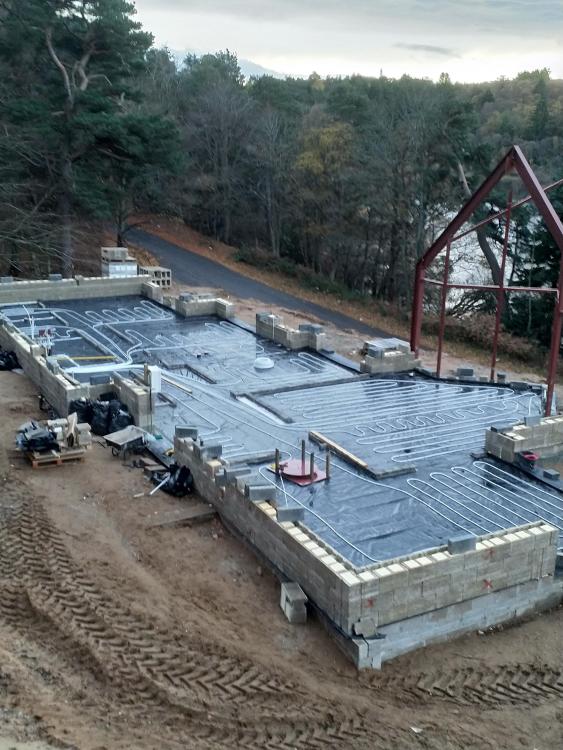

-
If you read the manufacturers instructions, they will mist likely tell you to add a condensate drain at any low points. If not I pretty sure building regs will. A 5 second search https://www.google.com/search?q=150mm+condensation+trap&oq=150mm+condensate&gs_lcrp=EgZjaHJvbWUqCggBEAAYChgWGB4yBggAEEUYOTIKCAEQABgKGBYYHjINCAIQABiGAxiABBiKBTINCAMQABiGAxiABBiKBTINCAQQABiGAxiABBiKBTIKCAUQABiiBBiJBTIKCAYQABiABBiiBDIKCAcQABiABBiiBDIKCAgQABiABBiiBDIHCAkQABjvBTIHCAoQIRiPAjIHCAsQIRiPAtIBCTExNjk4ajBqN6gCD7ACAfEF5ygzgMLm-90&client=ms-android-oneplus-terr2-rso3&sourceid=chrome-mobile&ie=UTF-8
-
ASHP with large thermal store (for load shifting)
JohnMo replied to apesort's topic in Air Source Heat Pumps (ASHP)
I would skip the thermal store, if you need 45 degs, heating the TS to 60 degs would hold 35kWh, so a small dent in your 110kWh. Also be a rubbish CoP doing 60 Deg and the ASHP may be defrost hell when you most it. An unvented cylinder for DHW, and an open system for heating running WC. Put a 3 port diverter between heating and cylinder so they run different temperatures. -
We have a 4G one up and running and it looks like this. VID20251124192811.mp4 If they haven't fully commissioned call you supplier, to get them back. There is nothing can do on your end by yourself.
-
Dumb Ubbink questions
JohnMo replied to Alan Ambrose's topic in Mechanical Ventilation with Heat Recovery (MVHR)
I used Epicair for my Ubbink stuff. Pretty good delivery and prices, just about the only company that had stock of anything during COVID, so used them after as well. -
Dumb Ubbink questions
JohnMo replied to Alan Ambrose's topic in Mechanical Ventilation with Heat Recovery (MVHR)
I think it's designed to fit the other way round, so a floor rather than a ceiling and then just gets screeded in place. -
Solar cable runs from roof space to plant room on ground floor.
JohnMo replied to jimseng's topic in Photovoltaics (PV)
I found this out a year after I installed mine. PV ultra cable is what you need now




