


JohnMo
-
Posts
13293 -
Joined
-
Last visited
-
Days Won
200
Everything posted by JohnMo
-
 Some general basics about how heat pump performance is affected. High flow temps, require the heat pump to work harder and results in a reduced coefficient of performance (CoP). This means you use more electricity for each kWh of heat delivered. The use of weather compensation (WC) maximises CoP as you will flow the lowest temperature you can at all times, if set correctly. You say you have a thermostat in the living room is this actually doing anything if so the WC course set too high. To test reduce the hot end (cold outside - hot flow temperature) of the WC curve 2 degs. Does your house still feel ok? Do this once every 24 hrs until the house feels a little too cool, then add on 1 Deg to the WC.
 -
I would do this https://shop.tado.com/en-gb/products/wireless-smart-thermostat-x-starter-kit-incl-programmer-with-hot-water-control-and-opentherm All the existing would go in the bin. The wire will need to be checked where it's actually connected. Tado do a boiler specific instructions.
-
What boiler do you have and does it do opentherm?
-
Yep been there, but everyone learn - every day's a school day
-
That's another thread don't let this go off on a tangent you will never see an answer
-
DHW is domestic hot water, so your hot water cylinder used for water that comes out of the hot tap. CH is central heating so radiators and/or UFH (under floor heating - heating with pipes buried in your floor). Hope this helps. So a couple of things for you to do Check your actual heat pump consumption and then you have the house consumption (octopus) and you heat pump consumption (Panasonic controller) and you can really see what your heat pump is doing. A video here to show you how to get the figures for the heat pump Next do you have a buffer, this is likely to be a smaller cylinder about a quarter to half the size of the main hot water cylinder. Next take some photos of your install both outside and inside, showing pipes and all the main items if the install.
-
No. Weeds are wind blown ones that setting the cracks and grow there. A membrane would do nothing to stop this.
-
Who has experience with graphene infrared underfloor heating?
JohnMo replied to JKami84's topic in Underfloor Heating
The reason for cold floors in houses without UFH, is generally down to on/off heating. So what happens, the radiators are run really hot, and people run short time schedules for heating. What happens is the rooms become cold, the heating comes on the radiators get to a high temp really quickly. This gives a strong thermal current and pushes cold air down from the ceiling to your feet. This process continues until your thermostat or TRV says I am hot enough. The room cools and the process repeats. The short the heating period the pronounced the effect. A better way is to run everything longer and cooler and let the house heat soak, then everything becomes more relaxed the thermal currents are more relaxed, the floor takes a more room temperature so longer feels freezing under foot. Plus side of this approach a cooler house actually feels just as warm, but way more comfortable in general. And shouldn't use any more gas. -
Think the trouble is MVHR on 24/7 Treatment plant compressor on 24/7 All water by well so UV steriliser on 24/7, plus intermittent lift pump use The lowest steady state electric load is about 330W. So that's about 8kWh before we do anything else.
-
Glad I'm not the only one
-
Not sure why you think the electric consumption is high. Assume you are all electric etc. Our house seems to use about 20kWh without the heat pump.
-
Think the takeaway is expensive heating bill even if you get a scop of 5+
-
Asked Chat GPT and this is the answer it gave If heating UFH with no insulation below the pipes what is the thermal gradient downwards and how far will the heat travel - assume 10 degs ground temperature ChatGPT said: Thought for 25s Short answer up front — without insulation under the pipes most of the heat goes into the ground rather than up into the room. On a daily timescale the warming is confined to the top ~0.1–0.2 m of soil (significant effect to ~0.5–0.8 m). On a seasonal/yearly timescale the heat can travel metres (seasonal penetration ~2–3 m; detectable effect even deeper over many months). That’s why insulating under UFH is usually recommended. Below I show how those numbers were obtained and give some typical heat-flux examples so you can see the magnitude of the loss. Assumptions used Ground (deep) temperature = 10 °C (you stated). Typical soil thermal diffusivity α ≈ 0.6–1.0×10⁻⁶ m²/s (reasonable range for loam/compact soil). Thermal conductivity k ≈ 1.0–1.8 W/(m·K) (typical for topsoil, consolidated fill, etc.). Typical UFH floor/near-pipe surface temperatures used for examples: 25 °C and 30 °C. Rough 1-D conduction / semi-infinite solutions and simple resistance approximations — these give engineering-useful intuitive answers. If you want different soil properties or a different floor temperature, I can re-run the numbers. How far heat penetrates — theory and numbers Penetration depth for periodic temperature changes For sinusoidal/periodic surface temperature variations (useful to understand daily or seasonal cycling) the thermal penetration depth δ=2αω\delta=\sqrt{\frac{2\alpha}{\omega}}δ=ω2α where ω is the angular frequency of the cycle. Using α = 0.6–1.0×10⁻⁶ m²/s: Daily cycle (24 h): δ ≈ 0.13–0.17 m. The amplitude of day/night temperature swings falls to ≈1% at about 4.6·δ ≈ 0.6–0.8 m. Yearly/seasonal cycle (365 d): δ ≈ 2.45–3.17 m. The seasonal amplitude falls to ≈1% at ≈ 11–15 m. Interpretation: if the floor is being heated on a daily schedule, the thermal effect is mostly in the top ~0.1–0.2 m and small by ~0.6–0.8 m depth. If you run heating continuously for months, the seasonal/long-term warming can penetrate metres into the ground. Steady / long-term heating If you sustain a higher temperature at the floor for many days/weeks, the warmed layer will progressively deepen (transient conduction — see error-function solutions). Over weeks–months it moves from the decimetre scale towards metre scales (matching the seasonal values above as time grows). Example conductive heat-flux numbers (simple resistance estimate) A quick way to see losses is to assume a temperature drop from floor surface to some soil depth L and compute q ≈ k·(T_floor − T_ground)/L. This is crude but shows order of magnitude. Examples (k, Ts = floor temp, L = effective depth): k=1.5 W/m·K, Ts=25 °C, Tg=10 °C: L = 0.2 m → q ≈ 45 W/m² L = 0.5 m → q ≈ 22.5 W/m² L = 1.0 m → q ≈ 11.25 W/m² Range across k=1.0–1.8 and Ts=25–30 °C gives roughly 15–180 W/m² for thin to very thin effective layers (see table below). Even the mid-range numbers (20–60 W/m²) are substantial compared with typical UFH design heat fluxes (~30–80 W/m² in rooms). (So: if the heat instead goes downwards because there’s no insulation, you can easily lose tens of watts per square metre into the ground.) Lateral spread Heat diffusion is 3-D, so lateral spread from a line or strip of pipe is similar in scale to the vertical penetration for the same time scale. In other words, on the daily scale the warmed zone sideways is of the order 0.1–0.5 m; over seasons it spreads metres laterally. This is why uninsulated slabs or ground-mounted UFH can create a warm “footprint” in the soil that extends beyond the pipes if running long enough. Practical conclusions / recommendations Short term (daily heating): most heat stays within the top ~10–20 cm of soil; significant losses to the ground are still likely unless you have under-slab insulation. Long term (continuous/seasonal heating): heat penetrates metres — you will steadily heat the ground if you run continuously without insulation. That is wasted heat from an energy-cost perspective. If your goal is to send heat into the rooms efficiently: put a continuous insulation layer under the pipes (typical UFH practice) — it dramatically reduces downward loss and reduces the heat you must supply. If you want, I can: run the same numbers with your exact pipe/floor temperature, slab thickness, and a chosen soil k/α; or estimate expected W/m² losses for a given floor construction so you can size the ASHP/controls accordingly. Would you like me to calculate a tailored example with your floor temperature, slab thickness, or specific soil properties?
-
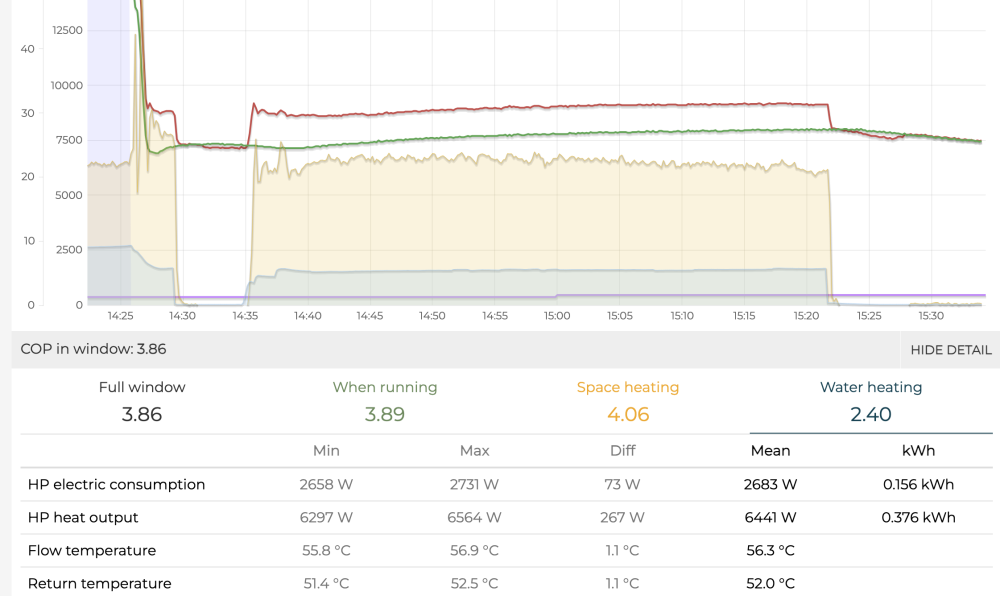
At 15 to 16 your floor is certainly not giving heat off, so no surprise you dT is zero. So you are getting heat added to the system as you have gone from 15 to 25 degs flow temp. But it could be your boiler has so little to do it just puts a blast of heat in to get the general water temp to 25. To demonstrate what I mean, this is my heat pump, when running its flowing about 30 degs, and has a dT of about 4-5. However when the heat pump or boiler is not actively heating, there is being little or no work done or energy added to the system, so the flow return temps dT drops to zero. This could be what you are seeing, so the yellow section is the kW being added to system, the red and green the flow and return. See how they converge once the heat pump stops adding heat. At time of screen shot the water temp had decreased to mid 20s. The heat is still being added to house as floor is warmer that the air. How is your boiler connected to the heating system? And how are you mixing the flow from boiler to UFH? With carpets you may need to go a little hotter yet to get any meaningful heat from the floor.
-
Not easy on a retrofit - or is but expensive and would you save that money in heating costs - most likely not
-
The running regime a little different to most expect, on at start of heating season and off at end - do not stop , no setback etc. stopping system means you need to rebuffer the ground and wastes a bucket load of energy. The heat will only travel a given distance underground based on distance and flow temperature and that becomes a heat buffer for the house. Past that travel distance the ground doesn't absorb any more heat as the temperature is at equilibrium. You need close spacing on the UFH loops so you can run the lowest possible temperature. It allows a low flow temperature as long as the rest of the house insulated. So with a heat pump you can get a good SCoP. Adding a little insulation in this situation cause more losses, as once the energies below the insulation it cannot come back up and is consistently lost.
-
For me you need low and slow heating, switching heat on and off really doesn't save money, the boiler just has to run balls out to catch-up and never really heats the building fabric. Run low and slow allows the building fabric to soak up heat and you can generally run the house quite a bit cooler for the same or better comfort. Not sure what boiler you have but with radiators your smart move would be an opentherm thermostat this will tell your boiler to modulate to get best efficiency out the system. My plan would start by running the boiler flow temperature as low as you can while keeping the house temperature stable, and taking most of the schedules off. Not the answer to your expecting I assume. But on/off boilers controls came from the 60s and that's where they really belong.
-
If you add the same make of inverter and they can operate as master and slave, so the master inverter has all control you should retain G98 certification. But this will be dependent on makes and models etc. The master is what allow stuff to to flow to the grid, slave just does as it's told.
-
Are you on the correct tariff would be my first question. If you have a battery maybe, without suspect not. Do you have a timer for DHW or is that for CH as well?
-
As you have thermostats and a buffer For now just go a fixed flow temp to see what temp you need to get FF output correct, start at 35. If your downstairs thermostat(s) switch of the HP, set all but one to the temp you want, leave one calling for heat (maybe turn down the flow to that loop).
-
What temperature were you flowing at and how long did you run the system? The divide by 40 is just a simplified version of the mass flow calculation. What do you mean by "got was the same flow and return temp on the manifold" were both the flow and return exactly the same going in and coming out i.e. 25 in and 25 out?
-
At those spacing and if well insulated 25 to 28 will be all you need to flow at. So do have mixer and pump as you are running an oil boiler? Not sure what you mean? 80m loop divided by 40 is 2L/min. You set the flow meter for that loop at 2 etc. Start with the loops at the calculated flow rate. If all open loop you then have to tune the system. If rooms are to warm decrease the loop flow rate, if to cool increase flow rate.
-
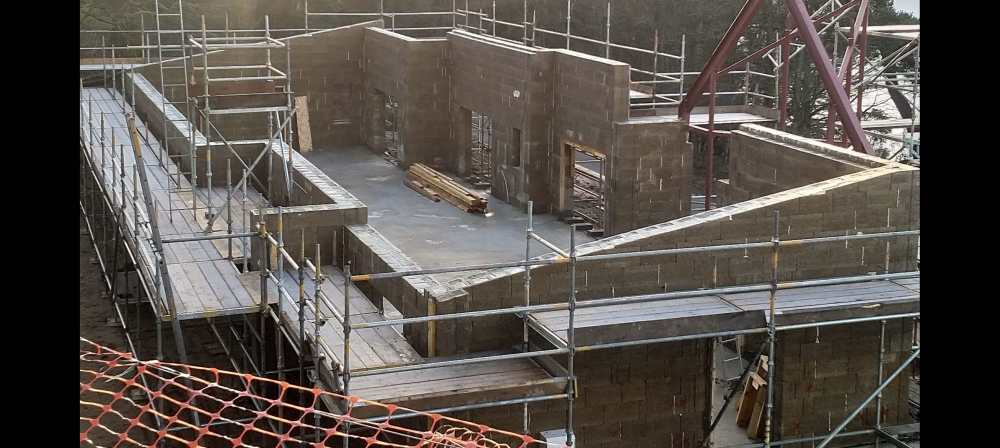
This took 4 weeks, two of us never done it before (working 8 hrs days in Dec in NE Scotland), 70m perimeter, up to 3.5m high at front. Then there was a break over Christmas and new year and roof materials arrived 12th Jan First week of Feb roof on. If you exclude the Christmas break, 9 weeks, not sure where the savings of 3 months come from.
-
No idea, no idea if the house size etc and how many people live there. MVHR you really need an airtightness of around 3 or your wasting money. Worse than that I would only do dMEV or MEV based humidity control. After moving away from intermittent fans, that are noisy and perform rubbish, wouldn't go back to them. A well thought out MEV or dMEV will yield lowest lowest ventilation heat loss and best control of humidity, with almost no running costs. So humidity controlled inlets in dry rooms, humidity driven fan from a MEV or dMEV system, all doors under to allow ventilation cross flow with doors closed.
-
I would Self install the PV Pay octopus to do self installation export, which is £250. Then not worry if you are using or exporting. You need an electrical.install certificate, as well as G98 etc, you may need a structural certificate depending how you mount the panels. Keep it all simple.



