
JohnMo
-
Posts
12465 -
Joined
-
Last visited
-
Days Won
179
Everything posted by JohnMo
-
Most of that can be deleted with a simple cascade MVHR system, you will still extract points in wet rooms, but not in dry rooms. But a well thought out dMEV system can be nearly as good, no noisy fans that come every time you switch on light. Add some humidity activated trickle vents, you have a system that looks looks after itself, while minimising ventilation losses etc. Sounds like an invite to black mould and unhealthy living to me. Airtightness is great, but you you still need controlled ventilation
-
Or don't bother with the grant a do what ever you want. Was looking at Hisense ASHPs the other day, great modulation, Hitachi compressor and other parts £2k.
-
I used a filling flushing point and pumped it in with a hand pump. But no longer use glycol, just inhibited water. Glycol is rubbish and generally not needed.
-
 Have you tried power off and on again?
 -
Agreed the first priority, but if you have great views and have maximised glazing (it happens - me for example) solar gain can still be an issue, especially on a no wind day. So active cooling is great over and above that. First what complex controls - some do this but they are not needed. My heat pump for example runs as a single zone fully open system, all UFH in the house and a fan coil in an insulated summer house. Effectively one valve in the system a diverter to cylinder or heating system. During winter it runs pure weather compensation all driven by ASHP controller with no external controls. Only thing to go wrong are the heat pump or diverter valve. In summer exactly the same almost, but now it runs in Weather Compensation mode but at a fixed temperature, no more controls in the system. Heat pump just senses return water and reacts when it sees return water getting above a preset temperature. It works well, it's not Aircon, but let's the house recover from solar gains quickly and more importantly limits the ultimate temp the house reaches, so it remains comfortable. Only control in the system outside of the heat pump, is to switch from cool to heat, I used a light switch to give heat pump volt free contacts an open or closed signal. Pipe life. During heating the pipes may see 36 degrees water and during cooling the target flow temp is 14, during a compressor cycle this temp can dip to nearer 12 degs. So neither temperature is going to shorten the expected life span of the pipes or valve. Similar the pipes out of the floor, a mix of copper and Hep2O are all in the normal and expected range of operation and a mile away from the max and min allowed. Do not expect any issues there either. The system as configured with no zone valves on the manifold or in the system, which makes it more reliable than a normal system, as there are no pins to stick on the manifold from valves being in a closed position over the summer. Or pumps or mixer valves locked for the same reason - as I don't have any of those either. So for clarity system is ASHP Diverter valve controlled by ASHP DHW Cylinder UFH manifold UFH pipes Fan coil teed into main system flow and return. A 50L volumiser on the return piping to extend cycle time of compressor. A zero volt switch to select heat or cool.
-
Having air traps at all high points, then you have no stubborn air traps. UFH loops blast them with tap water one by one.
-
No. The house needs to be heated by the a heat pump, you can have radiators or UFH or fan coils. You can also over specify the ground floor heating as long as you/installer can demonstrate it provides enough heat to also heat the upper storey. This is a bit installer specific. No sure the grant allow you take any credit for A2A just A2W heat pumps. I would have UFH in bedrooms. Why not, UFH downstairs, fan coils upstairs (over size slightly). Then dump the Aircon altogether. Then run heat pump in cooling mode in the summer to UFH and fan coils. In winter run all in heat mode. Cool energy do some nice looking fan coils even ones for the bathroom.
-
Cv is volume of water (in U.S. gallons per minute) that can pass through a fully open valve with a pressure drop of 1 psi across it. So 9.5 gallons per minute. 2000 L/h is 33 L/min. 3.785L to the US gallon. So 9.5 x 3.785 is 36L/min. So at full flow rate you are getting about 1psi pressure drop, or just under 7kpa
-
You are revisiting details discussed ages ago. Your valve CV is 9.5, so you already a pretty good valve.
-
No I mean if you leave it to long you are moved to a new supplier (not of your choosing) and will be out on a standard rate tariff. This is likely to remain that way for some time. But from the sounds of it, it is already too late to move yourself.
-
Sounds massive for a new build - get them to do an 8kW. It's a very different machine and way more flexible. It has 2x compressors instead of the normal one; a 2kW and 6kW in a single case. So super flexible.and good modulation.
-
No fan of PEX piping, the coupling seem to be awfully restrictive. Just use Hep2O, easy to get hold of locally. Piping size depends on pipe run length and number of unions Seems an expensive way to do a floor, just have pipes in the 250mm concrete attach to the top layer of rebar then dump the 70mm PIR and 80mm screed. I would do Electric only towel rails in bathrooms UFH in bathrooms at 100 to 150mm centres depending on floor space available UFH in rest of spaces 200mm sounds fine, but I would design it to match heat loss for ease of balancing I would have one manifold for each floor Is this a basement plus ground floor or do you have a second floor as well? You really should design what is needed now, making big changes once house is built is a pain. Design things, UFH and radiators to match room losses then do you need a thermostat - thermostats I would only do wireless, then you can move them if position is wrong. But aim for a fully open single zone system, otherwise you start to drive yourself towards buffers, which cost you money to buy and can hit efficiency for ever more Again design the system as whole - are radiators at the same design temp as the UFH, if not mixers are needed and that changes design needs Just do direct electric, then you can run cooling if need from ASHP and have warm towels
-
Basement - transition from above ground insulation to below ground
JohnMo replied to Ed_'s topic in Heat Insulation
Or do Ecobrix (Durisol) 95% external, with insulation in place from factory, do whole lot in same material, tank membrane the underground bit. 0.14 U value out the box with internal service void. Screw battens for external cladding direct to blocks, if rendering can be direct to blocks and/or stone or brick slips direct to blocks. -
Just to update cost for last annual service (yesterday) was £196. Mostly labour and travel time.
-
Sorry that is the press speaking and you listening. Size emitters and heat pumps correctly you should be a seasonal efficiency of 4 on any building. I pay 15p to import. Get 3x windows a day, on octopus cosy. Fill battery as needed. It already is CoP of 4. 15p per kWh, gives an effective cost of 3.75p. my effective rate last week was 10p per kWh so only 2.5p per kWh less than half the price of gas. A good solar week in winter it's even cheaper. Gas is cost per kWh and a boiler efficiency of 85%, so 15% more than you actually pay, plus a stand charges.
-
Maybe pressure drop and increased fan speed for a given flow and more noise. The companies all sell pre filters of one kind or another so it's just an added extra, if you feel you need it. We are among trees, the fields around are grass with horses, so our filters stay pretty clean. All depends on your houses needs and environment you are in.
-
Basement - transition from above ground insulation to below ground
JohnMo replied to Ed_'s topic in Heat Insulation
Easy way is to think that the underground and overground insulation has to meet to give a thermal bridge free design. It's no use having external insulation below ground and internal insulation above ground. So all depends on how you are constructing. Stick build, cavity, internal or external insulation, ICF etc. so a little more info needed from yourself. A drawing often helps instead of words. -
Combined client/bridge or bridge/access_point
JohnMo replied to MortarThePoint's topic in Networks, AV, Security & Automation
I use a mesh system as indicated by @-rick-. I use an outdoor node as well as indoor ones. I have my main router in a shed, connected to outdoor node, the nodes inside the house are connected via a powerline AC to WiFi adapter. -
Self build
JohnMo replied to steady's topic in Self Build VAT, Community Infrastructure Levy (CIL), S106 & Tax
I just wouldn't go that route, 3 years of company returns, and full accounts, 3 monthly vat returns. Even doing lots of work on the house myself, my vat claim was £23k. Like everything else keep it simple. -
Self build
JohnMo replied to steady's topic in Self Build VAT, Community Infrastructure Levy (CIL), S106 & Tax
So you are an individual that used a building company to build house, they have now finished. Additional trades should provide all man-hours and materials at zero rate vat. Material without labour are charged with vat and you claim that at completion of the build. -
Or be put on a standard tariff somewhere else until everything is legally complete.
-
Self build
JohnMo replied to steady's topic in Self Build VAT, Community Infrastructure Levy (CIL), S106 & Tax
So your(?) building company is the developer, or is it someone else's? Confused, building a house, it will sell to you once built? More confused now than I was. Have you gone to a building company to build your house? Have setup a building company to build the house? Or some different? -
No, they are providing a low background ventilation and depending on how they are setup will make a real difference. But to perform well they need proper cross flow ventilation. So you need trickle vents in dry rooms and they cannot be closed - better if you install humidity activated ones. Does your dMEV fans have automatic boost based on humidity if so make sure they are set to in that mode. To get least heat loss you need to minimise ventilation and only boost when needed based on humidity, not just because someone switches a light on. Are those your only wet rooms in the house?
-
Self build
JohnMo replied to steady's topic in Self Build VAT, Community Infrastructure Levy (CIL), S106 & Tax
Are you building via your business or another company setup to solely to build house? Not sure how that works as the company is a different entity to yourself in the tax world. The company would build for you, the client. But company needs to a building company not consultants as way of an example. Suspect it will be way more complex than it needs to be and possibly cost you more. -
MVHR Enthalpy Exchangers, BS or SB?
JohnMo replied to LnP's topic in Mechanical Ventilation with Heat Recovery (MVHR)
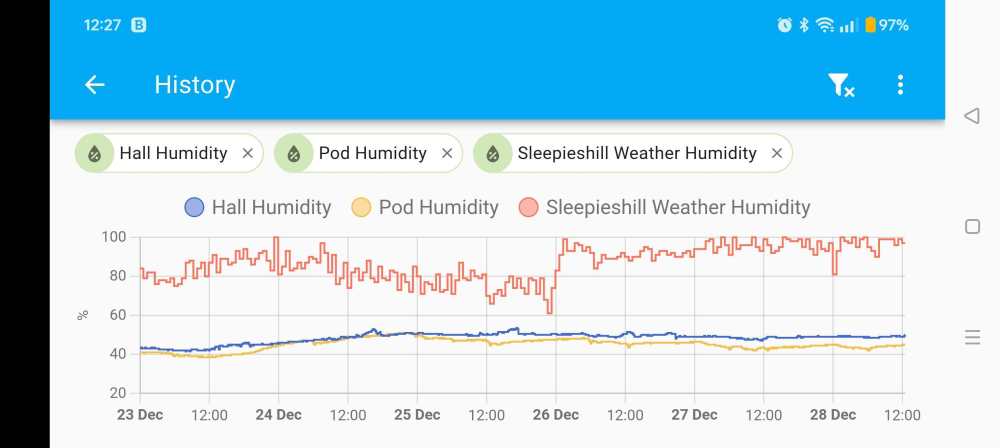
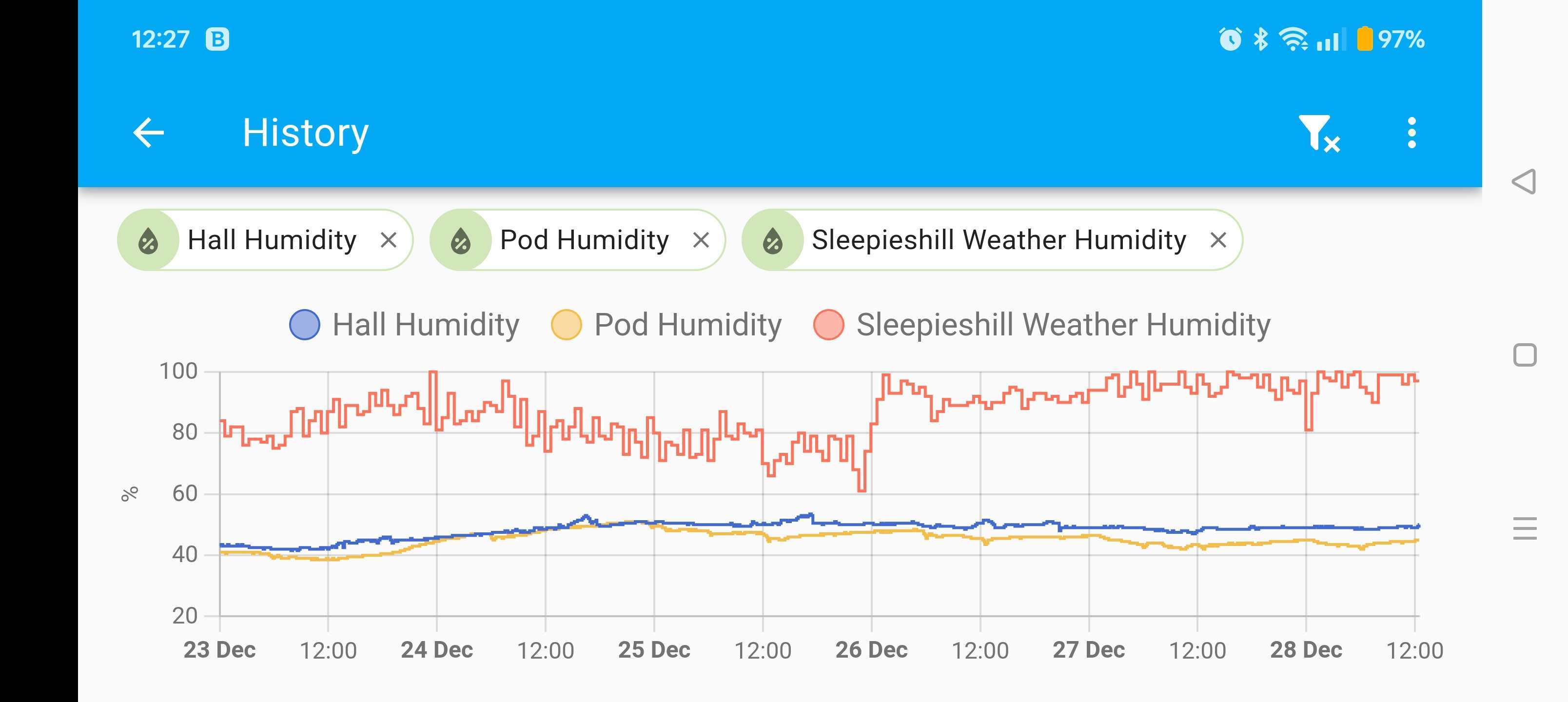
A screenshot I did last year, compared outside humidity levels to yinside the house (normal MVHR), the pod is a summer house that is heated and has dMEV. The summer house almost tracks the humidity levels of the MVHR.