


JohnMo
-
Posts
13292 -
Joined
-
Last visited
-
Days Won
200
Everything posted by JohnMo
-
So your usage is down to 3.2kWh per day, from 18kWh per day. That sounds like a win. £1600 saved in water heating costs!
-
You can if you have cylinder upstream of the combi. Just set up to do some experimenting, as we have quite a few days of overcast skies coming up/ Already have a buffer (thermal store) on the heating system, which has a DHW coil in it, this is used to preheat water going in to a combi in the heating season and heated by PV immersion in the summer. Downstream of the DHW coil is solar diverter valve (to a mixer valve or to combi). On a good solar we have free hot water. Have a good idea of gas used for DHW, when there is little or no solar. Have just set the heating system to charge the buffer at 47 degrees, 4 degrees hotter than the diverter is set at. Will see how gas consumption goes, over the next week or so. Have already noticed the draw of volume at the kitchen sink, is much lower with the heated buffer, than with the combi.
-
they are all the same - difficult if you leave it to dry out, easy if you don't
-
wood fibre, cellulose, natural wool, recycled plastic wool - but they also contain something nasty when you start looking, to either stop them rotting or insects/rodents out
-

Cladding options (now that Siberian Larch is contraband)
JohnMo replied to Kelvin's topic in Timber Frame
It had nearly a year exposed and untreated, was just starting to to have a tinge of grey. Now treated with ceder oil, as in the photo. -
Cladding options (now that Siberian Larch is contraband)
JohnMo replied to Kelvin's topic in Timber Frame
I have Scottish larch, dismissed Russwood on a price. Got mine from Ali Patterson of Nairn, all trees from local wood, will mill to any shape or size and about a 1/3 the cost. Good delivery.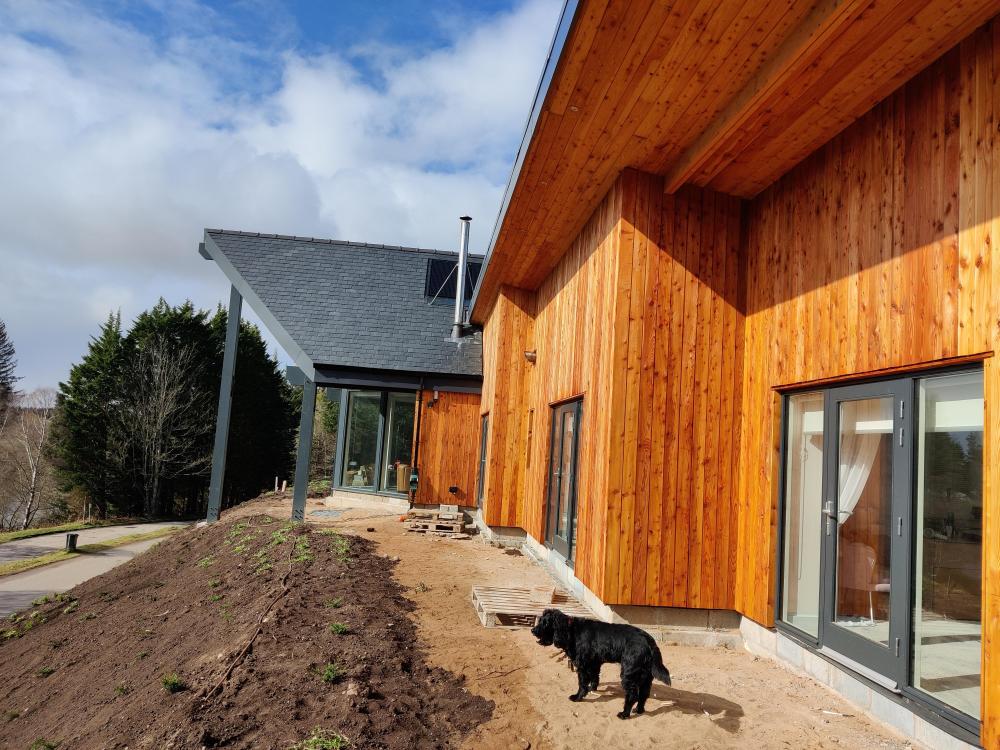
-
Typical turn down is around 2:1 on an inverter heat pump, some are a little better. So if you look at the heating characteristics of the house at say -5 and 10/12 degrees, will your chosen heat pump do max demand and min turndown (kW) without being too big for the heat demand at 10/12 degrees, so that you don't need a buffer?
-
Fleece or Butyl tape on plasterboard joints?
JohnMo replied to ashthekid's topic in Bathrooms, Ensuites & Wetrooms
Plasterboard tape and jointing compound, sand smooth? -
Sounds like the rip you off world of heat pumps. All heat pumps should come as standard with heating and cooling functions operative.
-
Ecodan heats water only to 39C with heat pump
JohnMo replied to FrankG's topic in Air Source Heat Pumps (ASHP)
Looks like your internal heat exchanger coil is 1.5m2 area, I think it more normal to a see a 3m2 coil when connected to a heat pump. So your issue is related to the DHW cylinder and it's internal coil being too small most likely. Did you install yourself or was it specified and bought by the plumber? Also looks like there is an anode to replace to prevent internal corrosion, these normally need to be replaced annually. -
Ask the structural engineering or architect why, way easier than loads of second guessing. There may be a simple explanation, or they have just and pasted from another job and not removed some details.
-
Ecodan heats water only to 39C with heat pump
JohnMo replied to FrankG's topic in Air Source Heat Pumps (ASHP)
No, the return will be lower than 55. If it's reaching 55, then the coil within the cylinder is not suitable for a heat pump. Assume you changed the cylinder when you upgraded to a heat pump. If you didn't or just installed a normal cylinder that is your issue. The coil within the cylinder is too small to transfer the heat from the lower temperature heat pump, compared to a gas boiler which with would be flowing at around 70 degC. The cylinder name plate will have all the info. You take a photo and post on here? -
MVHR with adiabatic cooling
JohnMo replied to Garald's topic in Mechanical Ventilation with Heat Recovery (MVHR)
I would check the min flow rates, as you don't want too many air changes in winter, as the air can get too dry. -
MVHR with adiabatic cooling
JohnMo replied to Garald's topic in Mechanical Ventilation with Heat Recovery (MVHR)
If you can get 4 ach from MVHR your unit must be massively oversized. Normal flow is 0.3 to 0.5 ACH and boost 25% or so above that. -
Ecodan heats water only to 39C with heat pump
JohnMo replied to FrankG's topic in Air Source Heat Pumps (ASHP)
Can you see what the return temperature is when you flowing at 55 degC? Also what make/model cylinder are you trying to heat? Is specifically for a heat pump? -
I challenged our SE on several issues, well worth it. Sometimes a different slightly more expensive grade of steel, gets you a smaller size and fixes the issue. Could you add an internal or external mid span vertical support. This reduces the work the lintel has to do, so size drops considerably. Or batten the internal wall and add internal insulation to cover the cold bridge and the rest of that wall. Many ways to get things to work. We have a wall of glass and the steel holding the roof up was massive and somewhat killed our views. A few challenges ended up with a more expensive steel frame in 90mm square section. We now have very small sight lines around our windows.
-
So 9779/1674 = 5.84=CoP or very close too.
-
Normal chuff, by ill informed broadcasters. Tell you part of a story, as it sounds more dramatic.
-
But why were you using so much gas, was the boiler oversized with no buffer, multiple zones, so continuously in short cycle? Using your figures if the same input heat, you getting a CoP of close to 6 in the coldest months! Which points to the gas system not performing correctly. Manufacturers would be shouting from the roof tops if you could get a CoP that good.
-
Refusal one 1 negative.. can anyone help ?
JohnMo replied to Sophsmort's topic in Introduce Yourself
I would firstly identify the tree species and plot all their positions. Then find out what the height to root spread is currently and likely to be once at full maturity. Produce a drawing with that information and the site layout and show how you will not interfere with anything that has a preservation order. Our site had similar issues, just a matter of dialogue and ticking boxes. -
Solar, good electric production in summer, but much lower in winter. Don't bank on it doing much to lower heating bills, unless you have a huge amount of PV installed. In spring, summer and autumn most of your hot water production should come from solar. How well insulated and airtight is the house? Your house is just under twice the size of ours and we have a heat load of around 3kW at -5 degC. You need to get the sizing of the heat pump right, that is the first thing, they are not as forgiving as say a gas boiler for being oversized. UFH is better, but radiators can also be done, with oversized radiators. UFH needs a well insulated floor, otherwise you loose too much heat downwards, and have to run the UFH hotter to compensate... What stage is your build at? What is your current wall, floor and roof buildup with respect insulation?
-
MVHR with adiabatic cooling
JohnMo replied to Garald's topic in Mechanical Ventilation with Heat Recovery (MVHR)
Not sure of the MVHR in reverse is. Just been looking at the price of the coolers, they are not cheap, you could buy Aircon for the same money. Not sure how effective the adiabatic cooling is at the air flow rates of MVHR as you are only doing a 0.3 to 0.5 ACH. -
Can you first fix for A/C just in case it's needed in future?
JohnMo replied to cbk's topic in Other Heating Systems
Just make sure you have good cross ventilation. Keep doors and windows closed until your internal temp is the same as outside, then open everything up to get cross ventilation. Purge the heat out. In the morning, if it's cooler outside than inside open everything up, as the outside temps increase, close everything in again, repeat... Have internal or external blinds on all windows that can get sun on them, close these as soon as the sun starts to come into the room. -
Really depends on. How much heat you require. How much solar you are willing or able to install. If you needed an average of 20kWh a day for heating, in Dec/Jan you would need 620kWh/month. For that around 7kW array assuming your heat pump gives you a CoP of 3. You would also need additional for hot water. You would also need UFH so you can bulk charge the floor while you are generating. Although some days you output will be close to zero, so will need an alternative power source.
-
Can you first fix for A/C just in case it's needed in future?
JohnMo replied to cbk's topic in Other Heating Systems
Could you just install fan coil units in bedrooms, could then use for heat or cool, direct from the ASHP. Or if you have UFH use that.


