


JohnMo
-
Posts
13296 -
Joined
-
Last visited
-
Days Won
200
Everything posted by JohnMo
-
A new build down the road is having 2 panels installed so they pass SAP. Roof is on and has been for quite a while. Next tiles are being removed for hangers to be installed and wires run. Just daft.
-

MVHR 2023 Recommendations
JohnMo replied to Lexifir's topic in Mechanical Ventilation with Heat Recovery (MVHR)
If you are installing MVHR just keep it simple. Push buttons for boost in wet rooms. Set the flow rates per building regs, until sign off, then reduce based on number of people in house. 90mm semi rigid, to easy to install, minimum number of runs and quite. Titon HRV, are good, made in UK with good technical and spares support. I had an issue and they were great. No call centres or people who have never seen a unit, trying to talk through a problem, like most companies these days. -
Bit of a downer. I also looked at the gutter while I was there, so 10.mins cleaning panels, 30 mins cleaning gutter.
-
Noticed my DHW temperature was not very high temperature and we have a couple days of clear skies, so should have been plenty of excess solar electricity. So checked the PV output. Just over 1kW. Panels and roof covered a green film of pollen. Out with soapy water and hose pipe and 10 mins later over 2.5kW.
-
First question is they have just used building regs to size. Are you better than that, do you have good airtightness? By the way the price is bonkers, same answer even if an installed price. The ASHP unit is made by Midea.
-
Basic Heating Control Understanding Help
JohnMo replied to Shaun McD's topic in Air Source Heat Pumps (ASHP)
But you can to a great degree just manipulate the flow rate through individual loop to correct for this. Increase or decrease the flow changes the delta T and therefore the mean flow temp. Anything below 20W/m2 heating requirement a 1 or 2 degree change in mean flow tamp has a big impact on heat output. Irrespective of pipe centres. -
Sorry cannot answer your radon question, but your insulation looks rubbish, does even meet building regs? Not sure my choice would be Actis Hybris, you would be better using something like Frametherm 32. You also need an insulation layer inside the studs to get rid of the repeat thermal bridge, so a layer of 25mm or better 50-75mm PIR insulation or insulated plasterboard. Sorry not really the answer you were looking for. Pay once for insulation or every year on heating bills.
-
Basic Heating Control Understanding Help
JohnMo replied to Shaun McD's topic in Air Source Heat Pumps (ASHP)
Not really a little water, there will be multiple loops, even with my 300mm centres I still have 28 litres just in the lounge, and there are another 7 loops.. -
Basic Heating Control Understanding Help
JohnMo replied to Shaun McD's topic in Air Source Heat Pumps (ASHP)
Yes. -
ASHP, how to decide - I just don't get it!
JohnMo replied to Jimbo37's topic in Other Heating Systems
Plenty of people take a slice of the cake to get from manufacturer costs, to the consumer cost. Import duty, vat, wholesaler profit, retailer profit, transportation etc. -
Basic Heating Control Understanding Help
JohnMo replied to Shaun McD's topic in Air Source Heat Pumps (ASHP)
There is always a bleed through from the return to the supply, tried two different types of mixer, a Reliance and Ivar, both have the same outcome. Was wanting to flow 26 degrees into the UFH loops, but had to operate the weather compensation curve higher to achieve it, about 3 to 4 to degrees hotter. Which is rubbish. If you are on the same floor, no need for mixers at all, in my opinion, others will not agree. Not sure where any benefit comes from a buffer with thermostat, as it cancels out running weather compensation. Just let it float on return temperature. Loop spacing, extremely small difference in flow temp if your W/m2 is below about 20. At 20W/m2 your mean flow temp at 100mm spacing is 26 deg, while at 300mm centers it has jumped up to 28 deg. The further below 20 you go the smaller the difference. -
ASHP, how to decide - I just don't get it!
JohnMo replied to Jimbo37's topic in Other Heating Systems
Why go abroad city plumbing. Plus currently you get 10% off that price.
-
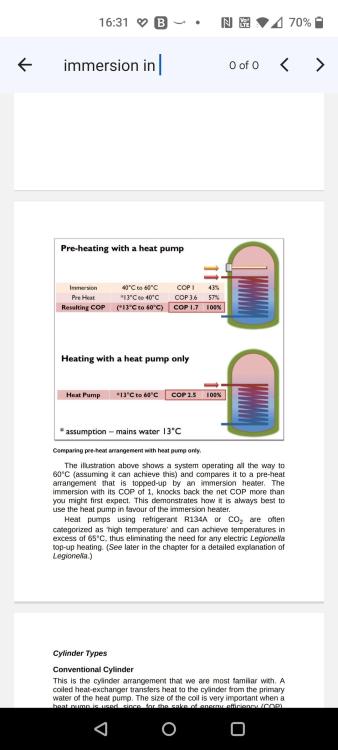
It's not that cheap to run making DHW, with an ASHP, its cheaper than direct electric heating, by a margin of two and bit. But preheating a single big cylinder to 50 or so via ASHP and topping up to 60+ via an immersion isn't much worse than a heat pump. Plus a big single cylinder of x capacity had a daily heat loss that is way less than 2x smaller cylinders of half the capacity each due to the extra surface area. Plus you also have parasitic losses of the piping x 2.
-
It sounds like the the cylinder set point is too high. So the heat pump runs to max temperature stops and restarts and keeps doing this. Your set point should be say around 48. What temp are you trying to achieve in the cylinder and from the cylinder nameplate it should state the coil size. So can you confirm cylinder set point, and coil size?
-
System sizing based on actual consumption - a better way?
JohnMo replied to JamesPa's topic in Air Source Heat Pumps (ASHP)
Novel solution... -
Basic Heating Control Understanding Help
JohnMo replied to Shaun McD's topic in Air Source Heat Pumps (ASHP)
No buffer equals big zones only, so possibly only one zone per floor, but you need to calculate the water volume for each zone to ensure it meets your specific heat pump requirements. I have a small zone (2x50m loops) the thermostat can switch the zone off but not on, as the volume is way to small to run on its own, without a buffer. 1. temp probe, when temp hits a defined limit, the ASHP drives a 3 port valve to DHW and ramps up flow temperature. 2. My ASHP gets a trigger from the single house thermostat, call for heat ASHP starts, no call ASHP goes into standby mode 3. Not sure your assumption is correct. The WC curve does not take anything from the thermostat or room temps. It's a basic, when external temp is X, flow temp will be Y, straight line curve. Even if it did UFH is way to slow to react to take room temp in to account. It just chases its own tail (been there, done it) 5. If you want a stat on each loop you need a buffer sized for the smallest loop. 6. You could do away with the wiring centre and control the pump directly by the thermostat. I dumped the manifold pump and mixer, as they incurred a temperature drop across the mixer of 3 to 4 degs, cooler but with two floors and different flow temps you maybe need one or both. -
ASHP winter additional heating ideas?
JohnMo replied to ashthekid's topic in Air Source Heat Pumps (ASHP)
So what do you mean when you say runs like a boiler. From what I can see you seem to run at 2t degrees or on DHW. -
ASHP winter additional heating ideas?
JohnMo replied to ashthekid's topic in Air Source Heat Pumps (ASHP)
Or just running everything too hot, for too short a period, therefore getting a rubbish CoP. Basically trying to run like a gas boiler. -
You would cheaper to just top up temperature with your immersion, if you needed too. A constant standing loss for each cylinder would be 1.5 to 2kWh per day. So not sure why you would want that. Or just add an inline electric heater, use your single cylinder as the main source of hot water, heated by ashp, then if the temperature drops below a set level, the inline heater kicks in.
-
ASHP winter additional heating ideas?
JohnMo replied to ashthekid's topic in Air Source Heat Pumps (ASHP)
If your UFH is running at 45 your CoP will not be much better than 3, if your running the UFH for short periods then CoP will drop from that. Running at 35 your CoP jumps to 4, so you use 33% less electric. UFH runs better if you run for a long periods at the lowest possible temperature. You need to drop the temperature on the heat pump controller, not the mixer on the UFH manifold as such. -
Yes two duct and one cable. I used the duct I used because I had it as left overs from the build. I sealed my duct ends with some stainless steel mesh and expanding foam. I did my insertion first then buried.
-
I would treat it the same as water pipe. Insulate and then encase on plastic duct. So something like 25mm wall thickness insulation, then a flex duct of some sort. My 28mm is inside 110mm double wall convoluted duct. I pipe per duct. Yours will be smaller but you could fashion something similar. No reason not to encase the cable on same duct, I would use armoured anyway, so it may be easier dropping in the trench. F gas bod should be similar to a plumber.
-
Just make sure anything sticking out of the wall exposed to UV, is UV protected. Normal armaflex isn't UV stable. It may make a small difference on the east wall, but it's air temperature that's important and that doesn't really change. Also make sure the temperature probe on the ASHP isn't exposed to the sun as it screws up your weather compensation curve.
-
ASHP, how to decide - I just don't get it!
JohnMo replied to Jimbo37's topic in Other Heating Systems
But if installed with a normal, instead of a large well designed buffer, you get mixing of the flow and return water, leading to heat pump having to run a few degrees hotter. Leading to a lower CoP. If installed as volumiser in the return leg that's ok but doesn't seem to happen that much. If you have a single or a couple of large zones designed to exceed the min flow rate, you shouldn't have an issue. Also don't install modulating radiator valves, as these slowly strangle the flow. Just balance the flows, which seems to beyond of most ASHP installers for some reason. -
ASHP, how to decide - I just don't get it!
JohnMo replied to Jimbo37's topic in Other Heating Systems
Couldn't agree more. ASHP, have a defined min flow rate, if they don't see it they shutdown on an error code. The only reason you need a buffer is if you do not meet the min flow limit, by having small zones that can be run independently of the others. If you can meet the min flow rate by having zones big enough the buffer just adds inefficiency. Withholding info because they have just priced (with plenty of fat) not done detail design, and will not until they get the job.




