


JohnMo
-
Posts
13311 -
Joined
-
Last visited
-
Days Won
200
Everything posted by JohnMo
-
Yes, but you need a calibrated, with supporting certificate (that is in date), flow meter.
-
I rang mine and they basically said not interested. If covered by other work that required planning permission, they are interested, otherwise not interested, get on with it. So I would think most councils will be the same. Unlikely they log what properties have an UVC unless otherwise stated in a planning application. Basically I have 2 certs "water bylaws" it states I should join a self certification scheme, where as, the "G3" cert says nothing. You would think it would be the way round. Not sure they know which way is up, so why should anyone else? Think like a lot of conversation on here, it turns out the 1% (or less) of people try to go the right thing, while rest do what they want, even the professionals, than should know better.
-

MVHR retrofit requirements?
JohnMo replied to oliviaaa999's topic in Mechanical Ventilation with Heat Recovery (MVHR)
Hi, sounds like lots of working going on. I would split your questions into different topics each in it's relevant section, otherwise you will not get many answers that make much sense in a weeks time. So take all those questions not related to MVHR and repost. So looking at the ventilation, no ventilation gets you away from opening windows when it's hot. Flow rates are not sufficient for that. It will help a little but generally not much. There are three plausible ventilation strategies. MVHR - mechanical ventilation for supply and extract with heat recovery. This runs all the time and is an addition to any leaks within the building fabric. To get the best from this system the house needs a reasonable airtightness. Filters can be expensive depending on unit used. MEV - mechanical extract only. Trickle vents in windows or walls. Would only use this system if trickle vents are humidity controlled AND extract points are also humidity controlled AND fan speed is controlled on a constant pressure. Easier to install than MVHR, one fan instead of two. Only runs when needed so heat loss is minimal. No filters to replace in theory, but would install with filter socks in extract points. dMEV, easiest to implement, similar to above but each wet room has its own fan. Inlet devises as per MEV. No filters All the above require internal door undercuts of around 10mm to proved a ventilation route if doors are closed. All will give good humidity control, should be near silent in operation. All have a compromise cost/difficulty of install, weighted against ongoing running cost (electric and filter) and heating cost. -
Kitchen hood grease filtering, hobs & automation
JohnMo replied to Mike's topic in Kitchen & Household Appliances
Not sure how you do your house ventilation, but we barely use our hob extractor anymore with MVHR (we don't fry much either), there is zero need, the MVHR extract in the kitchen seems to do a good enough job on its own. Just have a filter sock in the extract terminal for the MVHR to catch anything, before it gets into the duct. -
They don't make it easy. The Manual to Building Regs states "Some types of work may be done by a ‘competent person’. This is a term for an installer who works under a scheme that has been approved by the government." Then a table showing work process.

-
Mechanical ventilation design
JohnMo replied to giacomo_z's topic in Mechanical Ventilation with Heat Recovery (MVHR)
We have a Greenwood dMEV fan (set to minimum speed and is inaudible) in our summer house, outside it's currently 4 degs and 79% humidity. Inside it's 19 degs and 39% humidity. Over the last month the max humidity inside hit 44%. For comparison in our house we have MVHR and over the same period the max humidity in the house hit 46%. So overall pretty similar. To lower the humidity in a building you need a fresh flow of air and heat. You need both together, doing one without the other humidity stays high. -
G3 regs state 3.10 Hot water storage systems should be designed and installed in accordance with BS6700:2006 + A1:2009 Specification for design, installation, testing and maintenance of services supplying water for domestic use within buildings and their curtilages BS6700:2006 states 4.1 Maintenance procedures Maintenance procedures shall be adopted to maintain the performance of the installation at the level specified in this standard for the original design and installation. Unvented hot water storage installations shall be maintained and repaired only by a competent person (see building regulations A.1). 4.7 Vessels under pressure Any vessels storing water under pressure shall be inspected for indications of deterioration no less frequently than at the intervals recommended by the manufacturer. Expansion vessels shall be inspected for indications of deterioration in strength and the gas pressure measured no less frequently than at the intervals recommended by the manufacturer. If the gas pressure is not within the limits specified for the application it shall be adjusted to within those limits.
-
The main driver is cylinder warranty - some cut and pastes below. warranty 1. The unit has been installed and commissioned in accordance with our installation and service instructions and all relevant codes of practice and regulations in force at the time of installation. Maintenance periods will vary for many reasons. Ideal Boilers recommend a maximum of 12 months... On completion of the work, fill in the Benchmark Service Record at towards the back of this manual.
-
Mechanical ventilation design
JohnMo replied to giacomo_z's topic in Mechanical Ventilation with Heat Recovery (MVHR)
They need to really take account of room size, a room with a shower is still a room with a shower, big or small. But extract is doing several jobs, clearing excess humidity at source and dragging moisture from other rooms like your bedroom when you are sleeping. -
Mechanical ventilation design
JohnMo replied to giacomo_z's topic in Mechanical Ventilation with Heat Recovery (MVHR)
No, wet rooms have water in them, like a sink, shower etc. the solution above give ventilation across the room when required. The trickle vent opens and the dMEV fan which run all the time provide cross ventilation. Ideally you will have 10mm undercut at the doorways so air is free to flow when doors are closed. As above -
Mechanical ventilation design
JohnMo replied to giacomo_z's topic in Mechanical Ventilation with Heat Recovery (MVHR)
The one that @HughF found and is using, but not sure what make or model, but he seems happy with them. -
Mechanical ventilation design
JohnMo replied to giacomo_z's topic in Mechanical Ventilation with Heat Recovery (MVHR)
I think you are confusing yourself. Trickle vents, just add humidity activated trickle vents to dry rooms (close wet room ones); they look after themselves. In wet rooms and kitchen just add dMEV fans (such as Greenwood with automatic boost for humidity) set to required min flow rate. Job done. -
The normal for an unvented cylinder is cold goes to UVC, and is then taken to cold consumers at the same pressure as the cylinder from an output at the pressure control valve. My UVC was a retrofit, so the incomer into house has a PRV, it goes to the UVC, but I have a manifold for cold services just teed off after the incoming PRV. The white top pipe going to cylinder.
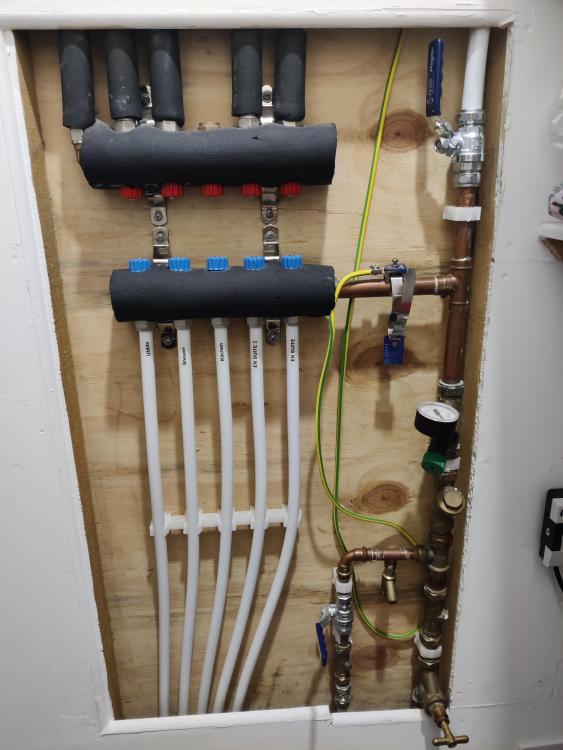
-
I really just looked at the risks. Coldest day AND many hours of power cut is required to get insulated pipe contents down to atmospheric temperature. At any other time the heat pump freeze protection program will look after you anyway. How many external oil boilers have antifreeze? Do you ever here of issues with frozen pipes? Adding some extra biocide I didn't concider so perhaps I should get some fernox F7 biocide.
-
You get the G3 cert covering you for English and Scottish Regs and hygiene cert for domestic hot and cold water systems. So you can design, install and self certify UVC installations. So can produce the commissioning certificate, and recertify annually also. If you need to register a cylinder install seewith local council you can do that also. But they do not need to come out to any validation or such.
-
But that is the only vehicle being offered by Octopus for V2G!
-
Tell that to my phone. Did you see the top gear episode here they tested a used Nissan Leaf, about 5 years old and the range was less than half of what it should be.
-
They are giving free charging - you don't stuff like that without payback. Words from the website We’ll set up your V2G charger to automatically manage your charging and discharging in the greenest way possible, so you can fill up for free. and then export back to power your neighbourhood when the grid needs help
-
Or just go to Screwfix, Flomasta concentrated antifreeze, it's Monopropylene Glycol based anti-freeze with additional anti-corrosion & anti-limescale components. I am doing between 15 and 20% Dose Rate 25% = Freezing Point - 11°C Dose Rate 30% = Freezing Point -15°C Dose Rate 35% = Freezing Point -18°C Dose Rate 40% = Freezing Point -22°C
-
Not sure I would sign up unless the car was leased. Suspect they will be borrowing your battery power to suit the network, not your car battery life. Note the title V2G not V2H - grid not home.
-
Best electric heaters for reasonable price - recommendations please
JohnMo replied to M-Rod's topic in Other Heating Systems
"Which" has reviews of various heaters, you need to subscribe for a month to get at the reviews. Things to watch for, some heaters have thermostats other don't, some measure the heater temperature and others the air temperature. Some have timers others don't. For me you want A timer A thermostat that measures air temperature A switchable output rating I bought a Dimplex heater from Screwfix which had all the above Dimplex ECR20Tie Freestanding Oil-Free Radiator with Timer. -
No idea, but duplex ones will be going in when I'm finished. Whole design is pretty poor overall.
-
Possibly the pump stops and starts on the valve microswitch? so pump doesn't stop until valve is fully closed. You could just be hearing the high velocity water going through an ever smaller opening in the valve?
-
If you go to a plumbers merchant you can get 35mm x 15mm insulation, goes over Hep2O fittings nicely.
-
I am doing an offshore job at the moment they have a pH of 5 from the water they make (reverse osmosis), and have been using copper unvented cylinders, which have to be replaced every two years, as they start to leak. Think the slight acidic nature stops the corrosion skin forming and copper disappears quite quickly. So good call on the use of tap water instead of rain water. You still end up eating the base material away, as the corrosion skin is just base material corroded. So each cycle takes the odd micron of material away. I would be tempted to add a gate valve and simple flow meter downstream or a flow setter, you can tune the flow rate, to get the best compromise between reheat time and lowest erosion risk. Add it to section of 22 or 28mm prior to reducing down to 15mm.




