

JohnMo
-
Posts
12470 -
Joined
-
Last visited
-
Days Won
179
Everything posted by JohnMo
-
 So although classed as a condensing boiler they are not really keen it being operated that way, with the advised baseline operating settings.
 -
Just let your heat pump control look after temps, if you are using adaptive control.
-
Not sure you are understanding condensing mode correctly. An oil boiler goes into condensing mode when the return water temperature is below 47 deg. Condensing is when the water vapour in the exhaust stream is converted from water vapour to water, the heat exchanger basically collects the latent heat and increased efficiency. Nothing to do with cycling or not in hot or cold weather.
-
Bit of fine tuning over the last few days (still a little more to do, to optimise flow temps) have added a double set point to the heat pump. This is selectable by volt free contacts. Both high and low temperature run the same WC curve but start at different flow temperatures. Normal curve Start temp is 28 at 12 deg outside temp increasing to 32 degs at -9 High temp curve Start temp is 31 at 12 deg outside temp increasing to 35 degs at -9 So basic operation is the garden room has a thermostat, which is timed to call for heat about an hour or so before I need it hot. This opens the double set point contacts via the thermostat and brings the heat pump on to its higher operating curve, all other times it's on the lower operating curve. The house thermostat is set to 0.5 degs hotter than at the same time, and house floor then acts as a buffer. The heat pump runs continuously during this period except for defrosts. The fan coil is left in auto mode, with a target temp of 22. It was -5 overnight and has got up to 1 deg today, no issues with the fan coil room temp didn't drop below 20 degs was up to 22 this morning.
-
And most places you wish it was actually hot, most the time it's just cold.
-
If you have mixer taps no need for a TMV
-
Look at the price of an Ideal branded cylinder they are exactly the same, several hundred pounds cheaper
-
Your bathroom, reduce spacing to 150mm, you never have enough heat. I would be inclined to the kitchen area on 225 to 250mm centres. Dump the hall loop, use the loops transiting through the hall and borrow that heat. I do similar, my kitchen loop does the shower room first, then zig zags by the front door, then does the kitchen diner. Works well, do hottest area first. Operate as a single zone, electric towel rail in bathroom, that adds a second heating zone and keeps building regs happy as well. Unlikely your dT will work, you will be nearer 4 to 7 in reality.
-
Go with DIY MVHR?
JohnMo replied to Enginuk's topic in Mechanical Ventilation with Heat Recovery (MVHR)
I think you have a few options 1. MEV, but get one with that varied speed base on humidity with humidity activated extract terminal, not much cost increase over a fixed speed unit. Add to this humidity activated trickle vents. 2. dMEV as above, but no duct. 3. MVHR - Almost what you described but do not supply to study, supply as far away as possible so the air washes through as much of the house as possible. Look how FreshR and similar units are used to get an idea. A through wall fan can get air movement, a dry room blows into a wet room for example. As @Nickfromwales says you have to be careful, a leaky house and MVHR even though it recovers heat it's is constantly moving air that may not need to move. You have natural ventilation AND you have forced ventilation on top of that plus running costs of 2 fans running 24/7/365. -
I started my Warrant process with ACJ, didn't finish the process with them we parted way.
-
Passivhaus Under Floor Heating & Water Supply
JohnMo replied to Carpe Diem's topic in Underfloor Heating
The thing with a passivhaus the heating demand is very low, therefore the floor surface temp only needs to be about 2 or 3 degrees above room temperature. Correctly setup the system should self regulate. The floor output is a factor of area and dT between the floor surface temperature and room temperature. So if your room temp is 21 and the floor is 23. Once room hits 22 the floor output is halved, so it looks after without any outside influencers. Solar gain who cares the floor output drops to zero without any intervention. -
Passivhaus Under Floor Heating & Water Supply
JohnMo replied to Carpe Diem's topic in Underfloor Heating
If you are running a weather comp curve, you just need to actively make sure on different temp days you are not running too hot or cold and make tweeks to the curve to fine tune. You really shouldn't be bouncing off thermostats ever. If you do your flow temp is too high. Our house isn't passive, possibly about 50% more heat demand due to form factor and some massive windows, our house will stay very stable down to zero degs just running the ASHP at around 30 and mixing down to 28 degs. So 38 was possibly way to high. For context the 8 degs possibly represents about 3-400W extra power while the heat pump is running, compared to 30 flow temp. -
I parted ways, it really was just as quick to start from scratch, get all the changes you want done dealt with at the same time. Nothing is quick with architects even if everything is handed to them on a plate, plus they will charge you just as much.
-
Passivhaus Under Floor Heating & Water Supply
JohnMo replied to Carpe Diem's topic in Underfloor Heating
When you get to low outputs (less than about 20W/m2) it make almost no difference to flow temp. We have 300mm spacing in a non-Passivhaus (around 600m pipe in a 195m2 slab), it was -5 last night and doing a batch charge our flow temp didn't go above 33 the house is at 20 degs and garden room is at 21. If I set my flow temp at or below 28 deg, it means my heating is effectively off, as there is 8 deg restart hysteresis from set point to restart after a heating cycle, so the house floor would have to drop to 20 degs to allow the heat pump to start, that just never happens, as that is below the house temp. Practically gets in the way, unless you want to install a buffer to draw heat from, but the heat runs hotter to charge the buffer. Never understood, why anyone needs 100mm pipe spacing unless the house leaks heat like seize. Installer may strive to get 100mm spacing but to what gain in a low heating requirement house or Passivhaus. -
Passivhaus Under Floor Heating & Water Supply
JohnMo replied to Carpe Diem's topic in Underfloor Heating
Why - are they too wide or too narrow a spacing? -
Fill it with cold water and circulate through the floor?
-
As above, the probe needs to be in the bottom probe pocket. You are only heating about 50L in the tank
-
Passivhaus Under Floor Heating & Water Supply
JohnMo replied to Carpe Diem's topic in Underfloor Heating
What is your floor make up? How are you operating your DHW heating - always on on, one or two heating periods per day and what temperature do you heat too? Was that a new build, first heat period? Do you mean 300L DHW cylinder? If so that is nothing to do with the UFH as that is a separate system. The Two tanks are DHW and a buffer, you will not need a buffer, unless you have a out 10 zones (thermostats) You heat one or the other not both at the same time that is normal. You have a priority hot water system. Your shower water will come from the cylinder not your UFH system - confused? What do you have automated and why? -
Intake and Exhaust Ducts
JohnMo replied to Mr Blobby's topic in Mechanical Ventilation with Heat Recovery (MVHR)
I quite like it, but you can also get slightly thicker version from other manufacturers. I got it from EpicAir, they are quite good to deal with and if not not their site they seem to be able to get hold of it. Easy to use and cut, not cheap but gives a nice finish. better than trying to make a bendy floppy duct straight. -
Intake and Exhaust Ducts
JohnMo replied to Mr Blobby's topic in Mechanical Ventilation with Heat Recovery (MVHR)
I used polystyrene duct - UBBINK AERFOAM INSULATED DUCT -
How to measure the remaining HW in an unvented cylinder
JohnMo replied to Adsibob's topic in Boilers & Hot Water Tanks
Putting a lump of energy into floor over a continuous period, anything from 3 to 10 hrs, then switching off the heating until the next heating period and using the floor to give back the heat to the house - bit like a big storage heater. Example On a day where you need 60kWh of heating to keep house at the temperature you need. You can slowly heat the floor at a rate of 2.5kW for 24hrs or you can put 6kW into the floor for 6 hrs. I do the charge based on some manipulation of thermostat settings and elevated (3 degs hotter than normally needed) weather compensation curve. Today we had 5 degs outside most the day and wet so not much solar gain. Heating went off after 8 hrs when the house hit 20.6 degs, the next hour house temp increased to 21.1, then the next 4 hrs drops to 20.9, then slowly decreases, currently 20.7, the recharge will start again at about 1.30. You need good floor insulation and thick screed. -
How to measure the remaining HW in an unvented cylinder
JohnMo replied to Adsibob's topic in Boilers & Hot Water Tanks
Yes it's sized correctly for my kW, flow and delta T. 22mm VRG133, ARA600 actuator, driven by ESBE CUA111 Controller. I used Kvs 6.3. Couldn't find a Kvs of 4 at the time. But I use mostly fully open as I am batch charging at the moment. Flow will start at about 28 at the start of the charge period and slowly increase 3 to 4 degrees as the floor warms up over the next hours. Max temp could go up to 33 on a cold day, so is set to 33 all the time, except at the end of the batch charge and it closes down to fully shut. Currently have it set I get a continuous run of the heat pump for about 8 hrs. When I did a fixed flow of 28 it would sit middle of dial and move about from there depending on flow temp.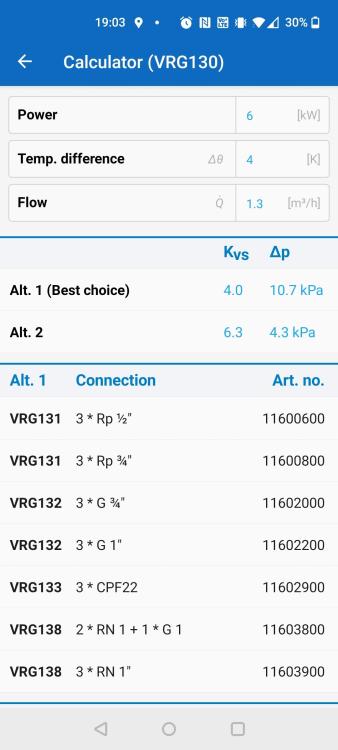
-
How to measure the remaining HW in an unvented cylinder
JohnMo replied to Adsibob's topic in Boilers & Hot Water Tanks
Would agree, I just set mine to max likely temp (33), so it generally fully open with no mixed flow, unlike a normal mixer that generally mixes down 10 degs like it or not. The heat pump really has no idea it's there as far as flow temps are concerned. They can be controlled at two set points - have second setting (22) set, so it closes the valve when the pump is switched off. -
Because we specified a slight positive pressure in the main room of the house, so as to be able to open the wood burning stove without sucking the smoke out of it. But that is quite a large difference, so i'm not sure that is right. Are they usually configured to be equal? Fan speed is set based on the pressure drop you have to make up, if your extracts are shorter runs, or have less bends generally you will run at a lower speed, for the same flow rates
-
That sounds better.



