


JohnMo
-
Posts
13299 -
Joined
-
Last visited
-
Days Won
200
Everything posted by JohnMo
-
 Those figures sound correct. Run it on gas the emission at tail pipe go down. Running costs should also drop also. Trouble is using or storage of excess heat, to make numbers work well. Big swimming pool sized thermal store. Pull heat out via water source heat pump. CoP of 6 or 7 should be doable.
 -
No it isn't. People just manipulate to suit their own ends, always have always will. Lie, damn lies and statistics comes to mind. People will see through it, if they look hard enough, but most people will take it at face value - global warming for example. One set of data, two options.
-
Paul heat recovery, they supply design and install. Not cheap BPC, design and supply Green building store, design, supply and installation (I think) Titon, supply and design, I think. Plenty of others, just Google for people in your area.
-
Suitable ducting
JohnMo replied to Tommy8884's topic in Mechanical Ventilation with Heat Recovery (MVHR)
If you're doing the MVHR, do it it with the correct stuff. Do either galvansed duct with the all the silencers in a branch system. Or do a plenum system with semi rigid 70 or 90mm duct. -
Sorry I like the Scottish system, either certified structural engineer provides a design certificate or you have to provide all the long calculations, for design approval, prior to getting a building warrant. No warrant no permission to build.
-
Why are you calculating, what's on your structural drawings? If you don't have structural drawings, you need to ask yourself why you don't?
-
Smart meter external aerial last ditch attempt?
JohnMo replied to SuperJohnG's topic in Consumer Units, RCDs, MCBOs
Left it an hour or so. Then went into the commissioning page on the smart meter and that looks for the network to hook up to, but didn't even find a signal. -
Possibly a bit more profit when electric and gas prices go up soon.
-
Smart meter external aerial last ditch attempt?
JohnMo replied to SuperJohnG's topic in Consumer Units, RCDs, MCBOs
Just tried this 2x slim jim antenna and coax. Outside one 7m up in the air and other one next to meter. Nothing changed. Think we have zero signal of any use near us. -
Do I really need a second layer over routed OSB
JohnMo replied to ricardo100671's topic in Underfloor Heating
It's ok if you have radiators elsewhere then you can run everything at the same temperature, but UFH at radiator temps is a waste of time and money. I ended with a fan coil. Room with UFH on 125mm centres. 250mm of insulation underneath. At zero Deg day, flow temperature over 40 Deg and room only getting to 16 degs. Pretty pathetic. Fan coil at 35 degs, any temperature I want in the room. -
Go to a DIY store, B&Q etc
-
A stock one I would doubt. You could always modify one that comes flat packed, by trimming the sides and shelves depth down. But a pull out larder I doubt exists. Could be wrong.
-
Do I really need a second layer over routed OSB
JohnMo replied to ricardo100671's topic in Underfloor Heating
Yes would agree, have both screed and covered with osb. The osb required such high flow temp to keep room remotely warm, I decommissioned. -
Razor wire and other serious deterrents
JohnMo replied to Adsibob's topic in Networks, AV, Security & Automation
Or just walk up your drive circumvented any barbwire. Leave barbwire to the military. Barbed wire just says, I am rich and have lots to hide and protect, please break in. Do you automatic lights? So they can't sneak about in the dark unseen. Or likely to be seen heard easily -
ASHP sizing compared to heat loss calculation.
JohnMo replied to DREG's topic in Air Source Heat Pumps (ASHP)
Compare the U values used to your build. Was an air test completed? Do you just have intermittent fans in wet rooms for ventilation? -
ASHP sizing compared to heat loss calculation.
JohnMo replied to DREG's topic in Air Source Heat Pumps (ASHP)
Also my build, around 200m², very poor form factor, vaulted ceiling in every room. If it was built to minimum building standards and didn't have responsible airtightness and MVHR would be about 5-6kW at -9. -
ASHP sizing compared to heat loss calculation.
JohnMo replied to DREG's topic in Air Source Heat Pumps (ASHP)
New build and 10.3kW sounds huge. Have you checked the heat loss calculation. Post it on here to be reviewed. Or go into boffins corner and find the heat loss calculation spreadsheet and do your own calculations. To put some perspective on the number 10kW x 24hrs is 240kWh a day. A CoP of 3 is 80kWh of electric per day. Or £20 per day, just for heating. -
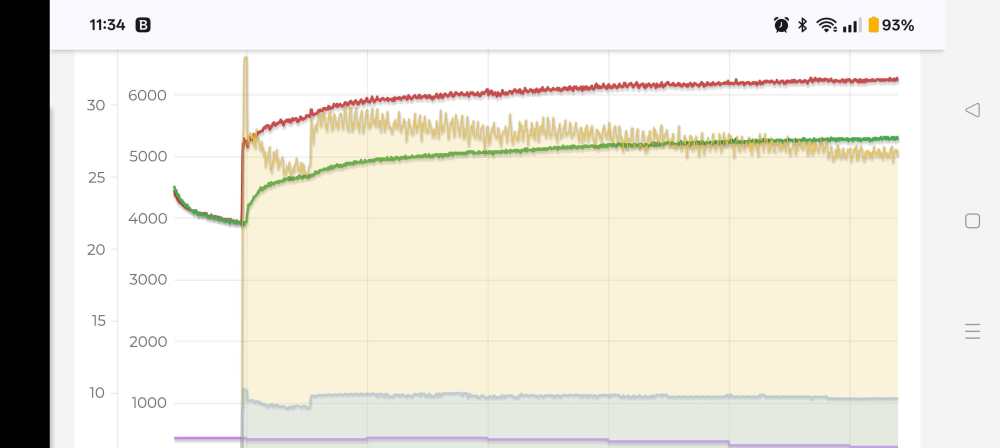
6kW heat pump into UFH system. 5.5 hrs of data. 6 degs outside. 4 degs rise in flow temperature. If you have a mixed system you need the UFH on all the time, if it's on a mixer the floor temp stabilises and the hot water flow inlet to system stays low, as does the out flow, so allows radiator flow temp to increase to required level. Faffing about with on off cycles just stops that process. Floor temperature requires most the flow. Gas boiler just throws out lots of kWs to compensate, heat pump cannot do that.
-
Not sure. Not seeing anything wrong with the foam, it's been in for nearly 4 years.
-
Icynene LDC-50 Used battens under posi rafter to kill of thermal bridges. U values Pitched 0.13 Nearly flat (12 degs) 0.12 Only issue with spray foam is numb skull installers that install in inappropriate places like holding a roof structure together with closed cell foam and a non vapour permeable membrane. Then wonder why the roof rots.
-
But when you strip out the minerals, via ion exchange and reverse osmosis you change the properties of the water a great deal. So check before you assume anything with respect pH.
-
Our roof is a similar construction, but I tried to go warmcell and they refused to do it. In the end I had all the interstitial condensation calculations done and went open cell spray foam - 300 to 350mm deep. 250m² of roof done in a day and a half. We used normal wood sarking boards with small gaps, no need for counter battens with natural slates.
-
Threaded bits are the same. Salus actuator has two clip on temp sensors for flow and return. Do may be different.
-
A wheel chair user can be in any dwelling and could be anyone, even if you think your able bodied. One fall in the ice, could have you on crutches or in a wheelchair for weeks.
-
MVHR - Frankische E11 Supply air error
JohnMo replied to Street18's topic in Mechanical Ventilation with Heat Recovery (MVHR)
ALL your pipes/plenum should be insulated in the loft - can see plenty in your photos not insulated. It appears to shutting down to protect the heat exchanger, but seems to be doing very early. I would have a read through the manual for the unit. Mine will go into extract only mode if it needs to protect itself, but it never seems to need to. A pre heater as linked to above is the normal way to do it. It can be electric or water based.


