
JohnMo
-
Posts
12468 -
Joined
-
Last visited
-
Days Won
179
Everything posted by JohnMo
-

Plant Room Distance from ASHP - 25m too far?
JohnMo replied to SBMS's topic in Air Source Heat Pumps (ASHP)
I think this where you need to do some research (not @sharpener) but the OP. ASHP run different algorithms - mine for example runs a very simple one, the circulation pump runs full speed when doing DHW and only at full speed. So I don't actually need a hydraulic separation between primary and secondary pumps. You only need when you havextwo pumps that can run variable speed as they fight each other. A second pump could quite easily be added (on the DHW side of the diverter) to start up when the diverter valve moves to DHW (from same power source) and switch off when the diverter moves to central heating. You then just change speed to get circulation rate you want. If you have variable speed pump operating during DHW, you need hydraulic separation IF you run the second pump with variable speed, or if you run second pump as above only on fixed speed then you don't need hydraulic separation. The main circulation pump will not then have a fighting match. -
Plant Room Distance from ASHP - 25m too far?
JohnMo replied to SBMS's topic in Air Source Heat Pumps (ASHP)
Yes. More risky the smaller the circulation pump. I use a small Wilo pump in addition to ASHP circulation pump. The primary circuit (ASHP circulation pump) does around 1.3m³/h and get around 1.0m³/h from the Wilo on the secondary circuit. Seems to work fine. A 12kW heat pump will be doing twice those flow rates. -
Plant Room Distance from ASHP - 25m too far?
JohnMo replied to SBMS's topic in Air Source Heat Pumps (ASHP)
Who is going to do that? 12kW pump has huge flow needs, so 22mm would be sh*te anyway. Sounds like a pressure drop calculation is needed to me. But second pump would ideally be hydraulically separated. -
Plant Room Distance from ASHP - 25m too far?
JohnMo replied to SBMS's topic in Air Source Heat Pumps (ASHP)
Do a test nearly everyday -
Plant Room Distance from ASHP - 25m too far?
JohnMo replied to SBMS's topic in Air Source Heat Pumps (ASHP)
Our run to cylinder is circa 25m. Some of the pipe around 7 to 10m is in 22mm plastic pipe, the rest is 28mm (6kW ASHP). Heat pump circulation pump didn't have enough power to get from A to B and back with sufficient flow rate. So use a second pump just for cylinder heating via a close coupled tee. -
I always thought that, my original setup had one and I zoned to death. But have found UFH in concrete/screed absorbs heat really well due to a massive density compared to air. One of the reasons to keep the existing floor engaged is it will soak up the heat well. Your issue comes with zones and not having the flow rate to keep the boiler happy, especially if you only have one tiny zone open - there just isn't any flow. Short cycling will occur - A volumiser doesn't help with flow rate either. They help with water capacity but a fully engaged floor is just way better. I can quite happily run my boiler doing about 8kW or heat pump doing 5kW for hours at a time without house overheating (using 0.1 Deg hysterisis thermostat). UFH just isn't the same as a radiator system, especially when you can have plenty of concrete to work with, as the OP can.
-
Do you actually save anything doing setbacks? Never really seen any savings especially with UFH. Can't you just balance flows to alter output via flow rate adjustment. 2 Deg change in dT is about 10% change in output. This then eliminates, 8 actuators, 4 or 5 smart thermostats and a buffer. So about £400, plus electrician to install most of it.
-
Don't like either option - Run the lot as a single zone. Single thermostat that switches pump on. No actuators needed or wiring centre. Get an Ivor mixer and only an Ivor mixer - assume your bedroom rads need a higher flow temperature. If you upsize the rads run whole lot direct from boiler with no mixer and WC. I would do neither option, I would have the ground slab fully engaged instead of isolated with insulated panels. Use egg crate style panels. Only use 16mm pipe not 12mm. 12mm performance isn't great you need higher flow temperature
-
If you can switch it off or disconnect internet and all the heating still functions - no not really. It then just a means of external monitoring or control override.
-
Or Sharp half the price (430W at £65) made in Thailand and Vietnam. At least it's not China.
-
Me too Didn't do that, but good idea
-
From Joulec web site "When there is a heat or hot water demand the ventilation rate increases to boost level." So you increase flow rate, extract more heat from house and push that heat to water heating either to DHW or CH. So rob Peter to pay Paul. I would keep ventilation (MVHR or dMEV on demand control to take no space) and heating (CH and DHW) separate. Something like this https://trianco.co.uk/activair-indoor-9111-9111 for a heat pump An unvented cylinder.
-
If you are thinking a smart, have that in addition to the normal stop cock. Dark, power cut, no internet and burst pipe come mind. Or it decides to switch main off because it thinks there's a leak, leaving you with no water. I have just removed all 'smart' from the running of the heating system, because I couldn't rely on it (class heating as an essential system). Only use 'smart' for PV excess power dumping, which at the end of the day isn't essential. Still have plenty of smart stuff attached to heating system but just for monitoring, so could be switched or on and not change the functions of the heating system. Control of your water main, I would class as essential. So I would only have smart isolator in a particular area, say near a washing machine and only isolate that pipe, not the whole house.
-
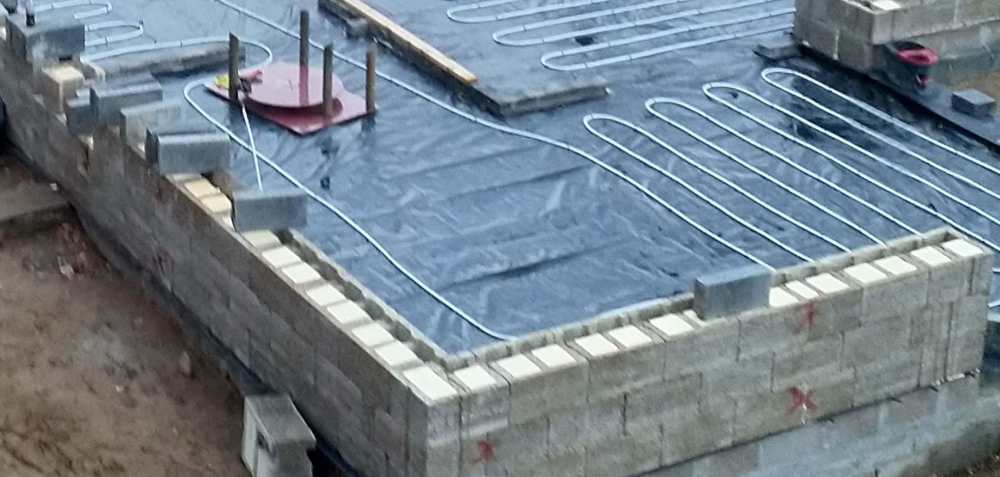
No direct pipes in utility, as the UFH manifold is at the back of the utility so all pipes transit through, had to insulate most to keep room temp down. Don't really buy the need for loads of pipe on a kitchen either, you may be shocked how little pipe I even have in there (yes I am running a heat pump). So kitchen diner is an L shapes room. Kitchen is the bit with the single pipe in it, the pipe runs between wall units and island. Does it work - yes, kitchen is currently 20.2 degs and it was 3 degs overnight. Total floor area is 192m² for bungalow and less than 600m of pipe.
-
Thin mineral wool or glass wool with aluminium layer for cavity wall
JohnMo replied to Clennls's topic in Heat Insulation
Bit lost what are you trying to do with the aluminium? Not sure what damp has to do with a cavity wall? -
£44k - why would you bother. UFH £1k or less materials Panasonic heat pump £2.5k Hot water cylinder £1.5k That's it materials wise. Plumber and his mate two days to UFH. Just need pipe and manifold - no pump or mixer or actuators. 210L unvented heat pump cylinder. Bring supply pipe from ASHP through wall to 28mm diverter valve (not a mid point valve). One did to cylinder other to manifold. Return pipes just tee tee together and go back to heat pump via a strainer and a couple of isolation ball valves. Run everything from ASHP Controller. So £5k materials for full heating system is and £39k labour and PV installation. Even with a min buildings regs house 7kW is big enough. Airtight with MVHR you should be looking nearer 3kW. 13kW of PV is huge, and may be capped for export. So you really need to size correctly. We are NE Scotland and yesterday was no sun directly, hot water and 3hrs of heating done just on excess PV after charging battery, we only have 6kW and lots of shading at start and end of day. Battery, the inverter size is important, you need one that can do 6kW continuous output, connected to grid or in power outage. Then you don't need stupid emergency only power.
-
As described very well above. Individual room control means zones. One of my loops does, main bathroom, then meanders around the hall near the front door area, then does the kitchen diner. All with a 100m of pipe. Bathroom is routed through first as that wants to be warmest. Just a matter of a little logic. The room isn't really warmer than anywhere else, just feels warmer because the floor is slightly warmer.
-
Who can dig the trench for my new electrical supply?
JohnMo replied to Bancroft's topic in Electrics - Other
When we did our zero mention of Lloyds accreditation. The wording was are we doing it (SSEN) or are you doing it yourself. I said myself, end of conversation, quote amended to reflect that. Our run was along the edge of the road in the verge (within 1m of road). Road work sign either end of works and ground work contractor just got along and did it. -
Think the person that designed has missed a trick. Study and WC could be one loop - well within 100m pipe length. 1 loop removed The hall could be heated by the pipes that transit through the hall by just spreading the pipes at 150 to 200mm centres instead of bunching them all up against the walls. Another loop removed The utility could be heated with the same loops in the kitchen. Another loop removed. So 3 loops removed without much thought. Ignore the flow rates. Flow rates, you set all flow meters fully open, set the flow temp to get the colder room to temp, rooms which are too warm reduce flow at the flow meter. This will give the heat pump the opportunity to have all the flow it wants, so it can modulate freely. This assumes no buffer, fully open system on a single zone. I have 7 loops over 192m² on a very loose 300mm centres and very rarely exceed 35 degs flow and that at around -9 outside. So you should never exceed low very low 30s, maybe high 20s ever.
-
Considering PIV
JohnMo replied to MortarThePoint's topic in Mechanical Ventilation with Heat Recovery (MVHR)
Be careful with the heater settings at 500W your looking at £3 a day when it's on. And that's just taking the chill of the blown air, not heating the house. So central heating is addition to that. -
Have you checked the price yourself? Why insulation type blocks in a garage? They do thinner cheaper ones that are just concrete filled. You still have the equivalent of a 100mm wood insulation.
-
Who can dig the trench for my new electrical supply?
JohnMo replied to Bancroft's topic in Electrics - Other
You can dig it yourself or use any third party. Trench has to comply with the rules and back filled to comply with the rules. Our ground contractor did ours, SSEN ran cable, did the earth spike etc. ran cable to meter location. Isolated supply and then disappeared, next day another person SSEN came along with our electrician they did the meter and temporary consumer unit. We backfilled trench after. To do it yourself, get SSEN to requote for what you are actually doing or not doing, otherwise it will end up a mess. Our temporary supply was actually positioned in the final location, in a waterproof box. When house was water tight the water proof box was cut away and everything screwed in to final position. Temporary consumer unit was replaced with final one by electrician. Should be the same for 3 phase, I assume? Could ask why 3 phase, but I won't -
Be worth watching this, it's talking about heat pump but equally applicable to gas. System used is easy and doesn't take up much space, you need to screed over, but you get good heat transfer. If you are keeping the rads as they are you will need 2 flow temps one for radiators and the other fir UFH so a mixer is needed. You can several different mixers done good some not so good. An Ivar mixer is good, link to first one that came upon Google, shop around for best price. https://underfloorparts.co.uk/product/ivar-uni-mix-underfloor-heating-ufh-pump-mixing-kit-underfloor-heating-manifold-control-unimix/?srsltid=AfmBOoqyNurwUf8R844Nbc0pdaRMSUPkMqZy8wvhKLBpAY1c1CW1wiun Link to discussion here Problems you could have Zones - the more thermostats you put in the system the worse its going to perform. Small zones and short cycling is an issue. I would suggest you explore weather compensation, you would have TRVs only on the bedroom radiators, everything else would just tick away on weather compensation. Your boiler does allow weather compensation, adding an external sensor, will allow heating water temperature to change in response to changes in outside temperature. This has a big impact on gas consumption for the better.
-
Air Source Heat Pump - 12kw vs 16kw
JohnMo replied to sokoma's topic in Air Source Heat Pumps (ASHP)
Not sure where the 75m² comes from they said 150m² footprint. Plus they are doing up the existing house so who knows the final footprint available. No one said average build (except yourself) I am just applying stuff I know to the OP questions. -
Radiators needed for ASHP and UFH?
JohnMo replied to YorkieSelfBuild's topic in Air Source Heat Pumps (ASHP)
Think what is going on and I said this on another post today is Installer knows you really don't need radiators in bedrooms when they are above a heated area in a new build, well insulated house. But to tick a box they are specifically specifying a high flow temperature, to allow smaller radiators. The installer and architect have basically said that. Reality is you run UFH as you would (no mixer hopefully) the radiators just tick away at UFH temp. Not really doing much, but everyone is happy(ish). Room upstairs take secondary heat from below anyway. Many state on here you just don't need them in bedrooms.