


JohnMo
-
Posts
13296 -
Joined
-
Last visited
-
Days Won
200
Everything posted by JohnMo
-
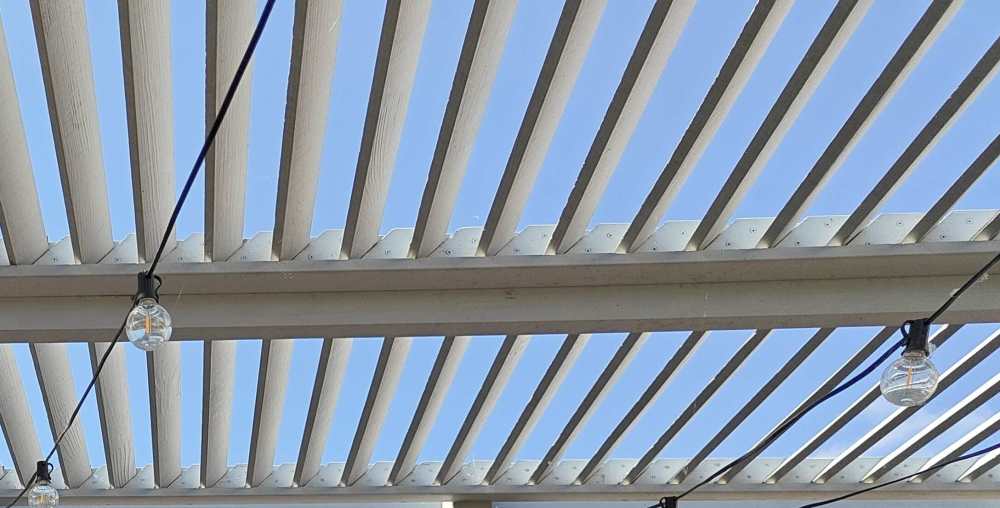
The datasheet says 26kg each, but they are also 150mm shorter than the datasheet, so suspect near to 25kg each. Have used bifacial so they are black both sides. Will be using a Ecoflow Stream Ultra battery inverter, each 500W panel goes back to the battery and you can hook up 4 panels individually via 4x MPPT in the unit. Comes with a 2kWh battery also. Apart from panels the rest will be open with timber strips angled at 45 degs every 50 to 75mm (yet to be determined), a bit like this
-
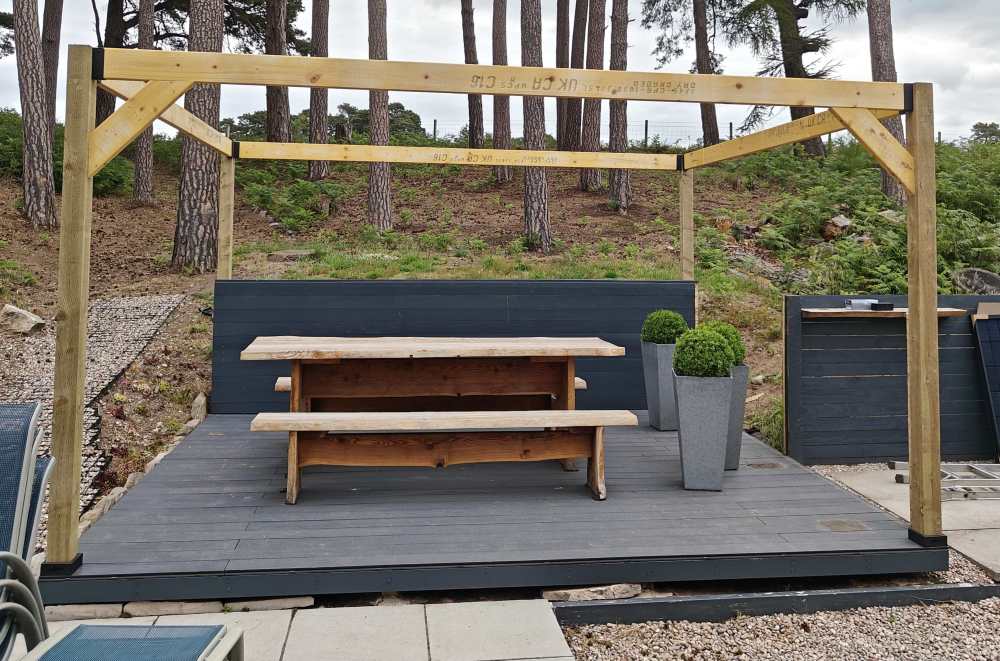
So day 1 working on my own, will finish corner bracing tomorrow and look at PV mounting. Posts are 100mm square. Side rails are 6x2. Rear vertical posts are screwed to existing decking posts which go up to the height of the rear wall. Used 3x 200mm structural screws on each post.
-
No it doesn't for a new build house, a 7.9kW geny isn't big. It will allow heat pump to start stop and run while the hob is on cooking the tea. Any Watts excess can go into the battery. I would really just install a room sealed log stove for belts and braces secondary heating. No power needed at all and house heating sorted. And have a back up generator, to run heat pump and house if you want.
-
I've just started mine, 2x 500W panels in the centre and the 45 Deg slat roof either side. Mine is 100mm posts and 6x2 perimeter framing. Are your panels really huge, your structure sounds huge. Zero chances of it being falling over even if your house fell on it.
-
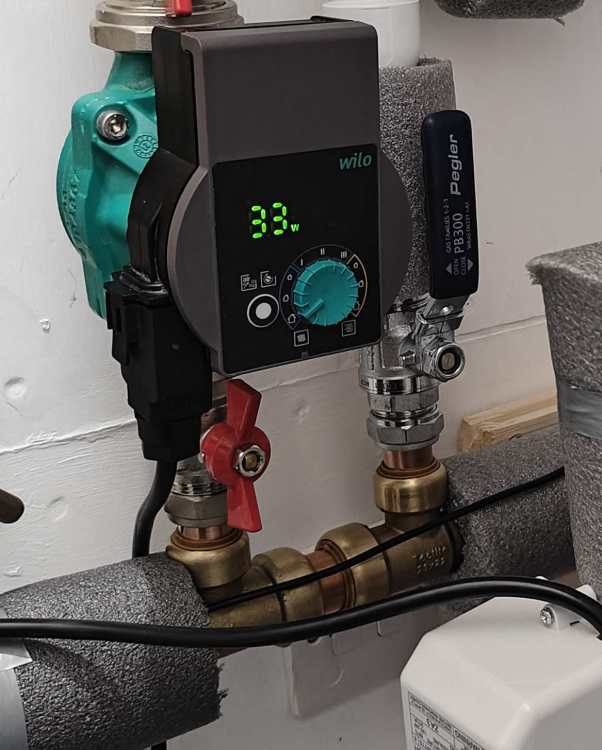
Or even easier and cheaper a close coupled tee. So on the ASHP pipe, take suction tee to boiler and return to a tee very close to the first. This would give complete hydraulic separation and let you boiler pump run as it needs. But ideally you would match ASHP flow and boiler flow to be pretty close to each other. It would look similar to the attached, but the pump would not be needed. Assuming the oil boiler has one. Question can you get an oil boiler that does weather compensation and will run priority demand hot water? If you can't this may get messy. An oil boiler may demand mixers on the UFH. Or you do a 2 port buffer, they are more efficient than the normal 4 port but the whole control scheme changes. 2 port buffer temp is the only thing that starts and stops the heat source, house temperature. So ASHP or boiler would fire to manage the buffer temperature. You do a simple electrical change over switch or control on outside temperature to switch over or a combination of the two fire power outages. The central heating side just activates the secondary circuit circulation pump. To do this you are better to use a small hysterisis room thermostat in say the hall, run a fixed temperature on heat pump, say 35 degrees and similar on the oil boiler. Then you need to think of DHW heating - ASHP will priority demand so run two flow temps one for heating and one for DHW. Your boiler? You need to start reading mitsubishi manual to see what it shows and understand what it does first. New build well insulated on MVHR heat demand is very low, an oil boiler doesn't modulate well, if at all. So you will need the smallest boiler you can get. Or a huge buffer.
-
Made a start, no photos yet. First issue - solar panel has reduced in size, from dimension on datasheet. Total length stated is 2094, actual 1950mm. Throw away statement "due to technological progress dimensions may change" So a couple of design tweaks needed.
-
We are NE Scotland, so milder than you, but still get -9 most years where we are and more than our fair share of power cuts. We have a 6kW heat pump, and it runs a small generator (7.9kW) and you can cook your tea at the same time. So house runs pretty much as normal. But now have the generation as a secondary standby. Have a GivEnergy AIO battery, 13.4kW usable storage capacity, charge it up on E7 it will run the house on all but the coldest days until next recharge. Hybrid plumbing can be done in several ways. You can run in parallel, just tee in to the ASHP flow and return, you can run in series, so all water always flows though the boiler. I had mine (decommissioned last week) via a plate heat exchanger. All depends on your house and heating system layout. I found the generic control system in the heat pump pretty rubbish, so in the end did my own. Used a good UFH controller with outdoor weather sensor and a timed average outside temp to initiate a heating demand. Controller only used to start stop boiler and monitor room temperature, hall sensor used for control. Used a +0 and -0.1 room sensor to control the heating demand, this went to the boiler via the UFH controller. Boiler flow set higher than WC curve on the ASHP. Setup boiler so once started it ran without stopping (a fixed flow temp on weather compensation curve and set back function). The ASHP would switch off as it saw the return temp satisfied. Boiler min output was about 7 to 8kW. No buffer or volumiser required. Have a read https://forum.buildhub.org.uk/topic/41531-boiler-heat-pump-hybrids/
-

Should I replace my cavity wall insulation?
JohnMo replied to rowan_bradley's topic in Heat Insulation
With rockwool and poly beads have the same R value, would make zero difference to your heat loss. Only thing I would do wait until winter and use a thermal camera on the outside of the house to make sure the outside walls and even colour. An 80s house is likely to have a thin cavity anyway so no huge gains with way. You will be better off looking for drafts and fixing and doing loft insulation well. Then looking at the heating system itself to get efficiency gains there. -
My other thoughts are about where the legs sit, is the floor strong enough, would feel sure you would be asked.
-
Having experimented with just about every configuration. A hybrid will cost you more to run. Just about every heat pump will support a hybrid solution. But the bottom line is you don't need them. But they only ask for the additional boiler to start if the heat pump cannot cope, so is undersized for the duty. If you are asking the heat pump for 30 Deg flow and the heat pump is doing that it will not ask for the boiler assistance. So a volumiser. With UFH a volumiser isn't generally needed, you are just adding extra costs. So hybrid solution would consist of Another boiler and oil tank, all associated materials, spend that money on solar and or battery. KISS. One zone, all UFH loops on or off, NO mixer or additional pump on manifold. Run from the manufacturer controller only, NO third party controls, run on weather compensation. Or instead of pure weather compensation, a slightly oversized heat pump, set up weather compensation and use the second operating point to run hotter when there is excess PV generation, and or during cheap tariff periods. This will reduce bills by quite a margin. Make sure your heat pump can do cooling, adds flexibility you may need or like it.
-
My two pennies worth. The stairs (treads and hand rail, balustrade would not comply with regs. The rear of the treads needs closing, there's a dimension in regs for max opening. It needs a hand rail that complies on the room side of the stairs. The balustrade with horizontal mid rail would not comply.
-
Something like minimum 27 for summer cooling setting and 19 in winter heating mode. Would have most the soft folk in this country crying in their cornflakes, either too cold in winter or too hot in the summer.
-
Wouldn't bother
-
Can't not pay that, so plus 60p per day
-
Coupled with PV not really, I actually spend less on electricity when it's blazing sun. ASHP runs a long time, powered by PV, battery needs less charge so less electricity imported. A dull day I might spend a pound or more on electric a sunny day 30p.
-
Fill your boots with a blob of glue, but doesn't do anything for you in reality. The island unit with draw open will use the legs nearest the draw as a fulcrum point. At this point with all the units screwed together you are having to lift the whole 2.8m of island unit with a couple of dozen plates. It's a bit like an elephant on one end the seesaw and a mouse at the other. The mouse being the plates. Do the maths. A quick calculation using best guess calculation based on, draws weighing 40kg with plates etc, Draws pull out 400mm Nearest feet 100mm in from unit edge of the island. The result is you only need 8kg at the other end of the seesaw. The end cupboard without worktop will weigh more than that. Without even consideration of the other units infilling the island and work top. Your overthinking an issue that isn't real. The shear strength of CT1 is 11kg/cm², gives more purchase than the small screws holding the legs to the kitchen unit. So the outcome if you had an issue, legs would stay fixed to floor, island unit would be in the air.
-
Well galvanized is out of the picture as the galvanize correctly the parts get dipped in a zinc bath. Your ship has somewhat sailed already so you have what you have. Although inside the heated environment, I assume the steel is attached to the foundation below insulation level, so will always be colder than the room. So will need to be insulated and boxed in.
-
If you include wood as an insulator, and with the cavity is insulated there is no thermal bridge to speak of. So not sure what the EPS blocks bring to the party.
-
Have a read on here and the download section https://www.thermablok.co.uk/our-products/thermablok-aerogel-insulation-strips/
-
Almost zero, it's a conductor.
-
Cold bridges. If you can draw a line without lifting pen off the paper through the insulation around the whole building you are thermal bridge free. Now apply that to your sketches. Do you have continuity of insulation?
-
ASHP grant without radiators/heating upstairs
JohnMo replied to BadgerBadger's topic in Air Source Heat Pumps (ASHP)
A Maxa i32V506. A 6kW heat pump -
Kitchen units aren't screwed to the floor normally. An island unit will normally have a heavy worktop on it holding everything down. The kitchen units should be all screwed together anyway, so batten add zero. CT1 bit of a waste of time. When the worktop is in place.
-
So you have a cold bridge from the outer block work and through the steel. Steel is a great conductor. Your plan does zero to address the bridge. I would do something like this Red 25mm PIR, yellow mineral wool
.thumb.jpg.5295c24adc5664dc3031184f2679df74.jpg)
-
ASHP grant without radiators/heating upstairs
JohnMo replied to BadgerBadger's topic in Air Source Heat Pumps (ASHP)
Another image on a hotter day and night. Looks like a lot of cycling but reality is just over one cycle per hour. Big spikes are DHW heating. House still gets warm, but recovery is a lot quicker, and more importantly, it doesn't feel overwhelmingly hot, as it would pre cooling. It's not Aircon, but no air blowing either.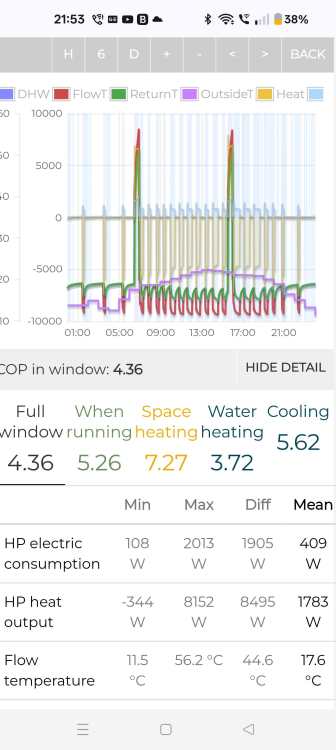







.jpg.93a8fa2851b1139224872857fa8b43cc.jpg)
