


Olf
-
Posts
315 -
Joined
-
Last visited
Everything posted by Olf
-
For me it looks doable: 32mm from the sink (preferably running in the wall and behind the bath) connecting to 40mm from the bath as close to the shower as possible, then joining to 50mm from the shower and out through the wall. The last stretch if ran in utility just sound insulate and box (though dropped ceiling is of course a bit more handsome). You still need either venting to atmosphere or AAV to make sure toiled does not suck out other outlets. I can see nothing bad in running toilet straight outside, just be careful with making the section through the wall at the right height (flex can only take so much at limited distance, and for sure won't make solids go up)
-
For sure water got there somehow If there is a point leak in the slan, the moisture will seep through the conrete, thought it would do this radially from the point of the leak (just pour a bit of water elswhere to see what's happening). Saying that, edges of the slab could promote moisture migration and make it hard to say what exactly is happening there.
-
Another autogenerated layout that makes little practical sense, but takes the company no time to make (and increases bill of materials, extra win) They did not even bother to mask out under toilets/bath! If that was my barn: - hall/utility and corridor warmed by this bunch of pipes going elsewhere, especially ends of return legs. Does plant room really need heating? If yes, just skimp on pipes insulation there. - living area - one concentric loop: maybe closer to 200m length, but due to lack of U turns less flow resistance than current 3 loops . Way easier to lay and more uniform heat delivery - the same with kitchen/diner - lov(th)e the dendrites surrounding the kitchen island on the 'project'. I hope the fridge/freezer is built in, otherwise will be cooked from underneath. - bedrooms - I'd run serpentine across the room, so the most heat is delivered in never obstructed traffic areas. Possibly even U shaped circit, with nothing under the bed (at the windows)- as little heat will travel up anyway as shielded by the bed. But that is a bit personal, dependant on comfort night tempreature (though U shaped circuit with reduced pipe spacing will match output of what's on that sketch and will be more efficient - less losses downwards)
-
It will be more or less destructive: try with a tip of a blade in the gap and pry against the body of the vent. If not successful use small woodscrew acting like bottle opener You mention percents, so you are talking relative humidity - relative to the temperature of air containing water vapour. That suggests you temperature upstairs is a bit lower than downstairs. Absolute humidity (expressed in g/m3) is likely similar, though bathrooms and kitchens will have it higher after use, and so bedrooms in the morning after all you breathe out. Near windows heat is lost more easily than at the wall, the temperature locally is even lower so RH is increased for the same amount of water in the air.
-
The cutter came with built-in deburrer, spent whole day spinning it, only now read the comment 😁
-
A question I could ask a 'competent professional' work I'm trying to mimic (though I admit it does not leak, unlike my amateurish attempt) Copper it is then, but that prompts for another silly question: the cutter leaves a little of burr inside. What would happen if I left it (I promise not to!)- only effect on the flow, or risk of debris collecting/being released as it wears?
-
This one is 28mm Oh, that may be the culprit. It looks like a trip to try other olives and joining compound in the morning.
-
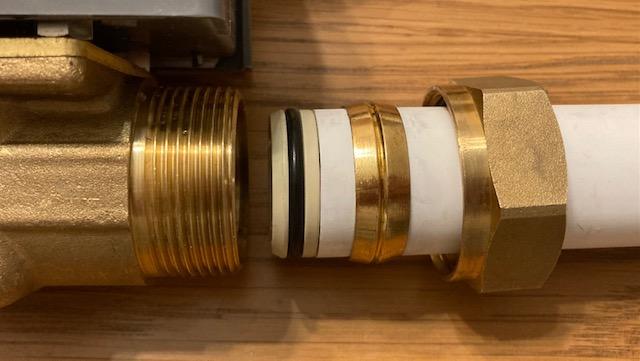
Zone valve came with compression fittings (olive + nut) on both ends. Speedfit pipe fits just about, but despite tightening the nut I can still turn it and with enough turning I can pull it out (and when filling the circuit under pressure it started moving out as by magic). The olive does not seem to compress and bite the pipe. I'm puzzled as the nut is as tight as I can reasonably make, is there any trick with plastic pipes, should I use copper instead? On the photo the olive is where it slides up to (there is slight discoloration on the surface of the pipe, but no round witness mark I'd hope for)
-
Why not passive slab? (100 to 150mm concrete on 200mm PIR on hardcore) That's a question your SE should answer, and if you don't want to have one, at least BC needs to yay it.
-
Thermal bridging from filling cavities under windows
Olf replied to RachelGodfrey's topic in Brick & Block
Yes, rigid insulation board stripes do the job. Also for the reveal you can use XPS tile backer boards instead of plasterboard: that removes thermal bridging through the surface. I would strongly recommend sandwiching an airtight layer under the surface board (regardless whether you choose xps or plasterboard), taped to the window on one end and sealed to inner skin - that way any microcracks caused by opening/closing of the window or structure movement won't rob you of warm air later. For such small area nothing fancy is needed, even stripe of DPC/DPM will do. Saying that, what is your airtightness strategy for the walls? With them stripped, now this is the right time to make it right.- 1 reply
-
- 1
-

-
I've just finished laying this system: EPS panels with 5-8mm Mapei 3240 screed on top. It adds only about 20kg/sqm, so well within bearing capacity of any existing floor. Frankly, thanks to load now spreading via new P5 boards, the point load is actually reduced (vs original floor boards, working pretty much independently as indicated by creaking - one of the reasons I decided to lift them), so there is less sagging and bouncing. EPS panels are very easy to route (if messy), though of course it would be much easier to use pre-made channels at 150mm centres, especially if serpentine is the layout of your choice. Also when extra grooves are added, more screed flows into them (or rather those you don't use) so you'd end up using more screed, making the floor a bit heavier (but sturdier at the same time) - I ended using 25kg bag per 1.5 sqm for 6mm, on a flat surface that should cover twice the area, so much goes into unused channels. I can't yet say about performance, I'm few days away from connecting to the existing system.
-
It sounds like you have good level of insulation now, but you still need to do your maths homework to know how much heat input you need to balance all the losses - see Once you know the heating power needed divide over floor area to get required output per area and that will tell you if 35'C is realistic Using clips you can do whatever you want I'm not sure though if there are any on the market that are designed for hard surface. 100mm centres should increase your heat output, but there is more to the story (shape of the loop, length) that may affect it and make no better than 150mm centres No cnc, because after routing 16mm channels for pipes your floor will become as stable as cheese. If you find a way to attach pipes to the boards you could pour thin fiber reinforced screed - look at Lewis deck for inspiration
-
Long story short: plumber was booked for the end of month, found other project, kindly offered me to wait 3 weeks. Thank you, will do it myself. Question: what tools and techniques to use for the best result? 1. The largest nut is 52mm on the pump, I may be able to handle that with waterpump pliers. I feel a large jaw adjustable spanner should do the job on all the other nuts (41,37,30 mm). 2. I can see all the connections rely on rubber seals - should they be dry, or is there any grease to be applied first, as necessity or good practice? 3. How tight the nuts should be? Until it does not move any more or better hand tight+1/4 turn with a tool is enough 4. Any tricks to feed UFH pipes on the eurocones? Warm pipes, washing liquid or just sheer persuasion? Any reamer for the pipe to remove any burr after cutting and/or 'pre-cone' it?
-
Retrofitting - UFH - Wundatherm Rapid Response vs Screed kit
Olf replied to agamemnon's topic in Underfloor Heating
That is not true. UFH suppliers marketing juggles with numbers to their liking end end up with such statements (as I quoted in previous post) You still need to run pipes from the heat source to UFH, add manifold and pump and there may be more pipes exposed than currently Not quite, Building Regs Part L claim otherwise. Also with large losses downwards your system may end up so inefficient that you'll never reach a comfortable temperature indoors. At the same time using a lot more energy, with current £££ price tag. Is that preference? Something is off with the calculations Depending on walls construction, that will be less or more, but still disruptive work - on top of the mess and restrictions in using the space when laying UFH. Imho using decent insulation under the laminate and going electrical mat under traffic areas for comfort/boost is the way to go in this case. If you're committed to butchering the walls to lift the doors, chasing to hide the existing pipes is a breeze in comparison. -
Retrofitting - UFH - Wundatherm Rapid Response vs Screed kit
Olf replied to agamemnon's topic in Underfloor Heating
What is driving this idea to start with? By now you see that your floor structure is not suitable for UFH, frankly contrary to the claim on their website 'So in comparison to a system using just radiators, it’s superior in insulation and will heat more sufficiently with better energy efficiency'. Don't get me wrong, I'm using the very same boards, but upstairs only and even that with in between joists insulation. For me it was to gain extra surface and room layout flexibility restricted by the radiators, so what get you hooked on UFH? -
100mm PIR on the 1st fllor sounds like an overkill to me: on the ground floor you have cold side at ~8'C, so you want to stay away from that, but on the 1st floor you have 'cold' side at ~21'C (= room temeprature downstairs, mind that warm air will lift so likely even higher) and any 'losses' that direction stay in the fabric of the building, so will make its way upstairs sooner or later. Why not fit insulation between joists (wool, not PIR as that is bitch to cut and fit), that will also act as acoustic insulation and lay the UFH pipes on top of the chipboard flooring and screed as planned originally? At least that's what I'm doing: 100mm Rockwool 45 between the joists, 22mm P5, Wunda EPS prerouted panels and thin fiber reinforced screed on top. I'm renovating, so limited in height and load hence Wunda system, you should have more wiggle room with choosing UFH solution.
-
They don't want to take the risk should you decide you need 80'C flow temperature and as a result wooden floor buckles. Do you know what floor temperature do you need, whether wood is appropriate at all? How thick is the engineered wood you're eyeing at? If you're after wood look then vinyl is vinyl and will never look like it. It's more like tiles, so if I had to go LVT route, I'd pick some colorful mosaic type.
-
Though I could not find that in builing regs, there is actually a nice chapter in NHBC standards. It also mentions 'long edges at room perimeters should be fully supported on joists or noggings' - oh well, I've got 2 more rooms to improve Though in my defence the existing floor (T&G planks) did not have that feature.
-
Intello has got variable diffusion resistance, though if you want to benefit from that you can still go for Gerband SD Vario at £140 a roll. It depends what building construction are you using it for and what do you want to achieve. For my refurb + extension I've used Protect Barriar and PHS Apollo (own branded Gerband I believe), which is still a massive progress in comparison to nothing applied originally . For optimal benefit and if your budget allows, or if you're bound by law (like Germans stipulating use of variable diffusion resistance membranes in all new buildings) choose accordingly. The membranes I used are both woven, not stretchy, easy to work with. I like Gerband products (used tape and sealant too) in use, though can't say the same about PHS store - though in the UK there is no much choice so you get (service) you pay for. Also 'no need for the plus unless you are using it to hold insulation in place like blown cellulose or similar or need it to be stronger' (from https://forum.buildhub.org.uk/topic/28471-would-you-tape-it/#elControls_427995_menu)
-
Sanity check - time to install ufh pipes / manifold
Olf replied to Moonshine's topic in Underfloor Heating
Do they have a decoiler? Serpentine is a bit of a bitch with fighting all the 180' bends, with poor technique it takes long to make it right -
The reflective component only works with air gap - will you have one either side? If sandwiched, it will be just a fancy airtight membrane. I disagree: from U value perspective alone, heat is not clever enough to distinguish what stops it from flowing and which direction. In steady state the same U cases the same flow. But life s not perfect and we have days and nights What stone cottage benefits from is high gravimetric thermal capacity (aka thermal mass) that delays the spread of heat energy (aka phase shift). And by the time it would try to get inside, it will start flowing back out in the night. Also a cottage usually benefits from uninsulated floor, with free underfloor cooling at steady 8'C
-
Everything helps bit by bit: - prevent roof from heating (reflective paint or coating) - remove hot air that collects in the attic (ventilation) - prevent top surface of insulation to capture radiant heat from underside of the roof (reflective film) - maximise insulation thickness (reduce speed of heat entering rooms) - increase decrement delay (so the heat flow created by day high temperatures is so slow that becomes cancelled out by nigh low temps) Superfoil is overpriced for what it does. Your 400mm of Rockwool does good job with stopping conduction, just lay something shiny on the top (emergency/space blankets). I'm not sure if a fan will improve flow a lot: temperature difference produces strong enough pressure to make a decent draught, it is the cross section of the roof vents that restricts the flow. Anectodal evidence is that when I open the loft hatch on the hot day the blow rips my head off (before roasting the rest)
-
Sounds like a plan: on landing (only 2 boards side by side) I'll add noggins under the joints. In the rooms I will just go with the flow: with many neighbouring boards, each shifted by half width, they will hold the short ends from either side.
-
That would make sense, though if gas could leak, why not the solvent itself (both cans are heavy) Is there a non-destructive way of checking that?
-
Today I came across 2 cans of foam clener that do not want to squirt the magic potion: one No Nonsense bough last week, used once (and was ok!). Today I can feel it is full of goodnes and hear it slushing inside yet not coming out - not in the gun, not with the nozzle, nor when persuaded with a screw. Another one: posh Ilbruck AA290. The same symptoms Was used about a month ago, today no response. What am I doing wrong?

