


MortarThePoint
-
Posts
2294 -
Joined
-
Last visited
Everything posted by MortarThePoint
-
Nice. I've used their flow sensors before and know the company to be reputable which is important
-
Nice. I've used their flow sensors before and know the company to be reputable which is important
-
Considering PIV
MortarThePoint replied to MortarThePoint's topic in Mechanical Ventilation with Heat Recovery (MVHR)
I need to install extractor fans anyway so the trickle overhead is small there. That's a lot less involved than ducting to a centralised unit. I don't want this to be anti MVHR as I think it suits many well. Personally: - I don't like all the ducting of MVHR. - I don't like the expensive single point of failure of MVHR - For my situation I don't believe the economics of MVHR work. Across 6months of heating season the average dT is about 13C and so the PIV annual running cost is £172 electricity. MVHR only about halves that due to its fan having higher power consumption. Even at £172pa the payback time would be looking like >15 years, based on a modest £2500 outlay. I suspect there are other annual costs that raise MVHR to costing over £100pa to run, taking the payback beyond 30 years. MVHR is largely about the heat recovery. What would you do if you ignored the heat recovery part of it? Sell me on MVHR without mentioning heat recovery ? -
It's a very interesting read. I've wondered about how to improve air circulation between rooms, even thinking about incorporating small fans into the bedroom walls to move air to/ from the hall. Children like to have their bedroom doors open at night and from an AQ perspective that's really good.
-
Gosh those values are very high. MVHR will help with those greatly. I'm looking to go a different way myself but similar principle
-
Considering PIV
MortarThePoint replied to MortarThePoint's topic in Mechanical Ventilation with Heat Recovery (MVHR)
I'll need extractor fans in the usual places and they will provide good 'leaks' I'm considering having them as dMEV too. I spoke to my SAP assessor and he thought it would be OK from the SAP perspective. My BCO has PIV in his own home. -
Considering PIV
MortarThePoint replied to MortarThePoint's topic in Mechanical Ventilation with Heat Recovery (MVHR)
Why not? Both draw fresh air in from the outside. MVHR distributes it better and does a better job of reducing energy waste but they are performing a similar function. -
Considering PIV
MortarThePoint replied to MortarThePoint's topic in Mechanical Ventilation with Heat Recovery (MVHR)
Sorry Peter missed your post. Ventilating an attic is normally a good thing isn't it -
Considering PIV
MortarThePoint replied to MortarThePoint's topic in Mechanical Ventilation with Heat Recovery (MVHR)
There is a lot of focus on PIV not being as good as MVHR on the heating bill side, which is only one dimension of this and I alluded to accepting that MVHR suits many so I'm more interested in people's thoughts on the other concerns. PIV Pros: Clean (filtered) fresh air blown in contributing to good air quality (AQ) No need for window trickle vents Controllable flow rate so can potentially be put into an AQ feedback loop No duct work and only one vent Low cost and low maintenance PIV Cons: Not as energy efficient as MVHR Many not distributed the fresh air as well as a ducted system Fabric condensation risk below 8C outside temperature ?more of a Timber Frame concern? Draught concern (if I was making a homebrew one I would include an ASHP powered radiator or the like) I am considering adding dMEV into the mix which would then greatly reduce the amount of air that is exiting via the fabric as well as improve bathroom dryness -
Considering PIV
MortarThePoint replied to MortarThePoint's topic in Mechanical Ventilation with Heat Recovery (MVHR)
Sorry for so many posts, but the picture is forming slower than I'd like Looking again at that unit (Blauberg EC S5B 270 £1250) it consumes a lot of power and it all looks to be fan related (i.e. no resistive heater or heat pump). Comparing it to a PIV system: PIV at 60l/s, dT=13C P_fan=20W, Q_heat=780W --> P_heat=260W (based on COP=300%) TOTAL=280W MVHR at 60l/s, P_fan=150W, Q_heat=780W*(100%-87%)=101W --> P_heat=34W TOTAL=184W So at an outside temperature of 6C that MVHR is saving you about 100W of electricity over PIV.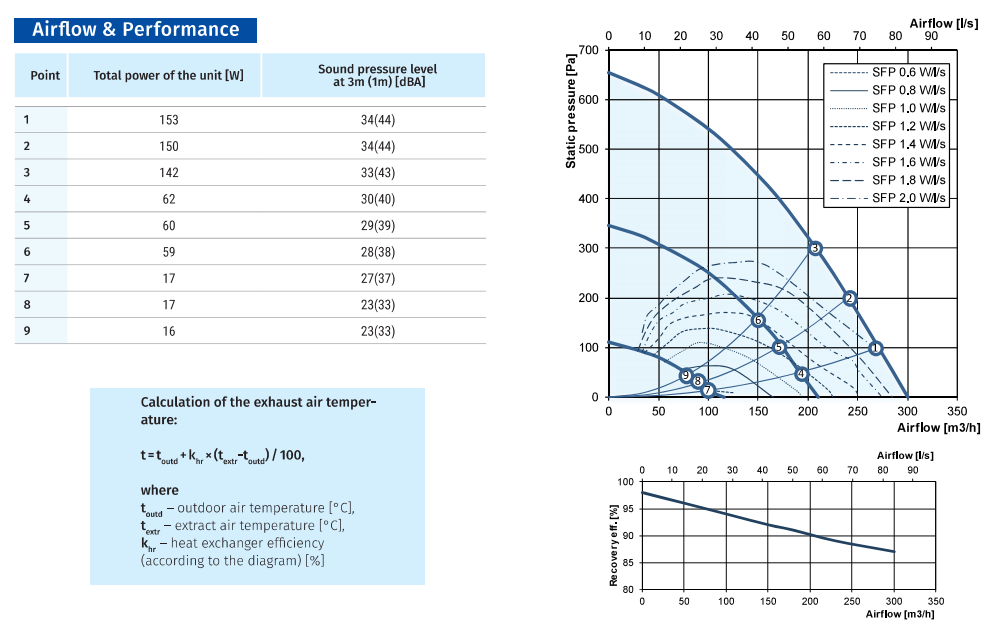
-
Considering PIV
MortarThePoint replied to MortarThePoint's topic in Mechanical Ventilation with Heat Recovery (MVHR)
That was a pretty weedy and cheap system. Looking at a more expensive Blauberg unit the numbers are better (below). The blue shaded text suggests the efficiency is quite flat with outside temperature, varying much more with flow rate which makes sense as that is what impacts the 'thermalisation' time. Blauberg EC S5B 270 £1250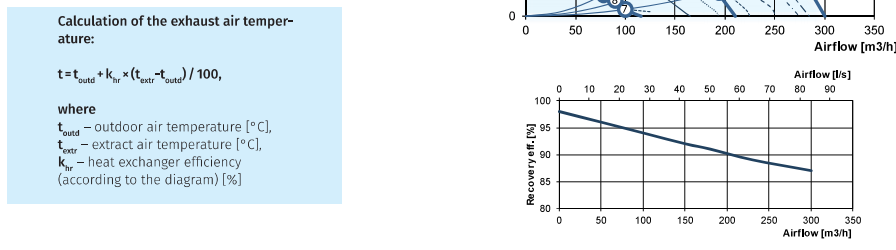
-
Considering PIV
MortarThePoint replied to MortarThePoint's topic in Mechanical Ventilation with Heat Recovery (MVHR)
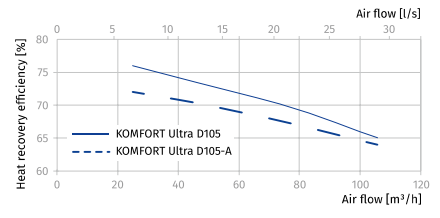
Thus far I have only found the graph below which is in someone's academic thesis and based on Stockholm where it is much colder. The temperature transfer efficiency is looking pretty linear and taking it as 87% at -4C and 95% at -16C it would be about 80% at 6C. These curves are suspiciously absent from the sales literature of MVHR systems though to verify. Blauberg Komfort Ultr 64-72% I can see heat recovery efficiency vs flow rate: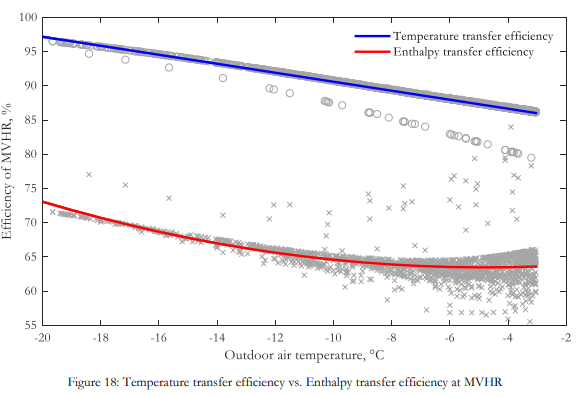
-
Considering PIV
MortarThePoint replied to MortarThePoint's topic in Mechanical Ventilation with Heat Recovery (MVHR)
I'm not seeing the relevance of 15C and having a quick Google suspect you may have used the EngineeringToolbox calculator but the air after heat exchanger temperature won't be constant at 15C. I can imagine the recovery (i.e. heat exchanger) efficiency being lower at smaller temperature differentials, but I can't find data readily available.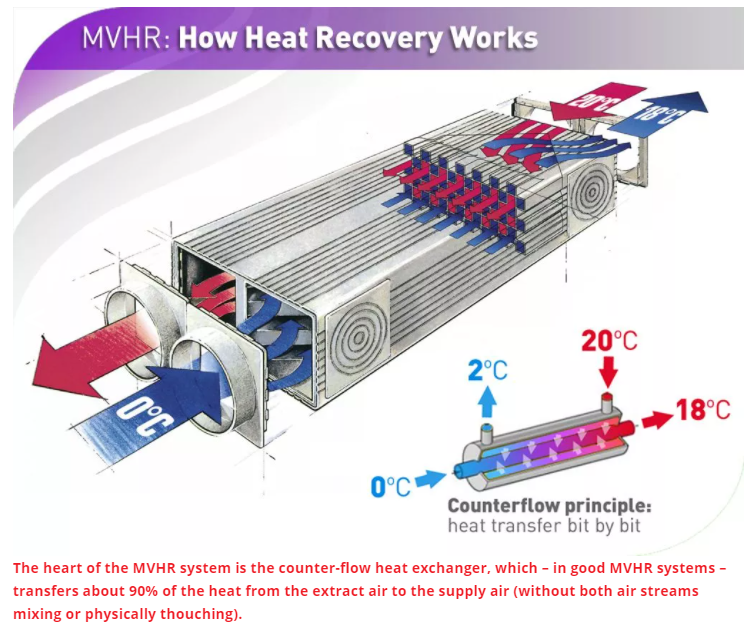
-
Considering PIV
MortarThePoint replied to MortarThePoint's topic in Mechanical Ventilation with Heat Recovery (MVHR)
Well that's vitally important as it's very rarely -5C around here. It's efficiency at an outside temperature of 6C is probably more representative. Can you share a link to the calculator please -
Yes, that is a concern. I know there has been a lot of progress in gas sensors over the past 20 years and hoped that some would have filtered down to consumer grade products. I do see some interesting IR based CO2 sensor modules for around £20 and PM2.5 ones for around £30. That's probably what I would incorporate into a homebrew one. Yes internal AQ. We're not having MVHR but I am looking at PIV and/or dMEV and so there is scope to close the loop on air quality which MVHR would also allow. MVHR is obviously a more energy efficient approach, but we're exploring all of that on another thread.
-
My budget is probably up to around £175. I don't need professional grade calibrated stuff, but I don't want junk (despite having just bought a £17 one ? ) Looks like I may have to make my own system which is a time sink but interesting. I'd buy something now rather than waiting to make something in a couple of years time.
-
Confused by Triple Glazing Justification
MortarThePoint replied to MortarThePoint's topic in Windows & Glazing
Your numbers look correct. 100m2 with an average U-value of 0.32W/m2K and temperature difference of 13C will pass 100 * 0.32 * 13 = 416W of heat. An ASHP will consume about 140W of electricity to create that heat (based on COP=300%). 140W average for 6 months with an electricity price of 14p/kWh works out as 0.14kW * (24hrs * 183days) * £0.14/kWh = £86/yr. That's the total cost of all of the 100m2, not just the windows or the difference between the two window types. My previous calculation identified 22.8kWh per year of heat for 1m2 as the difference between DG and TG. Based on 20m2 of windows, an ASHP (COP=300%) and 14p/kWh that would yield a total electricity saving of ((22.8kWh/m2 * 20m2) / 300%) = 152kWh per year, which amounts to 152kWh * £0.14/kWh = £21.28 per year. I worked out on another thread that 1kWpk of solar panel sited well in my area would generate 1000kWh per year. So if I wanted to save that 152kWh, I would need 152kWpk plus whatever inefficiencies, call it 200kWpk needed. Solar costs around £1/Whpk so that's £200. A 350Wpk solar panel is about £350. If you have a solar array you would get more environmental benefit by adding a single panel to your array than by upgrading >30m2 of windows to triple glazing (in the South of England). There are exceptions to this logic though. For example if you don't have an ASHP and want to keep all heat leaks down in order to avoid one. You may live somewhere that is much colder and gets less sun. The perversion of all of this is that I may end up going TG due to the 'brochure value' of it. We're building for ourselves, but I have to be mindful of the impact of decisions. That said, I'm still not convinced we will go TG. -
Thanks, I've started looking at various sensor modules so may end up with a bespoke system
-
I am interested in getting an air quality monitor, to include a CO2 meter. Can anyone recommend one? It would be good if it could measure: CO2 Particulates (e.g. PM2.5) Temperature Humidity Even better if it could log these, failing that Max/Min would be good as well. I have found various on Amazon, but they aren't particularly popular. This one was so cheap I have bought it to take a look, but am very dubious given the low cost: https://www.amazon.co.uk/dp/B085DJQRY1/ I'd be keen to get one I would trust a bit more though.
-
I'm interested in getting one of these, what model do you have and do you recommend it? Don't know much about MVHR unfortunately so can't really help with your main question
-
Confused by Triple Glazing Justification
MortarThePoint replied to MortarThePoint's topic in Windows & Glazing
It's not a utilitarian argument though. The real justification for WBS and open fires is emotional/aesthetic. People want a fire. I can see they're bad in cities but in the countryside not so much. We're all wasteful even when being environmentally conscious. I doubt many here have built the smallest house they can bear. We make compromises and balances to fit our own priorities and that's not one size fits all. -
Considering PIV
MortarThePoint replied to MortarThePoint's topic in Mechanical Ventilation with Heat Recovery (MVHR)
Completely agree, the cost of powering the fan (20W?) is small compared to the cost of heating the cold air up (400W of electricity at 60l/s and 20C temperature difference). 200W at a more normal dT=10C. But if trickle vents are/were doing the job they're supposed to then they'd be exchanging the same volume of air and costing 400W too. -
Considering PIV
MortarThePoint replied to MortarThePoint's topic in Mechanical Ventilation with Heat Recovery (MVHR)
In theory it should be no worse than trickle vents, except for the power consumption of the fan itself. -
Considering PIV
MortarThePoint replied to MortarThePoint's topic in Mechanical Ventilation with Heat Recovery (MVHR)
This sounds intriguing. Is that like food chillers? You need someone that wants to keep something warm or does a lot of endothermic reactions. Converting hot air to electricity is pretty inefficient (thermoelectric generators, thermopiles or even Peltier). Heating offices etc another good option. -
Considering PIV
MortarThePoint replied to MortarThePoint's topic in Mechanical Ventilation with Heat Recovery (MVHR)
I don't know how they work but you have presumed a single thermalization chamber that averages the temperature of the incoming and outgoing air. If instead you had three in series, the middle one would be at 15C, the inner at 17.5C and the outer at 12.5C. I'd imagine MVHR works on a succession of thermalization points. I presume the airs don't actually mix however. Another method would be to have a heat pump extracting heat from the outgoing air and putting it into the incoming air. Do you ever get condensation issues with MVHR? There is, wind ? couldn't resist it. Doesn't fit the context as well as a gale though.

