


MortarThePoint
-
Posts
2294 -
Joined
-
Last visited
Everything posted by MortarThePoint
-
Partitions: Timbers studs Vs Metal C studs
MortarThePoint replied to MortarThePoint's topic in General Construction Issues
I want to do the same on some walls. Got a price for 11mm OSB3 of £25 per sheet though ?. You're supposed to keep plasterboard off the ground and I suppose the same applies to the OSB3 but feels like some support at the bottom would be good. -
I've typically limited my thoughts to timber stud partitions, but am warming to metal C studs. The timber option has felt like the 'better' option and metal done for speed in the commercial setting, but I expect that's outdated thinking. Strength is a major driver and I've felt timber has that one. A major win for Metal is no warping, twisting etc. Timber feels like it's the better choice should you think you may want wall mounted shelves etc. How do you mount skirting board to metal studs?
-
10mm (2*12.5 vs 15). Still not massive So you went 2 layers of 12.5mm WallBoard rather than 1 layer of 15mm SoundBloc
-
Considering this article on the BG website (admittedly about walls), the sound attenuation in dB is linear with plasterboard mass. I have plotted the points they identify below and extrapolated some other makeups. Two layers of 12.5mm WallBoard has better performance than one layer of 15mm SoundBloc F and is slightly cheaper. Probably not when the additional screws are factored in. It is thicker which is a negative, but probably wouldn't be noticed. Installation effort is debateable as lifting a 23kg plasterboard sheet twice is arguably less effort than lifting one 41kg plasterboard sheet. WallBoard is more available however so that may mean I have to go that route. All of this is a gross oversimplification as the acoustic benefits can't be fully appreciated in a single number, but it could be indicative.
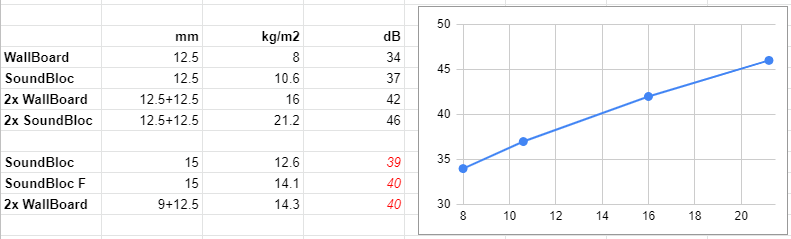
-
Similar story unfortunately. I don't think Knauf of Sinai GTEC do a combined sound and fire board. Like a lot of self builders, I think I find myself discussing niche products with suppliers which when times are like they are now are just deprioritised. I don't know, but I'd guess BG produce dozens of WallBoards for every SoundBloc they make, let alone SoundBloc F.
-
I was planning to use a single layer of 15mm SoundBloc F mounted @ ~450mm centres in resilient bar for the ceiling. Due to availability I am wondering about changing that to 2 layers of 12.5mm WallBoard mounted @ ~450mm centres in resilient bar. The mass will actually go up from 14.1kg/m2 to 16kg/m2. Both options would be skimmed. Price is about the same and I expect the fire resistance of two layers of 12.5mm WallBoard would be as good as one 15mm layer of SoundBloc F. Any thoughts?
-
Looking at the White Book C06 S06, it seems it can depend if you are trying to achieve BS EN1365-2 or BS 476: Part 21: 1987. No mention of skim. If I read it correctly, 600mm centres requires 1x15mm WallBoard or better. A skimmed 12.5mm sheet feels like it should be as good/thick as a 15mm sheet, but I don't see it sanctioned anywhere. Your BCO may accept it, I don't know.
-
BCO said he's wanting 30 minute fire rating so 15mm of fireline OK. He asked if it was going to be skimmed and I said it was, so that may be significant. If using 12.5 sheets I'd may have to double up.
-
It's ceilings I'm particularly interested in. Some of it is for a garage with home office above. Regs say I have to have fire rated, but being a garage I want moisture resistant. I'll be using SoundBloc in house too and then have bathroom so want moisture resistance there
-
The more exotic moisture resistant plasterboard is hard to get hold of at the moment (e.g. FireLine MR, SoundBloc MR, Duraline MR). Is there a way of wet plastering a non moisture resistant plasterboard and making it moisture resistant? Alternatively, can you stack a sheet of standard MR under a standard FireLine and effectively have it moisture resistant?
-
Cheap (and accurate) temperature data logging
MortarThePoint replied to dnb's topic in Boffin's Corner
I thought of adding a warning about the risk with the TI TMPx as well as it's probably tempting for some to relabel lower spec ones. I2C address may differ though. -
Converting shed into outdoor office - cost...
MortarThePoint replied to Jamil's topic in Garages & Workshops
As and example, I've got a photo from a new build show a few years ago where a cabin was reduced from £4395 to a show special of £3695 including build. It's currently £6795 : https://www.lillevilla.co.uk/shop/lillevilla-125/ -
Converting shed into outdoor office - cost...
MortarThePoint replied to Jamil's topic in Garages & Workshops
16k feels expensive to me, but it all depends what you're after. I expect there is a lot of opportunism at the moment as prices are high and everyone wants one. Could save you £8k to wait a year. As a reference: https://dunsterhouse.co.uk/helena-garden-office-right-w4-3m-x-d2-7m Their prices have probably rocketed too though -
Storage Combi or not - advice and help please
MortarThePoint replied to GraemeHM's topic in Boilers & Hot Water Tanks
Replacing it could be a lot more expensive than the gas saved. If what really bugs you is the noise from just washing hands, the cold water tap isn't a bad shout. I've seen small Ariston undercounter electric tanks that may be of interest. -
Long garden wall with no piers
MortarThePoint replied to newbuild's topic in Bricklaying, Blockwork & Mortar
Think caref6about the damp layer as well. Your first picture uses two layers on non perforated blue engineering bricks. Using plastic doc can create a real weak spot for walls like this. If you're making a 9" wall and it only has to look good on one side I can imagine you incorporating 100mm X 100mm reinforced concrete posts built in to one face. The posts would be buried a couple of feet down and lend a fair amount of strength. Would need to be confident that the posts wouldn't 'rot'. -
Cheap (and accurate) temperature data logging
MortarThePoint replied to dnb's topic in Boffin's Corner
https://thepihut.com/products/sparkfun-high-precision-temperature-sensor-tmp117-qwiic I can't remember which TI TMP sensor I used before but the TMP117 looks good. You can probably find cheaper, but one module is above. -
Confused by Triple Glazing Justification
MortarThePoint replied to MortarThePoint's topic in Windows & Glazing
From Pilkington themselves: "The float process emits approx 0.8 kg CO₂ per kg glass sold from both direct (fossil fuels and carbonate decomposition) emissions and indirect (electricity generation) emissions. Approximately 0.3 kg CO₂ are released per kg glass sold during the extraction, processing and transportation of the raw materials to our sites. Therefore, approximately 1.1 kg CO₂ is released in order to manufacture 1.0 kg of non-processed, glass." https://www.pilkington.com/en/global/commercial-applications/sustainability/sustainability-faq That wording is a bit clumsy or obtuse. But if you take that to mean 1.1kg CO2 is released in order to manufacture 1.0kg of float glass stock, then that's more favourable and the numbers come out as (1.1CO2/kg*10kg) / (0.23CO2/kWh) = 48kWh to make a 10kg glass pane. With ASHP that's a 48/(22.8/3.5) = 7.3 year payback time. Over the next 10 years the grid is supposed to be getting greener though which would lower that 0.23 kg_CO2/kWh figure and raise the years to carbon payback. Processing and other aspects of making a triple glazed unit, let alone the frame uplift, will take than above 10 year. With ASHP: 10 - 20 year payback CO2, 100year payback £. Without ASHP: 3.5 - 6 year payback CO2, 30 year payback £. -
Confused by Triple Glazing Justification
MortarThePoint replied to MortarThePoint's topic in Windows & Glazing
This paper [2] suggests 3.08kg of CO2 per kg of flat glass. The UK electricity grid generates at a CO2 per kWh of 0.23kg/kWh[3], that means that 1kg of flat glass is 13.4kWh or a 10kg glass pane is 134kWh. With an ASHP, just that part has a payback of over 20 years and without an ASHP and no PV it would be just under 6. This sourcse [5] suggests 0.5kg of CO2 per kg of flat glass (620,139 tonnes CO2 / 1.3 million tonnes flat glass) but that's on the low side of sources. This secondary source [4] puts the value at 8.4kg of CO2 per kg of glass but that seems high. [2] https://www.researchgate.net/publication/288785551_CO2_emission_of_building_glass_production [3] https://www.gov.uk/government/publications/greenhouse-gas-reporting-conversion-factors-2020 [4] http://www.greenrationbook.org.uk/resources/footprints-glass/ [5] https://assets.publishing.service.gov.uk/government/uploads/system/uploads/attachment_data/file/416675/Glass_Report.pdf -
£12.50+VAT/m for TP652 88/8-15 ouch. That's £75+VAT for a 1800x1200 window. ?
-
https://www.sealantsonline.co.uk/Products/Tremco-illbruck-tp600-compriband-foam-tape/TRE5040A They don't list the 20mm wide 8/15 but perhaps worth the phone call.
-
TP652 Compriband Trio Plus. The tape itself includes the airtightness. Has anyone used this one and gone through airtightness testing with it?
-
Is it worth paying £9000 more for better U value
MortarThePoint replied to Happy Valley's topic in Windows & Glazing
Based on the U values, I'd say one set is double glazed and the other triple glazed. If so, you might want to take a look at this other thread. Also, the company that's quoted triple glazing may do double glazing option and vice versa. -
Wax (PCM)
MortarThePoint replied to MortarThePoint's topic in Energy Efficient & Sustainable Design Concepts
It feels like there are a whole lot of environmentally focused products that perhaps work or are needed when you are Passive house, but simply don't stack up for a house with an ASHP or GSHP. The likely 10 year payback in the PH case is still not great and there are other solutions that, like you've pointed out, have better bang for the buck. I'd still like some cheap wax in the walls though. -
Wax (PCM)
MortarThePoint replied to MortarThePoint's topic in Energy Efficient & Sustainable Design Concepts
Yes, of course I haven't factored that in. Good point. With LiFePO4 I think you get near best case life from keeping the state of charge between 20% and 80% (don't charge to 100%). That increases the capacity required to 167%, so 4kWh of usable battery capacity would require 6.7kWh of nominal battery capacity. I think your 3x thoughts are more to do with AGM type batteries. The charger and inverter wouldn't get any more expensive and I feel I was generous enough with £400 for those. That makes for a 4kWh usable battery costing £670 + £400 = £1070 or £270/kWh. That's still near halve the cost of a likely PCM store. PCM might start to have a look in if there is no ASHP available. -
Wax (PCM)
MortarThePoint replied to MortarThePoint's topic in Energy Efficient & Sustainable Design Concepts
I'm just reading of the graph rather than calculating the Joule-Kelvin effect. I suspect commercially available PCM looks to be a 100year payback candidate, i.e. never as it wouldn't last that long. If so, the environmental cost of manufacture would also never be recouped. It might work for a solar thermal hot water system, but again other technology would probably beat it there too (PV+batteries or just batteries).

