
dnb
-
Posts
581 -
Joined
-
Last visited
-
Days Won
10
Everything posted by dnb
-
Puzzled by what my architect's drawing means
dnb replied to dnb's topic in Roofing, Tiling & Slating
Why would I want to pay their prices? Found trays much cheaper than that, amazingly without needing to mail order!! Looks like there are a few subtly different profiles of tray with different joggles and leg lengths from the drawings. Hopefully I have got one that works for my purpose. Cutting 20 of them would be a pain. Here is the original drawing showing the source of the confusion: Note the tray appears over the vent and does not appear to support the membrane. There appears to be no tray under the vent.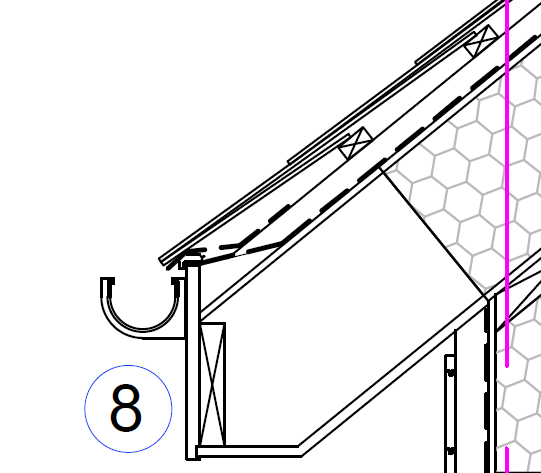
-
Puzzled by what my architect's drawing means
dnb replied to dnb's topic in Roofing, Tiling & Slating
That looks like the part I need. I have a box of OV25s so it might just work. -
Why do you not want to deal with the DNO? Mine were quite approachable and I now have an offer for 6kW single phase generation. I am not going down the MCS route because it looks like a gravy train with no benefit to me because I ought to be able to self use most of the apprx. 7000kWh the system is estimated to produce in a year (all electric house with full AC and planning for an electric vehicle). My payback around 5 years in theory. I would suggest GSE in roof parts might be a little cheaper than the Easy roof. You could also save a little on a different inverter. But either way it won't be a huge amount. Why not download a PV generation predictor and model your house and system with it? Then you'll have some numbers to work with so you'll be better able to estimate usage and form plans.
-
Puzzled by what my architect's drawing means
dnb replied to dnb's topic in Roofing, Tiling & Slating
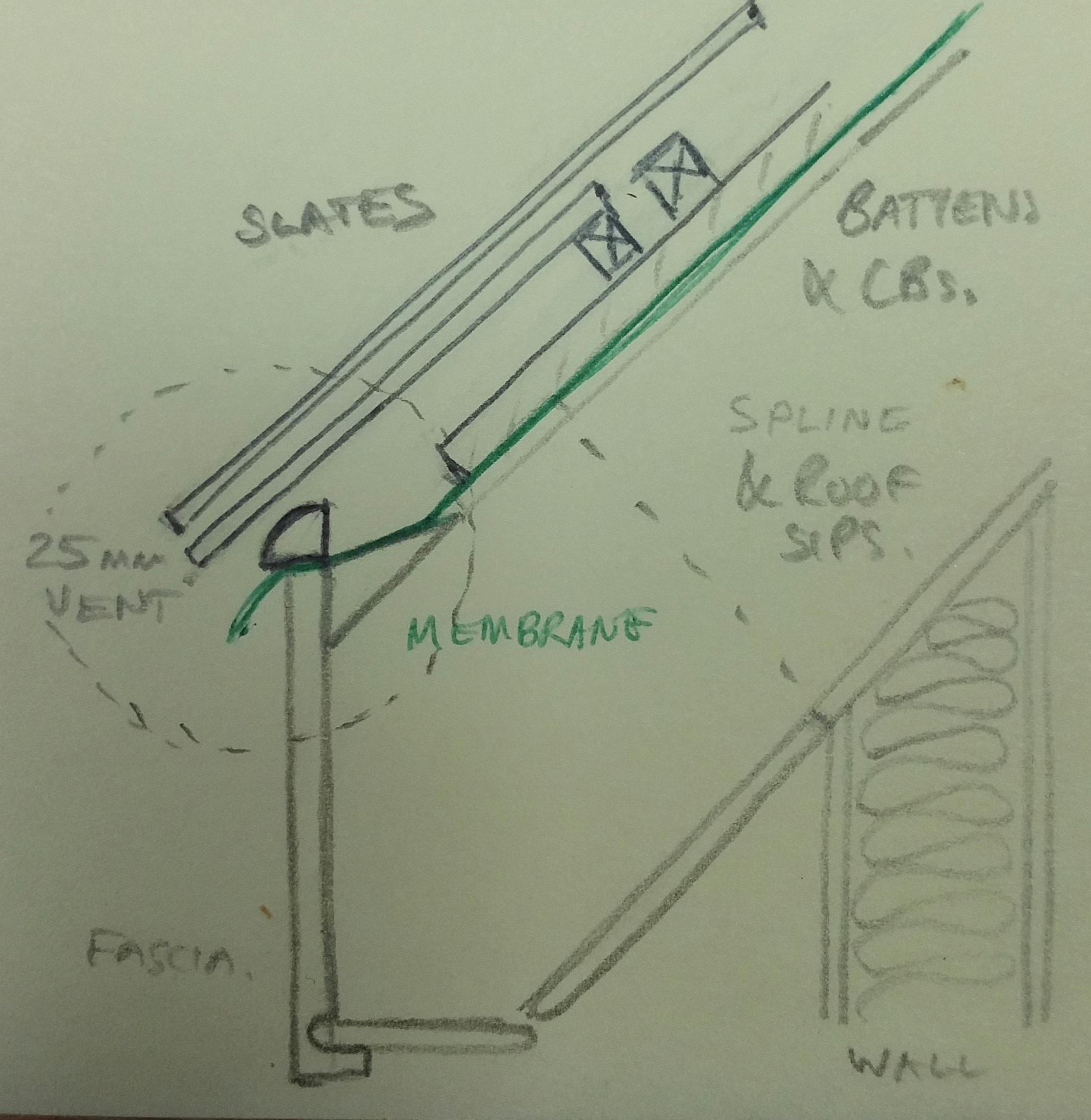
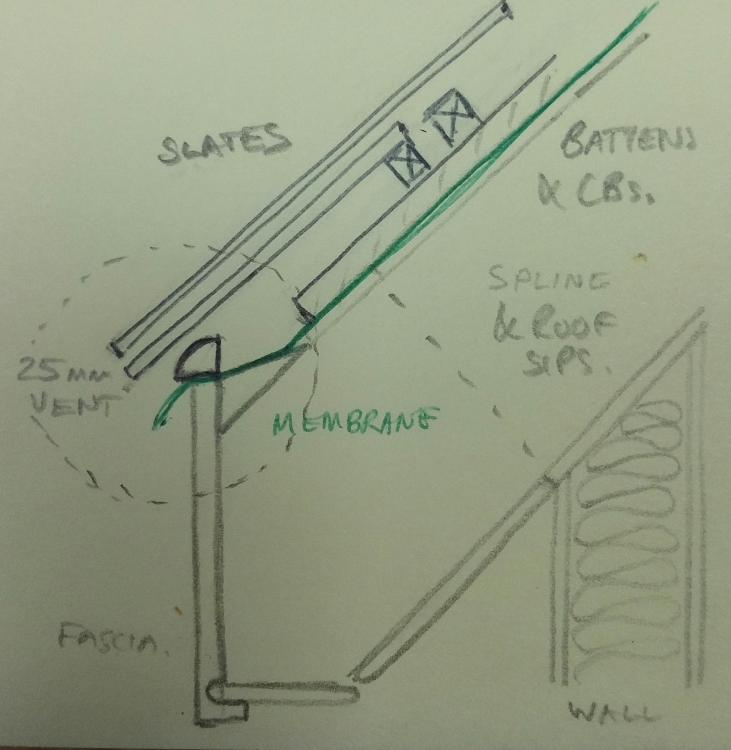
This is more or less what I think the architect meant to draw. I am content the ventilation aspects of the roof itself are all correct. It is getting the detail at the eaves correct that concerns me. It looks like the drawing Temp posted has a support tray under the vent or a combined part. This is probably what I need to find and what is not obvious on the original drawing. I promise to post the original drawing when in get home. Can't do it while at work. -
I am a little puzzled by part of one of the drawings submitted for building control. Nobody has argued with it so I am not concerned about mistakes but I obviously don't get everything it is trying to tell me. I can't post the actual drawing until tonight but here is a sketch to illustrate. The architect drawing looks like it has a support tray over the top of the 25mm over fascia vent, but shows the membrane as in my sketch, unsupported by the tray. So something doesn't look right. The trays i have seen can't go under the vent because it will close the vent off and the membrane probably shouldn't go over the vent because it will close off the bit of roof that needs ventilation - my limited experience suggests that roof membrane would make a fine alternative to sail cloth! Am I missing a product that is designed to do this? There isn't much experience locally of SIPS roofs and the architect is on holiday, but it seems a problem that must have a fairly standard solution so I turn to the best supply of building experience I know about. My desire is to get any water on the membrane to drain in the gutter rather than down the fascia - especially not the inside edge of the fascia!
-
I got my offer letter last week having filled in the forms all by myself. No reinforcement work required and 6kW max output to grid. I need to pay for a service alteration (separate job to the PV) and an inspection visit prior to commissioning.
-
I thought it was me being thick! Good job I know where there is a big pile of those! I assume that is in inches (unless it's a model house ? ) So 100x25mm - same as the GSE spec demands. Did you use any particular graded timber? Was hoping someone would say that! Thanks all. Looks like I can carry on with using my blue slate battens. Most of the time they are in more or less the right places.
-
I am curious as to what size battening people have used for their GSE in roof PV installations. I think mine needs to be 100x25 according to the GSE manual. But there is no further guidance on strength etc.
-
Working on the roof and waiting for the slate delivery
dnb commented on dnb's blog entry in Building in a woodland on the Isle of Wight
Not a problem. You are dead right to call anyone on safety issues. ? And yes, Onoff is right. I was a bit rough in those photos. It was 36 degrees that day. -
Working on the roof and waiting for the slate delivery
dnb commented on dnb's blog entry in Building in a woodland on the Isle of Wight
Those Bolle safety sunglasses. To hide the from working too hard on what feels like 2 full time jobs. -
Working on the roof and waiting for the slate delivery
dnb commented on dnb's blog entry in Building in a woodland on the Isle of Wight
Look again. Had glasses on the whole time. -
This isn't quite the help I had in mind, but it might work out..
dnb commented on dnb's blog entry in Building in a woodland on the Isle of Wight
It's always occupied when I want it -
Working on the roof and waiting for the slate delivery
dnb posted a blog entry in Building in a woodland on the Isle of Wight
This covers the past few weekends of family effort. My friendly builder Jeff is finishing off another job for my electrician (the Island is a small place) so we're been plodding along on our own. First, we needed to screw down the 50x38 counter battens at 300mm centres. The first pair in place with me balancing on the north side with my new roof ladder. The battens themselves are to be spaced at 600mm centres, but because we were worried about high winds that weekend we put up every other batten across the whole roof. This should hold the membrane secure for a while. This is the south side where the solar array will eventually go. (Yes, the wrinkles in the membrane do annoy me.) Battening calls for new toys and ear defenders. I bought an ex demo 1st fix nail gun for a good price. I'm very pleased with it, and nothing that moves when it shouldn't is safe now. We are fitting 300x600mm slates when they arrive with a headlap of 80mm. Our BCO has agreed this is sufficient. This makes the batten gauge 260mm. About half way up now. I'm tired, so it's time for a quick snooze. SIPS is good for this - more comfortable than it looks! Getting there slowly. Making the joints come out in the right places without a lot of waste is a good game on a long piece of roof. My daughter is firmly of the opinion that I've built the largest climbing frame on the Island. Just for her amusement. We test fitted the first piece of continuous dry verge (aka annoying black snake). I'm pleased we went for this instead of the sectional version even if it is awkward to handle. A quick QA visit from Griff and Raffe making sure there's nothing too badly wrong. -
My daughter thought I needed a bit more help with the roof, so came up with this pair of critters. The double act that is Griff and Raffe. What could possibly go wrong? They can saw the counterbattens... They can saw the battens... They can load the nail gun - when they aren't sleeping in the hammock And they even tried nailing the battening - but to the scaffolding.
-
Fixing for Sole Plate into concrete and Fixing for the Frames
dnb replied to Tony C's topic in Timber Frame
I used TimCo Expressnails (I believe they are a version of what the previous post describes). It looks like they work well - they certainly don't come out without a fight. -
I live in fear of band G. I will be appealing that one! We can make a reasonable argument for E but I expect we will be pushed to F.
-
This is why I'm looking at the RS485 network for the few things that need to talk to each other. (Most of my ideas don't require much comms - they have access to the data they need and should "just work" without too much intervention) I don't believe the IOT as it is currently being developed is particularly useful to consumers. It is however hugely useful to large corporations etc, and I see no reason to help them. I was looking at a washing machine that could be configured to start when there was excess solar power. The machine seemed to think that making a connection to a server belonging to the manufacturer to supply serial numbers and usage stats was required for this function.
-
You and me both! Yes it might be. I do have a few security concerns about everything sitting on a TCP based network, made up from random bits of I don't understand that won't get security updates... The well defined RS485 that has very little (but enough for the job) functionality appeals greatly!
-
I have one of those, but alas no detector thingy. It works well inside but is very hard to see outside over more than a couple of metres until it gets dark. Then next door can see it and think an alien invasion is happening. Mine appears to be sufficiently accurate for everything I've asked of it - most difficult was a height comparison over 15m distance. I used a more expensive red rotary laser with a detector-on-a-stick for getting the level of my blockwork because it was conveniently available.
-
"All the interfaces" and "Shield pluggable" are the main reasons. I prefer, at least for simple projects to keep things properly simple. I don't want to build in too many complex toolchains, opportunites for obsolescence or have to worry about somebody else's PCB design and track routing. On the whole, a shield based design drives me towards a more convoluted power supply and doesn't save all that many components, although the easy USB and possibly TCP interfaces would be nice to have. Processor speed isn't an issue because my design needs nothing to happen particularly quickly by modern standards. I can still get away with those optivisor things but it's getting harder.
-
Welcome. Both here and to the IOW. Is Vitesse from Triumph or Rover?
-
Stalking me again...?
-
Yes. They don't do ferries, but will ship to one of the terminals. Cost for getting across the water is far more than the diesel to take a vehicle to Wales and back... and has a much reduces chance of boards getting bashed into uselessness.
-
Hence my original comments about an HGV to Wales! I didn't know about the seconds place near Cardiff. Please could you share the name? Probably... No idea if they are all that keenly priced as yet, but there's no problem with designing to use two layers of 75mm or 80mm board. They can't. But they can "blacklist" your vehicle so you can't book the sailings you want. Not that I suspect them of such things, but I have in the past been told there's no capacity to later find the sailing had an empty car deck.
-
I will echo that plan changing is a significant cost increaser. Scruitinize the design carefully and cost everything before hitting "go". To give an example, one of my mistakes was to assume 2 metre wide windows were just going to work. I found that while they are available, either the maker will not warranty the style I want (stress on the hinges) or I must go to a more expensive product range. This wouldn't have happened at 1.8 metres. The piling works and SIPS were work packages I obviously couldn't contribute much to once the design work was complete. But don't underestimate the savings possible from a little knowledge of what the products will do at design time. We cut £10k from the SIPS cost by reducing the roof pitch by a couple of degrees - it cut out 2 large glulam purlins and made the roof into a single panel span. I have done a lot of mine on site, from digging trenches to laying blocks and installing beam and blocks. It's saved me a fair bit of cost, allowing me to spend it in other areas. I have a couple of good friends in various trades who have helped on an agreed day rate basis when more bodies were needed or stage deadlines loomed large. Now working on the roof battening ready for slates. The downside of doing things yourself is the tool bill. Over £500 this month alone. But afterwards I'll still have a lot of good tools! My experience is that local authority building control people could not be more helpful to a self builder provided you listen to them a bit. This has given me a lot of confidence to undertake and manage the work myself. This is obviously not guaranteed from area to area!