
dnb
-
Posts
581 -
Joined
-
Last visited
-
Days Won
10
Everything posted by dnb
-
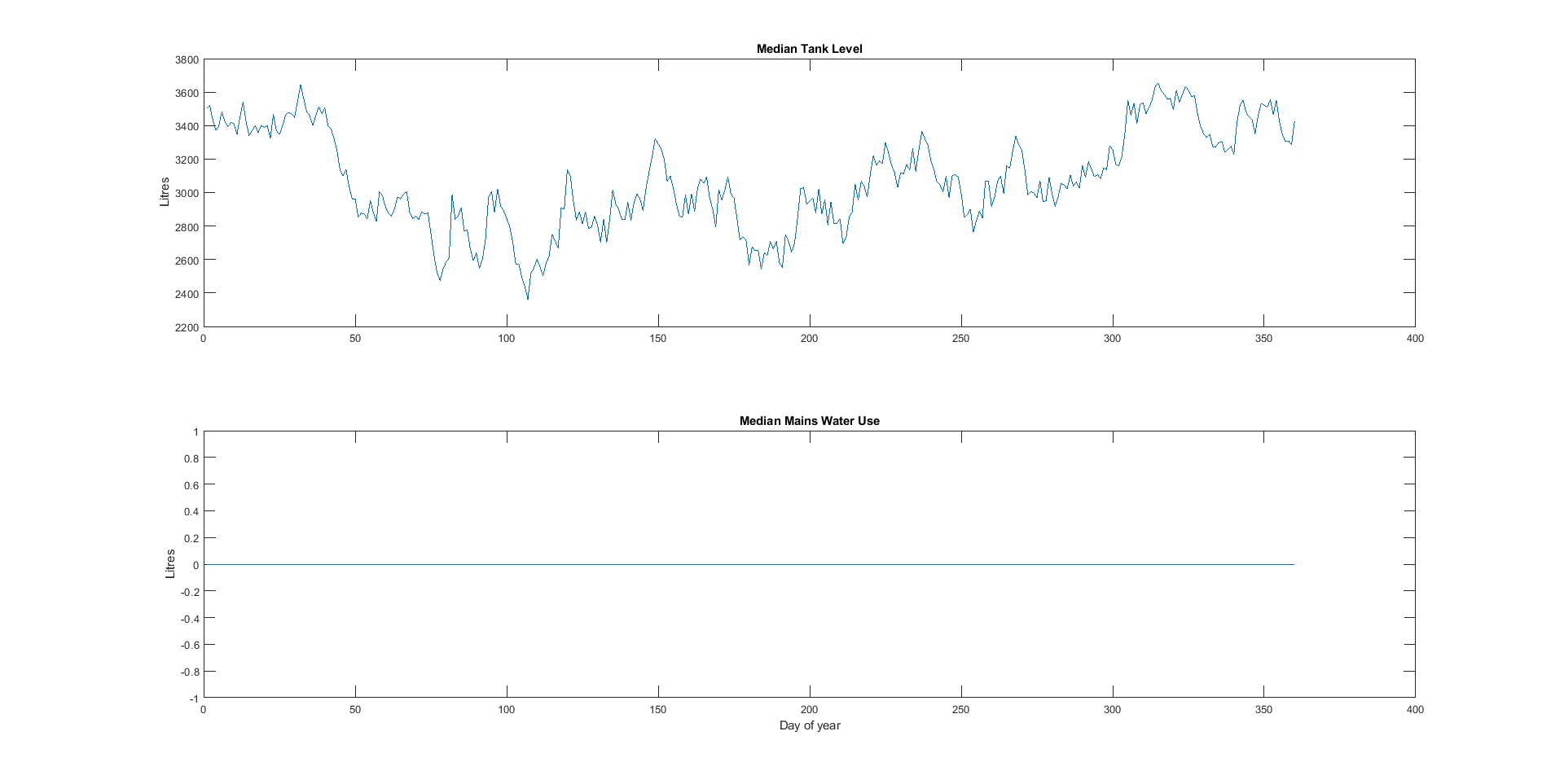
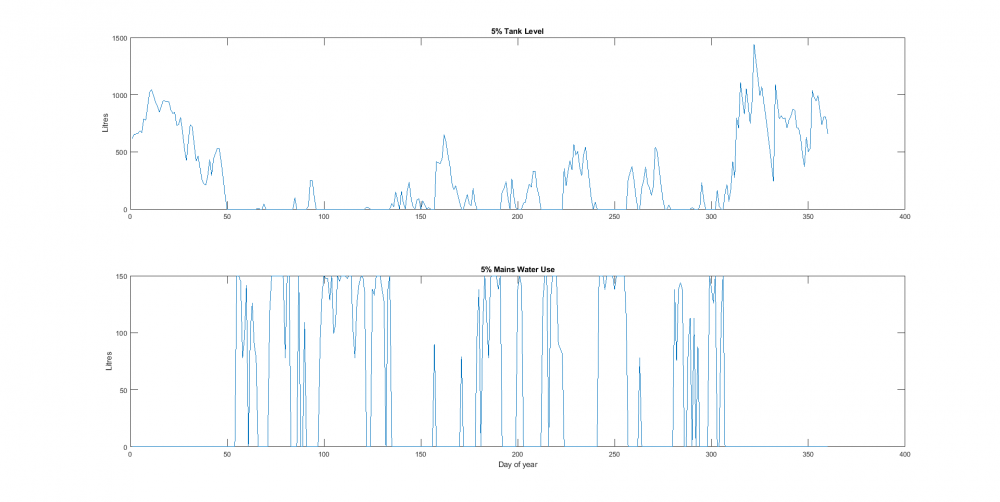
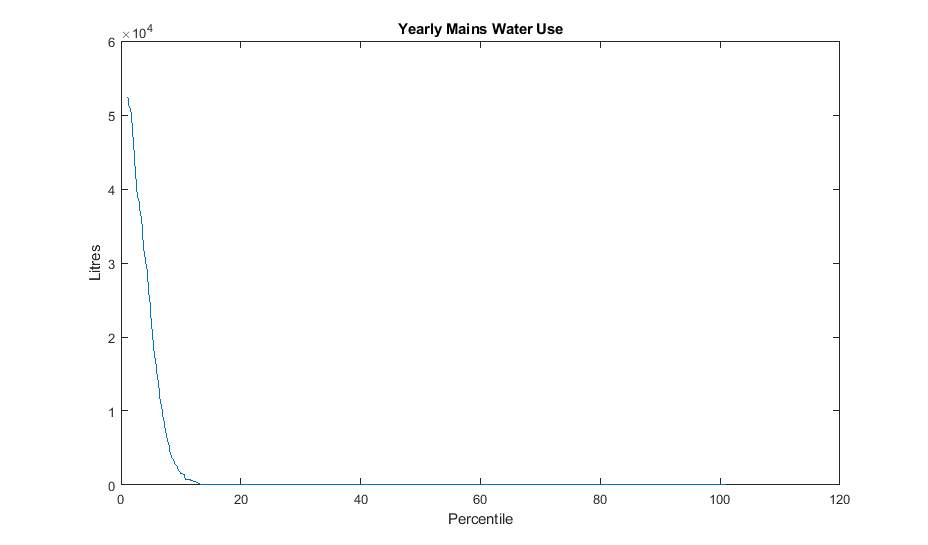
I promised some mathematical modelling. Not the clothes kind. I'm much better at the former. Here are some charts and things. It turns out that modelling rainfall is almost as difficult as modelling sea clutter as seen by radar. I ended up with a uniform distribution for deciding if it would rain on a particular day, and then a gamma distribution to determine how much rain there would be. It sort of worked but plan B - getting real world daily rain data for my area for the past 89 years - seemed a considerably better option when it appeared! I wrote a quick and dirty Matlab script to read in the rainfall data, then in a loop (couldn't be bothered to vectorise) of 1000 runs select a year at random and run through each day to work out how much rain my roof and a 4000 litre tank could capture less a fraction for efficiency of capture, followed by "using" 150 litres of water that day (no idea if that's the right amount, but it seems sane for the moment). Anything that drained the tank counted as mains usage. This gave me the following charts, averaged over the 1000 runs: The rainwater tank ranges from zero to full for most days at some point over the 1000 runs, but there are more zeros in the spring than in winter - hence the higher average mains usage. Means are pretty useless statistics though when outliers are involved (i.e. full and empty tanks) so let's look at the median. This clearly says the expectation is that mains water will not be used (on average) and that 4000 litres is sufficient storage for using 150 litres per day (again on average). So let's look at the 95% "worst case" level, since average is wrong half the time... In this case, the system only provides 30% of the water we need. But 95% of the time, it will do a lot better. Let's now look at how much better by plotting the mains use percentile for each year. It shows that the system usually provides sufficient water to sustain near zero mains use provided the assumptions on water use of 150 litres per day are sound. All ready for you lot to throw rocks at the charts now ?


-
That looks too much like my day job at times.
-
My blockwork skills have improved a lot over the bank holiday weekend. 90 blocks placed to 3mm accuracy in height. ? I was assisted by my daugher, the site foreman with "the stick of office" (sensor pole for the laser level thingy) and the real boss on mixer duty. (It's not too different to a Kenwood Chef ) Happy days. Until I started dreaming about blocks last night. A dreadful nightmare about how they were all laid perfectly in a staircase painted by MC Escher. The timber frame boss was very cross with me because it clearly wasn't flat enough. This was shortly followed by us both being cross with the man from English Heritage who appeared from nowhere and declared it a listed building because nobody had made a real Escher staircase before... Oh well, back to work for a rest.
-
Nice data source. Working on some Matlab tonight so I can have a MonteCarlo rainfall model.
-
Nice idea. I can reuse code (and some hardware) from my solar diverter project. Would be worth doing this in addition to my 1st plan because it will help to detect more fault conditions. I have a prototype microcontroller based tank level sensor I made for my father-in-law's yacht water tanks - it works on air pressure so has no moving parts in the tank itself (he thought it important for improving reliabiliy and repair time) , so was going to use this to switch off the pump and switch on the mains water when the rain water tank level got low. I have to admit I haven't got a good computer model of this yet, (It's what I do at work) but my best guess is that rain capture will be almost seasonal. There will be much too much in the winter, and then no rain for ages in the spring and early summer, followed by vague sanity in August, September and October where the rain is distributed more evenly. Neither am I. But I suspect that an overflow that can keep up with the pump and the fresh water together will be OK if it keeps a specified minimum separation (20mm comes to mind for no reason I can remember) of the mains outlet from the level in the tank. Good call. Baffles and chambers won't be useful here. I have thought about this and I'm still undecided if it is more efficient to do this or my first plan. It might prove easier though and that's worth a lot. The weather modelling will tell all here.
-
Thanks. That will be very useful. I do. It is currently connected to a single outside tap near the old garage while we wait for the house. I will be doing similar this whatever the outcome of this investigation. I am currently of a mind to use a header tank to gravity feed water to all the toilets etc so that it's easy when the time comes to manage air gaps etc. so I can avoid potential expense with needing low volume production parts that require some kind of approval, and in theory can get away with a smaller (and hopefully more efficient) pump. We'll see if the maths supports this hypothesis. Space for the header tank isn't a concern. Thanks. Nice to have a good review! I am not obliged to do this by planning, but it helps with the water use part of building control. SWMBO wants a large bath and some kind of high volume pressure washer as a shower so the deductions from water reuse are extremely helpful. (Our BCO has indicated he's keen to see compliance with the water usage)
-
I have rainwater reuse in my plans, but the build budget is tight (thanks to current events) so I need to keep things cost effective. I've noticed that there's a lot of expensive kits for using captured rain water and most of them look like I can make something almost identical for considerably less outlay. Let's say the budget is around £750 to £1000. (This is based on rounding up 33% of our expected water bill for 5 years, plus an allowance for things getting expensive) I plan to use the water for toilets, garden, car washing (with a decent filter!) and possibly for clothes washing (again if filtering can be cost effective). ICBs look like a good and cheap option for water storage, but I'm a little concerned about cost and complexity from burying them in clay and expecting them to stay connected, so I am considering an onion type septic tank as a rainwater tank. It seems considerably cheaper than a rainwater tank for the same (4500ish litre) volume and with very little work, e.g. to implement filtering and a calmed inlet, will do the same job. I assume the price difference is due to production volumes, because the calmed inlet and filter are often additions. My plan was to fit a header tank in the attic since this looks to be the simplest arrangement with the lowest running cost. Mains water can be directed into the header tank with a simple float valve maintaining sufficient air gap and I can implement a control system to turn off the mains supply with a motorised valve (probably a ball valve since it doesn't use power when in either state unlike a solenoid valve - and it can be manually moved when there is a power cut) when there is water in the main tank. This leaves the tank water side. A submersible pump, a pressure based controller and a float valve (probably one with a sharp cutoff) is again a simple and relatively inexpensive option. It does everything I need except sensible dry run prevention. (My theory is that dry run protection built in to the pump probably shouldn't be routinely relied upon.) So in addition I'll need to implement a tank level indicator of some kind and controller to switch the pump and the mains valve. (Sounds like another little microcontroller project, or something for a cheap "smart relay" device...) The tank and the pump use up most of the budget but I have a shed full of random spare parts that will more or less do the rest. What am I missing (apart from a lot of implementation detail with many a devil lurking inside)? Any regs preventing me from using a new septic tank for this purpose for instance? Can I do anything cheaper or more simply? I note there are lots of German and Polish parts on ebay that are very well priced compared to UK parts. Are we that far behind the curve when it comes to sensible water usage?
-
I can't really help, but I had a similar situation with my road and electricity supply. We are on an unmade and unadopted road where the ownership details are lost to time. (We have an indemnity policy in case an owner ever appears and gets uppity). Of course this didn't help when I wanted to dig a trench across the road to put in a new site supply so I ended up with a pole in the front garden and an overhead cable over the road - it got around the problem nicely for me, but I guess it's not an option for you.
-
Microcontroller & single board computer technology suggestions
dnb replied to dnb's topic in Boffin's Corner
That's easy - it's because I'm impatient with technology. ? The boot time is not the critical issue, but it is a factor in the design choice. Robust and quick recovery after a power cut is another design consideration - we get a lot of power cuts. (Enough that I am considering a small generator backup once the house is built, but that's for another thread.) Fundimentally I want as simple a solution as possible to the problem. My toaster (to quote a joke example from the early internet) does not need to run Linux! All will be revealed in a different thread. It's not a single project and is best presented when I have the whole system sketched out - I have a set of things I want to implement that would have improved functionality if they can communicate in a simple way. Complexity and extra processing power doesn't give additional benefit. They need to be supportable (by me) for 10+ years or until we stop wanting to pay "eco tax" (a thread in its own right) on energy and resource saving equipment in our houses. -
Microcontroller & single board computer technology suggestions
dnb replied to dnb's topic in Boffin's Corner
Ready built would be good, but I can usually convince someone at work to help out with bargain price PCBs. As long as it doesn't need anything other than the basics - a few PTH, silk screen and solder mask. -
I was only supposed to test it, not blow the bloody bungs out!
dnb replied to ToughButterCup's topic in Waste & Sewerage
So you are all saying that my plan of testing drains with a compression gauge an air compressor and a potato is a bad idea? -
Microcontroller & single board computer technology suggestions
dnb replied to dnb's topic in Boffin's Corner
@joth It's never clear cut... That's why it was in quotes. I like to copy the clever kid's homework where I can as much as the next person for exactly the reasons you illustrate so well. (CPAN is a favourite for me when not doing microcontrollers.) I suspect if we did more rolling our own, there would indeed be more exploits, but there would be less incentive to find and exploit them. In the case of Arduino for my usage this time it's best summed up by this: https://xkcd.com/801/ I understand I was less than specific about my intentions, but what I want to do isn't going to be difficult - apart from the now removed Ethernet requirement (the TCP overhead is orders of magnitude larger than the data, and it saves precious little complexity in the system as a whole, so better to do something simpler) @Dan Feist Those look interesting for some other ideas I have. On the whole, I think I'm safe sticking with AVR chips, especially if I move to the newer devices with the better pinouts (e.g. the idea of a single voltage supply and have it do the separation of analog and digital domains is quite nice.) and it's a good excuse to think about a new programmer board. Mine is so old it was probably made with leaded solder! -
Microcontroller & single board computer technology suggestions
dnb replied to dnb's topic in Boffin's Corner
Maybe. They are now made by the same people as AVRs and do similar jobs. Do they have a longer time before obsolescence? -
Microcontroller & single board computer technology suggestions
dnb replied to dnb's topic in Boffin's Corner
Reusing "already working code" is precisely the reason why Internet security is such big business!! Admittedly that argument is not applicable to my case, but it colours my desire to use other people's homework... Besides, if I need 3rd party libraries to make an avr do a couple of adc conversions and report it over rs485 (ethernet is on reflection not necessary) then I am not doing it right. I do take your point that it speeds up getting something working. I will have a look at the esp32. I could find uses for a good wifi device for other jobs. -
Microcontroller & single board computer technology suggestions
dnb replied to dnb's topic in Boffin's Corner
Arduino brings nothing to the party. It is an AVR chip (like I already use) with some additional components on a stack of pcbs supplied with a load of libraries to make it accessible to the general population. Excellent marketing though. Regarding RPi start up time, it is never going to be faster than a microcontroller. And I don't want it to take even 30 seconds to restart after a power cycle. -
Microcontroller & single board computer technology suggestions
dnb replied to dnb's topic in Boffin's Corner
It's definitely old. But I wouldn't yet call it obsolete. That said, I work in an industry that supports installations for 30+ years, so I routinely use a lot of older tech and often forget how old it has become. Thanks for the AVR & RPi support. -
Microcontroller & single board computer technology suggestions
dnb posted a topic in Boffin's Corner
I am about to embark on a little project for the new house (details to follow - they are relatively unimportant for this, but you can consider it as reading some sensor data via ADC, doing some simple calculations and toggling 2 or 3 outputs as required, then reporting the data and output state to some other device) and I was about to get out my old STK500 and an ATMega16A I had kicking around gathering dust when I considered that the 8 bit technology is at least 20 years old and runs with very functional, but antique comms devices. The AVR microcontrollers have served me well over the years in everything from tank level sensors to automotive engine management, so in many ways it's the easy option to use it again. They are still in production and development seems to be happening. But I wonder for how much longer? What is the controller of choice that will be supported for the next 5 to 10 years? What I think I need is a solution with plenty of ADCs (6 off 10 bit, but 8 off 12 bit would be better) a few general I/O pins to drive 5v 15mA (max) loads and read a few logic level inputs, and 100base Ethernet (but Gigabit is OK too). The Ethernet is the difficulty here - no AVR I have seen yet appears to have it as a single device solution. The Ethernet port is only to accept simple commands and return logged data so there may be a better choice of interface. I am put off a RPi based solution because the startup time is a bit too long and it feels a bit of overkill for this particular very simple job (besides, I'm not keen on Python!) I am planning a Pi based home automation solution for some other tasks so there is nothing stopping me (for instance) using RS485 to communicate between the Pi and two of the devices discussed above. Their data can be packaged up on the Pi and served to anything that wants it on the home automation network, and the Pi can act as a command "postbox" where required. But again, it's using old comms technology. Wireless probably won't work in this application since there is likely to be too much metal and distance in the way. Unfortunately this rules out a number of otherwise easy options. So, having bored you all, what tech are you using for your projects, and is it current and easy to work with? Or what would you like to use if you were starting again? -
I had this very conversation with my BCO just before lockdown. He said he prefers to see vents all round, but is happy enough with vents on two opposing sides providing there is nothing blocking the air path in between. I have 8 vents on each side and 4 on the back wall because I have numerous obstructions (i.e. other walls) in the middle of the house, and having insufficient ventillation on my site would be "a very bad thing" for a whole load of boring practical reasons. Your calculator link says I only need 10 in total, but I don't think the flow on my vents is as good as Rytons. They're cheap enough, so don't worry about a few extras.
-
I don't know for sure either, but the plan for my workshop has design loadings higher than that. They were briefed that I wanted a 2 post lift. Not got as far as building the workshop though, so I've not had the "design review" yet where I sign off the floor design.
-
3 phase power. Everyone needs good machine tools. Make it bigger. The correct number of classic cars to own is always N+1, where N is the number currently owned. Get the floor very flat so you can do suspension geometry measurements easily (seeing as you aren't having the 2 post lift) Overhead gantry for the winch for that time you need to get an engine out of a TVR, and the wheeled engine hoist doesn't have the reach. (Don't ask how I know...) Sink with hot water is a good call. I think a reasonable 2 post lift is going to be cheaper than a pit. But it depends on your soil etc of course.
-
Now it's the digger's turn to annoy me - with a water leak.
dnb replied to dnb's topic in Tools & Equipment
Often! Probably that bloke from QI who put lead in petrol and invented CFCs... Good call. I can get away without needing the digger much for the next couple of weeks too. Thanks for the links for parts too. Will give them a go. Sign me up. -
I just want to build a house. But this appears to be too much for just about everything around me. Today's distraction is my (usually reliable) IHI 2.5 tonne digger. The water pump has begun to leak from the shaft seal. It's not too bad now but it's certainly not going to fix itself, and K seal doesn't sound like the best plan. Does anyone know anywhere open that can either supply a replacement pump (that preferably doesn't have to be imported from China or USA) or a rebuild kit or could recondition my existing pump? The engine is an Isuzu 3KC2PA. Google only gives a few useful hits, half of which don't look like my pump or are from overseas with massive postage cost and longer lead times than my house... Thanks for any pointers.
-
That is good advice. Anyone can make a silly mistake at any stage. It's your job to spot the ones that will make life miserable for you. My build has had its fair share of these. One sticks in my mind where the architect added up the blocks etc in the foundations and wrote the finished floor level on the plans as 500mm from the ringbeam top, but had 600mm of material in the buildup! We spotted it early enough, fixed it and had a good laugh about it and how building control hadn't seen it. I am trying to get all my blocks to support the SIPS panel sole plate level to within 3mm and the lateral placement to within 3mm for lengths and 5mm for diagonals. This is very slightly tighter than the SIPS team have asked for but it gives me scope for measurement error. The ring beam was spot on on average, but undulated +/-8mm in height (worse than the 5mm I desired, but by no means a problem) and 15mm laterally (I budgeted 25mm, but it really wasn't critical since the beams were 600mm wide for a 400mm wall) We got the first row of blocks down to +/-3mm in height and +/-5mm laterally then found the floor beams were really inaccurate and errors accumulated really quickly.
-
Hydraloop water saving system.
dnb replied to Siochair's topic in Energy Efficient & Sustainable Design Concepts
It does look expensive. I can't immediately see any benefit over rainwater harvesting for toilets and washing machines unless outside space is a significant premium. -
I found out tonight that my daughter has named all the corners of the house. Presumably this is like a racing circuit, so she can commentate about where I am rushing to with my tape measure. We have Datum, Garage, Hammer, Digger, GRRR and Cursed. The last probably because I moaned about it never being right. The largest error is now 4mm (and this is within measurement error given the length) so happy days. A bit of trig indicates my corner angles are: cursed corner 89.992deg garage corner 90.004deg digger corner 89.964deg GRRR corner 89.962deg Hammer corner 90.058deg datum corner 90.026deg Of course, this assumes I have measured correctly to the accuracy of my class 1 tape.