Dan F
-
Posts
1431 -
Joined
-
Last visited
-
Days Won
2
Everything posted by Dan F
-
@Robert Clark Let us know how it goes.. @ProDave That makes sense, just keen to do a bit more than that, but can't justify spending £5,000 on Sunamp! Also my understanding is that a non-mixergy UVC without the careful stratification will need a larger ASHP (to stop water going lukewarm during heavy use) meaning we'd need to be looking at 12/14kW options (when we only need max 6kW for heating). How did you size your ASHP?
-
Has anyone installed and is using a Mixergy tank? @Robert Clark what did you do in the end? We are very keen to avoid a standard UVC as we won't have a gas supply and beleive that load-shifting DHW electricity demand makes a ton of sense in both winter (from cheap nightime tarriff) but also in the summer (from free PV during the middle of the day). My understanding is that with a standad UVC this is a major challenge without reheating water in the tank as you use it, unless you want lukewarm showers. Using Sunamp heat batteries is a great way to achieve i) load-shifting ii) partial charging iii) low heat-loss and all nice and compart but we've been advised that in order to get a very good flow rate and >300L capacity we'd be looking at 2 x UniQ9, and that's where Sunamp becomes less interesting because we'd be looking at almost £5000! It's clear that Mixergy is not as compact as a Sunamp (not a major issue for us), and will never be able to compete on heat-loss, but it does support load-shiting and partial charging and costs less that a 1/3 of the price of 2 x UniQ9. So, I'm really wondering if it makes any sense an extra £3,000 on Sunamps. (I know some people will mention the G3 annual service but in reality very few people pay yearly for this service unless pherhaphs they are landlords). Mixergy shared some real-world data from current installs that shows how a tank with 25% "charge", still has 58C temperature at the top, while bottom is at 12C, so it's definitly more than just marketing and an app. Also, looks like it potentially has better control system than Sunamp with option to use their app or integrated directly via modbus. Thoughts?
-
Just had this discussion with M&E consultant yesterday. He has suggested using 3 seperate ducts rather any more innovative Uponor products just to ensure as much flexibility as possible. Unsure exactly what duct is proposed though, currently allowing 3x75mm ducts. In our case ASHP will be about 6m away. I've seen some people take duct through EPS, but thinking we'll probably just use a pre-insulated pipe and take it under EPS.
-
There are a number of partners that are willing to resell... I'm getting some quotes for Loxone install, but if prices are high.. will buy parts from reseller and DIY. Might end up using KNX for some things, but still like the idea of Loxone as simpler/central control.
-
No, but our interior designer is strongly recommending Iguzzini for lighting. Most Iguzzini fittings support DALI and tunable white. Not looked at the relative prices yet though. Doesn't this means you need Loxone KNX extension + KNX->DALI Gateway? Another option I looked at is DALI 4Net (Lunatone) but that requires fairly complex modbus integration with Loxone (See: https://www.loxforum.com/forum/hardware-zubehör-sensorik/211535-dali4net-via-modbus-tcp) Have you already decided on Loxone? What do you plan to use instead of DALI for lighting? I wanted to try any find something low-voltage or PoE, but nothing really out there at all for the residential market.
-
@Falesh Yes there is a way. A number of manufactuers sell fittings with "tunable white" LED's that allow the color temperature to be adjusted between 2700K and 6500K. You'll need a suitable control system to "tune" them though. I plan to look at these, but integrating them with Loxone is a challenge given the Loxone DALI extension does not support DT8. Other options are: - "Warm dimming". These typically have a temperature of 2700K, but reduce to 1800K as they as dimmed, and are simpler to control. - Have main lighting at a high daylight temperature, and secondary lights for warmer more indirect evening light.
-
It your UVC is already at 55C, and you have a low-temp ASHP this isn't very feasible and that's why most people would switch to immersion for PV diversion. This Valliant ASHP goes up to 75C, so this might be possible, but I'm not sure how you'd wire things up to achieve this. That's a good point. Getting more bang-for-your-buck isn't very important in the summer if you have a fair amount of PV. But in spring/autumn would mean your PV would go twice as far, and in winter it would mean cheap night-time electricitiy import would potentially algo go twice as far.
-
Does anyone actually do this, or this is just Sunamp sales argument? I don't think they do do they...
-
@joth In theory you also save on (minimal) costs associated with legionella cycle, as the ASHP can do this instead of an immersion heater. I personally, don't see any reason Sunamp would need to test this ASHP given specs. Testing was/is much more important for other models with lower max temperatures and reduced operating ranges (can't heat to 65C below 2C for example), but this one shouldn't really need testing. I'm personally still not convined about using Sunamp with ASHP yet though, even though this model does reduce the risk of ASHP compatabiity significantly: - Lower COP's to charge Sunamp vs. heating UVC to 55C. - Harder (or not possible?) to leave room in Sunamp for PV diversion, than with a UVC where you can heat to 55C and then allow PV to heat further.
-
Three single-phase variants of this new R290 ASHP have now been MCS-certified and can be found in MCS database. The 12KW version seems to have pretty impressive SCOP values: 3.5@55C and 4.9@35C. Not sure why 65C values aren't included here, I've requested more technical details. Maybe I should reconsider Sunamp, now there is a monobloc ASHP can than happily charge a 58PCM Sunamp without requiring compatability testing or a backup heater. I do want to check COP and flow rates at 65C first though.. @joth@oranjeboom Also, Sunamp have all but confirmed that there is no PCM48 version that will be avialable in the next 6mths, but to expect an annoncment regarding PCM43. I'm not sure PCM43 is really suitable for DHW though, flow rate must be closer to 40C max + pipe losses != a very hot shower. Also 25% less dense than PCM58 I assume.
-
Getting started on the PV G99 (and G100) minefield
Dan F replied to dnb's topic in Photovoltaics (PV)
It seems that's what G100 is all about. I beleive that this is now allowed as long as your inverter supports G100 compliant ELS (export limiting scheme). https://www.energynetworks.org/electricity/engineering/distributed-generation/engineering-recommendation-g100.html -
Getting started on the PV G99 (and G100) minefield
Dan F replied to dnb's topic in Photovoltaics (PV)
I'm also in a SSEN area. Out of interest which application did you submitin the end? G98, G99 or G99 fast-track? -
@jothI just had a quote for the same door (Ferro Firesafe 826 x 2040 leaf) from a Principal Doorsets for £3500 + £500 delivery (excl VAT)!! Also unfinished MDF. What did you decide to do in the end?
-
Not sure how to interept Daikin numbers, as it looks like they quote a COP of 4.27 for 55C flow temperature. Can this be right, seems too good! (See: Average climate water outlet 55°C - C Condition (7°CDB/6°CWB)) Colling is must for us. Wondering if cooling could be enabled somehow on non-cooling version.
-
Ecology/Buildstore - Self Build/Personal Loan
Dan F replied to Mark Boland's topic in Introduce Yourself
You can get a rough idea of the products available here: https://www.buildloan.co.uk/product-list.php https://www.ecology.co.uk/mortgages/residential-mortgages/self-build/ (this doesn't mean they are all suitable for you though!). My understanding is that lenders do allow for interest-only during the buld, yes. That's certainly what we are doing, I'm unsure how widespread that is though amongst other lenders though. There are various different approaches that different lenders use. Cost-based vs value-based and arrears vs. advance stage payments. Normally though, if you own the land outright, based on our experience, you can take an intial drawdown of around 80% of the land value and then the stage payment approaches apply to the rest of the build. -
@Dreadnaught Undecided as of yet. The efficency is only 5-10% better than LG/Samsung R32 models, so it will likely come down to price/availability if we are using a UVC. (the COP of 5.4 is a bit of an outlier with specific models at specific temperatures) That said, this ASHP would defintily allow the use of Sunamp PCM58 without worrying about if it meets the required flow temperatures in practice and if it is still able to charge Sunamp at low outside temperatues. (this is a concern with R32 models without Sunamp doing testing and I know others including @oranjeboom and @joth are wary about using ASHP with Sunamp due to this) From an effiency standpoint, it might be prefferable to use a Sunamp PCM48 (which they say they plan to release) as this is hot enough for DHW, gives better COP and wouldn't require a speciifc ASHP. The downside of PCM48 is that you get les showers per Sunamp. In sumary, I'm waiting to see fulls spec, and also waiting to see what Sunamp release (if anything) in the next 4-5 months.
-
By way of an update, I got some info from Vaillant rep and these R290 "aroTHERM plus" models will apprently: 1) Be due out in June. 2) Have models between 3KW and 12KW. 3) Have COP of up to 5.4 (A+7/W35kW) 4) Have flow max temperature of 75C (COP at 65C is 2.3) EDIT: Full specs haven't been released in U.K. yet, but I found these specs from the Netherlands for some of the models: https://www.vaillant.nl/professioneel/producten/arotherm-plus-warmtepomp-65024.html
-
With slabs, you'd have gaps where joists are I assume, so hard to see how effictive it would be. If noise transmission is important to you might want to think about one (or both) of the following on top of the standard insulation as shown in @ProDave picture.: 1) ScreedBoard above the joists 2) Resiliant bars (or suspended ceiling system of some sort) below the joists (we haven't built yet, but this is what we plan to do)
-
We are thinking about it as a largish walk-in pantry, primarily for freezer and food storage cupabords just with the added bonus/flexibility of there being a decent-sized worktop and a small sink, but definitly no hob or cooker! We were thinking that a food processor could potentially live on this worktop though, so as to not take up room in the kitchen and so we don't feel to need to put it away (so I guess that could be classed as "prep"). We considered putting a dishwasher in here, but decided it's best by the main/large sink in the kitchen, especially as we plan to fit an erator. We don't have oven/hob next to each other either. We'll have: - Hob on island, sink on side wall. - Dishwasher and sink next to each other, with bin close by. - Dishwasher somewhere it won't be too much of a pain when open. - Fridge somewhere you can get to easily from breakfast/dining area without having to go past oven/hob/sink or do a lap around an island. - Microwave/kettle also somewhere with easy access from breakfast/dining area. - Freezer in pantry not in kitchen.
-
Some people do use a rendered block external leaf, yes. A couple of different project managers that I spoke to regarding our build tried to convince us to use a block skin. Their argument was: i) more solid ii) easier to mortgage. We ignored them (we're not using them either) and we were able to get a mortgage without a problem.
-
Minimum Reasonable wall width for good U values?
Dan F replied to puntloos's topic in Heat Insulation
IMO yes, no issue at all. We're doing the same, but with twin-wall 300mm system and haven't had an issue with mortgage or warranty. - Timber frame without block skin does limit lenders slightly. - Timber frame without BBA or BOPAS accreditation limits lenders further. - But, there are still a fair number of lenders, including Ecology (which a number of people on buildhub have used). We went with someone else in the end as they could lend us more. Of course, it'll be wise to check with a mortgage broker before signing off on anything. -
Minimum Reasonable wall width for good U values?
Dan F replied to puntloos's topic in Heat Insulation
Not everyone will mortgage it, but it's definitly mortgageable. Agree with @ADLIan that using a suitable/approved render/cladding system is important for mortgage/warranty/insurance if you aren't using a block skin. This link has a lot of interesting information on insulation options, seems to suggest decrement delay of of mineral wool & PIR is around 7-8hrs: https://www.ecomerchant.co.uk/news/insulation-materials-compared/ (In our experience mortgage providers willing to mortage MBC system was more limited because they do not have BBA or BOPAS accreditation.) -
Minimum Reasonable wall width for good U values?
Dan F replied to puntloos's topic in Heat Insulation
The MBC 0.14 system (other companies have similair systems) is about 225mm if I remember correctly (OSB, 140mm frame with mineral wool infill, 40mm PIR + service cavity) +15mm internal plastboard + 45mm for external cavity, renderboard + render = 285mm total (or 325mm for 0.11) Passivhaus doesn't have any specific u-level requirements, if you need 0.1, or if 0.15 is fine to meet "passive standard", will depend on climate, u-value of floor and windows, thermal briges and airtightness etc. Our walls will be 425mm inlcuding extenal render system and internal PB, but thats because it's a twin-wall system with celuose (as a number of other people on this forum have used). You need more depth of celulose, because its less insulating that mineral wool or PIR. Celuose is 0.038 W//(mK) vs mineral wool 0.032 and PIR 0.022. It does have other advantages though; i) better eco-credentials ii) better decrement delay. -
That's not odd! We have the same in our rental property and are doing the same in our design and putting the hob on the island. We are doing something even odder than you though... our sink isn't under a window! For some reason everyone seems to put a sink under a window. Does this come from when everyone used to wash-up by hand, and the view made it less boring I wonder? We'll have diswasher in kitchen (near sink), but like you have not gone full open-plan, as it's just not practical. We have kitchen/breakfast as one area, and then more formal dining/lounge as another area, connected by full-height pocket doors.
-
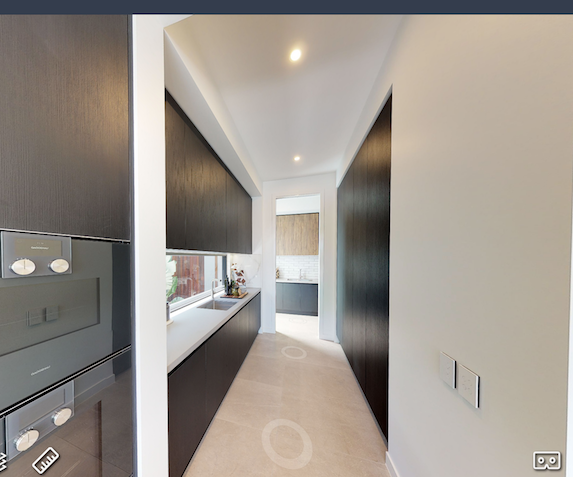
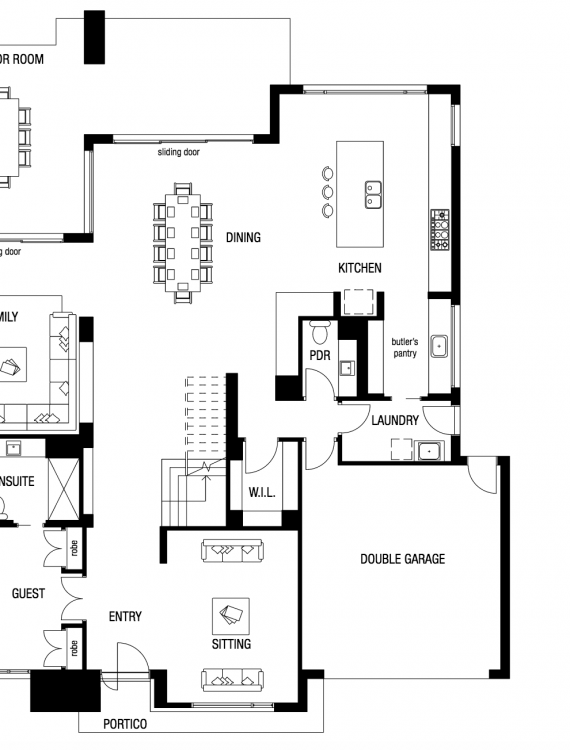
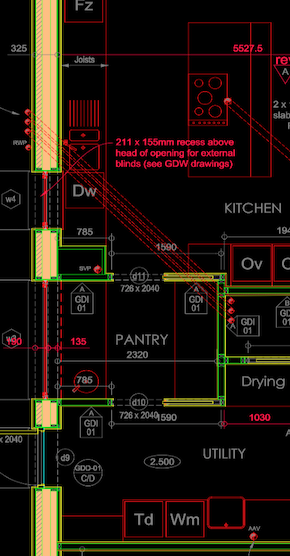
These are popular in Austrailia from plans I've seen online. Rather than being a second kitchen, it's more of a utility sized (or smaller) area with both storage and some worktop, decoupled from the ktichen which is typically open-plan. The addition on a sink means they can be good for food prep too if required, and not just for hiding all the dirty stuff. We saw some Metricon (australian builder) layouts with them in and really like the idea, especially the layouts that have a butlers pantry between the kitchen and utility and stole the idea for our house too. We have slightly less storage cupboards in the kitchen because of this, and like @Dreadnaught we plan to put the freezer in here also, with frezzer and two full height 600mm storage units on one side and a counter-top with storage below on the other side. We've not starting building yet, but this is where we got the idea from: There is a walkthrough VR of this design here: https://www.metricon.com.au/new-home-designs/qld/riviera?category=virtualtours&photo=riviera&floorplan=54 The metricon website also have plenty of other, more modest designs, with this concept too. This is our intereptration of it (clear copy! bit smaller I think though, and with the addition of pocket doors)