Dan F
-
Posts
1431 -
Joined
-
Last visited
-
Days Won
2
Everything posted by Dan F
-
@ProDave @Sensus Thanks. I do need to submit a minor ammedant for an additional WC window still. I'm wondering if it might be worth including the ASHP size/location in this submisison also (without specifiy what it will be used for) and by doing this get formal planning approval for it. Or, if it might be best to keep it out of the ammednant, just to avoid any potential questions and simply go ahead with it (while complying with the rest of the PD requirements)?
-
Hi, We didn't include an ASHP in our initial planning application but now plan to use one. I've tried asking our local planning team if I need a planning ammendment or not but have be given mixed answers: 1) If you decide to use an ASHP (assuming this will result in altered external elevations) you would need additional permission. 2) Please see below the link to the Planning Portal information on Heat Pumps which you may find helpful. In order to confirm that all conditions have been met, you will need to submit an application for a Certificate of Proposed Lawful Development. The fee for this is £103. The concern our M&E consultant has is that we plan to use it for hot water and some cooling and not "just for heating" as stated in requirements and so technically we wouldn't comply. Although our architect has a good point when he explained that permitted development rules, only actually apply once a build is complete and not in the context of a planning application for a new build. Anyone else have any experience with this? Wondering if we should just proceed, or need to potentially submit a minor ammendant. Also, if the hot-water/cooling aspect really is a concern regarding compliance. Thanks!
-
I don't have the Daikin datasheet, but the with LG 9KW R32 monobloc model I've been looking at the difference in COP between 55C and 65C depends on lot on exterior temperature. It's minimal when it's cold outside, but more significant otherwise: 2C Outdoor: 2.55@55C 2.15@65C 7C Outdoor: 2.66@55C 2.40@65C 10C Outdoor: 3.18@55C 2.55@65C 15C Outdoor: 3.73@55C 2.80@65C 18C Outdoor: 3.93@55C 2.95@65C The flow rate is 25% less @ 65C also on this model, so the recovery rate of Sunamp wouldn't be at good (even taking into account the addition 10C I beleive) We ran some calculations and the loss in COP cancelled out any saving from heat loss. Agree on space saving, but a slimline 300/400L doesn't take up much more floor space that an Sunamp. Also, we considered that if we wanted to ensure high flow rate we'd actually need 2 Sumap's pushing up the capital cost even higher. We've decided to go UVC for now based on the above, but will revist in the spring based on further information or product releases (e.g. a PCM48).
-
Any idea what control systems are available that could use this API to adjust things, like to what % you heat UVC etc? Coud a Loxone setup use this API pherhaps?
-
I took at look at this ASHP also and had the same concern. The other thing with using ASHP to charge Sunamp is that any savings in heat loss (which actually helps heat house in winter) are wiped out by the lower COP of heating to 65C rather than 55C. I'm told Sunamp are testing a Monobloc LT ASHP, but I thnk I'd still stuggle to justify using ASHP+Sunamp given lower COP and higher capital costs.
-
The other popular in-roof system is GSE. http://www.gseintegration.com/en/InRoof.html#
-
Natural Slate Roof - Looking for recommendations
Dan F replied to colin7777's topic in Roofing, Tiling & Slating
These say snowdonia approved: https://www.cembrit.co.uk/roofing/slates/glendyne -
Exactly my understanding and thoughts. Which was why I was suprised Sunamp seemed to be recommended them. I did search forum for "Hydropath" without luck, will search a bit harder for the thread you mentioned. Thanks!
-
Hi, Wondering if anyone has any experience with https://hydropath.com/ I'd typically be wary of non-salt based softeners as I thought they were mostly gimmicks. But this one comes recommended by Sunamp, and looks a bit more serious than some of the simple magnets you sometimes find. Thoughts?
-
@oranjeboom FYI, I've been talking to Sunamp about use of ASHP with their units. While they talk about the Daikin HT heat pumps in some of their literature (which I assume is more costly/complex than a standard LT ASHP), they also recommend the use of some specific LT ASHP's that can provide a flow termperature of 65C. They suggest the "Daikin R32 LT ASHP" range, but I think this only comes in a split system. So, after some investigation I came across the LG Therma V R32 which can also suppy 65C, will be cheaper to install than a split system and comes in 5.5/7/9/12/14/16KW versions. The COP at 65C is of course not particulary high, but a 2.5 ( @ 2C external) isn't terrible. Wondering if anyone has used a LT 65C ASHP with Sunamp in practice? Looking at potentially using 2 Sunamps in parallel to ensure both very good capacity but also a good flow rate. Wondering if there is any way to charge Sunamp to say 60% only with grid electircity during the day but allow it to be charged 100% with PV or E7? To achieve the same PV-only buffer @ProDave mentioned that he achieves by only heating UVC to 48C and PV heating it further.
-
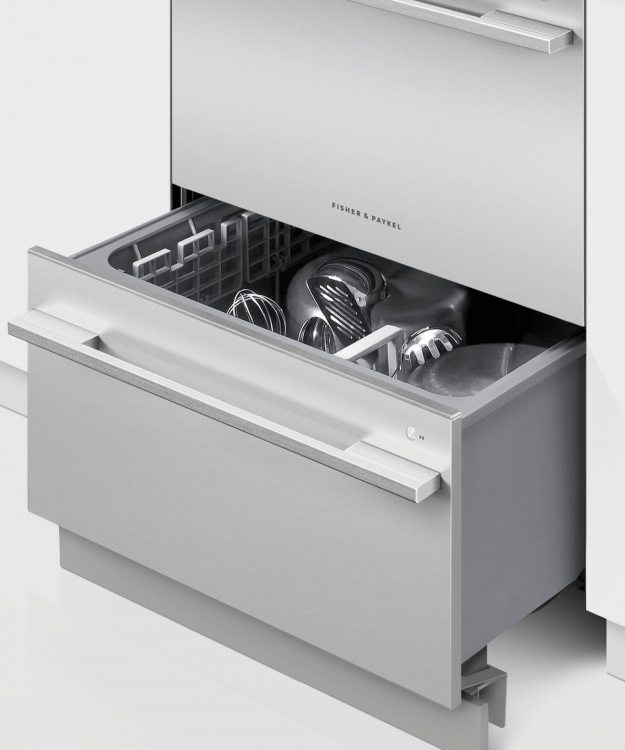
Hi, Rather that 2 full-sized dishwashers, has anyone got/used a double drawer dishwasher? It takes up the space of a single dishwasher, but has two drawers that can be stacked/washed seperatly...
-
@HerbJ Do you have any stats on how often UFH upstairs actually turns on in your case? We are currently specify heating for a 300mm MBC system build. Our current thinking (advice we've been given by consultant) is to only use UFH downstairs and use MVHR post-heater for heating/cooling upstairs as a way of mitigate the concerns with heating/cooling having to propagate from downstairs->upstairs. We haven't compared costs of UFH vs. post-heater yet though. Post-heater would be powered by same heat-pump as downstairs UFH.
-
Based on the interesting feedback from others, seems we have four options: 1) High-temp heat pump to drive UFH and PCM58 Sunamp. 2) Standard heat pump to drive UFH and either a buffer tank or PCM35 Sunamp, then use a PCM58 Sunamp powered by PV/grid (not heat pump) to increase temperature. 3) Heat pump for UFH only. PCM58 powered by PV (+ grid in winter) for HW. 4) Standard heat pump + standard hot water cycliner.
-
@JSHarris I'm sure you have detailed this somewhere else in the forum, but can you either summerize briefly or provide a link? Would it make sense to have standard ASHP heat a PCM35 SunAmp which is used for i) UFH buffer ii)) pre-heated HW, and then use a second PCM55 SunAmp which is heated an additional +20C by PV/grid? (Would this be similair to what you were hoping to achieve with a sungle Sunamp @oranjeboom ?) This approach (if it makes sense) seems like a good idea, the only issue being that if i) you shower a lot ii) don't size PV large enough, then you could end up paying for a lot of grid electricity for your HW, and I doubt it's that easy to model this..
-
@oranjeboom Yes and yes. @JSHarris Do you, or anyone you know use Sunamp with high-temp ASHP? Or is typical usage of Sunamp's by members of this forum primarily only heating from PV/grid? Thanks,
-
Having read a fair amount about Sunamp's in this forum and having spoken to Sunamp directly we were (are) keen to use Sunamp instead of HWC for i) smaller size ii) reduced maintenance iii) reduced heat loss. But, our M&E consultant is currently advising us that is best to use a standard HWC. The thinking is: - Heat Pump is preferred over gas for i) colling ability ii) free cooling/HW from PV in the summer ii) gradual decarbonization of the grid. - But, if we use a heat pump instead of gas for HW, then we'd need to heat to 65C rather than 55C for HWC, meaning most heat pumps wouldn't be suitable. - The limited number of suitable heat pumps wouldn't be particularly efficent heating to 65C either. Basically, if there was a PCM55 version, they'd jump on it.. but there isn't. So, in a similair position to @oranjeboom I think, and wondering if we should: i) Take advice and get standard heat pump and HWC ii) Insist on HT heat pump and Sunamp and what disadvantages with this might be. iii) Combine things somehow by using standard heat pump + HWC but also seperatly a Sunamp powered by PV and/or cheap grid import in winter. (heat pump will also be used for UFH downstairs combined with some MVHR post heating/cooling for upstairs)
-
Hi, We get stains on our cream coloured Corian, particularly with things like pepper/beetroot etc. Stains can be removed fairly easily using "Bar Keepers Friend Surface Cleaner" that comes in the Corian maintaince kit. Stains are removed via mild abrasion, but this doesn't really impact the look/feel of the worktop given ours has a dull finnish anyway. I wouldn't use Corian if you want a shiny surface, because otherwise minor scrathces (not noticable from a distance), along with stain removal, will gradually make the surface less shiny as @Christine Walker also suggested. That said, we are going to look at Silestone (quartz) or Deckton for our new build, for the kitchen at least.
-
Welcome. We are in Wokingham just up the road from you, just got planning a month ago and hoping to start on our build Nov/Dec. > Our tender pack has gone out to a few builders, Have you already decided on brick and block? I've been talking to various PM's and main contractors in the area, but still undecided on which route we will take. We are plannning to use timber-frame though, so slightly different situation maybe if you aren't..
-
@vivienz Are you sure it was Sonos you were talked into and not Sonance? Sonos is a wireless system typically used when you don't have any audio system wired-in. Sonance meanwhile sell built-in wired speakers for whole house audio as far as I understand. https://www.sonos.com/en-gb/home https://www.sonance.com
-
@Oldsteel We haven't decided yet. We've ruled out: - Typical tender process going out to local brick-and-block builders. - Project managing ourselves. We are considering: - Project manager (but fees are significant, you potentially also need a site manager or working foreman and it's hard to prove the supposed cost savings up front. Also not keen on one-man PM) - Splitting project into 3; groundworks, timber-frame, fit-out and finding a main contractor for each phase. - Talking to hand-picked main contractors we've been recommended and/or who have timber-frame and passive house experience and getting them to price the job. Rather than tender process, we are thinking of using a QS to split up the project into component parts and then get main contractors to price against this, as well as price other routes against this also for comparison. Currently still talking to different people though. Where are you at? Dan
-
Hi, We are currently doing a post-planning layout review and working out if we want to change anything and/or use planning tolerances to increase any spaces slightly along with reviewing the stair rise/going etc. I may be getting a bit too detailed maybe, but I want to ensure that we allow enough depth for internal walls, so that we don't find that after having applied acoustic treatment later we actually end of with smaller spaces (particulay in smaller rooms and hallways) than expected and/or kitchen units no longer fit because internal walls are 200mm and not 100mm. I've been reading the British Gypsum white book and found these options, quantified with decibel values: 1) 2x2 12.5mm SoundBloc + 2 x Resilient Bars + 50mm mineral wool = 59dB (175mm thick with 89mm stud) 2) 2x2 12.5mm SoundBloc + 1 x Resilient Bars + 50mm mineral wool = 56dB (159mm thick with 89mm stud) 3) 2x2 12.5mm SoundBloc + 25mm mineral wool = 46dB (143mm thick with 89mm stud) 4) 2x1 15mm SoundBloc + 25mm mineral wool = 43dB (123mm thick with 89mm stud) This of course doesn't detail all the options, but it seems that one of the best things you can do from looking at this is use resilient bars on at least on one side of the wall, and I'm thinking the sweetspot for areas where sound-proofing is important might be the 159mm variant. But I'm keen to understand peoples real world experience: - What have people done, but then post-build realised it wasn't enough? - What have people done, and been very happy with post-build? Thanks! Reference: https://www.british-gypsum.com/~/media/Files/British-Gypsum/White-Book/White-Book-C04-S11-Partitions-Non-loadbearing-timber-stud.pdf?la=en
-
@K78 For a free web-based floor/room planning with some basic 3D visualization capability I'd recoomend https://www.homestyler.com/ Sketchup is a 3D modelling tool, not for creating layouts. Homestyler should run on iPad and potentially has an iOS app too.
-
The spec you'll need will depend on: - How large/complex your Sketchup models are. - If you plan to use any rendering plugins. (there are some free ones). - If you plan to use the free web version or the desktop app (I find the later is more responsive, whereas I struggle with the web based) In terms of a MacBook again, it depends on: - If it's Macbook, Macbook Pro i5 or Macbook Pro i7 and the number of cores. - Amount of RAM. - Amount of graphics memory. I'm using a 2.5GHz i7 with 16Gb memory and an integrated graphics card and the Skethcup desktop application works smoothly with a fairly large model. Could be a bit more responsive but very useable, although turning off shadows improves things. Web-based version hangs a lot though.. Dan
-
Thanks @jack @JSHarris. I think we'll push for 950w,190r, 274g then. If we stuggle to make them fit, I assume even going down to 265/270 going would still be preferable over the 205mm rise though, right?
-
Just found this thread and it's very interesting as we are also looking at open-rung stairs, and currently reviewing the sizes. We currently have 204mm rise, 290mm going and 900mm width specified. Reading this thread though, it seems the rise is higher than ideal, the going rather generous and the width quite mean. At the same time, we don't have a huge amount of space to lengthen stairs much without compromising other spaces. Given this thread I'm thinking we should definitly increase width to 950 (or 980), and rule out the current 205mm rise, but I'm not sure if we should try to get down to 178mm rise if it means compromising both the going and living areas. There are a few of the options I've been considering: - 204mm rise, 290mm going - 190mm rise, 274mm going (means finding another 114mm for stair length) - 178mm rise, 264mm going (means finding another 268mm for stair length) Which would you have gone for @jack? I've also realized that with open-rung stairs, if you want to keep a nice clean look without intermediate bars etc., you need to use chunky treads to meet the 100mm ball test if you have a large rise. With a 204mm rise that mean equates to a minimum tread thickness of 110mm, whereas with a 178mm rise you only need a 80mm thick tread and a 190mm rise, would be 95mm thick treads. Thanks! Dan