Dan F
-
Posts
1431 -
Joined
-
Last visited
-
Days Won
2
Everything posted by Dan F
-
Whats the other red/black cable in the wall?
-
ASHP SCOP=3 in uninsulated 1960s house!
Dan F replied to richi's topic in Air Source Heat Pumps (ASHP)
Not going to happen IMO. Might get COP of up to 5 if radiators are made large enough to run at 35, it's 10C+ outside and ASHP is running at max 60%. But that doesn't translate to SCOP of 5! -
Decentralised MVHR
Dan F replied to HelenS's topic in Mechanical Ventilation with Heat Recovery (MVHR)
Send your plans to Partel and they can advise. https://www.partel.co.uk/lunos-decentralised-ventilation-systems -
Do you have all circuits running at same temperature, or do you have them mixed? I'm using "active" room temperature mod. I'm unclear of pros/cons of "active vs. expanded". Have you seen the issues mentioned regarding VF1? Do you think these impact you? Very interesting. Can I ask how you are doing this? Raspberry pi with USB ebus adapter? Any specific software to decode proprietary ebus stuff?
-
Are you referring to ASHP pump or UFH pump? The ASHP pump is variable-speed although the primary modulation approach is compressor speed. I was referring to UFH pump whose speed directly impact kW delivered.
-
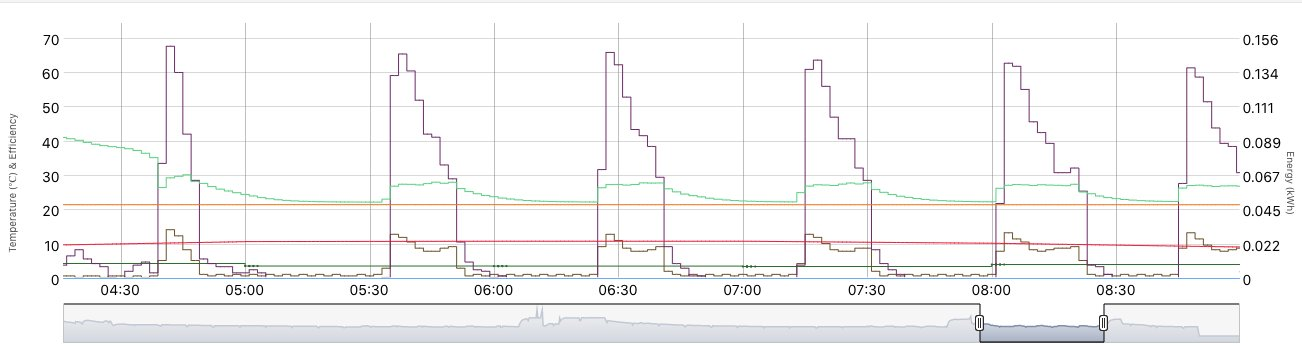
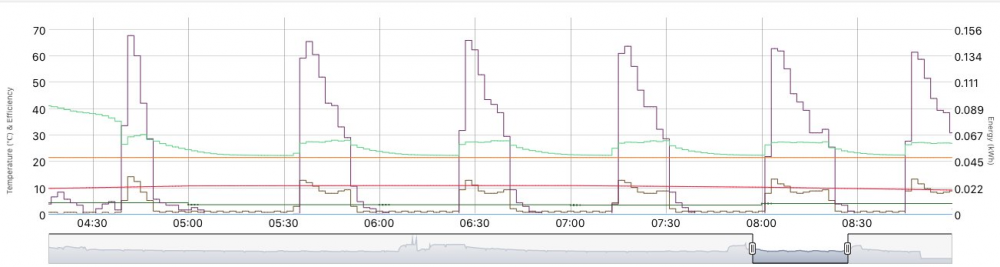
So i've been thinking about this too. I'm very interested in @TerryE's ideas, but am currenlty running things with the ASHP controller's weather compenastion to see how it behaves: This is what I've observed: - The Vaillant heat curve of 0.2 tells ASHP controller to use a flow temperature of 25C with the current external temperatur. - The power output by the UFH is a function of, not only the flow temperature, but also the pump speed though. Given the ASHP controller doesn't know anything about the pump speed, the heat curve required needs to be re-adjusted if the pump speed is changed. - Vaillant has various weather-compensation modes. The one I'm using considers internal temperature, but doesn't turn the heating off when a set-point is reached, but rather keeps running with a lower flow temperature. - In practice what happens is that the UFH pump runs continously with a mixer valve being adjusted by controller to maintain 25C UFH flow. The ASHP itself powers up every hour or so for 10-15mins and raises buffer temperature to around 28C, and then powers down. So whats the issues with this? Well, if you look at the supposed efficency of the ASHP for A7W35 it's 4.8. But, if I look at data from 6am to 6pm today, for example the actual COP is just 2.9. So it looks like leaving the system on all day and allow it to adjust temperature isn't particulalry efficient and, given UFH is in a passive slab, it would be more efficient to allow ASHP to run at a steady state for longer periods of time and then turn off the heating circuit. This requires either continuing to use weather compensation, but using the mode that turns off the heating when setpoint is reached, or moving to a differnt, probably externally controlled, heating strategy. EDIT: The energy figures on the right are kWh/2min. So ouput climbs to 4kW for 2-3min and then starts dropping off.
-
Not in our case. Our installer basically did their own thing, and then modified it when I requested mixed circuits. We get 7yr guarantee because our installer is Vailant-registered, but Vaillant haven't been involved at all. This come from any Vaillant info, or is just best practice that you are aware of? Our installer wanted to try to match emitter flow rates with ASHP flow rate as much as possible, not clear on reasoning for this though.
-
The installer set it based on reading manual(s). I had independently studied the manuals and come to the same concluion though.
-
You can generally do basins in less than 15mm. Most basin taps i saw are limited to around 6ñ/min anyway. 15mm for kitchen/utility sinks, yes.
-
Buffer only. No glycol in system, got these instead: https://www.altecnic.co.uk/206. Means no effiency losss from using either glycol or HEX.
-
Yes, it conflicts with schematic I know (could be an error?). I'm running "8" and everything works, I haven't tried 10.
-
It could be an issue with VRC700 (I have VRC720) Have you checked this with Vailant? According to manual basic system 10 is for systems with HEX. Basic system 8 is for systems with HEX. Scroll up to see the screenshots from the manual.
-
Controlling MVHR preheater
Dan F replied to markocosic's topic in Mechanical Ventilation with Heat Recovery (MVHR)
Flow temp is controlled by ASHP controller as heating circuit. Flow rate is fixed, based on pump size and configured speed. I had to reduce pump speed on mine. If I remember correctly, i think enthalpy exchanger was good down to -17c (or was it -7C) without frost protection. You couldnt use same brine loop for GSHP and paasive MVHR warmung though, could do? You'd have to use GSHP actively, right? Other less popular alternative is to actually run the air intake in a loop underground before entering building. -
Controlling MVHR preheater
Dan F replied to markocosic's topic in Mechanical Ventilation with Heat Recovery (MVHR)
Duct heaters I've seen are typically used after MVHR, not before. MVHR units often have an electrical element for frost protection, although if your have an enthalpy exchanger this isnt really needed unless it gets really cold. The other option for pre-conditioning MVHR intake is brine loop (some MVHR manufuactuers have their own product for this). This is good to stop MVHR cooling the house too much in the winter, but the ROI for cooling purposes is terrible if you have PV and this gives you free ASHP cooling when its hot. We are using a Comfopost after MVHR and it's simply controlled as an additional heating circuit for heating and cooling. Boosting MVHR would make it slightly more effective, but heating/cooling power is rather limited regardless. It has a condensate. -
Interesting. My VF1 works fine and ASHP flow temp is always around the max (of 3) circuit temps. I have VRC720 though, maybe issue is with VRC700 only.
-
22mm for basins?
-
Did this claim go through? I've tried calling HMRC to clarify this given there is mixed information online but they just point me to their web pages ? In our case our PV install was zero-rated and our PV supplied has quote to zero-rate the battery intsall too. They problem is they don't have stock and other suppliers seem to be a lot less keen to zero-rate the battery supply/install! I could pay the VAT and reclaim, but from what I've read online this looks like a risk.
-
Most basin taps, ones I've seen anyway, have limits around 6 l/min. 15mm copper, which is max you'd use, is less than 15mm ID. Why not run calcs with 10mm copper or MLP too though, you don't really need 15mm for basins. I used 12mm uponor MLP which has the same ID (8.8mm) as 10mm copper. Where does 300s come from? Surely you don't need that to flush 1.7l?
-
What is outside tap presuse when running 20l/min?
-
I don't get this. ERV has lower output RH from Comfopost simply because RH into Comfopost used is lower I thought. The total cooling power with HRV is higher isn't it? We introduced this because of feedback from others with similiar contruction that first-floor can typically be a degree or two higher/lower in hot/cold weather. But before using Comfopost made doubly sure that fancoils weren't going to be needed and that we weren't going to have localized overheating either. Our primary strategy to reduce cooling load is Loxone-automated external venetian blinds.
-
How's that?
-
It does what it says on the tin. See https://www.plumbingmag.com/pressure-reducing-valves-dynamic-vs-static/ Yes, downside is that dyanmic pressure under flow is lower than what PRV is set to. Typically this is unavoidable though because a dynamic PRV doesn't control static pressure, which is a requirement for unvented UVC I think. Yes of course. Right. If you assume loss (at 20L/min) via water softener is 0.5bar and loss via PRV is 0.5bar and you have static PRV set to 3-bar, then I thnk: - PRV before gives you 2 bar - PRV before gives you 2.5 bar (assuming supply give dynamic pressure >=3.5 bar) Depends on your supply as well, not just the area. i.e. do you have 25mm supply on 15mm meter, or 32mm supply.
-
This is exactly what I have set up, apart from the fact that our installer also insisted on installing a (IMO redundant) circulation pump and zone valves. I don't know exactly what Panasonic supports, but from that snippet it looks like it suppots this setup at least. I'd also look to see if the Panasonic controller also supports i) use of different (optional) heat curves for different circuits with min/max temps. ii) has dew point monitoring to automatically limit UFH temperature etc. You may not use these for ComfoPost, but both heat curve and dew point monitoring are useful for UFH On the Comfopost(s), have you looked a the very low heating/cooling output that they provide: https://www.paulheatrecovery.co.uk/wp-content/uploads/2020/07/ComfoPost-CW6-PAUL.pdf. I don't know how much glazing/shading you have, but unless you cooling load is very low I would not look at only using comfopost for cooling. In fact, assuming if you are using UFH cooling downstairs (which I agree is a no-brainer), I would only use Comfopost (vs. fancoils) upstairs if you have comprehensive shading (e.g. automated blinds on most windows). Otherwise the limited output from Comfopost probably just is going to be enough on a hot summers day. You mentioned your cooling demand is around 3W/m2. What is your total area? What cooling power can ComfoPost provide based on flow rates? Even if Comfopost can meet your cooling load, you still need to consider if you have any rooms without shading which suffer from solar gain and may overheat. If this is the case, you would need aircon or fancoils in these areas, and you could not depend on Comfopost. PHPP doesn't consider things room-by-room, only the house as a whole.
-
Hard to know. If they are ceiling mounted though, i can't see you getting good signal on second floor (from first floor AP) as i think the beams point downwards, if that make sense? Most don't, but i think they may have just released one with an AP incorporated, might need to check EA store though. PC/Pi to run the management software, but this is only if you don't buy a dream machine.
-
Dynamic control PRV limits dynamic pressure and not static pressure. That is the only real explanation IMO. If there is pressure loss in a pipe run, then the dynamic pressure clearly is not the same everywhere!