joth
-
Posts
2918 -
Joined
-
Last visited
-
Days Won
5
Everything posted by joth
-

A2A + A2W ASHP or a more powerful A2W ASHP?
joth replied to puntloos's topic in Air Source Heat Pumps (ASHP)
We had ufh downstairs only. If we needed heat upstairs the fcu could do it, but it's never been necessary (quite the opposite even in winter the master bedroom overheats. The guest room does dip to 18C when unused but warms up as soon as a body is sleeping in it) We're passivhaus retrofit and no issues with the grant. You need to tell your installer that room by room satisfaction is the mcs recommended method but it's not a requirement of BUS so long as whole building heat demand is met, using the passive house phpp Vs group floor emitter power would also satisfy this. -
A2A + A2W ASHP or a more powerful A2W ASHP?
joth replied to puntloos's topic in Air Source Heat Pumps (ASHP)
@puntloos went for option A I helped out with the Loxone programming for it, and I went for option B in my own install a few years before, so I can speak fairly well to the pros and cons. In my experience: Benefits of option A (separate a2a and a2w) - redundancy: still have heating (and cooling) even if one ASHP is out of action. - greater maximum output (if house gets way off target you can run both systems together to get back). (also can heat/cool while doing DHW cycle) - cooling is more effective. A split system using refrigerant can make 5deg C air, vs about 14degC with A2W (due to condensation). (of course, not everyone likes/wants such cold air blowing at them) - relatively easy to phone up an ASHP and an Aircon supplier to have the fix it Benefits of option B (a2w does everything): - lower capital cost (and potentially lower labour cost, esp if you're doing the FCUs yourself) and lower maintenance - slightly easier controls, possibly. In the sense only one setpoint per needed to control both systems, and no chance of heating and cooling fighting each other. - somewhat lower risk of creating uncomfortably low humidity house (as keeping cooling above dew point) - less room needed for outdoor units. (also slightly less planning permission hurdles, although these were recently relaxed somewhat) However finding a supplier to install option B satisfactorily (with FCUs) may be the deal breaker. -
Fancoil - Best invention ever no contest!
joth replied to Dave Jones's topic in Air Source Heat Pumps (ASHP)
One thing to note is sizing depends on the air source going into the FCU. My 2 FCUs are in the loft, so pulling fairly warm air in summer (and cold in winter, if I ever used them for heating. I don't). So my FCU have higher realized output power than if the air coming into it was already "pretty cold". (Output power is determined by the delta between air inlet temp and the water temp, and air flow rate). If you have the FCU in the room being cooled, and down at floor height (where air is naturally cooler anyway) it will not have as much effective output than if you are drawing in hotter air from higher up. Hence why split aircon units are normally installed up high. (but rads installed down low) -
Fancoil - Best invention ever no contest!
joth replied to Dave Jones's topic in Air Source Heat Pumps (ASHP)
Yes I originally ran my FCU at those sorts of temps, while all the pipework is well insulated the snag is all the valves, pumps, mag filter, flow sensor etc etc. There's a lot of extra "gubbins" inline in an ASHP install (at least, there is in mine) and it's really onerous so lag all those components, not to mention makes maintenance of them harder. And even when I tried I found condensation was forming due to tiny gaps and then e.g. the pump gate vales starting to corrode over. So on balance I now just run mine at dew point. (some stuff still gets a little glistening with beads of sweat but no river of condensate running everywhere) This point was easily avoided in my installs: ecodan has two zones with independent setpoints, using an electronic mixing valve, so with the loxone load/weather curve the UFH generally ticks over at 18C flow temp while the FCU at around 12C (due to GF not needing as much cooling as upstairs) -
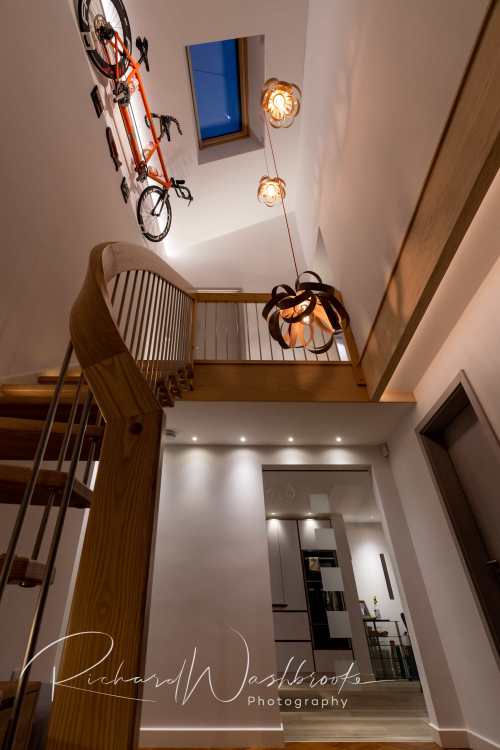
My answer is very similar to @Dan F I'd already decided on Loxone, was originally desiging the lighting myself but my electrician thought I wasn't putting enough fittings in (from the usual one spot per 1.5m2 grid of approach lights school of thought) so I got a designer to review and then improve the design. The main benefit there is she modelled the lighting to determine if it was sufficient, the alternative would be over provision and dim. Also having loxone I wanted layers of lighting in main spaces, either for reflected atmospheric lighting or direct working lighting, and the designer helped a lot in details to make that work well - e.g. placement for fittings to give and optimal shaped "scallop" of light projected on walls, and suggesting details like small markers inside window reveals. She also had discounts on a few manufacture products she passed through, which against MRP probably paid the fees on its own. I'm really happy we went professional designer route, but it isn't for everybody

-
What next for heat pumps after BUS and MCS?
joth replied to joth's topic in Environmental Building Politics
That's fine: No Mains Gas supply => Get cheaper rate mains electricity. What they do with the electricity is up to the home owner. They may choose to go all electric heating (heat pump or resistive), electric cooking, electric car. Or they may keep with non-grid combustion for those things which already is more expensive and likely to get more expensive still over time. -
Yeah, I've given up harping on about this but if you search this forum for "polyphase" you'll see I've been trying to raise awareness of this for a number of years.. 😂
-
What next for heat pumps after BUS and MCS?
joth replied to joth's topic in Environmental Building Politics
Looks like the ministers heard me! Sort of. https://www.ft.com/content/b0a9eb3e-38f8-4fc4-8a60-72a12142244f UK ministers consider electricity bill discounts for heat pump owners Households replacing gas boilers may not have to pay green levies on power costs I think it would be crazy to key the discount on presence of a heat pump and/or absence of a gas boiler, which needs surveying and monitoring, rather than simply "does this property have an active gas supply", which can be done with a simple grep on a central database. But hey, ministers must create 2 new bureaucratic hurdles for each one they remove -
If you have a 3 phase supply anyway, and the price is not prohibitively higher, then yes it is. Splitting your generation over phases means less voltage lift per phase, so less risk of the inverter shutting off if the local supply voltage runs high. I believe this depends a lot on DNO and location. I heard a while back Western power were starting to insist on doing 3 phase install (even if only 1 phase brought out of the head) wherever they have capability for it.
-
Haven't seen this answered, but, even if you do have different phases to different areas, so long as the whole lot are being supplied via a DNO cut out and single mater, you can still put a 3 phase inverter onto the main 3 phase supply and then divide the phases out to sub distro boards as needed. To a degree this is always going to be the case - there's no such thing as a 3 phase domestic "ring main" socket so some areas of the house will be on different phases. And you'll probably want all 3 phases in the garage anyway for the car lift or, whatever. If you're worried about balancing PV generation to demand across phases, don't. Modern meters to net billing so you're only charged for your net import (or paid for net export) across phases at any given moment in time. Couple more things to note: - you can't buy a 3 phase inverter now "just in case" and upgrade to 3 phase supply later. A 3 phase inverter needs 3 phases to output onto. - A single battery often has a power limit lower than it's capacity, e.g. a 16kWh sized battery may only be able to supply 5kW at any given moment. This also limits it's usefulness for high demand users - do you have DNO approval for 14kW PV ? They may look more kindly to this if on 3 phase. - have you asked for an indicative price for 3 phase? This maybe prohibitive and will answer your question - "The 16kw was advised as part of a recent quote I had." - this is obviously just guess work with so much future expansion of use planned. tldr you can always more than you have, the optimum size depends a lot if you just plan to time shift your PV generation or use it for cheap overnight rate time shifting too. With my tariff (Eon Next) it's actually more financially rewarding to sell all PV generation rather than store it, and then fill the battery from grid each night. But that may change when the tariff is updated next year.....
-
A pair of relays and a dedicated permanently powered spur/radial https://knowthecode.io/labs/basics-of-data-and-program-circuitry/episode-6/or-gate-relay-logic But honestly if implanting moods I'd use a set of lighting controls designed for the job, but I would say that 😂
-
An advert for 1GB in early to mid -90s is very plausible. My first PC in 1995 had a 1GB HDD... that was my second hard drive, just a few years after purchasing that 20 MB drive for my Amiga. A period of insane growth, bit like AI expansion is now.
-
I doubt this very much. 1GB would have cost about $1M in 1985, so 1TB would be more like 1 billion dollars. (Or $100M for 1Tb if you mean bits not bytes - not conventional*). https://humanprogress.org/dataset/average-cost-of-hard-drive-storage-per-gigabyte £6000 would have maybe get you 10 MB mid 80s. In the early 90s I paid £200 for 20MB hard drive - £6000 would have bought about 600 MB. By the end of the 90s I paid about £150 for 4Gb - so £6000 would have got 160GB. It's almost the mid-noughties before £6000 would purchase 1TB - around the time I started working for Google which is where I first started hearing TB referred to in casual conversation. So off topic.... * - of course we should be using MiB GiB and TiB for storage, not MB GB TB but honestly that never caught on did it.
-
Is it worth having a gas connection for self build house?
joth replied to Wadrian's topic in Central Heating (Radiators)
Isn't this topic about a new build self build where UFH can be installed and running costs will be much lower. I really can't see how debating hydrogen in some far off future is a useful thing to consider when building a brand new house at this point in time -
Drivers, drivers everywhere - isn't there a better way?
joth replied to Benpointer's topic in Lighting
No, still evil, because - the lamp can't turn on until some low-threshold is reached (not enough power available when the phase cut ratio too high) - the power level and lux brightness it comes on at will vary from one manf to next, even from one bulb to next within make/model, so you get random spotting on of lights on a slow fade up - it's very laggy - it's inefficient Fundamentally, communicating direct to the bulb's low voltage driver and telling it what PWM to drive at (e.g. via DALI, KNX, or yes even some godawful wireless protocol) is going to give an electrically and visually better result. We're just now in the unlucky state that phase cut is the lowest common denominator communication protocol and commoditised solution for controls to speak to lamps. -
Video doorbell pain - so ring ?
joth replied to Pocster's topic in Networks, AV, Security & Automation
Agree their doorbell is a bit of an electrical-mechanical-firmware fail. At least you don't have the previous version with PoE over USB-C (a horrible connector for outdoor installation use), and pisspoor electronics that would melt down and release magic smoke if you enable "mechanical chime" mode when powering it direct from a 12V psu. Do you need a cloud key to run it, or just to setup? In the old days you could use a laptop to run the cloud config software just when needed. And most the "smart" features (like AI object detection) are built into the doorbell itself. You should be able to configure webhook(s) on it to have it ping HA (or whatever) when object spotted or button pressed, and this part at least doesn't need the cloud key. I guess remote answering via app does though. Anyway good news is now you have cloud key you're one of us, and lower marginal cost to buy your next shinny unifi object. -
My system low limit is calculated dynamically based on indoor temp and RHI, using https://www.loxone.com/enen/kb/dewpoint-calculator/ However in practice I could hard code it at 13deg and be about the same result.
-
Drivers, drivers everywhere - isn't there a better way?
joth replied to Benpointer's topic in Lighting
Are these specifically for LED strip tape? If so, yes I prefer using one central 24V PSU (or one per floor), PWM dimmers on the low voltage side of the PSU and then radials to the LED strips. Size the cable appropriately (1mm2, or 1.5 if the runs are long or LED strips large) and never seen any problematic voltage drops. Put in a maintenance free junction box near the fitting to swap from thick T&E to finer flex cable to the strip itself. This is going the other way: hide the driver inside the light fitting. (It still has one, just integrated into the GU10 bulb). Not really an option for LED tape. But I'm increasingly favouring this in all but high end designs (preferring DALI there), not because it's technically elegant (dimming via mains phase cut is evil) but because the longevity of both the LED bulb, the fitting it is in, is bound to be higher than proprietary driver/emitter combos that may well be impossible to replace like for like in a few years. -
What emitters is that with, and where? I've been doing this with UFH (GF) and fan coil (upstairs), I've never found the UFH cooling especially useful, but if you have UFH upstairs then perhaps it is more useful. Our FCUs work a charm though. (Or did, until motor on one failed.... ebay special was not so special, sigh)
-
Lifespan will be much more than this 10-15 years, it's just the capacity reduces. (Same as PV the peak power degrades over time). So a 10 year guarantee normally guarantees something like 90% capacity remaining. I expect the 15 year guarantee wording says 85% capacity remaining. If you have space and dno approval it makes more sense to plan to add additional battery in a decade or whenever, rather than replace.
-
I'm having moderate success with the waveshare mmWave module, per https://community.home-assistant.io/t/waveshare-mmwave-module-any-successful-implementations/747900/2 At £3, plus the price of an ESP, it's excellent value, and I have total control over where I send the data. The movement proximity sensing is much more accurate than I would have expected. Downside is the calibration is a bit painful, and everytime I update settings it seems to get in a muddle and need a reboot to resynchronise where it is in Presence sensing. (Also it seems ESPHome has bloated quite a bit and getting a bit unwieldy to use on ESP8266, which is most of what I have in my parts box. ESP32 doesn't cost much more so probably time I bin my spares and start over... getting better SSL support is never a bad idea.) Anyway it was a fun project and working pretty well as an office presence detector. (I'm planning to put it in a case with a big thump button on top to act as quick access to mute music in the room!)
-
Globally, most people live in cities In the UK most people live in urban areas (towns and cities) Most people with the free time to harp on on the internet about this terrible lot in charge and bring back the good old days don't live in cities edit and add I'm including myself in this slander. I'd love an EV, I have gobs of spare PV I could charge it with, but current models just don't work for most my use cases. My work now does require some smaller local trips so a transit EV or ID buzz would be great, but it'd mean becoming a 3 car household. Most our lives we've been a zero or one car household so 3 just doesn't sit right. The existing RV and estate car do their respective jobs perfectly and have decades use left in them, hopefully by the time the car needs replacing an EV will be more viable (or our needs reduced to match them). It's not range that's the main issue with EV btw, it's smaller size and lack of winter driving suitability (and capital cost) Anyway my main point is I'm not most people, I'm a random outlier. No commute, no school run
-
It'll be interesting how developing nations, er, develop over coming decades. There's a school of thought that having one big nation sized (or multinational) synchronized AC grid is unnecessary and inefficient and more resilience to be had by having many regional islands of AC interconnected by DC. Just like most international interconnects currently work. Starting and stopping islands of AC would presumably then be a more known procedure. That doesn't help Iberia rn though
-
Subsidies, grants, and taxes on fuels have a fairly political basis But doesn't mean a podcast about the technology is political, any more than top gear or the Money Programme are
-
Had a quick look - courses are about £200 and need refreshing every 5 years. That's not bad value, but I would need to bend the entry requirements a bit. Examples below. I think as a Loxone installer I could confidently state I have 3 years experience as a professional heating controls engineer. https://gretraining.co.uk/product/g3-unvented Entry Requirements: Trainees must hold a recognised trade qualification (e.g. NVQ/SNVQ Level 2 or 3 in Plumbing and Heating or Domestic Heating) OR be working towards one OR have evidence of 3 years experience in the plumbing or heating industry, including a cover letter. https://www.logic4training.co.uk/courses/plumbing/water-safety-courses/hot-water-systems-and-safety-course-unvented-hot-water-course/ Entry requirements Candidates must be experienced in the installation of domestic hot and cold vented and unvented water systems and hold one Department for Communities and Local Government (DCLG) recognised competency in a conventional fuel. The initial assessment is designed for operatives who do not have an up to date HWSS certificate.