joth
-
Posts
2918 -
Joined
-
Last visited
-
Days Won
5
Everything posted by joth
-

Self build house - is MVHR worth cost?
joth replied to Wadrian's topic in Mechanical Ventilation with Heat Recovery (MVHR)
According to the status page ours is reducing our heating demand by about 2000 MWh per year. So something like £50-400 per year savings, depending how much you pay for heating energy. But hard to place a figure on the air quality, cleanliness and health benefits. That's the primary reason I installed it, rather than for a bottom line cost saving -
Haha well remembered - yes that is a problem we have in our house, but not one I've tried to solve through simultaneous ASHP heating and cooling. (Although a w2w heatpump would indeed allow pumping excess heat from the FCUs upstairs back down to the UFH downstairs) My solution is during the heating season, the ASHP is in heating mode only (for the UFH) and the bedrooms have additional fan bringing in cool air from outdoors as needed (essentially an MVHR mega-boost mode). This air intake fan shares duct work and electronic dampers with the FCU network.
-
Week 11 - Solar PV panels.
joth commented on Benpointer's blog entry in Contemporary build in north Dorset
That's a neat in-roof install method, great to see new innovations for making neat and cost efficient installs. ( I say new, maybe this is old hat but it's 6+ years since I researched RIS for my own install) Using battery to smooth out export within your export cap is excellent idea, but doing so optimally is an interesting problem in sunshine and price forecasting. Do you already have tech solution in mind for that? -
Did I? I forget where i might have said that. Certainly, that's not the system i ended up with in my own home; we have a single 2 pipe monoblock
-
Can't connect the SWA cable. Practical help please.
joth replied to saveasteading's topic in Power Circuits
Funny enough the last electrician that worked on my CU (in 2024) complained it must have been installed (in 2021) by someone old school as black was sleeved as blue, and the modern convention is to eschew black as neutral. I just smiled and nodded (perhaps with a shut up and do what you're here to do vibe) -
I have done both, and shared some views here earlier today TLDR separate AC is lower hassle if getting someone else to do it. All in one ashp is neater and probably cheaper, but you need to be even more the ball managing or DIY installing it
-
@SBMS 24kW cooling load?? If you're serious about meeting that, forget underfloor cooling and water heat pump, it won't delivery that. Talk to a commercial refrigeration expert Specifically: a 12kW heat pump will typically have a bit lower nominal cooling capacity (depends on model), but will have much much lower practical capacity unless you run it at around 5°C, with all the heavy condensation issues that brings up. UFH can't safely be run below 12°C minimum, and even then has lower effective emitter power in cooling than heating due to lack of convection currents. So I'd guess you'd get 4-6kW max effective cooling. At best you can run some modest cooling from the ashp in addition to an industrial sized A/C system to help support it. Good luck.
-
MVHR and cooling
joth replied to flanagaj's topic in Mechanical Ventilation with Heat Recovery (MVHR)
Also have a look at radiant panel cooling. Like FCU this is popular on the continent but less so in the UK. But apparently works very well for fanless cooling. Happily this has recently been relaxed for detached houses. Physically finding space for two outdoor units can be a pita though, a definite benefit of going single unit. -
MVHR and cooling
joth replied to flanagaj's topic in Mechanical Ventilation with Heat Recovery (MVHR)
As a counter point - I did the single ASHP with heating and cooling system in my own home, and overall it required more dicking about than the two separate systems I've setup controls for in other homes. Admittedly, I did mine in 2020 when there was less information available on how to do it. (And, global events were making doing anything more difficult lol) So on balance, if doing it again then I'd do the same (single ashp) using the knowledge I'd gained. But if advising a friend (who isn't technical / isn't going to be hands on in the install) I'd probably advise separate systems unless I'm happy to hand-hold them through the whole process -
MVHR and cooling
joth replied to flanagaj's topic in Mechanical Ventilation with Heat Recovery (MVHR)
This is exactly not my experience (Enerphit passive house). Heating you can batch input, a few hours will allow the building to coast through the day. But cooling needs applying in the occupied room, when it is occupied. We sleep with the door and window closed (for noise control), and a couple humans output enough heat to cause the room to overheat even in winter. I said noisy in comparison. I have ducted unit so can't directly compare, but the ducted unit is near silent - no noisier than MVHR - unless running at full tilt. Indeed, I ran the condensate pipe anyway as why not. My point was if paying someone else to install, forgoing this will help eek in under the grant cap. If the BUS funded ASHP is sufficient size to supply all the whole property heating needs, and the AC is there purely to supply the cooling needs (which MCS don't cover in their design guidance anyway) then logically there's no conflict. What the installer and/or someone arbitrating the legislation would rule I don't know. -
MVHR and cooling
joth replied to flanagaj's topic in Mechanical Ventilation with Heat Recovery (MVHR)
If you can get multiple FCUs installed along with the ashp and uvc and come in under the grant, then you're doing very well. I was quoted £8k for supply and install of a single (ducted) FCU! Obviously I didn't pay that If you're happy with wall hung FCU with no condensation drain then it maybe more achievable; plenty of success reports from that approach appearing now. (As well as much easier to source, wall hung are easier to install and to control. But ugly and noisy in comparison) if you're DIY installing, no grant, then single ashp is going to be cheaper. If you're paying for professional install, (in price hiking south of the country) and already maxing out the grant on the a2w, then adding on an a2a is probably comparable price to adding additional FCU. Especially if going for ducted installs. -
This is exactly what I've been doing for a couple years. I hear the argument that charging it to full every day is worse for longevity, but if I get drawn into that argument the only winner is never charging the battery at all. I'm buying at 7p overnight and selling PV at 15p so even stronger argument. I do still redirect some PV to ashp (setpoint boost) and the battery. Financially I shouldn't do any those but they're more a nod to sustainability (and improving my home assistant self-sufficiency score) really
-
Heating and cooling automation on the cheap
joth replied to Pocster's topic in Networks, AV, Security & Automation
You paid over the odds! £6.99 for a fan controller, and use any old PC fan. This is what I did for cooling my multi zone amp. Potentially* could power from the amp* 12v trigger output, even https://amzn.eu/d/9cjSv9L (I actually bought a nicer quiet noctura fan and nicked 12V from a nearby led PSU) I think I have a similar looking inkbird thing for the BBQ and smoker temperature controller. But yeah I'm a big fan* of stand alone cooling for devices. No need to wire it to the house brain. (Unless it's super noisy in which case a nighttime quiet mode maybe in order. ) * - no puns intended. -
Yeah sounds like a no brainer then. That'd be £400+ of missed exports and the lost ashp / immersion duty could be met from overnight cheap rate import at half the price of additional export you'd have made.
-
How much PV do you have, and how much do you typically end up exporting? For me I'd pay the £250 regardless anyway as it feels rewarding to be getting something back for the export but I know others that don't care. I'm in eon next and still don't have EV, I had to click through an agreement saying I had one but that was the extent of their checks.
-
Further to what @jack lists as challenges, a variation is to do weathertight + airtight shell, so include windows and roof in the shell-builder's contract. This way you can specify airtightness and weathertightness requirements on that shell. Although they've lost some popularity, MBC Timber Frames offer this service. I'm sure others do too.
-
Just to expand on this, I had a trawl through the legislation and think you're fine (unusual disclaimer, IANAL etc): your options 1-3 are all allowable under the BUS. https://www.legislation.gov.uk/uksi/2022/565/regulation/9 my emphasis: (2) A heat pump meets the suitability criteria in relation to the eligible property F2... for which it is installed where— (a)it provides heating— (i)solely to that property, or to both that property and any related property, and (ii)for the purpose of both space heating and hot water heating, using liquid as a medium for delivering that heat, (b)it is capable of meeting the full space heating and hot water heating demands of that property, and The key thing here is whether the outbuildings (workshop, annex) can be defined as Related properties". So "The/That property" is just the main house, and the other buildings are related properties. AFAICT the main criteria for related properties is they are not covered by the main property's EPC https://www.legislation.gov.uk/uksi/2022/565/regulation/2 “related property”, in relation to an eligible property, F6... means any building or swimming pool which is used by, or available for the use of, an owner or occupier of that property and where the building, building unit or swimming pool is not covered by the valid energy performance certificate for that property;
-
If you want proper 2-way switching without replacing the cable, wireless is probably the way to go https://www.tlc-direct.co.uk/Main_Index/Quinetic/index.html replace indoor switch with a "Quinetic Wireless Switch c/w Built In Receiver". Add one (or more) "Quinetic Kinetic Wireless Switches" wherever you need them.
-
The grant covers supply and install under a single contract for heatpump(s) sufficient to space heat and provide all dhw for "the entire property". I think the clearest out if you want a modular system is to discount the garage or workshop as being part of the property. (If they aren't built / converted yet then clearly at this point you'd be fine)
-
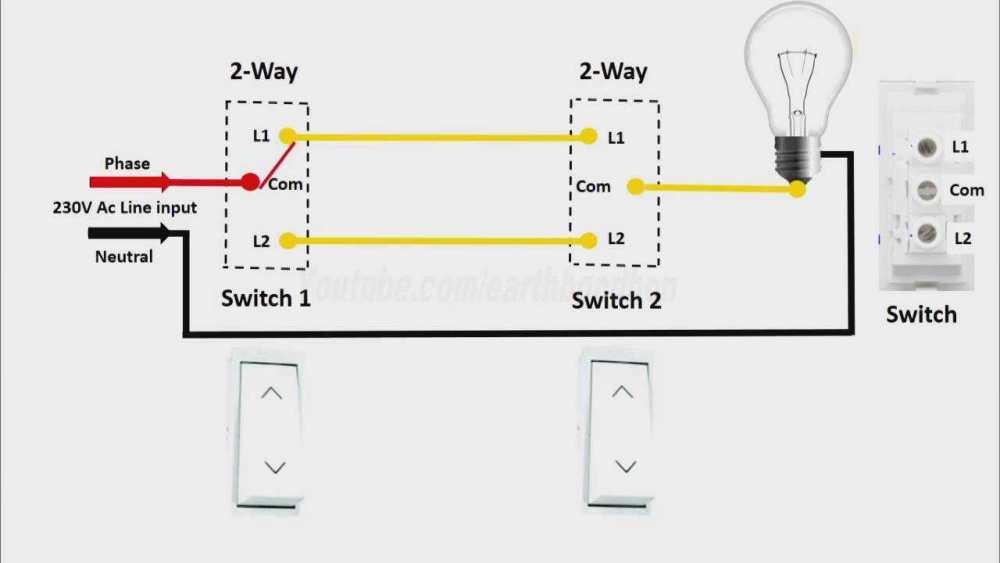
The difference is single vs double pole switch (SPST Vs DPST standard abbreviation). If the inside is a double pole it's probably an isolator switch: if the outside unit had a fault (water ingress) it might trip an rcbo by leaking neutral to earth if only live is disconnected, so for total disconnect both live and neutral are disconnected in an isolator switch. Normally adding a second switch you want a double *throw* switch (SPDT) and fully connect the two switched poles This means either switch can turn on/off the switch at any time regardless of position of the other switch. If you put a SPST inline (in series) as you describe it will act as a disconnector, so you can turn lights off from outdoors but then can't turn them back on from inside without going out and toggle the outdoor switch back to the on position again.
-
ASHP without Boiler Upgrade Scheme?
joth replied to timhowes's topic in Air Source Heat Pumps (ASHP)
Interesting my experience was very different, they refused to talk to me because I'm not a registered installer. -
ASHP without Boiler Upgrade Scheme?
joth replied to timhowes's topic in Air Source Heat Pumps (ASHP)
Not so much "want" as compelled to: Ecodan manufacturer instructions mandate the use of a low loss header and registered installers won't deviate from that for fear of violating the warranty Obviously "don't use Ecodan" is easy retort but I'm primarily answering why existing ecodan installs like nod's will have it. -
Carefully planted and maintained trees can block summer sun but still let in some winter light. That tech is beyond me though (and takes time). You could add brise soleil to the plans, gives you the approval to install them if you ever want to in the future Else +1 for external shutter blinds, it's what the rest of Europe uses surely only time before we wake up to using them more here.
-
Self installed Air Conditioner
joth replied to Annker's topic in Mechanical Ventilation with Heat Recovery (MVHR)
I got one of these https://www.appliancesdirect.co.uk/p/eiq-12wminv/electriq-eiq12wminv-wall-split-air-conditioner electriQ Easy-Fit 12000 As other say R290 so no FGAS engineer needed. (But clearly, needed someone more competent than myself 😂) It's in the garden room / gym so currently doing nothing as it's too hot to consider an indoor workout. But I might go sit in there later with a cold drink and set it on 100% -
Self installed Air Conditioner
joth replied to Annker's topic in Mechanical Ventilation with Heat Recovery (MVHR)
There's two types of self-install, the all in one with a large external duct (effectively the same as the "stick a pipe out an open window" portable AC unit), and the pre-charged minisplit with a length of refrigerant pipework you hook up between the indoor and outdoor unit. I went for the latter, but even though I used the soapy water leak test, I did a poor job tightening down the the compression fitting so the refrigerant leaked and I needed to get it professionally recharged. I couldn't find a local AC engineer that would touch R290 so I had to go via the distributor (appliances direct) and pay an arm and a leg for it. It would have been cheaper to have it professionally installed in first place I expect, but hey, learning opportunity! The monoblock hole in wall solution is much more idiot proof, but puts all the noisy gubbins indoors and obv needs a much larger hole core drilled. Whichever you choose the electrics is simple, plug into a 13A socket. The minisplit you do need to connect a flex from indoor to outdoor unit, but it's like two screw terminals - no harder than wiring a plug.