
Radian
-
Posts
2586 -
Joined
-
Last visited
-
Days Won
15
Everything posted by Radian
-
Ah, sorry, what I meant was that I'm trying to simulate switching over to an ASHP. This is jointly an exercise in squeezing as much as I can out of the gas and seeing if my house could feasibly be heated by an ASHP when the boiler inevitably pops its clogs. Flow temperatures in the 80's are therefore not a realistic proposition - unless heat pump technology has made huge advances since I last looked! I'm busy right now making a measuring device with a couple of digital temperature probes for this exact purpose.😃
-

"Modern" radiator design and controls?
Radian replied to mjsx's topic in Central Heating (Radiators)
Can be a big problem. It certainly is for some of my windows. Add up all the square meters of glass on a particular elevation, multiply by 0.2 and feed that into PVGIS as Installed peak PV power [kWp] along with 90o slope and the azimuth of the wall they're installed in (-90° is East, 0° is South and 90° is West) and you can see the monthly and yearly contribution to your heating. -
"Modern" radiator design and controls?
Radian replied to mjsx's topic in Central Heating (Radiators)
I'm in agreeance with this. As well as solar, kitchens can get hot through cooking. No amount of balancing or weather comp helps with this. I do however think there are plenty of rooms that could do without TRV's - especially on the ground floor. TRV's everywhere coming up to setpoint can play havoc with boiler return temperature and cycling. -
Damn I need one of those! Got a sycamore that's seeded right next to an ornamental tree and its got its roots down. Was thinking about making something using mole grips bolted onto angle iron.
-
Well it's rather subjective except that for vented HW cylinders (like mine) the water is supposed to be stored at 60oC to prevent Legionella bacteria colonisation. In practice this would be very energy inefficient and can be addressed with occasional cycles at that higher temperature. Putting that to one side, 50OC (not 55OC which is actually the absolute lowest return temperature I can get away with to heat the water to 50OC at the cylinder sensor) is the setpoint I've been using but I will be lowering it little by little to see what minimum can be comfortably used. This is a good point - although one other thing I'm trying to achieve (I forget that I hadn't mentioned it) is to range rate the boiler down to ASHP equivalent power levels. It was originally at it's maximum 30kW but I've taken it down to 20kW and I'm aiming for 15kW. 80OC is therefore off the table but I'm allowing 65OC for DHW for now. Really? My boiler draws a maximum of 36W when at 66% modulation (its current range rated maximum) and falls to roughly half that at minimum modulation. The circulating pump draws 16W and the three valves are less than 1W each. But I agree, it shouldn't be forgotten.
-
I think I understand that except for what criteria make for the 'ideal'?
-
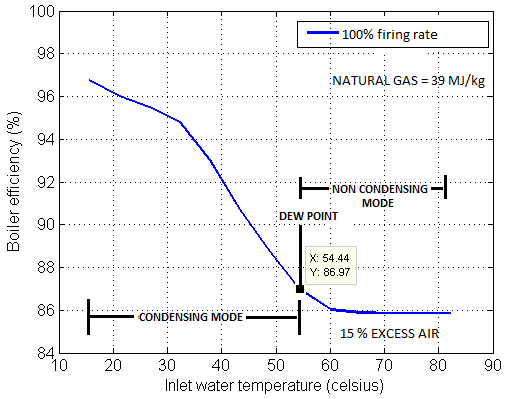
So now I've finally got some half-decent control over my heat-only gas boiler thanks to ebusd: ...now I just need to learn how to drive it 😂 While the electronics I've added hasn't transformed the 15 year-old boiler into a state-of-the-art heat source, it has enabled me to adjust the flow setpoint and monitor all its vital signs to assist with optimising the efficiency of the heating system. Now I have to confess that I find the electronics much easier to get my head around than the hydronics. I simply came to this with the rudimentary understanding that the efficiency of condensing boilers is inversely proportional to the return water temperature - which in turn is a function of the flow temperature and the ability of the heat emitters to dissipate the heat energy pumped through them. Before I got digital control over the boiler, the lowest I could set the 'one and only' flow temperature was to several degrees higher than the temperature required for the Domestic Hot Water - otherwise the boiler would never reach the DHW set point. By just looking at the temperature of the DHW and how long the boiler took to achieve it, I had already determined that I needed a flow temperature at least 10oC higher. Interestingly, setting the DHW thermostat to 55oC and boiler flow to 65oC was resulting in a average return temperature of 55oC although the peak was as high as 60oC with a probable efficiency hit according to the typical efficiency curve such as this one: This seems to be a fundamental limit to the efficiency that can be achieved with a condensing boiler heating DHW? If you need water hotter than 55oC coming out of your taps you have to accept sub-optimal fuel use. After all, SWMBO's not going to be particularly happy with 30oC bathing water in order to get a 10% energy saving. However, now that I can partition the DHW and space heating processes with their own flow temperatures, I can start to see how low I can go with the radiators. But what how do I asses this? Presumably it's going to be a trade-off between how long the boiler fires for and the gas consumption over that period. The product must still be such as to achieve the heating demand. I can picture there being a ripple with varying frequency. And a response time that can be compensated for with timing adjustments. Oh, and weather compensation! TBH I really haven't got a clue what to do next 😔
-
Which set point are they talking about?
Radian replied to Radian's topic in Boilers & Hot Water Tanks
I somehow missed the latest activity in this topic. I think the behaviour I've logged is to be expected - there's nothing for it but to shut down the boiler when the modulation bottoms out (10kW in my case) but the return keeps climbing. There's evidently a couple of degrees of grace allowing the flow temperature to exceed the setpoint - but then enough is enough and cycling begins. What threw me was the expectation I had before I looked at the table. Quoting the delay for a flow temperature of 20oC is always going to be unrealistic. As for my setup, it's constantly evolving 😃 The plot above was just for the UFH zone which runs of the 160L 'buffer' of my HW cylinder per: Somewhat unconventional but it works for me! -
I always start by thinking that.
-
OK, in context, that actually looks pretty good to me. This is all very subjective of course. But I think you know what I was referring to with flat warm roofs. Your design is strongly influenced by set of cubic modules so the higher elevations lend to this goal. All this talk of aesthetics isn't helping your original question about construction method though!
-
Why should you be the only one here not burdened by doubt?🤣 ...Just forget I ever mentioned it! That picture doesn't give a particularly clear overview of the design overall but I'd say there's promise. What's it like in plan?
-
How do you feel about this? To me a warm flat roof is already too thick (from the aesthetic POV) as it presents a big vertical wall on top of your glazing units. Kirkburton Passivhaus is two-storey so the extra height doesn't look too amiss, but on a single storey extension it always looks top-heavy to me.
-
Lime plaster is breathable but no insulation means you might still have condensation problems unless the room is very well ventilated. To be honest, very old buildings are not my speciality. You do seem to be very aware of the pitfalls - which is a good start. Hopefully you will get some more advice along the way.
-
The wall may indeed need to breath in both directions. That's the problem with insulation retrofit in what is presumably a single skin masonry wall. Either a breathable insulation and surface finish (difficult) or non-breathable finish and insulation with a well ventilated gap to the masonry (compromise) or best of all, Exterior Wall Insulation. Then you can leave the inside as it is.
-
Solar Quote
Radian replied to bob the builder 2's topic in Environmental Materials & Construction Methods
What do you mean by standard error? -
Solar Quote
Radian replied to bob the builder 2's topic in Environmental Materials & Construction Methods
If measuring output from the AC side of the inverter then the operating temperature of the inverter can have a significant effect. Taking measurements from the DC side is the only reliable way to assess the module performance. -
You remind me of a TV program where a woman tells George Clark she doesn't like en-suite bathrooms because they have a 'water smell'. George was quite taken aback, but the woman's experience was probably based on living in a series of poorly built houses where such leaks are common. Also, the grout and sealant on tiles always gives up eventually and the widespread (bad) practice of tiling straight onto regular plasterboard means mould is flourishing in all kinds of unseen places. I've got recurring issues in my own shower room to take care of again now.🙄
-
How is the PB attached to the wall? If there's a vapour barrier I guess it must be on battens - which might imply it has been boarded to mask a penetrating damp issue. How thick is the polystyrene? What your senses are detecting is probably the flourishing micro-environment in the gap between insulation and masonry. But with a vapour tight membrane between it and the inside atmosphere, the only issue is what ventilation is available to the inside of the masonry.
-
When is a cold bridge a cold bridge?
Radian replied to SimonD's topic in Energy Efficient & Sustainable Design Concepts
More like a reflection of the internal temperatures. If you wanted to measure the actual surface of the glass you can stick a piece of matt black electrical tape on it and image the tape. Great work with the pictures and analysis. Your thermal bridge bridge is a tease though. Even if you wrapped the entire steel it has to terminate somewhere - higher ground? -
Yes Simon, I've been posting over on the openenergymonitor.org community for a while but the solutions we've built do require some electronics skills that not everyone has. When I read of people on buildhub piecing together rudimentary diverters using off the shelf WiFi switches with much less efficient control I started thinking about a design along the lines of @SteamyTea's 'Lego mentality' where the bits could just click together. The kind of screw terminal Jack that @MikeSharp01 put up could help with that as at least it could support a couple of resistors without soldering.
-
When is a cold bridge a cold bridge?
Radian replied to SimonD's topic in Energy Efficient & Sustainable Design Concepts
This thread is worthless without the pictures 😁 -
Yes, I was thinking that. It's how to make sure the contractor follows the same advice that's the slightly delicate matter. Presumably it has to be rolled flat as well. More hire gear I guess.
-
Yes. The measurement algorithm sums the power (+/-) at least 128 times per half cycle. This updates a Joule counter for every cycle and when an export threshold is reached emits a signal (by UDP or similar low-latency communication) to the switching device(s) to energise. The effect the dump load(s) have is naturally factored into the subsequent power measurements at the meter tails and when the Joules come back in over the import threshold, the load(s) are de-energised. Any number of receivers can play as the only feedback comes through the actual diverted loads imposed on top of the rest of the house. The minimum system only needs a CT in the meter box. It's only interested in nett import/export so agnostic about inverters, batteries etc. It's just trying to mop up anything leaving the premises. It's not even necessary to monitor the immersion load with another CT as this can be inferred from the power delta seen at the measuring device. If the immersion stat switches off, it will be evident that there was no response to the dump request and a second tier switching signal (to storage heaters etc. ) can be issued. UDP broadcasts can reach anywhere on the LAN so any number of SSR WiFi sockets could participate. You should be able to see that it really all hinges on finding such a beast. I scratch-built a diverter using a Triac driven by an ESP32 but I'm used to building 240VAC stuff. To remove this hurdle, a commercial SSR with WiFi provided by a Tasmota compatible ESP might be adaptable via Tuya Convert built into the Raspberry Pi. This is what I'm thinking.
-
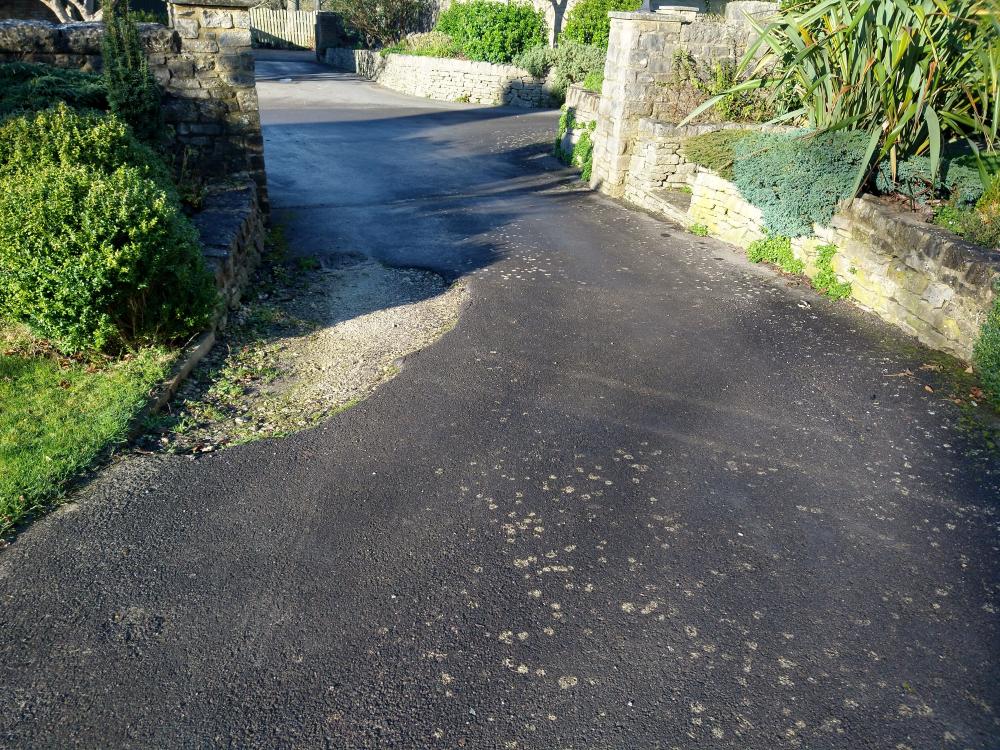
I'm going to have to hire a contractor to repair the end of our drive which got mashed by grab lorries, skip lorries and heavy plant when our extensions were built. It's tarmac laid on type 1 and the damaged area sunk and cracked away The plan is to cut across the entire section from side to side, dig out and whaker in type 1 as it's a bit on the thin side. Also I want an Aco style linear drain across the entrance to catch the runoff when it rains and we wash the car as otherwise it all ends up across the road flooding a neighbours garden. What I'm unsure of is the process of having the tarmac delivered and layed. Is there anything I should be looking out for? Questions I should be asking?
-
The main reason I suggest using a pi zero is that the firmware can be written to an SD card on a PC using techniques already quite familiar to people. Literally all you need is a card reader/writer which some laptops already have. I think the reliability issues come down to the operating system and how it's set up for use with an SD card. Steps can be taken to significantly improve reliability such as running from RAM and only using the SD as read-only at boot. The nuclear option would be to bare-metal code the required functionality onto the ARM chip i.e. eliminate the OS altogether. Then it becomes a fancier ESP. But still programmed by writing an SD card. Quite a bit of work though. If there was an off-the-shelf ESP32 with a card reader that came with a bootloader for it, that would be good too but I don't know of anyone making that. I'm not planning to make anything available myself. The exercise here is to see if readily available stuff already on shelves can be pulled together in to a fully specified diverter.