


BadgerBodger
-
Posts
209 -
Joined
-
Last visited
-
Days Won
1
Everything posted by BadgerBodger
-
Lincolnshire. Day rate - labour only. From found to wall plate inc two external gables and one internal. 101m2 external 150mm cavity wall. Brick/block with English garden wall bond externally. 45m2 internal block some 140mm and some 100mm. All “technicians” work I.e tray, taped insulation, stays etc. insulated block and beam with reinforced slab atop. couple of days left but currently sitting at 13k and forecasting to finish under 18k
-
Running MDPE pipe through drainage field
BadgerBodger replied to flanagaj's topic in Waste & Sewerage
IMHO you should definately have used barrier pipe. -
Public liability insurance - nothing else (yet)
BadgerBodger replied to Drellingore's topic in Self Build Insurance
Howdens brokers I had a reasonable quote from them for various individual aspects -
Crane pad thickness
BadgerBodger replied to Lincolnshire Ian's topic in General Self Build & DIY Discussion
Have you considered a designed solution, technically this is temporary works and should be considered by an appropriately qualified engineer based on ground residual ground bearing pressure of the outriggers and the bearing capacity of the substrate… if not at the very least, go with the crane suppliers advice. And, if you know you have „bad ground”, throw some geo grid and terram down under the stone for good measure, it will help act a a separation membrane when you’re digging it back up later. the last thing you want is a crane going over! -
To throw into the mix. What is the verdict on resin stone baths in people’s experiences?
-
5.95 offer received in last fortnight. Took roughly 6 months to pull together doing my own BOQ and pricing.
-
This puts my quote for 2500 from Yorkshire water into perspective. They only lay 2m onto the property though. Annoying considering I put 575m pipe down the lane for less than 1800
-
Also I see a shed load of “computer says” with engineers on site… a misinterpreted point or an incorrect layer on a complex drawing can be an extremely costly mistake… It’s like using Chat GPT, the technology is great so long as you A. Know how to use it and B know enough about it/what you are doing to interrogate the output. Amazingly, many lack skills in A, B or both!
-
I’m reading your other thread and thought I’d throw my two cents in… Perhaps I’m a little more prone to taking risks but if the overall upstand size still fits (I.e the rooflight can still be installed over it), the upstand is at least 150mm on all sides from top of the flat area of zinc and the workmanship of the weld detailing is acceptable (you’d have to make the call on that or get a consultant to comment) and velux haven’t explicitly stated that it can’t be installed over multiple layers of zinc, I’d be inclined to install anyway… If you are still unhappy, the zinc layering means the rooflight doesn’t fit or the upstand is too short, have you considered extending the upstand with solid timber and/or cutting back the zinc in the bracketed areas using a colour match GRP to dress in the detailing. Yes it might not quite give the aesthetic you want but many GRP specialists warrant their work for 20+ years. In industrial roofing with Kalzip (a similar albeit not the same product) this is a typical detailing solution for unplanned or overlooked penetrations. I’m sure if you spoke with the roofing manufacturer and velux technical teams a simple enough solution is in front of you. As much as we would all like it to be, building on site is not always a precise science and one has to be dynamic and pragmatic about things like residual risk in situations such as this. The main problem is that for the most part, most people only think about THEIR job and not how it interlinks, impacts or even obstructs a subsequent task. In fairness I am often frustrated by this but I have to remind myself that it is not their role. Adding to this frustration, the architect does not include explicit instruction and provides “typical” details which overlook the most complicated scenarios (in your case, where the materials overlap). There are many reasons for this which often includes an inability to half the issue in their minds eye and permissible dimensional and installation tolerance in accordance with the British Standards. Adding to this confusion are the manufacturers guidance notes which in many cases are only available by request and are more restrictive than the British Standards which architects specify to. As others have said, don’t beat yourself up about this, it’s a typical conundrum, but it’s also a situation which would be “overcome” by a site or project manager by opening dialogue with all the relevant parties albeit sometimes circumventing a difficult contractor and just telling them what the solution was.
-
What to do with bare earth garden during build?
BadgerBodger replied to Ed_'s topic in Landscaping, Decking & Patios
Glysophate sounds like the solution here. Maintain that scorched earth look like a champ. -
For building regs you normally need ties 225mm from wall opening jambs at 450mm vertical centres (I think). More than likely an issue…
-
I found that once I got most of the bigger players discussed here down to the same spec and scope there were much of a muchness for the material cost +\- 10% or so. It was the fitting that varied the most and I just want entirely sure with some that I wouldn’t get more costs down the line. In some cases fitting wasn’t offered. Installation, surveying and delivery varied the most being between 40 and 60% of the material cost. We went to VELFAC, Nordan, Norrsken, Rational, internorm & 21 degrees. Or relevant rep installers. Some were just plain difficult to deal with and went off the list. We’ve needed up with Norrsken based upon reading here and elsewhere. Would have like Nordan (used before) but they didn’t offer fitting. Being honest the Norrsken windows are the only ones we haven’t seen but in reality IMHO they were very similar with the main leading difference being the larger the frame size, the more “solid” they felt. I wasn’t so keen on the Belgae ironmongery (too spindly) and it was the flimsier feeling of them all. The only exception being the internorm lift and slide which was truly magnificent!
-
I think this is the detail you are looking for…
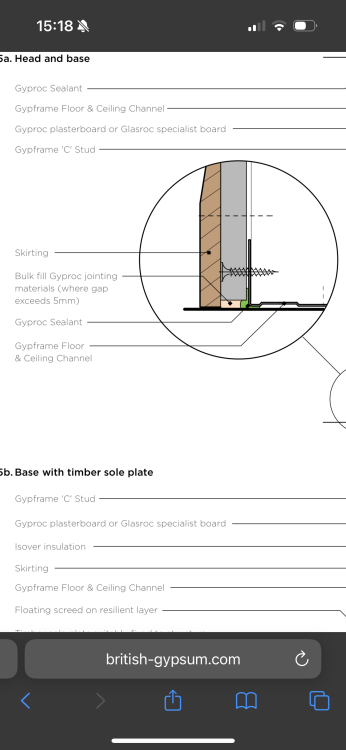
-
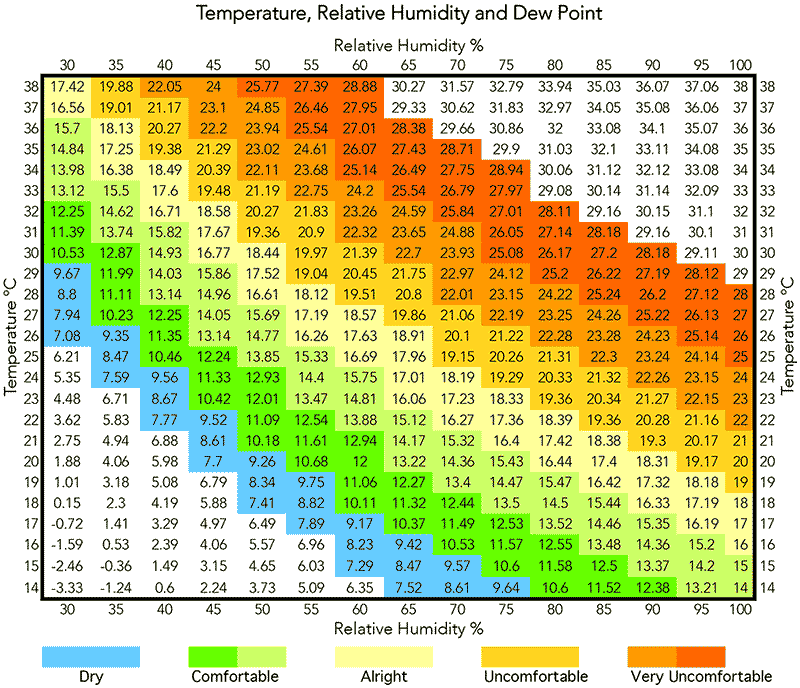
Yes, it’s the upper floor UFH i am most concerned about as opposed to the flow/return to the manifolds. I know everyone says that UFH likely isn’t needed upstairs but because of the high ceilings and general area I’d rather have it and not use it that not have it and want for it! So here if the surface temp of the floor was say 30 degrees and the RH within the house was 50% the dew point would be around 18.5 degrees meaning the flow temp of the water in the upper floor area would need to be above that because the UFH pipework isn’t insulated. Or am I missing something?
-
My worry is in the upper floors where pipework runs in a joisted floor. I’m not sure what the air temp might reach because of the larger space, air tightness and increased insulation but unless I’ve misunderstood, the table below indicates that my current room in roof dew point in summer at 40 % rh and reaches 35 degrees quite regularly, the dew point is just above 19 degrees. How would I manage the flow temp to ensure it runs above the dew point for the relative RH? I could probably tolerate a wet floor in the tiled hall. I wouldn’t want soggy ground floor ceilings.
-
Shoot me down. This works in my head… Back at university when completing a mechanical design module I recall designing an energy efficient solution for cooling using passive chilled beams. As a concept does using a couple of chilled beams in a central hallway for cooling at high level (8m above ground floor level) with an ASHP and MVHR to encourage circulation of that cool air and subsequent recovery/recirculation… To reduce the weight applied to the roof structure I’m looking at using PIR to ensure a low u-value but I’m worried about overheating in the upper floor area (which resides in the roof space). They are large areas with high ceilings (3.5m to the apex) and have limited windows apart from the hallway which I’m unsure if the will have a positive or negative impact. In my minds eye the chilled beam is a novel solution to reduce the risk of running the UFH using cold water and the associated condensation risks.
-
Corrugated roof material - recommendations?
BadgerBodger replied to Great_scot_selfbuild's topic in Roofing, Tiling & Slating
Have you tried keylite? They’ve come up way cheaper for me. -
The advertised rate and the actual negotiated rates being so wildly different. Why not just give me your best price? I’m constantly surprised as to who is offering the best price, recently been to two specialist BM for roofing materials. Both were beaten by my local BM for a not insignificant roof area of 282m2. Timber, felt, lathe, trim, nails, tiles, the full kaboodl!!! Same goes for lintels. Why advertise a rate of X when the merchant will immediately give you 40+% off!
-
Groundwater comes up/across, surface water comes down. Rainwater would generally be surface water until it meets the water table. Most French drains are dealing with surface water only. Land drains can be dealing with either or both. Land drains tend to be used to manage the water table (in drained land) or alleviate pressure (behind retaining walls). There are variations on the theme .
-
Percolation test. Draining too quickly
BadgerBodger replied to flanagaj's topic in General Self Build & DIY Discussion
Apologies, you’re right. That one is for the surface water. I did not need that test in the end as we are using an existing pond which has been used for the same purpose for the last 30 years. I used a generic test from one of the tank suppliers. https://www.jdpipes.co.uk/knowledge/sewage-treatment/how-to-perform-a-percolation-test.html#:~:text=The procedure measures how long,will come from the drainage And you are right. I did it wrong. I should have measured the time from 225mm down to 75mm but with the weather and me being in a general rush to get done (doing 3 tests at once) I forgot that and explained it to the BCO at the time. People make mistakes. In reality, my point was faster speeds can be accepted and that you don’t have to do it on three consecutive days. Which so far as I can still tell, you don’t. -
Tough call. Are you draining groundwater or managing surface water? As a general rule I’d say textile all the way. In some exceptional circumstances I’ve seen them block (using non-woven). But these were truly exceptional.
-
Percolation test. Draining too quickly
BadgerBodger replied to flanagaj's topic in General Self Build & DIY Discussion
Three consecutive days? I know the first “fill” should be on day one and the other tests follow but I actually thought you were meant to test consecutively on the same day so you get a cumulative impact (making the test take longer each time) which results in a larger drainage field. This is more important with poor draining land but not to be ignored. Either way. I did my own test as above, and got pretty low values (as in fast draining) but they were accepted (using PSTP). Admittedly I didn’t follow the guidance entirely as it was the middle of storm darragh… but I think it helped my cause. I also did three trial holes and tests picking the worst two for my final result. I used this website for guidance… https://www.copeland.gov.uk/sites/default/files/attachments/percolation_surface.pdf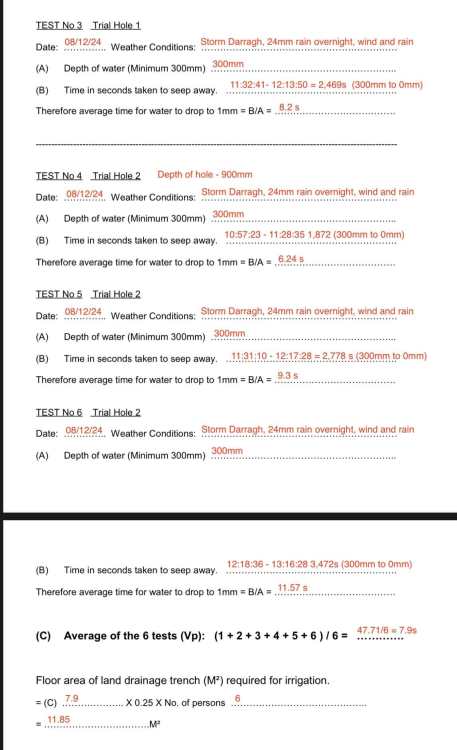
-
No!!! The total build-up was 1.4m. If I recall it was geotextile, geogrid (Tri-axial) 300mm 75-125 stone, three times, with 300mm 6f2 and an MOT capping to make-up. It was a for a pile mat. The permanent structure was built on driven piles. I don’t think It’s absolutely necessary. I was looking to use grid at my place but given that the drive is caked in mud at potato harvest I figured grid wasn’t any use as it would be gunked up with much after the first winter.
-
@Redoctober I use the membrane below the type 1. It’s mainly out of habit now as every road, car park, plaza I do seems to have it so when I’m doing myself I figure I never have to go back to that spec so if it’s good for them, it’s good for me. Anecdotally, in my experience it helps with ensuring you don’t get such a migration on fines (upward) from formation level. Over simplifying it, geogrid type product greater resist punching down. I’ve had some pretty bad ground in my time and pretty much every time a combination of geogrid, membrane and stone in varying thicknesses generally gets the result we need. In some cases for pile mats I’ve put in 1400mm stone!! The rest of the site received cement stabilisation.
-
Angular gravel is the way. Essentially quarried only. As everyone else says river bed gravel, shingle, pea gravel or otherwise, spills, ruts etc. Up to 50mm of angular gravel on a good sub base (minimum 150mm MOT) with woven geotextile below is reasonable (substrate dependent) for passenger vehicle. The MOT wants compacting well (twin drum roller ideally) and the gravel should knit well. I recently did a temp car park on bad ground and we swapped out the gravel for 150mm of 40mm clean compacted and it’s held out for 3 years of heavy use.



