Spinny
-
Posts
598 -
Joined
-
Last visited
Everything posted by Spinny
-
I think the flooring company want to be last in so the flooring doesn't get damaged by other trades. The plan is currently to put levelling compound over the concrete, then fit the kitchen, then come back to latex the LVT down. I guess they may come back to fit the floor while we wait for the worktops to be templated - but not sure how the waterfall end should work. Plank LVT, so there is also the issue of trying to get reasonable lines between the planks, the walls in the hall & kitchen, and the line of the island and kitchen units ? Never ever had a new kitchen before, and not in a new extension. Glass splashback presumably has to be templated after worktops are fitted. Presumably sinks can't be fitted until the worktop comes ? Seems like maybe floorstanding appliances need to be stored in another room and only fitted into the recesses after the LVT has gone down - although you would think fitting them is going to be dangerous for damaging the LVT. Fridge-freezer is integrated - but obviously might have to be removed for any maintenance need - so should that go in before the flooring like a cabinet. Then there is sparky and plumber to come in and out - potentially like windy miller ? I also have plasterer saying he can plaster the ceiling but come back later to fill in strips near the bifolds after the upstand is finished. Anyone got a full order of works as it seems quite tricky ?
-
Is the answer different for LVT flooring ? I am being told by flooring company, kitchen first then they will lay LVT under the edge of the units up to the legs (and in under the floor standing appliance recesses) , then plinths go onto units ? And sorry to hijack a bit. We are having a 'waterfall' end on kitchen island quartz worktop. So waterfall end on to top of flooring, or flooring (LVT) laid around waterfall end ? (A complication for templating)
-
Is it the highest or lowest edge of the rooflight that is leaking (or one side) ? Might it be some form of capillary action ?
-
Is it straight forward to chase out into 7N concrete blockwork using a multitool ? What blade should I use, and will I be able to cut out the chase with a blade too, or have to chisel it out ? Need to do about 2m down a wall.
-
See my post above.
-
The basic architect questions thread
Spinny replied to SilverShadow's topic in Surveyors & Architects
Not clear to me what this third party company is you refer to. Building Control can be done by the Local Authority, OR you can pay a private BC company to do this (or I think possibly a licenced individual ?). You choose. I think generally the view is the LA is thorough, but can perhaps sometimes be jobsworth over some aspects, and might take days to turn up on site to inspect things, inconveniencing or delaying build. Private BC typically turn up quickly within 24 hours or so, and can be more pragmatic and less pedantic - many seem to be ex builders. However, it can feel cursory, and they may not look under the rug at all the details. I have the impression builders prefer private BC - Builders are the poachers, BC is the game keeper - so that maybe says something. Architects process is - PP Drawings, then detailed Design & Construction Drawings, then Statement of Work, tender and contract award, then contract administration and oversight/support. You can choose to stop with them at any stage. We went through the full process except contract admin and oversight/support. Architect recommended a structural engineer. Structural engineer specified all the structural things - lintels, joists, beams, foundations, concrete slab spec and calcs in a report to accompany the detailed architect plans as input to BC for plans approval. All quite costly for us. But you get a lot defined clearly. Some builders barely read the SoW, but it becomes part of the contract with the drawings, and SE report. We paid the architect by the hour for support during build, unless it was drawing errors. An awful lot depends on (a) your budget, and (b) your knowledge, time, desire, and abilities both technically and managerially and (c) how much you care about how close the build is to your spec. and (d) how much you are doing yourself, (e) your ability to deal with problems. Tight change management and change management records is ESSENTIAL. Regular meetings and communications is ESSENTIAL. Remember the builder's/contractor's objectives are DIFFERENT, from your objectives. Builder/contractor wants no change, and can charge you what he likes for change. He is trying to make money, get the job done, and get the cash in. He will buy whatever is on the shelf at his favoured local merchant. He likes cheap, light stuff, hates special heavy stuff. Someone has to be gamekeeper. When it goes wrong - as it did for us - it is horrendous and expensive. Once a builder starts smashing up your house, or gets well into the build he has you by the ghoolies. Other builders don't like taking on part built jobs. Other builders will take probably a year to find and start any work. It can take 6-12months to terminate a contract. Your builder knows this. You need a detailed quote - don't accept estimates for electrics and plumbing - builders estimates can be half the actual quote. Keep a written paper daily diary. Who will project manage ? Who will be on site ? Project management is demanding. I have had to do a lot of it because builders may not do any more than the basics. You want some item not in stock at the favoured merchant - you may have to source it and order it. The builder/contractor may potentially, ignore the spec, challenge the spec, change the spec, buy the wrong materials, use out of date materials, not turn up. Best to know and choose what builders or contractors you are going to use before you start. If it doesn't go well, you WILL need support. The builder/contractor may essentially ignore you questioning work - you need someone with all the letters after their name to tell them the same thing you said before they will do it. Be able to call in the SE or the Architect or even a QS - someone authoratative and suitably politely assertive. BC only do BC, they don't care what you specified, only whether it meets minimum regs. Sorry if this sounds bad - our single experience bad. Many good people out there no doubt, and on this forum. In general they are busy and challenging to find. Not trying to tar all with the same brush at all. -
Front of the extension is at the very bottom of the pic, and as the lateral drain is more than 0.5m away from the extension, they have self certified to avoid paying for a build over agreement. However they are building forward of the extension by 2m to create a raised platform and steps with a planter on top. Something of a grey area perhaps. (I plan to do work in the area around the public manhole on my property in the coming year or two - replace old concrete and/or put slabs down. Presumably I don't need a build over agreement for that either as I am not 'building' over by replacing the surface ?)
-
The lateral drain is the water company responsibility. If it leaks or blocks they have to come and fix it. As I understand it, they will dig up anything in the way as necessary to fix it in those circumstances, which would include the neighbours finished work. Water company have already told me that if there are any problems with the manhole on my property to call them and they will have to come and fix it. (Never realised this in the past and have paid for drain blockages to be cleared there myself). It just seems daft to me not to replace the pipe crossing the boundary now - in everyone's best interest - the neighbour, the water company, and me.
-
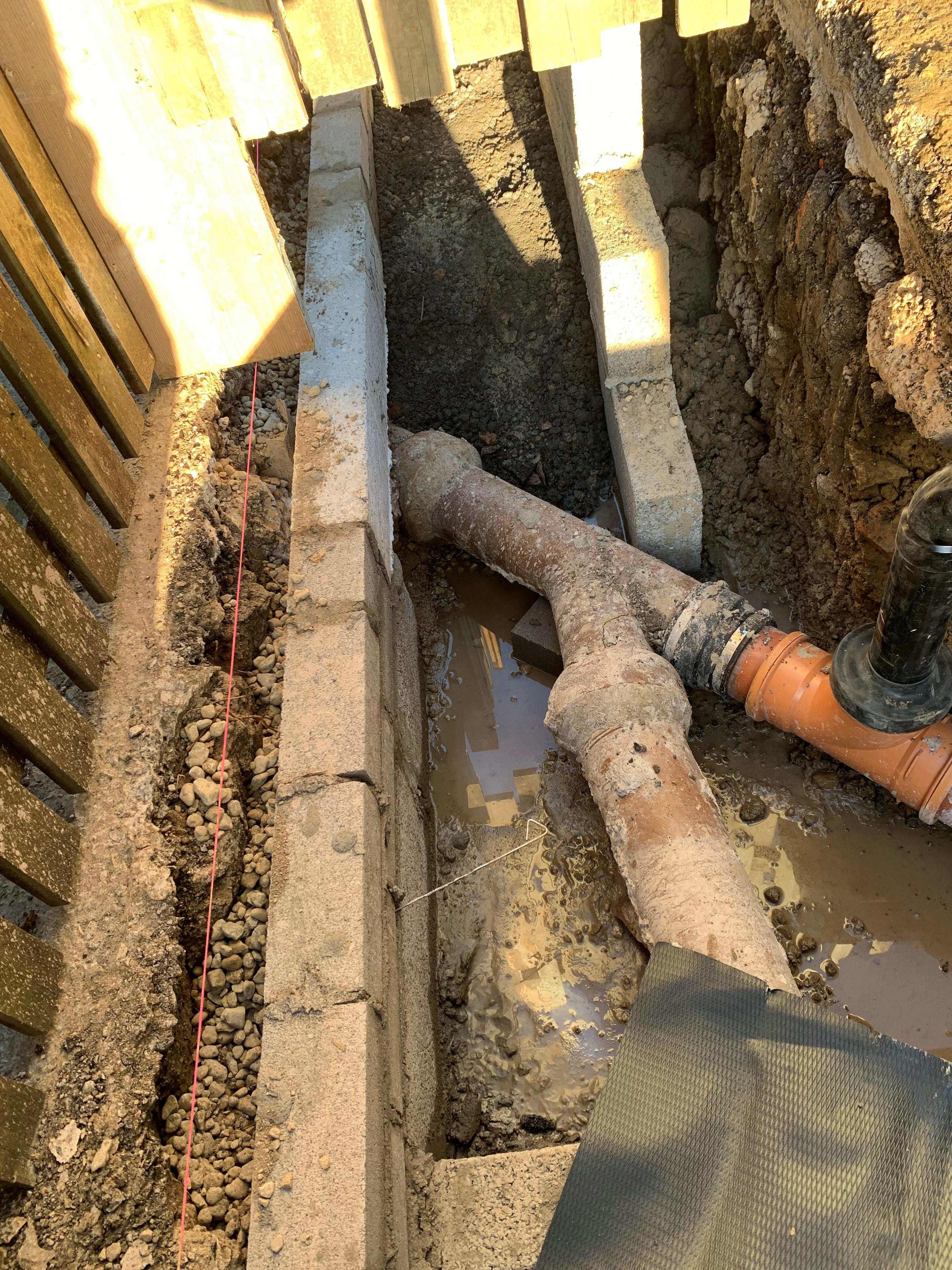
2 pipes (their private drain pipes) flow from the right and merge on the neighbour's side to flow into one pipe which therefore becomes a lateral public drain at the boundary/adjacent to fence. The lateral drain then travels 2m or so across my property into a public manhole on my property (not in photo). Yes we are on the left of the fence in that pic. If you enlarge the photo and look closely you will see that the clay Y pipe has visible cracks in it. They have already put some plastic pipes in to try to fix other clay pipes with holes and cracks. It is still leaking. Yes by replacing their private pipes with plastic (or plastic sections) they can fix it. But clearly there is still then a single clay pipe which spans the boundary to flow into the manhole on our side. Given the problems with the clay pipes on their side, I would think the clay pipe spanning the boundary is quite likely to fail (or indeed might already have cracks). Or their join onto that clay pipe could fail or break the lateral pipe. Now would seem to be the ideal time to replace that pipe before they start building steps and a raised platform over it. Given the pipe spans the boundary it should presumably be the water company's responsibility to do that. If I were the neighbour I would want to get that done too rather than have the water company turn up one day to break out the work they are doing so they can to fix a leak.
-
Thoughts on the drains now please. The neighbours drains are leaking again as you can see. Look closely and you will see cracks in the clay pipe. I think plan is now for him to replace with plastic. I am concerned that then leaves the pipe across the boundary still as clay (boundary is near the fence). Doesn't seem a great place for a future leak at that final clay pipe joint, where it already looks as though the collar may have been repaired with concrete or something. The pipes carry all his foul water and almost all his rainwater including that from the new extension. Do you think the water company will come and take this opportunity to dig the lateral pipe across the boundary out and replace with plastic to avoid future problems ? I am ok with the water company digging on my side because it is old concrete that will need to come up anyway. Now seems a better time for preventative maintenance, rather than waiting for any hidden foul leak to arise ? There might be a question about where to stop of course. Lateral pipe goes to public chamber on my land fed by my drains too. Chamber is brick and pipe inputs and outputs clay - presumably been there since 1935. Thoughts ? What would you do ?
-
Builder plans a 32mm coping and is building 40mm from the boundary. What are the chances of building a 7m by 4m wall without deviating by 8mm on the front face ?
-
How to Build 100mm blocks onto 95mm blocks
Spinny replied to Spinny's topic in Bricklaying, Blockwork & Mortar
And the acceptable tolerance from plumb on a 4m high wall which is 7m long ? (I am seeing something suggesting +/-10mm over 2.5m height, and +/-10mm over a 5m length ?) Would seem to suggest it would not be hard to be out by 15mm over such a wall ? -
Concrete blocks are 95mm actual width, faced blocks are 100mm actual width. So how do you position the 100mm faced block wall onto the 95mm footing ?
-
And how damaging is concrete dust please ? If it is going to be cut by the builder seems likely to generate copious clouds of dust which will settle on our doors, windows, cladding, render, single ply roof, car etc ?
-
What sort of poor workmanship ? (I guess a lot of people like me would just assume a concrete pour is hard to get wrong.) Any idea of the cost of concrete cutting ? Did they use a specialist contractor or just hire in the cutting machines ?
-
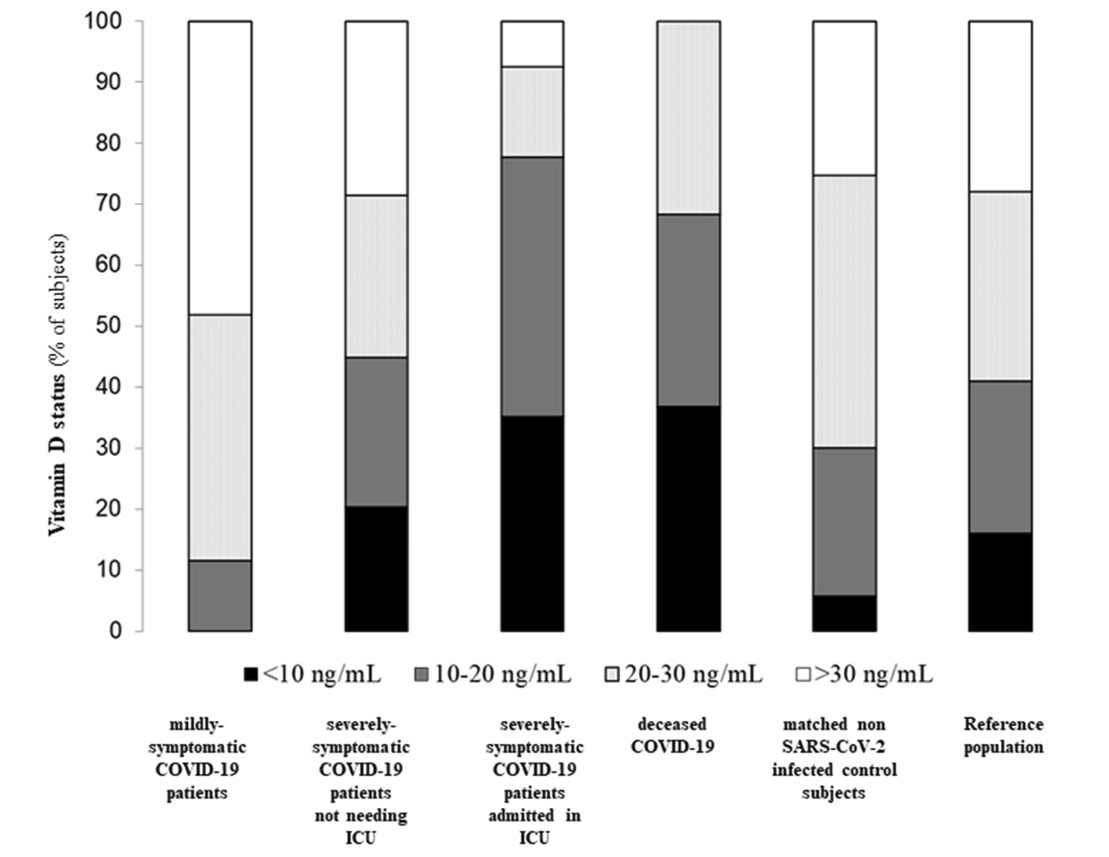
You believe they did Vit D trials by testing the blood of dead people ? https://www.mdpi.com/2077-0383/11/22/6818
-
Online photos seem to show the cutting wheel mounted at the side, so I imagined you could just walk it along the top of the foundation to cut on one side by walking in the appropriate direction. Top of the foundation is flat and level.
-
Pegs were put in by measuring down from a laser level line I believe.They had to keep the concrete below the drainage pipes, otherwise I think they would have poured higher.
-
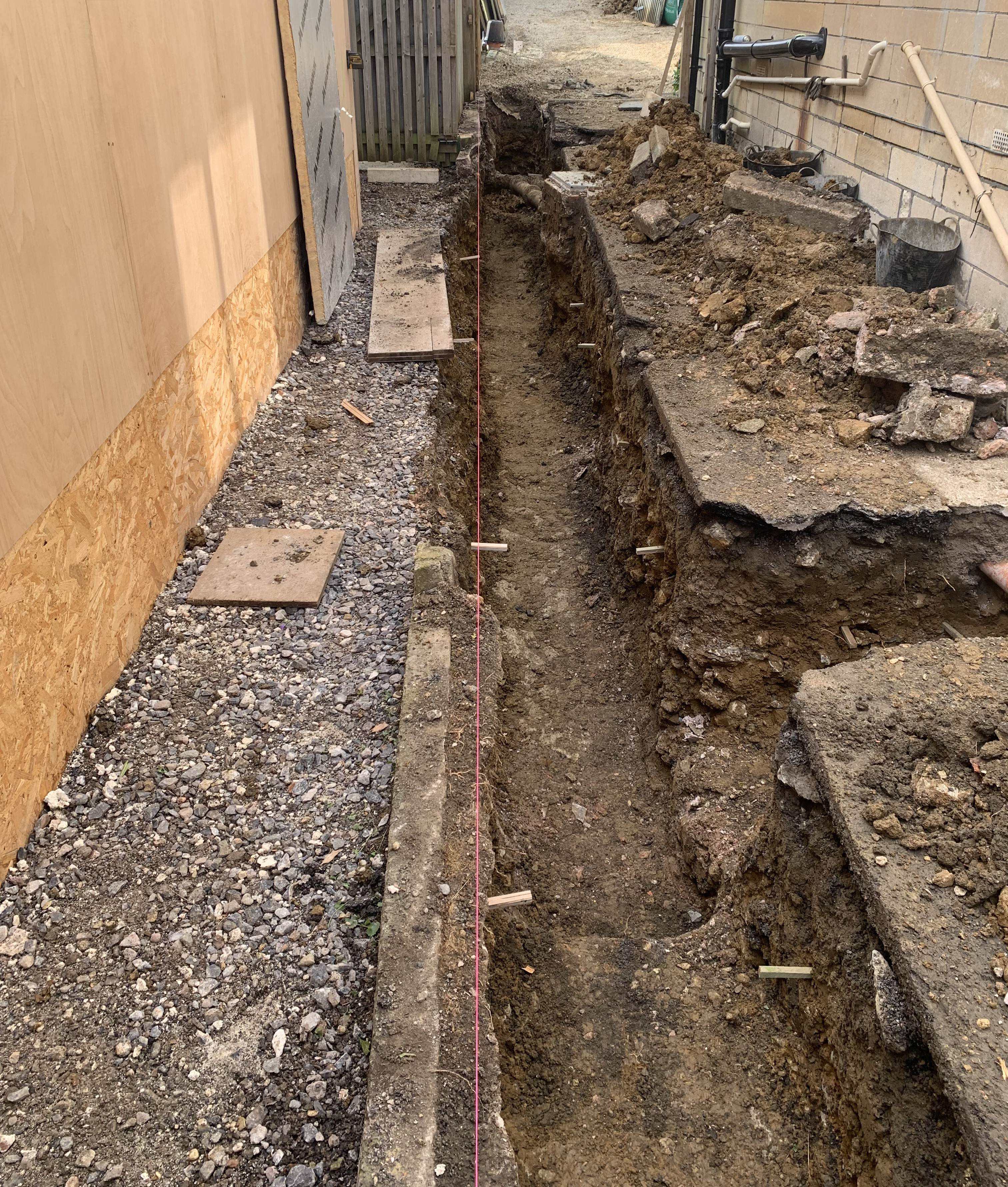
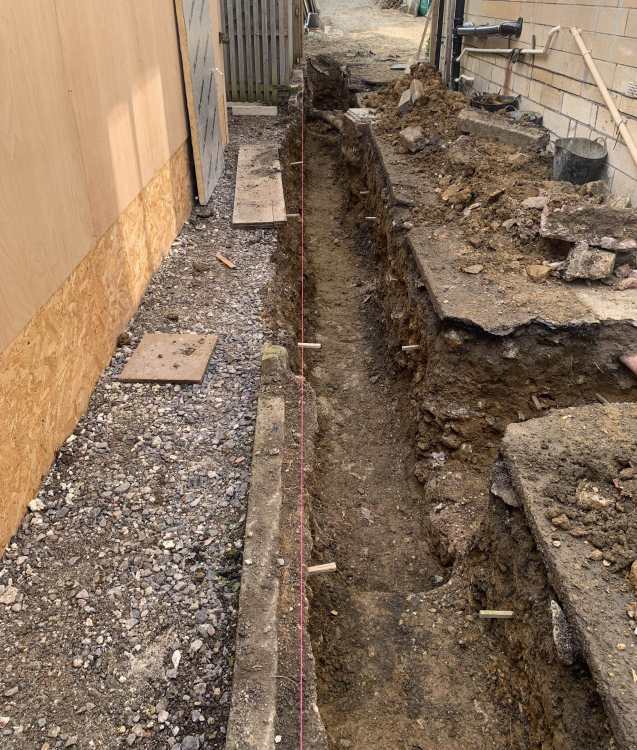
Builder is saying it is because kerbing at edge collapsed in on the day of the pour and had to be removed. Says trench is therefore angled out to the top of the concrete. Also says stones in the side of the trench broke out when digging out the edges. Therefore when he is back on Tuesday he plans to mark the boundary line down the top of the concrete with a string line and angle grinder, and then cut down and breakaway the angled edge with the expectation this will fix the problem. I appreciate trenching is not a millimetre activity, and shuttering would presumably have meant digging out on my side. However he could have raised this with me when it happened of course and chose not to. I suggested a walk behind concrete cutter but he was not interested (My guess because that would cost money). Pic of trench just before pour. Wondering whether I should be seeking some restitution in the form of an addition to the PW Award stating owner of my property has the right to join any future boundary foundation into the one he is putting in ? Not quite sure how such an agreemnt would have to be formalised - PWA, Deeds, letter, covenant etc ? Also wondering whether a structural engineer and/or BC need to be brought in to make a formal statement about the structural integrity of the cut back foundation ? Any more input very welcome from all the good peoples on this forum.
-
Grateful for any further views or advice on this. Clearly I cannot remove any concrete and have no means to do so, and it has now been going off for 16 hours. I am waiting to hear back from the builder, who has previously said he doesn't work on site on friday's.
-
A walk behind concrete saw ?
-
No. They did it, and yes a good job done, content with it. It is only possible because I don't have roofline fascia's on yet and of course it will now prevent that, or even measuring up, for many weeks. They have had to screw into my edge timber.
-
Builders have gone for the day, and won't return until monday now. Annoyed because I went out this afternoon to find the trench wider and the kerbing removed in that section in the photo. I am told some of the trench side collapsed today and so they decided to remove the section of kerbing - presumably to avoid the risk of it falling into their concrete pour. At that point the concrete lorry arrived. I made the point that they were now putting concrete onto my land, was told they could cut it back later and to please move back away from the trench/work area. Then they filled the trench. Annoyed because clearly they could have knocked on the door and told me about the trench problem earlier in the day but must have deliberately chosen not to. I have already written to the neighbour (currently away) stating they may not build on or over my land. They are making a 40mm setback only for an alu capping on top of the wall. Yes they have access to my land to do the work under a party wall award.
-
saveasteading - cor blimey, I just consider it a healthy scepticism/realism developed over 60 years. TBH people on a forum don't generally have a commercial interest to push. I value experienced input but reserve the freedom to politely discuss or disagree with anyone. Ever had a misdiagnosis from a medical professional ? I have but it doesn't mean I disbelieve anything and everything a medic tells me. People are only human even experts, even moi. I sincerely thank you and appreciate your input.