Spinny
-
Posts
923 -
Joined
-
Last visited
-
Days Won
1
Everything posted by Spinny
-
Thanks , that's fine. Take care in finding your independent inspector and be sure to put all the hypotheses people have suggested to him to have him check and comment on each. Hopefully you can find someone that will come with measurement devices for temps, plumbness, fit accuracy, air gaps etc. It will be interesting to hear what he finds. I think this is a common concern and has got me thinking again about what to put between the packers under my bifolds. I had to have celcon insulating blocks replaced with concrete blocks because my builder was seemingly unable to actually securely mortar in the celcon blocks, and the window company doubtful about screw fixing into them.
-
OK, but I don't see that there is any other method to identify what is actually happening other than identifying a list of possible hypotheses that might explain it, and then seeking to test and check these hypotheses one by one. It is what we call the scientific method. Once there is an objective identification of the actual problem(s) it is possible to ascribe responsibility and whether reasonable care and skill has been used or not. Unfortunately it is still often human nature for people to start by avoiding blame and attributing faults to other factors as your fitters are doing. They might be right or wrong, and what is needed is a logical scientific identification of the problem(s). Even bringing in other 'experts' can sometimes only generate more opinion unless there is some focus on establishing facts and evidence supporting or refuting hypothetical causes. I will say that in my experience it is too common for some trades people to essentially ignore what the customer says on the basis that the customer is assumed to be ignorant, inexperienced, unqualified to comment etc. To try to be fair there are doubtless customers where this is true but in reality it should matter not who makes claims or statements, only whether they can be established as factually true or false. But I have also had 5 different plumbers give me 5 different opinions on a plumbing problem - some of them fairly obvious crap. However sometimes you do need to bring in somebody with letters after their name and direct experience (e.g. surveyor, engineer, architect, QS etc) to tell some tradespeople exactly the same as the customer is saying and to state the bleeding obvious, before they will remotely accept it. I would encourage you to focus on rigourously identifying the problem(s), because even if you gain a section 75 financial settlement you will still need to get the doors replaced - and if you don't understand the current problem(s) you are likely to see them repeated on a new product/install. It has been my experience in life that things are mostly like the saying about making a cooked breakfast - the hen is involved in the endeavour but only the pig is actually committed. Whether it is a health problem, a car problem, or a building problem you can seek help and opinion but in the end it is only you the pig that actually bears the problem and is truly driven and committed to getting a resolution. Ignore the bullshit, the name callers, appeals to claimed 'authority', those that play politics, the insurers, lawyers, dissemblers, chancers and deniers etc. Find the truth, hold people to account - whether a window fitter, the horizon scandal, the blood transfusion scandal, grenfell, or hillsborough. Find the truth, speak the truth, live the truth. As the man said 'For a successful technology, reality must take precedence over public relations, for Nature cannot be fooled' Happy New Year
-
Go to ChatGPT and type in... "Is it possible for cold air to pass through a double glazed door or window by passing around the sealed double glazed unit i.e. between this unit and the frame it is fitted into ?" When Chat GPT answers and then asks you the frame type etc type in,,, "a upvc frame which has been fitted a few weeks ago and comprises of a french door fitted between 2 outer fixed glazed windows" (And the first 2/3 minutes of this video may be of interest... https://youtu.be/rc5DutkQ0WM
-
Also that heat camera is showing the coldest strips at the bottom edge of the double glazed units i.e. just above the bottom frame where the glazing starts. Could it be that the double glazed units were not a good tight fit into the frame itself, so that you actually have cold air finding it's way through the windows/doors themselves - underneath the base of the double glazed unit - i/e/ between upvc frame and DG unit. Window companies may be ordering in ready made dg units to fit into their frames. They will NOT want the glass to end up too big, so it would seem quite possible for the dg unit to end up on the small size sometimes and perhaps not to fit tightly ? Also there are usually seals between the glass and the frame - are these tightly fitting ? I think it is usual to have a little lee way for heel/toe adjustments, but ultimately the entire door assembly should be perfectly air tight on both sides. If you fart outside you should not notice it inside :0). Maybe you could try some sort of smoke test ? (In my youth I once had to travel around with a fire service chap for a few days as part of a business analysis - the height of his entertainment was taking out a phallic shaped smoke machine which hummed and emitted smoke from the tip to test the smokes. For some reason he thought it amusing to test the smokes in the headmistress office when visiting the girls schools ?!@)
-
Can I add in another consideration. From what you have described the complete window/door consists of multiple individual parts: The two fixed side windows with their own frame (presumably pre glazed with double glazing units), the central doors with their frame, and the cill piece itself which the other parts sit onto as a base. Have you carefully checked the vertical and horizontal alignment of these different parts ? If for example the two side windows were fitted to the outer edges of the opening first, but the inner vertical frame edge ended up not being perfectly vertical, then fitting the door frame vertically against it would become a problem. Quite possibly a fitter might then choose to then fit the door frame perfectly vertical regardless. So there would then be a variable gap between the side frame and the door frame - quite possibly tight at the top, but with an increasing gap near the base. This could then be filled with mastic/sealant and appear normal. However there could be an uninsulated gap or path left between the fixed windows and the door frame at the lower part - thereby causing cold bridging problems. In a similar way there could be misalignment and gaps occurring between the cill and the window and door parts fitted onto the cill - again possibly leading to cold gaps between the cill and frame possibly hidden by sealant. I have to say it is a skilled and potentially time consuming task to assemble frames into an opening with precision such that all the verticals are spot on plumb and all the horizontals are spot on plumb level. Doors especially need to be true so they don't swing open/closed of their own accord etc and meet correctly when closed. Anything other than expensive spirit levels are unreliable and can easily be out. Small alignment errors which many tradies might think 'good enough lets go down the pub' might mean installation gaps at the lower part of the frame and between cill and frames. I might be barking up the wrong tree, but get yourself a long expensive known accurate spirit level (or plumb line) and carefully examine whether all the parts of the installation are properly plumb and tightly joined to one another. (It took a second fitting visit to get our alu bifolds right and they sent their crack fitters that were at it until 7pm getting it all just so. And I imagine UPVC frames may show more bendability than aluminium.)
-
I have aluminium doors and three have cills. The manufacturers technical drawing shows that the cill (as with the frames) incorporates a thermal break betwen the external facing aluminium and the internal facing aluminium. If you google 'do PVC cills have a thermal break' their AI engine says PVC cills do not incorporate a thermal break etc because the UPVC is itself more insulating, and that air pockets are usually also incorporated into the design to reduce thermal bridging. I think you might start by obtaining and examining the technical drawings of the UPVC cill and frame designs, and also to identify what the manufacturers data sheets and specs and installation instructions have to say about the thermal properties the door and cill etc is designed to achieve - and with what installation detail. This then might allow you to identify specific product thermal specifications you would rightly be expecting to achieve, and to compare this with what has actually been achieved by the install. Any discrepancy will then either be due to a defective product, and/or a defective installation and therefore responsibility rest with the manufacturer and/or the installer. You say a conservatory was taken down and this window fitted into the opening in the wall ? Did you give any consideration to ensuring the opening was properly prepared for the door fitting - e.g. by a builder such as the one doing the demolition ? If you ordered the door without having the opening surveyed or prepared to the installer/manufacturer's instructions then I would imagine this might make a claim more questionable ? From the photographs it looks as though there is two layers of sealant and a DPM between the cill and the brickwork. One might expect this to at least provide a little insulation, but if you can feel draughts it seems the underside of the cill is not properly sealed up. So you might try actually getting the gap between the cill and the brickwork properly sealed up externally to stop all entry of cold air from the outside. I can understand you being very disappointed with the thermal performance - did you research and check this out when choosing your doors ? Personally I would expect the window company to be trying to do something more than complete denial.
-
In our build the architect included a continuous row of celcon blocks around the inner leaf at insulation and concrete slab level (your screed level) to provide some insulation in the inner leaf between foundation/footing level and wall above. I think some people also build the inner leaf entirely from celcon blocks. I think our builder put the 25mm PIR around the perimeter and then used the underfloor insulation butted up to the edge of it to hold it in place - simply a matter of practicality to hold the edge insulation in place for our concrete pour. Think it may help if you can say whether you are doing new build or retrofit, and to describe the makeup of your wall structure - concrete block, celcon block, stone, sipps etc.
-
Our smoke in the hall used to go off whenever someone did a fry up and with a high ceiling you couldn’t reach we could be found opening the front door and madly flapping a tea towel at it. ok new kitchen should be different I suppose with a powerful extractor etc. But there are times people might end up with some smoke in the house - even if just the 437 candles on my birthday cake :0) so my experience all alarms have proven to be false and a real PITA when someone’s house or car alarm kicks off at 4am. Ok unlikely to be burning the divorce papers in the waste bin at 4am. lots of stuff in today’s world is unnecessary, we used to live just fine without mobile phones or Amazon deliveries or cars that tell us where they are parked. But people can’t help fiddling with stuff ‘just because you can’. Work in an engineering company and you’ll find they are all messing with their cars and stuff at home. Some nutter called Musk seems to think cars need to drive themselves and we should put life on Mars. Each to their own madness.
-
However what you also want is the ability to silence the alarm remotely.
-
Don't forget that when the doors are stacked you have the full weight of all doors in one place. We gave the door weights to our SE to confirm all would be ok.
-
I have put in 47mm back boxes everywhere for the light switches, and a number with backboxes twice the size of the cover plate to provide plenty of room for switch/dimmer modules. Despite this my sparky seems to belong to the abstract spaghetti school of smart module wiring. I find it frustrating how the manufacturers are so focussed on the retrofit market, there seems to be a big gap to be filled with products for people doing new builds and total renovations. Having smart things on show is all very well, but I do think the ideal smart home would have the devices hidden from view. Nobody seems to have worked out how and where to integrate in presence/motion detectors etc. Lots of things in white plastic boxes only. I like things like the Sensative strips that are invisible when installed. Have you integrated smoke and heat alarms into HA ? Because the England regs require wired detectors which is a PITA and seems to preclude all the smart home solutions that are almost universally retrofit battery powered and don't meet regs. Also are you using anything for smart control to turn the water mains supply or gas supply on/off - such as the robots that will turn a lever arm valve ? Are you using LED strips under your kitchen counter tops, and if so what type, and are they surface mounted or in routed channels ? (It is amazing just how many lights you can end up with. I have 8 dining spots+9 sitting spots+3 entry spots+10 kitchen spots+5 pendants + 7 led strips + 3 under cabinet pucks + 3 accent spots + 3 picture lights + 1 wall light = 52 individual lights in one open plan room, with another 11 external lights (6 soffit, 4 wall, 1 step). I guess I am as mad as mad jack mcmadman from madsville.)
-
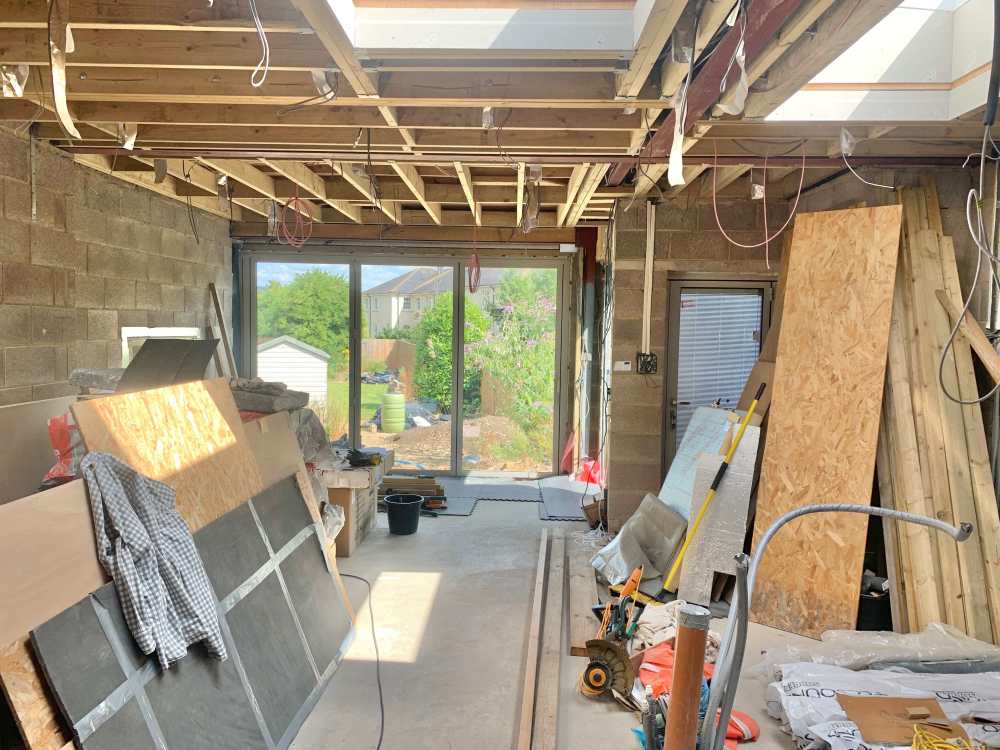
Aluminium Bifolds 3.5m wide and 2.4m tall, top hung, stack can be positioned to either side of opening when open. Fixed to timber and steel beam above. (The timber was added because we changed the choice of doors and the height of the opening had to be reduced to suit.) Best to have professionally fitted by careful, conscientious and experienced fitters. Getting the threshold position correct is critical if you want something close to a level threshold, so knowing where the finished floor level will be. PROCESS: Prepare opening, survey measurement of opening and marking of reference level markings around the area, detailed drawings with tight opening size, bifold manufacturing size etc, carefully check drawings and amend as necessary then sign off drawings, send to manufacture, professional delivery and installation, test and acceptance. Beware the limited accuracy of laser levels. The company claimed floor level had been changed between survey and fit but this was nonsense. Their lasered levels differed by 11mm over 9m from survey to fit because laser levels clearly not reliable/calibrated. My water levels showed they were wrong. So buy a water level and mark careful reference levels. Make sure the fixing methods and positions are defined and there is going to be solid material in the right positions and alignment for the frame to be fixed to. Insist on careful preparation, inspection and checking of the opening - builders lie and cover up - thus in our case the first fitting visit was abortive.
-
Is that Artex or similar on the ceiling, and do you have a plan for dealing with the ceiling ? Are you planning on putting in some extractor ventilation ? In the ceiling ? Or is the block wall an outside wall ? Is there somewhere to duct it out ? Downlights to go in the ceiling ?
-
Yes, another sharp practice in the black arts of the tradesman. I thought I was getting a landscaper with 15 years experience - what I actually got was a 20 year old with negligble experience and a mobile phone.
-
Looks good. What wall switches are you using with your smart lighting ? I have still to buy some retractive ones and am interested in what others are using. Are you automating any electric roller blinds ? I will be starting to move to Home Assistant soon as I find different manufacturers are still implementing certain features in incompatible ways. For example I am using some sonoff relays, but they have implemented the detached mode in a way that hides switch presses from non sonoff ecosystems. I have implemented a work around but HA seems like it should be the bees knees and avoid such things. What are you using for presence sensing and do you have eny experience of the extent to which it may be usable through plaster board ?
-
How old is the sewer pipe, what is it made of, and has it been inspected ? I have watched my own neighbours build over their drains including their drain chamber and all rodding points. In my opinion a very stupid thing to do despite it being permissable. Just building over a pipe and providing all existing accessible chambers, rodding points etc remain fully accessible seems more reasonable. However as my neighbours discovered clay pipes that have not been disturbed for 80 years are not too robust, they had pipes that were found to be cracked, and multiple others that cracked during the building work. Clay pipes can have hairline cracks that can open up and parts of the pipe give way. So if you were going to build over I'd have thought you would want to be 110% certain that buried pipe was going to be good for at least another century. Therefore replacing the existing pipe seems adviseable, certainly I wouldn't want to build over a clay pipe.
-
Ta for comments. Steel is not boarded over yet. So yes will be insulating between it and the p/board. It supports an RSJ across the inner leaf above my bifold opening. So in theory it sits in the warm zone inside my wall insulation, and underneath my warm roof. But of course it has cold rising up the column from foundation level and nobody thought about insulating pads and stuff when it went in, so an unfortunate vertical thermal bridge I suppose. Have a light switch to go in too and will be using a 47mm box to accomodate a smart home relay module, probably got about 60mm between steel and back of P/B. Can you get surface pattress boxes with an adjustable lug ? (Just in case my spirit level isn't working that day.)
-
So I am looking to position a metal back box for a double socket just in front of a steel box column. Not sure of the thickness of the steel - I guess maybe 8mm or 6mm. As it is a steel column rising from foundation level it is or feels cold to the touch, so I plan to insert a layer of insulation e.g. 10mm XPS board between the back box and the steel to heat insulate the back box. What size Techscrew should I use to screw the back box into the steel column ? How do I insulate the screw to stop it cold bridging the XPS insulation to make the back box cold ?
-
I did ask chatGPT to produce a 2d diagram showing the lux distribution for a set of downlight positions based on their specs. It did the job, though how precisely accurate its' answers were I couldn't say. illuminance_map_60deg_beams (4).pdf
-
Just took some water pressures again. The mains supply is at 50 Psi, and downstream of the caleffi pressure reducing valve is at 50 Psi. Is it possible that if the plumber that cleaned it didn't reset the screw pressure adjustment properly, and the downstream side has been subject to some 6 bar back pressure, that the screw may have worked out more over time?? because immediately after that plumber had been 4 months ago my memory is that the PRV output pressure was more like 3.1/3.2bar rather than 3.5/50psi, having been about 2.8bar before he started. And in principle is there any reason the system can't be run at say 3.1bar, rather than the 2.8bar it was at before, because even this small change has a very noticeable effect on our shower flow.
-
Only the shower head and one set of basin taps post date the new system - there is a little on the shower head but nothing that impacts flow at shower head or basin tap. The water softener is a PITA because (as you can see) I defo need a proper fully competent, experienced, and conscientiuous plumber. The Water softener is to go in the understairs cupboard but needs to go tight back against the outside wall and tight on one side to a stud wall with the understair loo behind it - otherwise it prevents any meaningful access and use of the rest of the cupboard by blocking the cupboard doorway. The original builders plumber installed the valve/bypass valve too far over, and also decided to put a standpipe positioned right behind the water softener position and bossed into the u/stairs toilet soil pipe, also necessitating a waterless trap. This arrangement is crap and doesn't achieve what we need/asked for. The water softener itself was never actually plumbed in to bring it into use and the builder and his plumber long ago terminated. Ring another Plumber - Send details/arrange visit - quote promised - quote chased - no quote and availability ever obtainable - ring another plumber: repeat on an infinite basis for 2 years, dry wife's crying eyes, and say don't take the anti-depressants. A better idea would seem to be to drill straight out through the outside wall with holes for the drain pipe and the overflow pipe. There is no outside surface drain in that position at the moment but it is close to a drain chamber, and it has been suggested to me that a (good) drainage plumber could dig out the hardcore and put one in.
-
However I have had occasional tundish discharge before the plumber ever came to clean the caleffi PRV. So potentially him leaving the PRV set to a higher pressure has simply made the problem worse and more noticeable.
-
So I guess you are saying, if the cylinder is running at 3.5 bar rather than 3bar, then this is going to compress the expansion diaphragm even at cold water temperatures (if the vessel diaphragm is only air pressurised to 3 bar) and therefore some of the expansion capacity will be lost. Therefore the expansion vessel pressurisation should be matched to the P reducing V output pressure with a small adjustment for height difference between the valve and the vessel (about 1m or 0.1bar).
-
I can see both sides of the valve because the outside outside tap is connected directly to the incoming mains - I have taken the pressure there a lot of times and it is 3.5bar or 50PSI with very little variation (I have a new 32mm mains pipe connection installed earlier this year to replace the old lead pipe). The inside taps in the utility room only have about 3m of pipe running from the cylinder location. The cold tap is on the balanced cold and the hot tap is from the hot pipe/cylinder. So pressure readings taken from these inside outside taps are essentially the same as the pressures downstream of the pressure reducing valve. (negligible height difference).
-
So the hot water timer was set to come on for an hour at 4pm today. At around 4:40pm I noticed the tundish going again - so same problem. Static pressure before opening at the hot tap was 90 PSI again etc. Same short burst of water from the cold tap before it goes to normal flow rate. (I should say these are outside taps fitted internally as a temporary job so there is no mixer block or flow restrictors on them). The static water pressure at the outside tap (fed directly from incoming mains) is 50PSI or about 3.5bar. The static water pressure at the internal cold tap is about the same, but it may be picking up a bit of extra pressure from the over pressure hot side ? (Water pressure at the internal cold tap drops to about 37 PSI when the hot tap is running - to be expected) I guess even if the mains pressure reducing valve had failed the incoming pressure to the system would only be 3.5 bar, yet clearly the cylinder pressure is getting up to 6 bar when the water is heated. So it must all come back to a failure at the expansion tank. Used a thermometer to take the hot water temperature which was under 60C, so can't be a water overtemp thing or failed thermostat.