Spinny
-
Posts
923 -
Joined
-
Last visited
-
Days Won
1
Everything posted by Spinny
-
Difficult, already wanting to unilaterally change the design on the fly. PW Award and a letter have already warned them of their responsibilities. They have been told in writing that repairs could cost 5 figures.
-
Yes Dust sheet will rip off in wind and doesn't protect against knocks. Any scaffold will not go up until a lift is needed and might just be platforms.
-
-
So as to create a void/air gap between the covering and the actual cladding and rendering ? Not sure how to spike into the ground which is hardcore over earth.
-
I have, but they propose to hang 2.4m insulated plasterboard sheets from the fascia board. Doesn't seem the best idea to me, given even polystyrene rubbing against the surface seems likely to mark or damage it. Also plasterboard and rain doesn't seem a good mix and p/board sheets hanging could blow about or even come down off fixings.
-
Thanks for response. A main problem would seem to be how to actually fix any covering, given you cannot fix into the cladding or render, and the height to top of roof is about 3.2m. (taller than any 2.4m board) Also needs to survive the weather going into winter for 3/4 months. What do you mean by 'protection boards' ? Proplex ? Concerned that anything in direct contact with the cladding and render will then itself abrade the surface finish as it is bound to move somewhat over time from the weight of it or action of weather or being knocked.
-
I'd have thought the architect should assist.
-
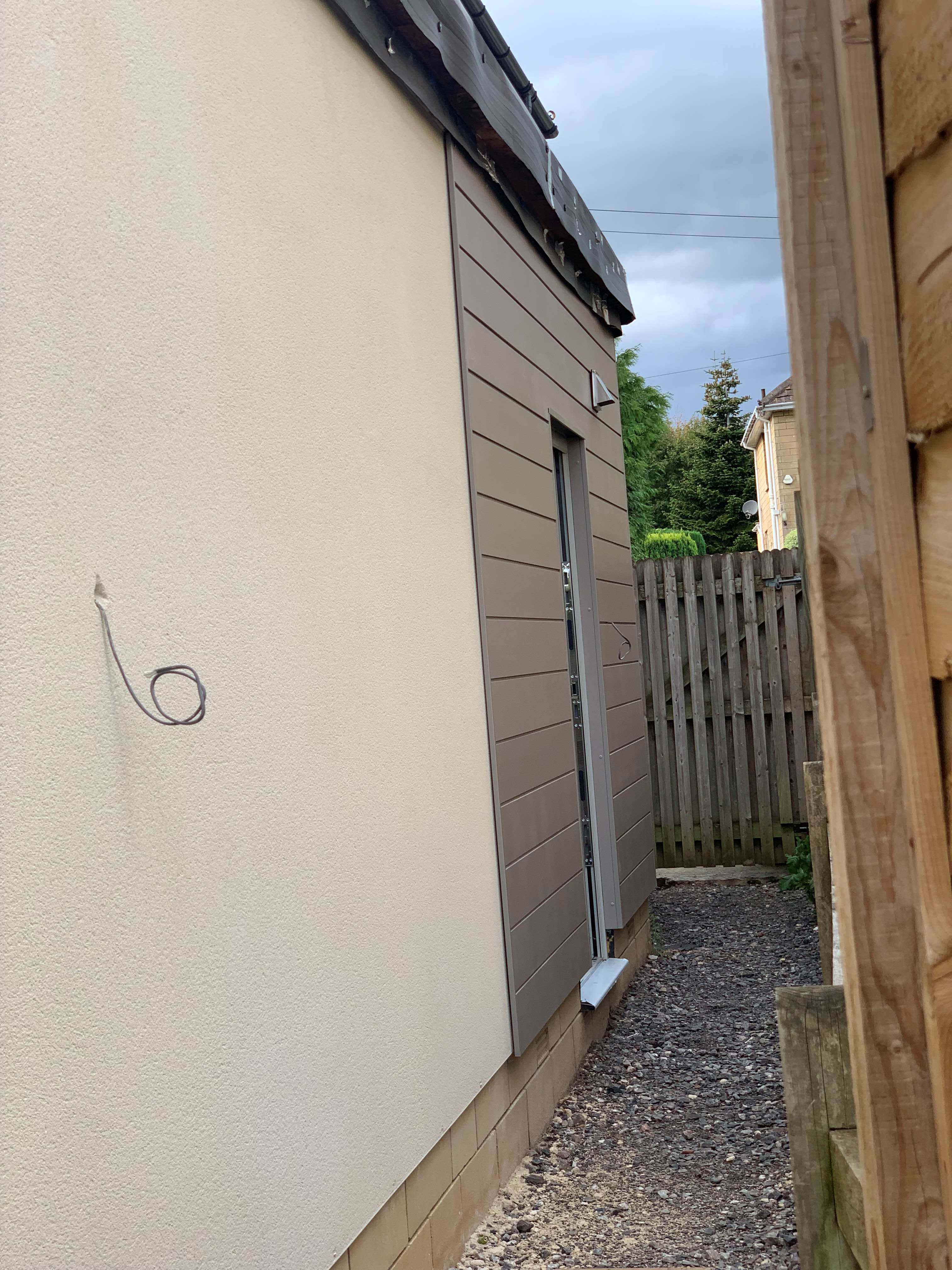
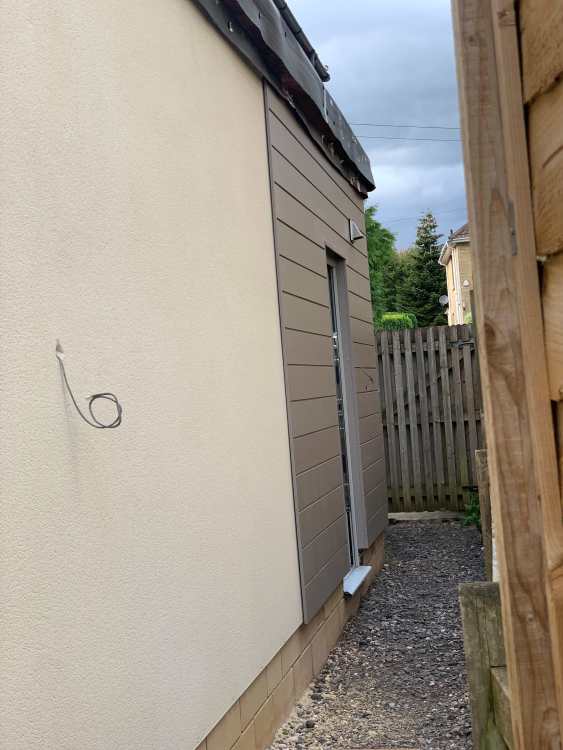
Building work to dig and lay foundations and build the outer wall of an extension a metre away from the cladding, possibly with adjacent scaffold or platforms. Yes work will be done from the metre gap which is our land. So digging including use of a digger, breaking out, cutting, dust, possibly knocking with ladder, or tools, spashing with mortar etc. Part of wall is also rendered - k-rend. The only obvious fixing point is fascia/soffit/capping timbers at the top of the single storey wall - where timber has not yet been covered with any alu roofline trim.
-
Any ideas for the best way to protect cladding from damage by adjacent building works please ?
-
Any advice appreciated here, 'cause I am stuck scratching my head with plasterers coming on monday.
-
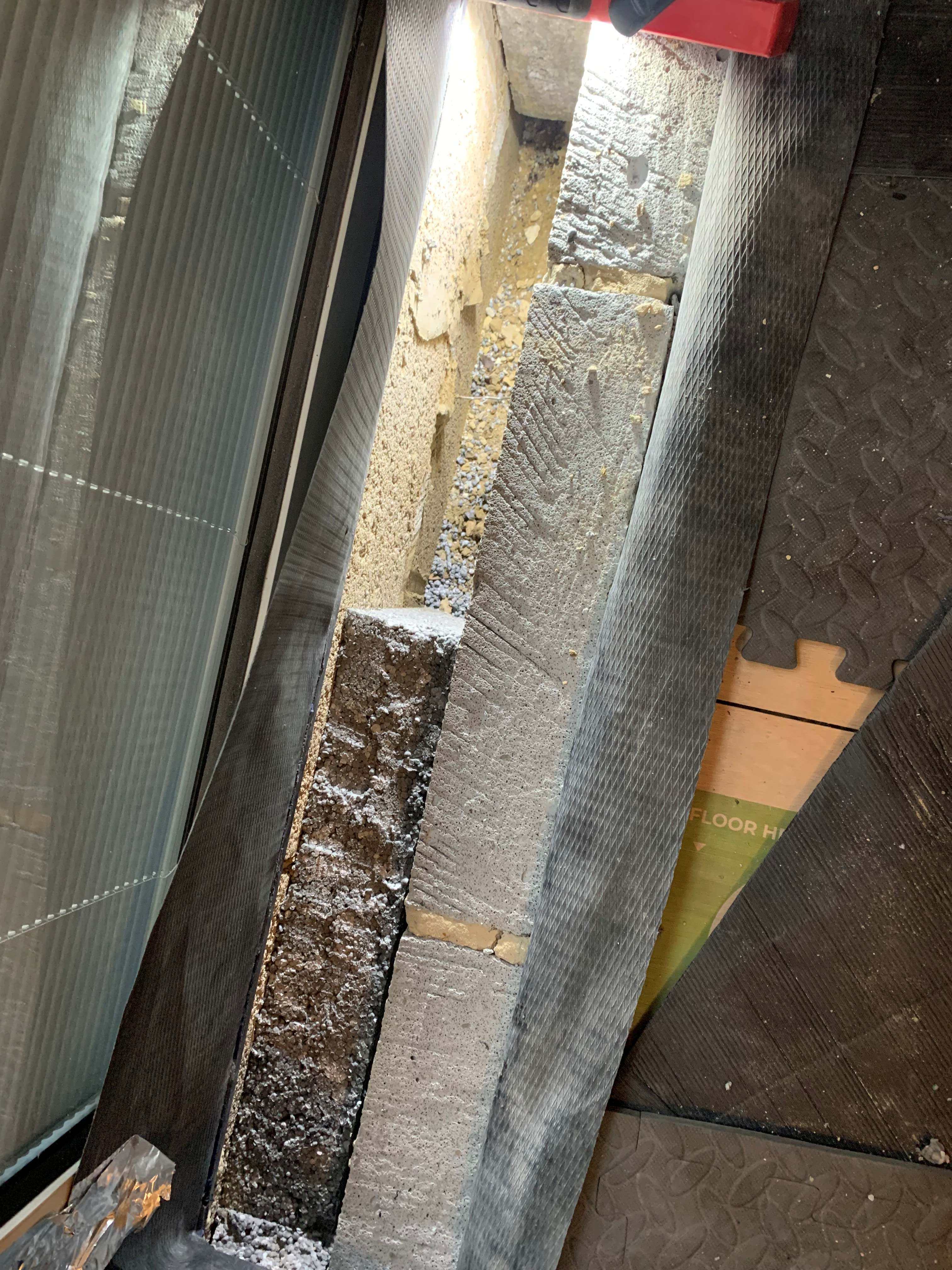
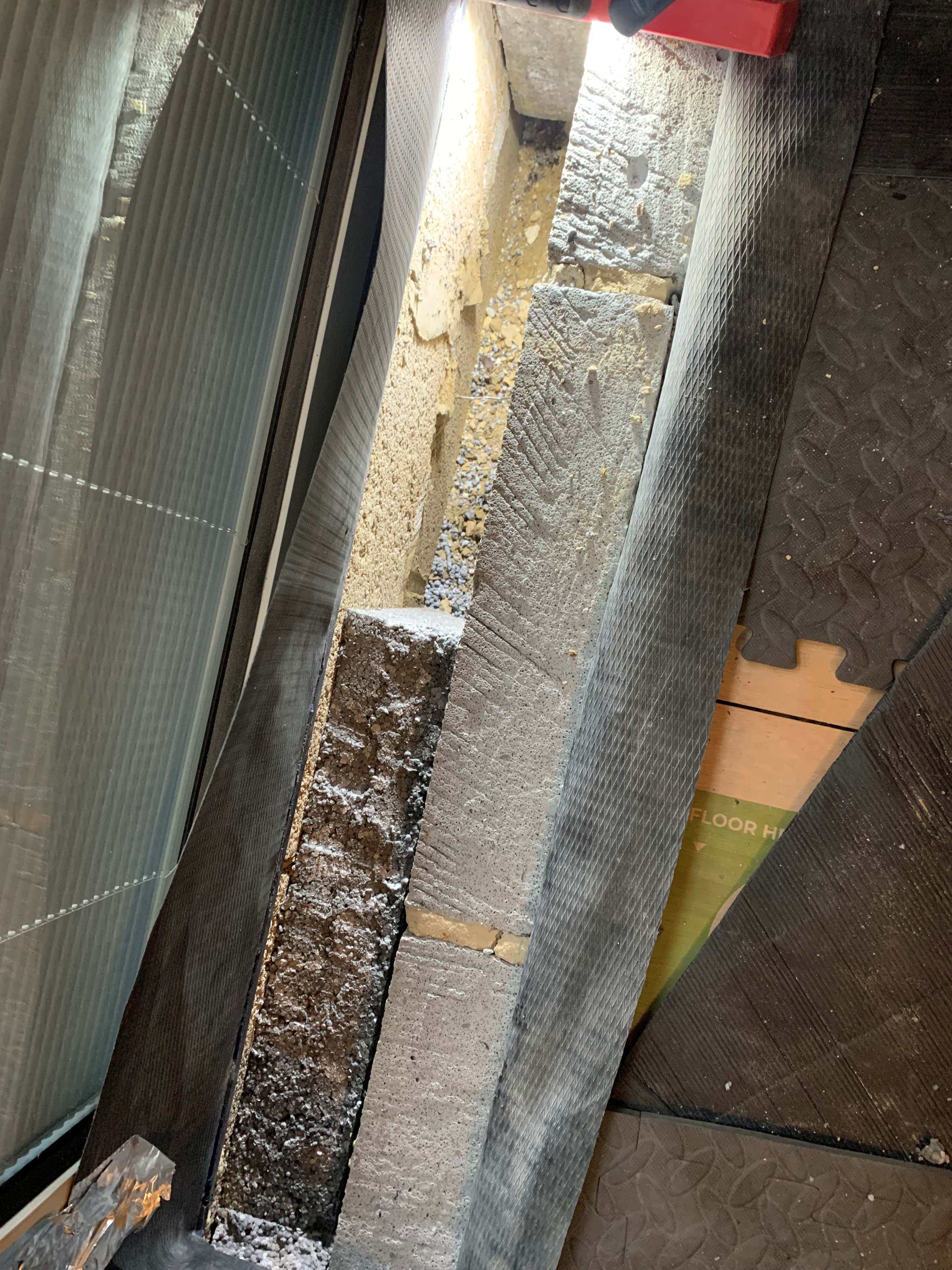
Hi, Still wondering how to resolve the 'how do you close the cavity under a door' issue for my own door (see photo) and came across this thread. Please can I ask what exactly is 'lean concrete infill' ? In my case I have concrete blocks on the outer leaf, and celcon blocks on the inner leaf. I am concerned that if I use a partial infill of concrete that it may not adhere well to the side of the celcon block. I need some reliable way to support what would otherwise be a floor cantilever over the cavity.
-
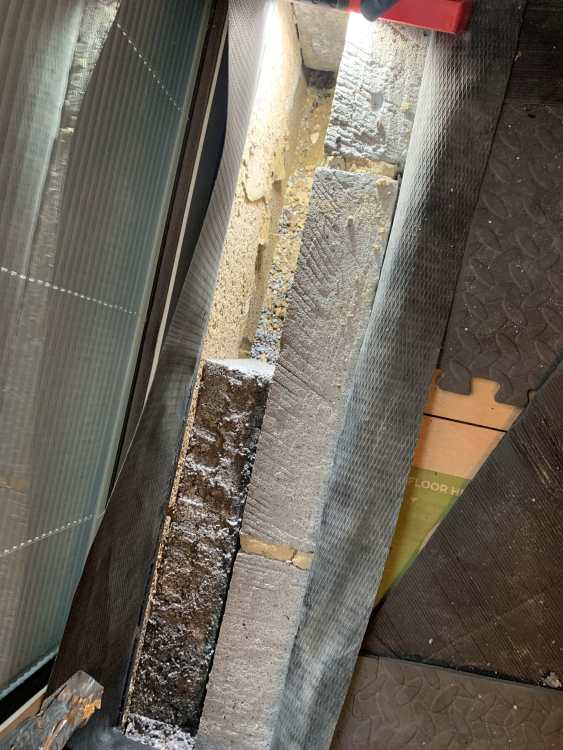
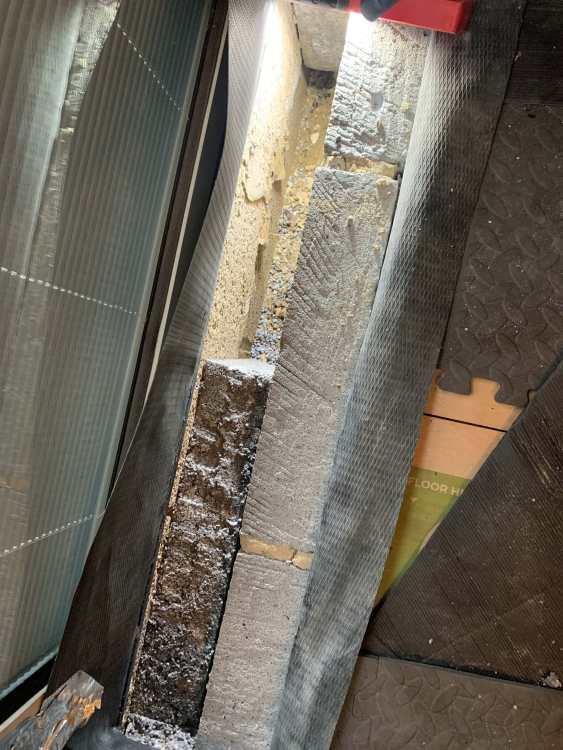
Current state of play now in the photo. Couldn't get a stable piece of board with the cavity closer underneath, so have bitten the bullet and cut it out and removed it. Have cut the Celcon block down so it is currently about 12mm below top of floor cover boards. Cavity has graphite EPS below DPC as spec. I can remove one piece which was rocking on a wall tie. The other piece is joined into a larger piece and not removeable - I have cut it down a little. What next ? All I need really is something in the cavity to remove the cantilever over the cavity. If I cut down the EPS to leave a gap above it of say 2 inches and fill with a quick setting concrete mix, and an upstand of 30mm XPS on the door side - will that be good enough to reduce the cantilever to just 30mm ? Is 2 inches enough ? Yes I know, but is 2 inches of concrete enough ?
-
The chimney is usually where people have their TV aeriel mounted. So note the aerial has been sited at the top of the front wall instead. Don't forget you can normally freely search the local authority planning application database and building notice database. If there was significant building work there might have been a building notice - or indeed building notices related to the issue for other properties with that design. You could search the local rags archives for any stories about problems with the houses. Houses sold on death of granny often havn't had any maintenance or upkeep. There was one in our road in a shocking state. Such houses can be an opportunity if you are young and handy and can get the right price, but perhaps not what you want in later life. Don't let the magic word 'bungalow' cloud your judgement if in later life.
-
@Nickfromwales and everyone... Have finally been messing with this. Tried just cutting half the width of the celcon block down under the edge of the cavity closer only, to sit the cavity closer down more level. But when I put board in on top there is still movement in the cavity closer on the door side above the cavity, and with nothing to fix to I can't see a way to make it rigid. Board could be screwed or glued to the celcon block but the 'cantilever' above the door side still will not be rigid. So I am going to have to cut the cavity closer out, as per your solution Nick, and start messing about to cement fill and insulate the cavity. Some questions... Why did you say don't let the SLC come into contact with the masonry in the post above ? How do I stop the cement running down the cavity ? Keep it a stiff mix, and put something underneath like cardboard to act as form work ? How do I fix the insulation to the outer block so it cannot move or flex downwards ? (I have some rigid 30mm XPS) Screw it into the block ? What is the best thing for fixing the inner side of the backer board firmly down onto the celcon block without the celcon block breaking up ?
-
I have a piece of wall where I need to fix plasterboard to some blockwork to align with adjacent stud and plasterboard. This is because I have been advised that it would be a bad idea and highly likely to crack if a wall is part wet plaster and part board and skim on studwork - best to board the whole thing and skim. I need to fit the plasterboard closely against the blockwork (it is an internal wall, so no damp/thermal issues), so within 3.5mm of the blockwork. I am thinking I could achieve this using (a) foam plasterboard adhesive and (b) adding a few screws into the blockwork. What is the best screws/fixings into the blockwork and do I need to prime them before skim coat ? Do I need to pre-drill the wall and any tricks for aligning boards with holes ? How can I make sure the adhesive isn't too thick ? Just apply in small beads through a thin tube and nozzle ? Or press to the wall before the foam gets tacky to squash it thin ?
-
And who regulates building control to prevent 'a nods as good as a wink to an old mate' ? And the Water Company won't know anything about it, because you push the rainwater into your drain, off it goes to the sewer - taps side of nose.
-
You could ask when it was rendered ? Render might have been used to hide the issue in the past. Clearly there has been movement since the rendering, hence the cracked rendering. The pillar to the left of the arch when facing the house looks an odd shape, almost as though it might have been thickened at the bottom before the rendering. Perhaps you could formally ask the owners to provide you with a full history of the issue and any and all work done to remediate and when. Perhaps there are other similar design properties nearby (as it looks like it might be a road of bungalow/chalet style houses built at the same time by the same builder). If so look to see if similar properties show the same issue, which might be design, construction, or materials related. PS Also, is that a rendered chimney ? Sign of issues there too ? Neighbouring property has recent looking cladding - another possible cosmetic approach to dealing with structural problems ? Agree about the weird bricks and the ratio of blocks to mortar doesn't look right there.
-
What exactly determines whether you can put rainwater from an extension into the sewer ? A person has a 50sqm main roof which discharges to the sewer. They also have a 16sqm extension which discharges to the sewer. Can they build another 15sqm extension and discharge to the sewer ? What are the rules ?
-
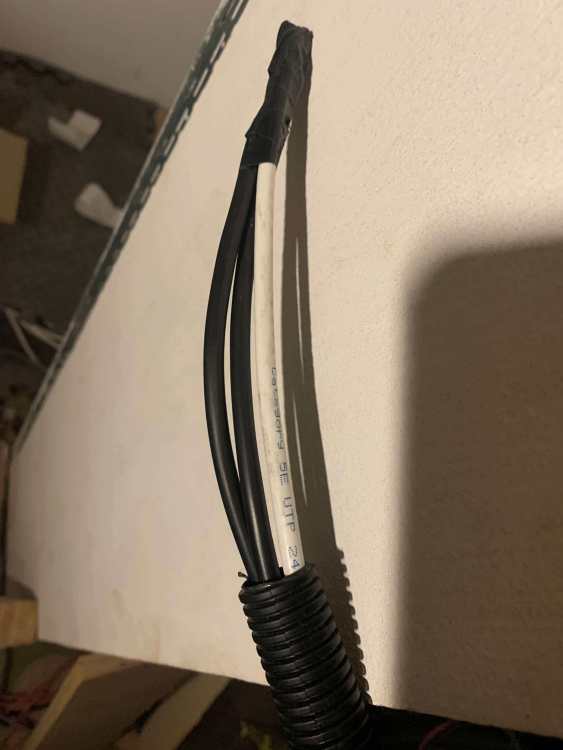
I will only use the led tapes one at a time. Either colour, or white, but the transformer, power switch and WLED controller will be in the electrical cupboard so two power leads do need to run to the rooflight. I could use one 6 core cable. But the 2 cables are around 5mm diameter so fit ok, the third white cable here is LAN and not needed, am going to replace it with something thinner as a pull wire. I did run cables outside the 50mm conduit runs I have under my suspended heated floor to keep them free for future use, but not so feasible here with just one hole into the rooflight upstand - a hole now lined up with the adjacent box - the plan being to push any connector or soldered end back into the box. I am wondering whether 20mm smooth walled conduit would be better, but never used it before - saw a spring for bending it - how does that work - do you heat it up with a hairdryer then bend it with the spring ? Anybody else run cable to led strip in rooflights ?
-
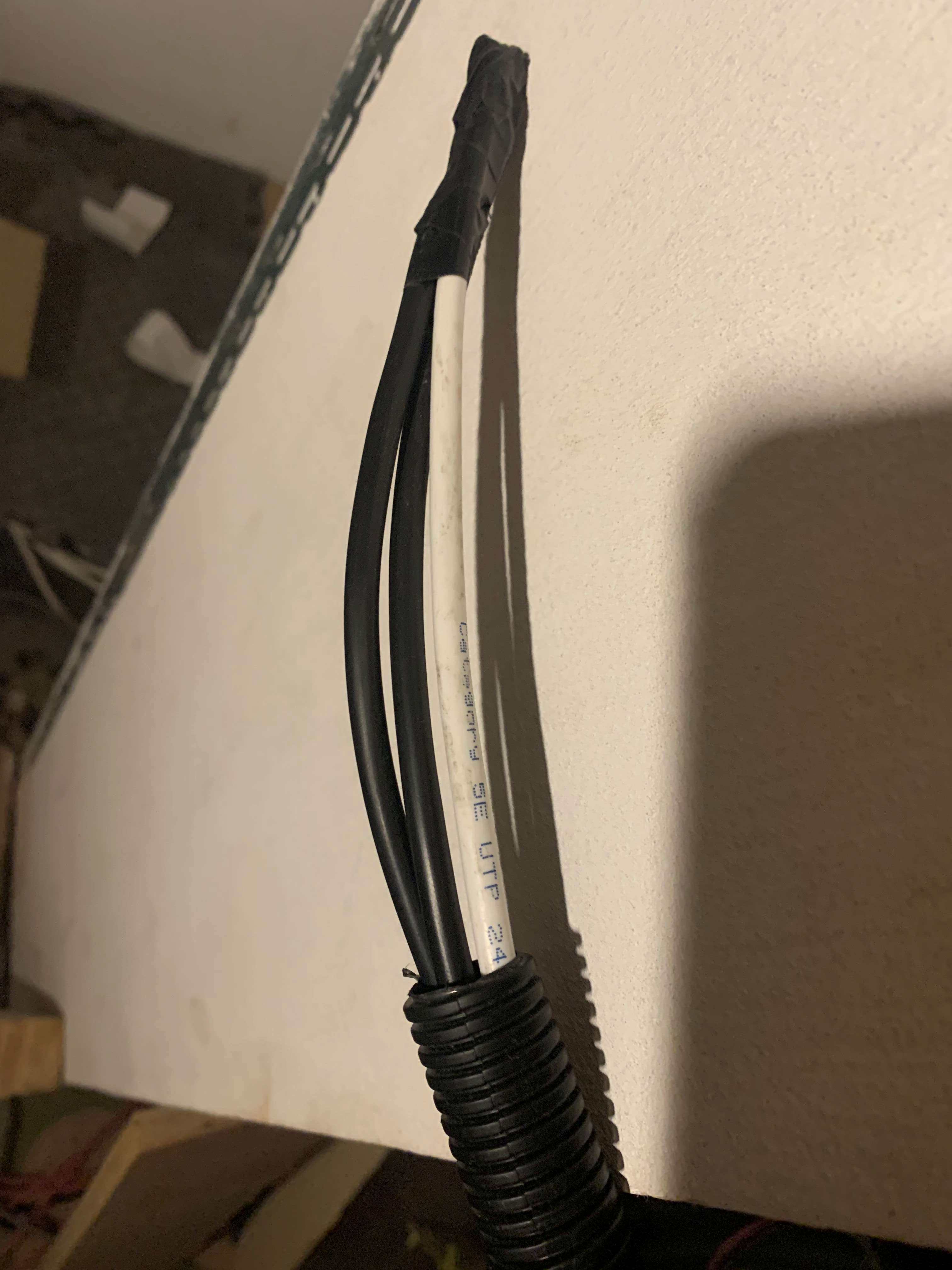
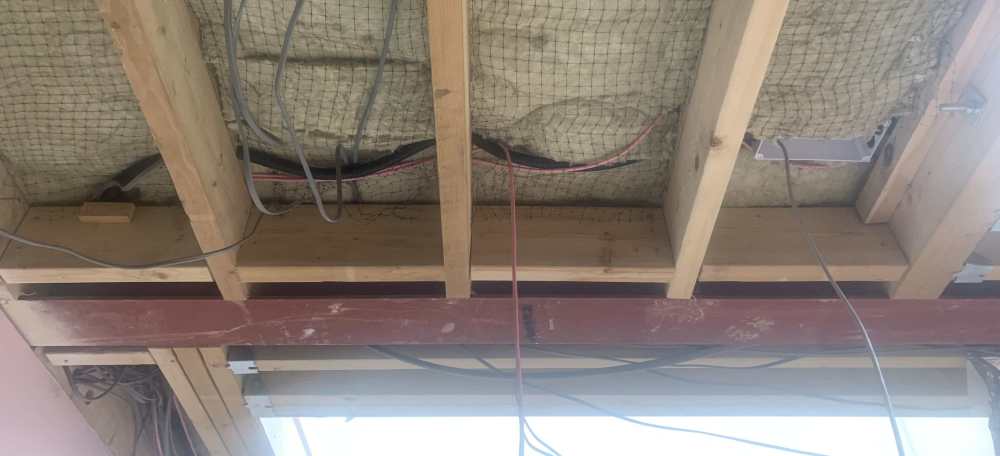
Here is a photo of 1 run, I have flexi conduit running to 3 roof lights with a box placed adjacent to the rooflight - as in this one you can see the box on the right. Sparky put the flexi in with a lan cable stuck through it. I am running 2 cables for each rooflight - both 4 core 0.75mm cables because I am going to put two LED strips into one plaster-in alu profile around each rooflight. 1 cob addressable 24V RGB and 1 cob addressable 24V CCT. (Yes strictly I only need 3 core cable, but a spare core seemed ok as a reserve). So ultimately I need 2 cables and a pull wire running through each 20mm black flexi conduit run. Really don't want to be pulling the ceiling down if a new cable has to be run to a rooflight. No doubt I can find a way to get the cables through in one way or another, especially as I have access to the conduit until it is boarded over. But it being tough to get through worries me for future fishing through. Worst conduit has 2 90 degree turns to make - two horizontally and then one vertically to escape into the electrical cupboard.
-
Thanks all... I do have a lan cable through each flexi conduit already. But when I used it to try and pull the 2 24V cables through (plus another pull cable in tow), it all still got stuck. It only seems to take a fairly large radius 90 degree bend or a slight 'S' bend to cause problems. It seems surprising that this stuff is sold and seemingly used so much when the ribbing on it seems like a real problem. Is there any danger to the cable sheaths from a silicone lubricant ? if I tape up and silicone should I be aiming for a particular shape - I guess a shape wider than the rib width by 3 times perhaps ? Surprising they done sell some sort of rolling ball end to attach which would revolve as it is pushed around corners. (I claim that patent).
-
I have some 20mm flexible conduit running in the ceiling space to rooflights for led lighting. Finding pushing a cable or fish tape down and it just seems to get stuck wherever there is a curve or bend in the flexible conduit ! Any tips for overcoming this ? Should I replace with something else - smooth walled ? (didn't expect this and was using the conduit to facilitate easy cable replacement in the future)
-
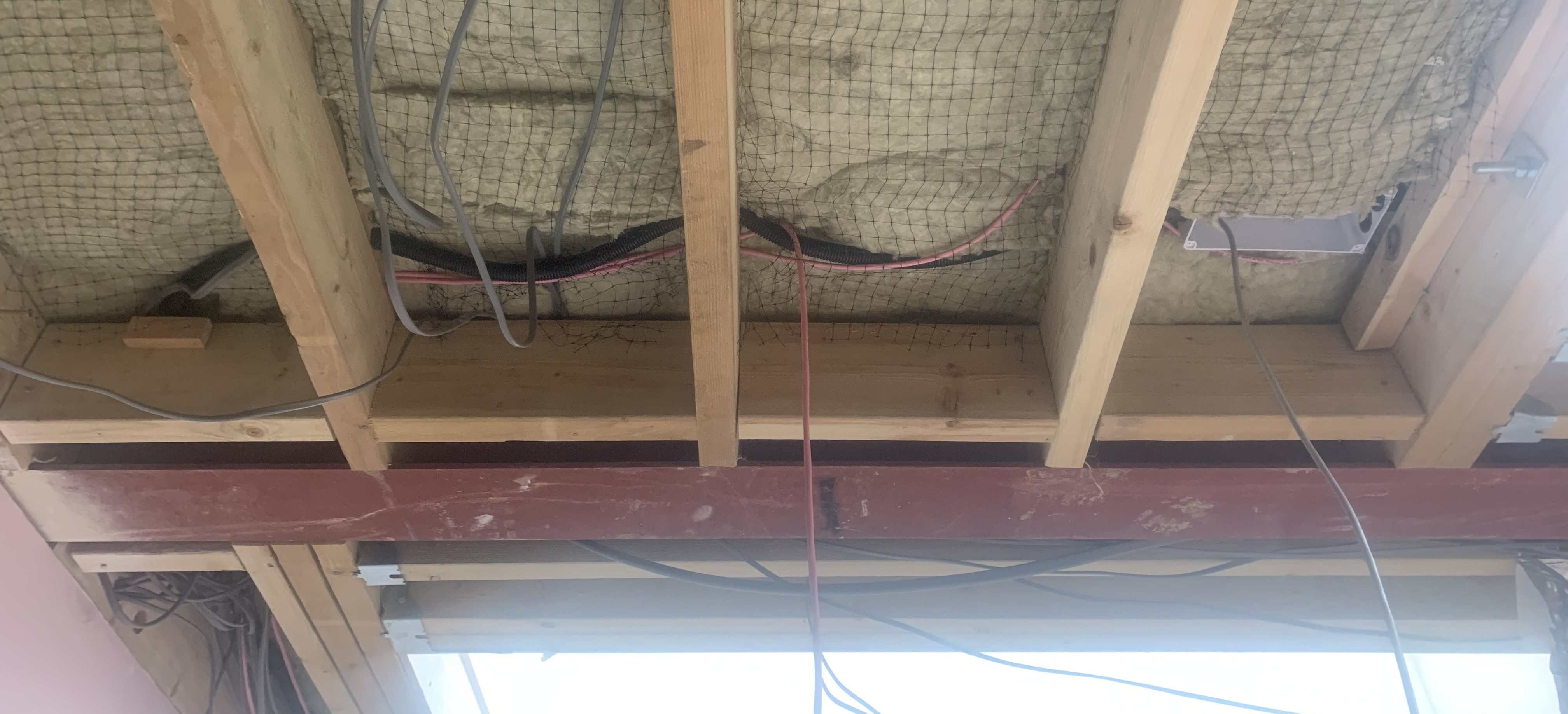
Landing & bedroom above, but the ceiling has been dropped to run under the steel, so room height already down from 2.62m to 2.46m, so not at all keen to double board, but was thinking fireline is heavier and better sound barrier than standard pb anyway - and I guess 15mm 20% better than 12.5. Can't see a good alternative to downlights - like a kitchen we need light in the right places. And it isn't a tucked away utility so will be open and visible a good deal. Lots of room above beside the steels though so was planning to put 100mm or more rockwool above.
-
Just wondering which plasterboard to use for utility ceiling - washer, dryer, sink, boiler, cylinder, manifolds. Only about 2m by 3m, but has a double steel level with the joists so needs fireboard under the steels. Thinking maybe it makes sense to just use fireboard over the whole ceiling ? Then there is fireline but also fireline MR and whether to use 15mm or 12mm. The spec sheet for fireline MR says 'You should normally avoid applying skim plaster to moisture resistant boards'. But am expecting to have the plasterer skim coat the boards. So does this rule out using MR ? Will have 6 downlights in the ceiling. I have one sheet of fireline on site but it has been here indoors for about 18 months - plasterer has suggested boards dry out over time and it then sucks the moisture out when skimming making it harder to plaster. So maybe 2 new sheets of 15mm fireline and bin the old sheet ? Paint the ceiling in bathroom paint ?
-
When it comes to measurement, 'there ain't 'alf been some clever bastards'... Part 1... https://youtu.be/YdOXS_9_P4U?feature=shared Part 2... https://youtu.be/hFMaT9oRbs4?feature=shared