


ryder72
-
Posts
498 -
Joined
-
Last visited
-
Days Won
1
Everything posted by ryder72
-
Thing is, no matter how finely its cut and butted, multiple pieces are not the same as 1 piece and a stack of 30 pieces is never going to perform as well as a single piece, leave alone one made from 3 or 4 offcuts. I hadnt paid any attention to the use of mixed brands but thats a good point that will need addressing too. Appreciate its not going to landfill but at the risk of being called a nimby, 'not in my house'. Very disappointed.
-
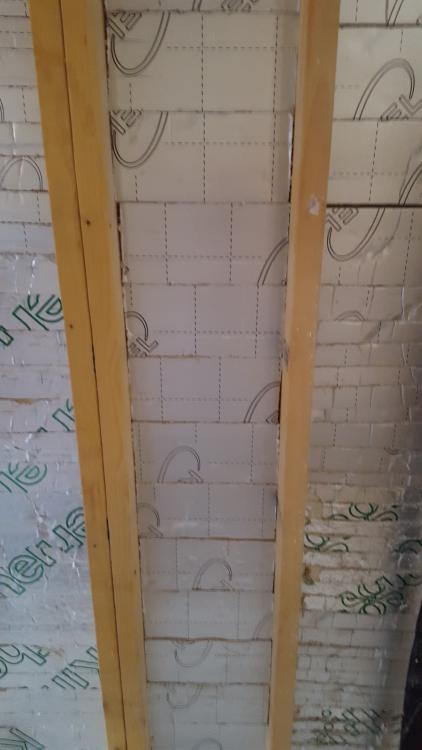
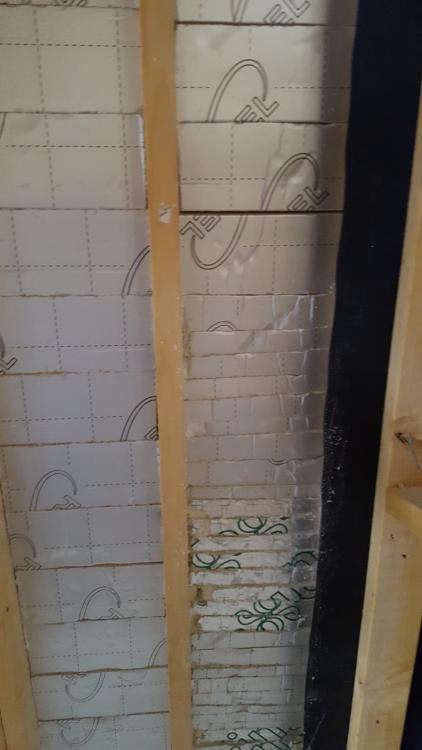
Thanksfor your replies. I have seen this in only 1 room. The insulation is two sheets of 70mm PIR and most places (5) where the inner layer was visible was in this state. There may be more but i didn't have time to check today. I will be asking all secondary layers to be stripped back to inspect, something I wasn't expecting to do. I will obviously report tomorrow. My concern lies around the fact that i have uncovered this and I wonder what else lies hidden.
-
So I visited site today and found this. This is one of two layer of PIR insulation being fitted between timber studs. The height between studs is around 2.6m so it is inevitable that there is atleast one join and perhaps sections where 3 or 4 pieces make up the insulation but 20-25 pieces doesnt sit well with me. Your thoughts?
-
MVHR differences
ryder72 replied to NIreland's topic in Mechanical Ventilation with Heat Recovery (MVHR)
I had looked into a unit from Systemair (recommended by someone who has had it for nearly 10 years with no issues), who do the wheel type unit. These used to be popular in the Scandi countries in the early days of MVHR units but are being phased out. My research indicated the following - Lower heat recovery efficiency More wear and tear parts in the unit Possibly noisier They were popular in very cold countries as they eliminated the risk of frosting up but this has been dealt in other ways. Upon probing Systemair they agreed that thier newer units were being replaced with the more efficient counterflow type heat exchanger with no moving parts. When I looked only their smallest units had been switched over. -
Largest I could find was 1200 * 900. What happens to the remaining 500/800 mm?
-
I need 2 formers, ideally with linear drains, 1700 * 900 and 2000 * 900. Any recommendations? At the moment the only ones I can find are On The Level and Wedi. Impey dont quote make the sizes I need and I am unsure about levelling off the remainder of the shower area and create a leak risk
-
WH toilet frame and MBC stud frames
ryder72 replied to ryder72's topic in Bathrooms, Ensuites & Wetrooms
TerryE/Nickfromwales - i can see where we got crossed lines. If you take a look at the ensuite next to bedroom 2 (PDF attached) you will see that there is a soil pipe in the top left corner by the shower tray. This soil pipe is going to get boxed in and the boxing will continue along the outside wall and will also hide the plumbing to the basin, waste and water to WC and concealed shower valves and the WC frame. All of this will sit proud of the 70mm PIR and the battens. We are not looking to save space since the location of the soil pipe has already 'lost' us the space. In hindsight, we should have thought of this, but hey-ho. Given that we are where we are, we want to fix the frame straight to the studs to minimise/eliminate what @TerryE cals Z-axis movement. If I interpret Nicks's photos corectly, that is what he has tried to do by cutting off the battens to gain that extra 38mm. I have also attached the wall section to illustrate. This is not the usual MBC wall build up. 1229.02.02K.pdf Typical Details.pdf -
WH toilet frame and MBC stud frames
ryder72 replied to ryder72's topic in Bathrooms, Ensuites & Wetrooms
I dont see how we are losing space. The frame will have to sit proud of the battens in any case. All he is trying to do is put in battens so that the frame is directly connected to the studs rather than indirectly through the batters. He isnt convinced that the 70mm PIR in between the battens and the studs is going to eliminate flex. -
WH toilet frame and MBC stud frames
ryder72 replied to ryder72's topic in Bathrooms, Ensuites & Wetrooms
We are using Geberit Sigma 12cm frame (120mm depth required). MBC arent suggesting going to the underlying frame but connecting to just the battens. Plumber wants to create a structure strong enough, conencted to the main studs. -
MVHR and boiler flue outlets
ryder72 replied to ryder72's topic in Mechanical Ventilation with Heat Recovery (MVHR)
That is an option. We can exit near the ceiling and then run up the external wall to the top of the parapet. -
The build up on our MBC single stud timberfrme house is 140mm stud filled in with PIR insulation, airtight membrane, 70mm PIR insulation, 38mm studs, plasterboard. We need to get 3 WH toilet frames fitted. MBC's recommend is to fix the frame to the 38mm studs which line up with the 140mm studs and are screwed together with 150mm screws (effectively around 42mm deep fixing into the 140mm stud). My plumber is not at all happy with this idea mainly because this fixing is through a 70mm PIR insulation layer and instead wants to put in one 60mm timber between the 140mm studs and a second one between the secondary 70mm insulation layer. This will ensure that the whole structure is connected right through and very secure. Does anyone have a view on a robust way to fix this?
-
MVHR and boiler flue outlets
ryder72 replied to ryder72's topic in Mechanical Ventilation with Heat Recovery (MVHR)
So we are on a slightly exposed location and these outlets are on the the northern elevation which is the least exposed of the 4 elevations. The building is a proper cube so I suspect the airflow will be quite disrupted around the building. The prevailing wind direction is west so we will have the flue downwind of the inlet but I suspect when the air gets round the building it will be a very disrupted air flow to get anything meaningful direction on it. -
MVHR and boiler flue outlets
ryder72 replied to ryder72's topic in Mechanical Ventilation with Heat Recovery (MVHR)
This might sound daft, but wont the upwind/downwind answer depend on the wind direction. For what its worth the inlet will be to the west of the flue. Most likely by about a meter in the horizontal plane and a meter in the vertical plance. Its a condensing oil boiler 15-21kW. The most separation we will manage is 1.5m on a horizontal plane so we have to use a combination of vertical and horizontal planes to ensure we are compliant Grant Vortex Eco utility System 15/21 oil condensing boiler. My thinking was that stale air from the MVHR extract and flue gases will be warmer and rise so keeping them above the MVHR inlet minimises the chance of the MVHR unit sucking flue gases or stale air back in. -
Hi we are close to coring out holes for the MVHR inlet/outlet and boiler flue holes. I need to locate these in the plant room and ensure that minimum separation to meet BR is met. The guidance seems somewhat confusing. I have attached a spec sheet of the MVHR unit and the floor plan for reference. The unit is wall hung and the Right hand version. It was our intention to install the MVHR unit on the left hand wall in the room near the corner 300mm from floor level. This gives us an installed height of about 1050mm meaning the lowest point at which we can have an outlet will be about 1400-1500mm from floor level. It is my understanding that the inlet should be at a lower level than the outlet and a minimum separation of 1100mm (centre-to-centre) is required. By positioning the inlet as low as possible and towards the middle of the outside wall and the extract near to the ceiling we should be able to achieve this. The boiler is floor standing and will go on the outside wall in the right hand corner with the flue running to near ceiling height and out. Effectively this would give us a triangle with the distances beteen the 3 points being roughly similar at 1100mm or thereabouts Does this make sense and comply or am I missing something fundamental? If this doesnt work, we would have to move the MVHR onto the left hand wall by the entrance door and have ugly ducting crawling all over the walls. Inputs gratefully received. Adroit-DV145 Spec.pdf 1229.02.02K.pdf
-
I think Blanco rushed in with a tap around that time, based on the Itho and withdrew it within months. Itho is an established company so hopefully they were teething problems. However from experience I know when a company launches something which isnt part of their core product line and simply buy it in to react to market conditions, it usually ends up in tears if the product isnt very good. The launching company doesnt have the service network to support the product and there is a frustated consumer at the end of it all. Quooker are strong on their marketing and I do sometimes feel they are being a bit greedy, but their product reliability and service is really very good so on balance its hard to fault them.
-
I think there were an assortment of problems, 2 IIRC related to some aspect of the tank and one with the push button to activate the boiling water supply.
-
I am of the opinion that they are the best alternative to Quooker. Not as good as Quooker in that it isnt true boiling water, smaller tank, but its a proven product. I know Jeremy has had a very good experience with Itho. Ours with Franke (made by Itho) has been unsatisfactory on 3 of 4 we have supplied so on that basis, I dont recommend them. Amol
-
Quooker or Insinkerator for me with Quooker being the tap offering true boiling water. Pretty reliable too though they are starting to change things on the tap to generate more service revenue. Nothing that anyone with some working knowledge of electrics/plumbing and a decent set of tools cant do.
-
I think the current version of the Minerva is the improved one. The ones we worked with go back to 2011/12. Franke didnt have a clue about their servicing and I wasnt sure who made them. I havent generally been impressed with Franke service anyways, so we just gave up on the product.
-
Quooker recommend use of their scale reduction filters with their taps in hard water areas (pretty much all of UK except South-west and Scotland). These are quite expensive (£245) for what they are and they have started tying the warranty of the tank to the installation of the scale filter. We have supplied the Minerva too and have had nothing but problems and poor customer service (maybe they were bad pieces) but we have given up on the product. In balance we find that only the Quooker or the ISE hot water tanks to be reliable.
-
Do I really need an extractor in kitchen?
ryder72 replied to jamiehamy's topic in Kitchen & Household Appliances
As ever Jeremy, the voice of reason - thanks very much. -
Do I really need an extractor in kitchen?
ryder72 replied to jamiehamy's topic in Kitchen & Household Appliances
Completely take on board what you say. I am willing to go as far as to open a window when the hood is in use to compensate for the suction, but the risks involved with not having sufficient extraction for the amount of cooking that goes on in the house make me very uncomfortable with the idea of just recirculating. That said, I am investigation a soon to be launched Bora range very closely. -
Do I really need an extractor in kitchen?
ryder72 replied to jamiehamy's topic in Kitchen & Household Appliances
Apart from what regs say about extractors, I would say they are essential for 2 reasons- Grease removal - Anyone who wears eyeglasses and has tried to fry without good extraction will testify to this. Grease gets everywhere, carried by air currents generated by cooking heat and this will settle on worktops, floor, kitchen units and walls leading to dirt build up, musty smells, discolouration. Odour/moisture removal - This is somewhat aided in houses with MVHR systems but nothing beats removal of odours and moisture at source. I would recommend an adequately specified extractor with a good quality grease filter and possibly activated carbon filters too (if recirculating). I will be installing a ducted extractor in my house even with MVHR. -
Quooker is really the best of the lot. Well made product with good customer support. The segment is growing very quickly so there are lots of me too products.
-
Yes, thats the tap and tank

