

.jpg.c21f3ac78c9b7efd90cbdcb312744dc5.jpg)
jack
-
Posts
7462 -
Joined
-
Last visited
-
Days Won
41
Everything posted by jack
-
.jpg.c21f3ac78c9b7efd90cbdcb312744dc5.thumb.jpg.7adcad4c0e384f5ecd7d56b0618df6e5.jpg)
What is this spinning bevel edge planer called?
jack replied to epsilonGreedy's topic in Tools & Equipment
In case anyone is reading this and considering buying a router, before using it, do some research about what direction they're supposed to be pushed relative to the edge you're working on. -
We go through periods of using ours for boiled eggs. Great for that. And steamed treacle pudding at Christmas.
-
Would do again: MVHR. Hot water tap. UFH. UFC (cooling!) of the slab. Boiling water tap. Eating area on island that allows people to sit across from each other like at a table - never got the idea of a row of stools along the length of an island. Would like but didn't do in the first place: UFH in bathrooms. While the house as a whole is fairly comfortable and cheap to run, we don't get a lot of solar gain in winter, and the bathrooms can be a bit chilly underfoot. Better use of kitchen diner space. It's a pretty big space, but we didn't think hard enough about comfortable seating in that area, o Bigger and better laid out utility room. Waste of space: Bath in ensuite. It's been used once or twice a year since we moved in and takes up a lot of space that could have been used to greater effect if the bath wasn't there. Steam oven (admittedly ours is steam only, and apparently steam combis make a lot more sense). White corian worktop on one side of the kitchen. Hate, hate, hate. Stains like hell and shows every little mark. [Edited to add] I agree with @Bitpipe's comment about balconies. They were only ever a design feature, but I don't see any real likelihood of them ever being used, plus they added a lot of cost and introduced the only significant cold bridges in the entire house. Windows too big in some rooms, to the point where opening them is intrusive.
-
VAT evidence to HMRC
jack replied to Moonshine's topic in Self Build VAT, Community Infrastructure Levy (CIL), S106 & Tax
Sorry, "receipt" there should have read "receipt/invoice". Nearly all till receipts include the supplier's VAT number. I cant recall any that didn't. I think we had 4 out of well over 300 that didn't have the VAT separated out on the invoice/receipt. -
VAT evidence to HMRC
jack replied to Moonshine's topic in Self Build VAT, Community Infrastructure Levy (CIL), S106 & Tax
It's exactly that. I suspect the chance of the bundle being lost on the way to HMRC is low, but given the amount of money involved, the time spent scanning to make sure we had a clear record of what was sent seemed sensible. No, a receipt is not required if you have an invoice. I imagine it's pretty rare for any business to issue both a (till) receipt and an invoice. I can't think of one instance of that in the 300+ invoices/receipts we processed. We had all sorts of stuff allowed - pro-forma invoices, invoices showing part payment as a deposit, till receipts with no name, invoices in the name of our tiler (his trade discount saved us way more than the VAT refund would have been, so this wasn't much of a risk), one invoice in the name of some random company we had no idea about (we believe it was an over the counter purchase where we didn't have an account, and the invoice just showed the last customer). We made a brief note in the covering letter explaining every oddity, and all were allowed first time without so much as a follow-up question. -
VAT evidence to HMRC
jack replied to Moonshine's topic in Self Build VAT, Community Infrastructure Levy (CIL), S106 & Tax
I should say that what I actually did was a lot closer to what you wrote than what I suggested! -
Another one here with thick, cellulose-filled walls. It works very well, although at the end of a long hot spell, all that heat is retained in the walls, and it can take another couple of days of cooler weather for the internal temperature to fall much. Personally, I wish we'd made provision for active cooling, at least for the bedrooms. Downstairs we cool the slab with our ASHP, and that works amazingly well.
-
It depends how you implement it, but generally yes. Assuming you're cooling using an ASHP, the main control input would be the supply temperature. You'd then use a thermostat to decide when the cooling turned on and off. Whatever temperature you want. It's generally just going to be a thermostat. Just about impossible to predict without a lot more information. What sort of insulation does the house have, what's the capacity of the MVHR cooling coil, what's the cooling capacity of the ASHP, etc. My feeling - and it's just a feeling - is that in a well-insulated house and airtight house, with good control of solar gain (e.g., external shutters or blinds), you could expect a decent amount of cooling for a typical cooling arrangement, as long as you keep it running fairly continuously. The low rate of air delivery with MVHR means you aren't going to come home to a hot house in the middle of the day, turn the cooling on, and have the house be noticeably cooler in half an hour. If you want that, you're far better getting some sort of air conditioning installed (they work fine in conjunction with MVHR).
-
VAT evidence to HMRC
jack replied to Moonshine's topic in Self Build VAT, Community Infrastructure Levy (CIL), S106 & Tax
You need to supply original receipts, but do scan them and record them in a spreadsheet as you go. Not doing this means a massive job at the end. The spreadsheet doesn't need to be anything special - just include the same column headings as in the form and you can print it out and include it with the reclaim form. Add a sequentially numbered column to the left and pencil the number onto the corresponding receipt. The order isn't at all important. Given how much could be at stake, I think scanning or photographing each receipt/invoice as it comes in is good practice. I wouldn't be surprised if we misplaced the odd one here and there along the 6 year journey from starting the build to making the claim. Also, in the unlikely event the parcel goes missing when you send it to HMRC, you at least have a record of what's been lost. Note that hire with an operator can be claimable. We missed a trick with this: we had a large telehandler with operator for a day to help install the windows. That should have been zero rated, but it was too late to correct it by the time we realised. Not claimable afterwards - if there's a labour component to the invoice, the whole thing must be zero rated at supply. -
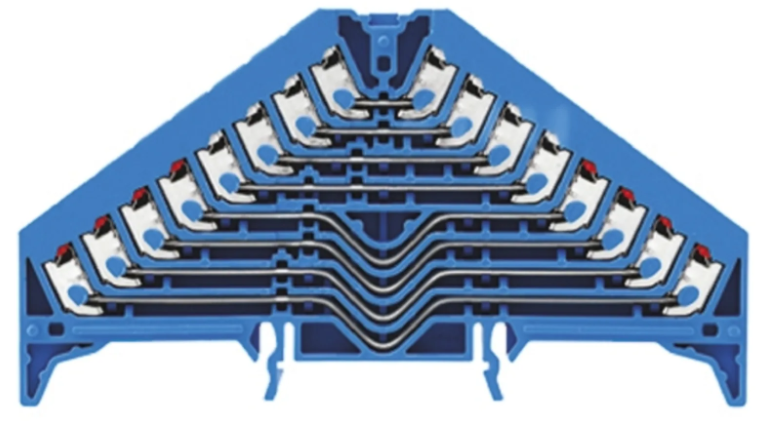
You can get busbar-type products as well, but I think this type is neater and now compact.
-
Yes, that's right. You supply 24V to one side of the switch and connect the other side of the switch to the digital input of interest. At the moment, we have a weird arrangement where each extension has a cable extending from the power supply to that extension, to which the wires for the 24V side of the switches for that extension are connected. It's fine if you never want to change or add anything, but it means you need to bring both wires in each twisted pair all the way up to the extension. The product I had in mind would likely be something along the lines of the one for which an image is posted above. It's called a DIN rail termination block. I think I grabbed that image from RS components, but let me know if you have any issues finding what you're after.
-
Yes, except most only charge at full rate up to about 80%, and then slow down.
-
I've been mucking about with our installation a bit recently. I don't recall how many CAT6 cables we have arriving in the cabinet, but most only use a single pair out of the four available (because most cables are to light switches). We ended up stripping the outer sheath off each CAT6 cable before it enters the cabinet, and peeling out the pair that's needed for each connection. The remaining cores are neatly coiled in a separate box adjacent where the CAT6 cables arrive at the cabinet. Even with this approach, it gets very congested given the number of runs and the mixture of low and high voltage in the same cabinet. I've only recently become aware of the fine detail of this arrangement, and believe we missed a real trick when installing. Instead of taking each twisted pair up to whatever Loxone component it's connected to, we should have split the twisted pair, terminated one conductor in a busbar-type din rail termination, and the other in a multi-terminal din rail termination like this: Then you just need to run a single wire up to the relevant input. This approach also lets you use a thicker hook-up cable for the internal cabinet runs, which is far nicer to use than CAT6. You can also get double-insulated hook-up cable, which improves safety. It will absolutely cost more to do it this way, but every future interaction with the wiring in the cabinet will be easier and safer in my opinion. Once I get a bit further through my long to-do list, I'll be converting to this wiring approach.
-
Where to buy Loxone kit (DIY)
jack replied to Hilldes's topic in Networks, AV, Security & Automation
If you have any questions while trying out the config software, post them here. It takes a bit of getting used to, but once you get the hang of it, it's incredibly powerful. For example, I've just installed magnetic (reed) window sensors on my garage door rail, and mounted the corresponding magnet to the door itself so that one of the reed switches is closed when it's full open, and the other is closed when the garage is fully closed. I also wired in an output relay across the open/close volt-free contact that controls the garage door. Programming Loxone to read the open/closed status based on the reed switches and to add a virtual button to the app to let me open and close the door took about three minutes. Later, I plan to add some logic so I can see when there's an issue. For example, start a timer when the door starts closing, and flag when it hasn't closed within a certain time (suggesting there's a blockage or some other problem). -
We've had at least a couple of interesting threads on this topic: https://forum.buildhub.org.uk/topic/7459-ideal-stair-angle https://forum.buildhub.org.uk/topic/1983-stair-design-for-comfort Edited to add: for my money, your proposed just-shy-of-200mm rise is on the high side.
-
Where to buy Loxone kit (DIY)
jack replied to Hilldes's topic in Networks, AV, Security & Automation
Really useful to know, thanks. Most of the channels I have are 4 x 8W downlights or a handful of 2W downlights, so shouldn't be an issue. Kitchen is the only one that might be an issue at 7 x 9W, but I could have them ramp up at startup if any issues, I suppose. I do wish I'd gone for CC DMX drivers. They would have cost a bit more, but the quality of the dimming is a different league entirely. I bought an EldoLED CC driver a while ago to play with and was amazed at how low they dim without the slightest flicker. -
Where to buy Loxone kit (DIY)
jack replied to Hilldes's topic in Networks, AV, Security & Automation
Yes, I'm on DMX too. I initially used those nasty Chinese 3-channel dimmers everyone was using with Loxone a while ago, but they're unreliable to say the least. I've replaced half of those with an 8-way KNX dimmer, and am presently eyeing up replacing the rest. Not sure whether to go with one of those new Whitewing dimmers and possibly replace everything (and sell on the KNX dimmer), or possibly just accept a mixture of two different dimming types. -
Where to buy Loxone kit (DIY)
jack replied to Hilldes's topic in Networks, AV, Security & Automation
No, I believe they've become increasingly hostile to the DIY market over the last few years. They shut the forum down 3 or 4 years ago, started refusing to answer technical questions unless you were a professional installer, and more recently stopped even selling direct to consumers. I've encountered several people (including myself) who did the installers course at least partly based on the promise of the discount, only to be refused it at the end because they weren't professional installers. There's some recent discussion about Dali on the forum posted above. Loxone's gear is generally pretty good, but often it's much more expensive than other options like Dali or DMX. -
Where to buy Loxone kit (DIY)
jack replied to Hilldes's topic in Networks, AV, Security & Automation
Incidentally, I'm not far from you and installed my own Loxone system with the help of an electrician about 5 years ago if you ever want a chat about what you're doing. Currently in the process of adding sensors to my garage so I can control it (and determine its open/closed/blocked status) via the app. -
Where to buy Loxone kit (DIY)
jack replied to Hilldes's topic in Networks, AV, Security & Automation
Have a look at Loxone Google Groups: https://groups.google.com/g/loxone-english/ (if you're doing any of this yourself, if makes sense to be in this group anyway, imo). There are at least a couple of UK-based suppliers who've offered to supply to UK private customers. Edited to add: I can't see why this would be the case: What error message are you getting @Hilldes? -
Welcome to BuildHub!
-
It was a Loxone forum, so more concerned with home automation. It might be that this is an unusual subset of users and is therefore skewing things.
-
Utility connection - Scottish Borders
jack replied to Omi's topic in General Self Build & DIY Discussion
Ah right, sorry. I thought you were talking about just the road crossing. -
That surprises me. I'm a member of a home automation forum, and Texecom is widely and repeatedly recommended as the best brand to install.
-
Utility connection - Scottish Borders
jack replied to Omi's topic in General Self Build & DIY Discussion
Nope:
.jpg.c21f3ac78c9b7efd90cbdcb312744dc5.thumb.jpg.7adcad4c0e384f5ecd7d56b0618df6e5.jpg)


