

.jpg.c21f3ac78c9b7efd90cbdcb312744dc5.jpg)
jack
-
Posts
7460 -
Joined
-
Last visited
-
Days Won
41
Everything posted by jack
-
You've hit the ground running with having a design ready to go if/when the sale goes through. Was the plan off-the-peg, or was it designed for the plot? I only ask because off-the-peg designs often fail to take into account the plot, including things like orientation (sun), views, access points etc. I imagine being on a corner plot raises extra concerns/possibilities when it comes to design. Also, you're talking about lining up builders, groundworks, etc, but has planning been granted for what you hope to build? And have you worked through issues re: CIL? It takes very little onsite activity to accidentally trigger formal building commencement, which can't be undone, and might leave you paying thousands in CIL you might have avoided. That said, I don't know much about CIL. Perhaps the fact the plots are serviced means that's all been sorted already?
-
I completely agree with that. I visited a friend on a cold day in winter after they'd finished their massive refurb. Left my shoes at the door, and then had my feet sweat uncomfortably through the next couple of hours. That said, we have UFH throughout our ground floor, which is 90% concrete. Even when it's very cold outside and the flow temp is at its highest (27 deg, C, I think we have it set at), the floor temperature is never uncomfortable underfoot.
-
.jpg.c21f3ac78c9b7efd90cbdcb312744dc5.thumb.jpg.7adcad4c0e384f5ecd7d56b0618df6e5.jpg) Ah yes, that's exactly the type I was looking at. I only learned these even existed about a year ago when I was helping my electrician with some rewiring in the cabinet (new dimmer) and realised how difficult/ridiculous it was having so much wiring cluttering it up. My electrician did a fantastic job overall, but I think we missed a trick on this particular point. Edited to add: Perhaps the cheaper outlet I was trying to terminate to was Cat 5 (not 5e) then? Whatever it was, I couldn't reliably punch the Cat 6a wire down into it. Good to know Cat 5e 110 block will work, thanks.
Ah yes, that's exactly the type I was looking at. I only learned these even existed about a year ago when I was helping my electrician with some rewiring in the cabinet (new dimmer) and realised how difficult/ridiculous it was having so much wiring cluttering it up. My electrician did a fantastic job overall, but I think we missed a trick on this particular point. Edited to add: Perhaps the cheaper outlet I was trying to terminate to was Cat 5 (not 5e) then? Whatever it was, I couldn't reliably punch the Cat 6a wire down into it. Good to know Cat 5e 110 block will work, thanks. -
I can't add much, other than to say we used solid core, Cat 6a wiring throughout. Paid a bit more for LSZH cable. I don't know whether copper-plated aluminium is a thing in Cat 6a cables, but worth checking you're getting solid copper. One slight downside to Cat 6a compared to Cat 5e is that you have to use Cat 6a sockets, which from memory were a fair bit more expensive than Cat 5e sockets. Same with patch panels, although in the scheme of things these aren't expensive items. Like everyone else, I wish I'd run more cable to and between certain areas, but I suspect an even a better approach would have been more ducting. The main thing I think I got wrong with Loxone wiring is the termination of cables as they come into the Loxone enclosure. What I should have done is terminated every cable on a massive patch panel (possibly outside the enclosure) and then run double insulated twisted pairs from that to the various inlets and outlets. Instead, the wiring is a rat's nest of Cat 6a cable squeezed into the cable guides. It's something I plan to improve when I have the time and funds available.
-
I didn't know that - interesting, thanks. From his description, it sounded more like resistive heating. 1200%? That seems optimistic. You mentioned not needing an ASHP, but you'll still be paying for the heat pump in the unit you're looking at buying. The main advantage would seem to be system integration.
-
So it's resistive heating, which is currently several times the cost of gas (I guess 2-4 times the cost - not sure tbh) per unit of energy delivered. You say your house isn't going to be super-insulated/airtight. I think you'd really want to do your sums before committing to this approach. Your heating bills could be absolutely terrifying!
-
Ours have holes for the strings and a small (few mm) gap either end of the slats. Together, these let in enough light that we find them unsuitable for bedrooms, especially those with east-facing windows. I'm sure some potential miscreants look at them from a distance and assume they're security blinds, but they're completely useless for that. You can easily lift them up in the rails with one hand. I imagine you could tear them off without too much trouble - they're only aluminium with plastic end guides in the rails. They do rattle a bit in heavy winds. There's a recommendation to raise them into the housing during strong winds, but we've no longer bother after never having had any damage even during the worse storms. Might be different if you lived in a windier area than us.
-
Supplying all of your heating via MVHR will likely require a much larger volume of air than you would otherwise be exchanging with an MVHR system set up for just ventilation. The system design is quite different and you may need a much larger MVHR unit. Having worked in offers where heating was provided via the air conditioning ducts, I personally really don't like air as a heating method. If you aren't using an ASHP to provide the heat, what will you use? If resistive, then be prepared to pay 2.5-4 times as much per delivered unit of heat. And what will provide your hot water?
-
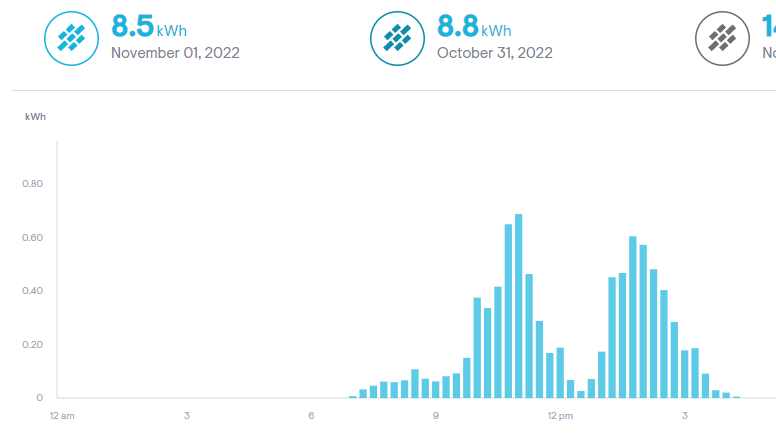
8.5 kWh for us yesterday, from an 8.5 kW array. Can you spot when the storm came through?
-
How to get an extra 2 SAP Points?
jack replied to Andeh's topic in General Self Build & DIY Discussion
I stuck a temperature probe into the trap after showering this morning. The temperature was 34.6 ºC. You might lose some heat to the drain before the water enters the WWHR unit, but 27 ºC doesn't sound unreasonable for modelling purposes. -
Polished concrete - timelines in your own experience
jack replied to KillyfadNewBuild's topic in General Flooring
I'd generally take the specialist's opinion over that of your contractor, unless your contractor has a lot of experience working with polished concrete. -
Search BuildHub for the term "hereditament" and you'll find some useful threads about when a council can legally charge council tax. The completion certificate may be the trigger for some councils, but they won't necessarily wait to see that before trying to charge you council tax. We didn't get our completion certificate until years after moving in, but they seemed to figure out the month we moved in, and we paid council tax from that point.
-
How to get an extra 2 SAP Points?
jack replied to Andeh's topic in General Self Build & DIY Discussion
If we accept the 80% (or even up to 90%) recovery figures for MVHR at a high airflow rate and a typical temperature difference of perhaps 15-25 deg C, 50% recovery in a heat recovery system of this type given a temperature difference that's typically at least as high doesn't seem so unlikely. The main thing that bugs me about the idea is the likelihood of biofilm building up on the inside of the pipe, which would reduce performance. I'd planned to inspect and clean mine every year or two, but have never managed it in 7 years. Perhaps I'll do some experiments if I get the time in the coming weeks (Narrator: "There's no way he'll get the time") -
Polished concrete - timelines in your own experience
jack replied to KillyfadNewBuild's topic in General Flooring
Just the polishing process? We had a two man team in (after their colleagues laid the concrete a few days before) and it didn't take them a full day. They did around 160 m2, although the studwork was in place, so there was a lot more faffing about than if it was just a single slab. -
I seem to recall that another member - maybe Jeremy Harris? - did something with thin ply over a frame when he had very limited space to build a wardrobe. He was surprised at how stiff and strong the whole thing turned out to be.
-
I'm surprised it's only a factor of two.
-
If the display was on the smart meter itself, would you argue that I wasn't looking at the smart meter? Of course not. The only difference is that the display is remote, so as far as I'm concerned, it's part of the package. Moreover, of the three examples I gave, only one of them (the heater in the garage) was a result of interaction with the display. The others were due to me analyzing online data that was uploaded by the smart meter. And yes, they could supply a device that interfaces with a dumb meter to provide similar data, but why do that given how little extra hardware is required to allow the data to send back to a central site for logging and display via an app or a web interface? You'd be throwing away half the functionality and convenience. The alternative would be local(-only) logging, but it would be a waste to store that sort of data locally and not make use of it for billing purposes. If it gets uploaded for billing, then we're back to the result effectively being a smart meter. As you say, if you're technically competent, you can probably put together some hardware and software that provides you with the data you get from a smart meter (probably better data, actually), but 99% of the population can't do that.
-
I disagree with this. Reading your meter tells you how much energy you use, not how that energy usage happens. Despite knowing (vaguely) the power outputs of our kitchen appliances, I've been quite surprised at how much energy they use when cooking, especially if you have a few things on the go at once. If I were struggling to pay my bills, this could be a very useful piece of information. Same with being able to see my background energy usage - it's over 300W a lot of the time, which really surprised me, and is something I'll be digging into to try and bring it down. And finally, being able to see my smart meter allowed me to notice a persistent 1.5+ kW power consumption even when no-one else was home and almost everything was off, which let me find that my son had left a fan heater on in the garage gym. Without a smart meter, that could have been left running for days. I'm sure there are other examples, but those are just what jumps to mind.
-
There's no guarantee how HMRC will treat it, but we had a few invoices in the name of someone other than us. One was an over-the-counter transaction at a builder's merchant, the invoice for which was in a business name completely unknown to us. We assume they did something like (accidentally?) using the account of whoever had the transaction before us. Another couple of invoices were in the name of our tiler. That was because his trade discount was so ridiculously good that we would still have been well ahead if the VAT reclaim had been refused. The last was some wood we bought for one of the contractors, which for some reason was supplied with an invoice in his business name rather than our name. We just missed this one at the time. In all cases, we made a note about it in the covering letter, and all amounts were allowed without question.
-
289 m2. Your U-values are good. It's possible you might meet PassivHaus standards (which set energy consumption targets rather than insulation values), depending on other factors such as solar gain, windows, form factor, etc. 5-6kW might be okay, but a little more overhead might be useful. It also depends where you are in the country - I imagine someone living in the north would have greater heating requirements than me in the south. One thing you might consider if it suits your layout is waste water heat recovery, which recovers some of the heat energy from showers while they're in use. Depending upon what proportion of the hot water water in your house is used for showering, the net effect can be significant. Some have argued that the payback is too long, but there are decent energy savings to be had, and they're about as set-and-forget as anything you can install when building a house. They do take some planning when it comes to drains.
-
One small thing to consider, especially anyone fitting a relatively low power ASHP: We've been very happy with a 5 kW ASHP doing our hot water and heating for the last few years. Recovery time isn't too bad, and no issues keeping the house warm (roughly PassivHaus levels of insulation and airtightness) and sufficient hot water in the tank. I've recently found the one shortcoming: we're trying to move over to doing as much as we can in the 00:30-04:30 cheap period we get on Octopus Go. Unfortunately, looking at the data I recently started collecting, I think I realistically need to allow up to two hours in very cold weather (and very cold incoming water) for the tank to fully heat up overnight. That leaves me with only two hours in which to heat the slab with the ASHP. I plan to increase the flow temperature by a few degrees - it's currently 25 deg C (the lowest setting) for all but the coldest weather - in the hope I can get more into the slab during the heating period. However, two hours of heating is not going to be near enough to get us through the day in very cold weather. Another option I'm thinking of is using the immersion heater during the cheap period for at least some of the DHW during the coldest weather. Even if the ASHP could manage a COP of 3 during the coldest part of the year, it's still cheaper to use the immersion at 7.5p/kWh than the ASHP is at the full rate of around 34p/kWh. I'd then have the ASHP for up to four hours to do the UFH. More data and thinking still to come, but it's an interesting topic.
-
I think the general consensus is that solar thermal is at best marginal compared to PV. The latter has a much longer usable season, plus when the tank is completely hot, you can keep using surplus electricity for other things. If you're considering batteries, I think the maths is even more firmly in the PV camp. Perhaps the only potential issue is how much PV you have installed now, and whether your local network operator might object to you connecting more.
-
Never thought of it that way - interesting. Must be more to it than that then (assuming the principle is even correct).
-
The relative impact of air tightness rises as the internal volume of the building increases. It's to do with the relationship between wall/ceiling/floor areas and internal volume. That's why you'll sometimes hear it said that poor insulation on very large buildings (think warehouses) is far less an issue than getting them airtight, whereas the opposite applies for, say, a small bungalow.
-
I don't know, but bloody warm! We have an insulated garage door, and the rest of the insulation is better than current house building regs. I've just been out there actually, and it's still very warm hours later.
.jpg.c21f3ac78c9b7efd90cbdcb312744dc5.thumb.jpg.7adcad4c0e384f5ecd7d56b0618df6e5.jpg)


