.jpg.c21f3ac78c9b7efd90cbdcb312744dc5.jpg)
jack
-
Posts
7460 -
Joined
-
Last visited
-
Days Won
41
Everything posted by jack
-
Have you thought about engaging a local architectural consultant to answer your questions? I'm sure someone would be happy to do so on an hourly basis.
-
.jpg.c21f3ac78c9b7efd90cbdcb312744dc5.thumb.jpg.7adcad4c0e384f5ecd7d56b0618df6e5.jpg)
Any help with a noisy fixing clip on GypCeiling system
jack replied to nmh's topic in Floor Structures
This is more or less a duplicate of the question here: To keep all the replies in one place, I've locked the current thread and will leave it in place so people can use it to navigate to the thread I've linked above. -
Welcome to BuildHub! Introducing yourself is a nice way of announcing your arrival on the friendliest and most helpful self-build forum in the UK. Feel free to provide as much or as little detail as you feel comfortable sharing. An overview of your project(s) and/or your background can be helpful (we love photos if you're okay with putting them on the internet). Sharing your general location - at a county level, say - can also be helpful. If you've joined to get feedback on a specific question or problem, please post about it in the relevant sub-forum. If you're not sure what sub-forum is most appropriate, just ask in your introductory post and someone will let you know. Posts that include detailed questions will be moved to the relevant sub-forum. Posting in the right area will increase your chances of getting a helpful answer. Not all members read posts in the Introduce Yourself sub-forum, so they may not see questions posted here. Indeed, some members tend to focus on particular topics that tweak their interest, so will only see questions posted in the relevant sub-forum. Also, by posting in the right sub-forum, the answers to your issue will more easily found by others with similar issues in the future. And finally, as explained when you signed up (and covered in BuildHub's Guidelines), BuildHub is a non-commercial forum. It is run by unpaid volunteers. If you're thinking of advertising a business, especially before you've established a decent posting history, please don't. Your post will be deleted and you may be permanently banned if it's judged you've joined just to spam the forum. So go on, let us know who you are and what you're up to.
-
- 1
-

-
Welcome to BuildHub!
-
electric boilers are cheaper than heatpumps to run
jack replied to dpmiller's topic in Environmental Building Politics
I assume you're being rhetorical. They're charging that much because that's what the market (including the government incentives) will bear. -
You set it in the lighting controller in Config, so it can be programmed before you install the strip if you want! You can set a maximum power for other types of lighting too (i.e., not just LED strips). For example, we have some wall lights that look ridiculous when driven at 100% so I've programmed in a maximum of 60%. To be fair, most of the time people will be switching scenes rather than adjusting the power of additional channels, so there're limited reasons for spending too much time worrying about this for most channels.
-
You can set a maximum output per channel in the lighting controller, which prevents the app from being used to set too high a value. Leave a note in the config to explain why you've done this. I did this with our one 24V strip, because at full whack it took us closer to the power supply's rated power than I was comfortable with.
-
I've always thought it's a shame you can't (practically) take the heat rejected/absorbed by a heat pump and use it for other things. Eg, use the cool air from heating/DHW production and use it for refrigeration, or the hot air from cooling and use it to preheat incoming water before it enters the DHW system. Same with warm/cold water going down the drain. I know there are waste water heat recovery systems, but I'm more talking about using waste water as a heat source/sink more generally. All possible in principle, but the reality is a little bleaker!
-
They're harder to find, but you can get DIN rail mountable versions of these. I have a DIN rail unit with four relays.
-
That sort of thing should be fine. If I were starting again I'd use a lot more non-Loxone components, especially DMX relays. They're very cheap per channel and DMX is reliable when set up properly, especially where you're just using it for switching.
-
We've switched a few lights like this for 8 years, no problem.
-
One extract will move very little air and make little difference to temperatures locally, let alone to the whole house. If you don't want air conditioning, think it's better to have insect screens and open the upstairs windows as soon as the temperature outside is below the upstairs temperature.
-
My only question would be whether you plan to terminate all twisted pairs from all ethernet cables at the 24 V terminations section. If so, how many cables are you planning to route there, and what's route are they taking? It can get very busy, very quickly when you have a lot of cables (ask me about the rat's nest that is my Loxone cabinet!), especially when you're trying to retain separation between mains and low voltages. If I were doing mine again, I'd put my ethernet terminations on the top or bottom rail so the ethernet cables don't need to travel far once they enter the cabinet. Since 90% of the time only 1, or at most 2, twisted pairs of each cable are actually used for anything, terminating as close to the cable entry point as possible will signficantly reduce the volume of cable running within the cabinet. Sorry if your plan takes all of this into account, but thought it worth mentioning given how unpleasant my cabinet is to work on given the choices I made at installaion.
-
300 mm is usually made up of 3 x 100 mm layers. We have similar, and I ran some cheap drainage conduit through two channels I cut into the middle layer of insulation when the guys were onsite doing the foundations. I was able to bend a reasonable radius up into the plant room. No issue pulling the flow and return pipes through later. More detail here (worth reading both threads in their entirety, but particularly the first one):
-
Someone mentioned this on here ages ago. I looked into it at the time and you couldn't get them anywhere.
-
If you like your bedroom that cool, I don't see any way around having active cooling of some sort. Personally, I'd just plan for a small air conditioner for use in summer. Solar shading (ideally external) makes a massive difference to the energy that will be required to keep things cool. Also, if you like the windows open, consider planning for retractable insect screens at the design stage. We can't have windows open overnight at ours because of insects, and retrofittng screens is going to be quite difficult. If you have a central area where you can put an opening roof window, you can get some good stack ventilation going too. We'd planned for that, but the insects have made it difficult. Our solution to the heat is a small pedestal fan. Works fine (basically just directed at me, as my wife doesn't mind sleeping in a warm room).
-
Not often. I had issues with cheap DMX dimmers for a while so I did need to switch it all off to make changes. I wouldn't bother just for the convenience of having fewer switches to isolate, but I do like the idea of less wiring coming into the Loxone cabinet. As with so many things, there's a lot I'd change if I were doing it all again!
-
I have to flip several RCBOs in our CU to isolate the Loxone panel. It's been over 8 years since we did our installation, but I vaguely recall having a conversation about this with the electrician, and seem to recall that he was uncomfortable with moving a lot of what would usually be in a CU into the Loxone cabinet. I don't remember whether it was regs or a lack of panel space that led us to the decision in the end!
-
We're trying, honest! 😄
-
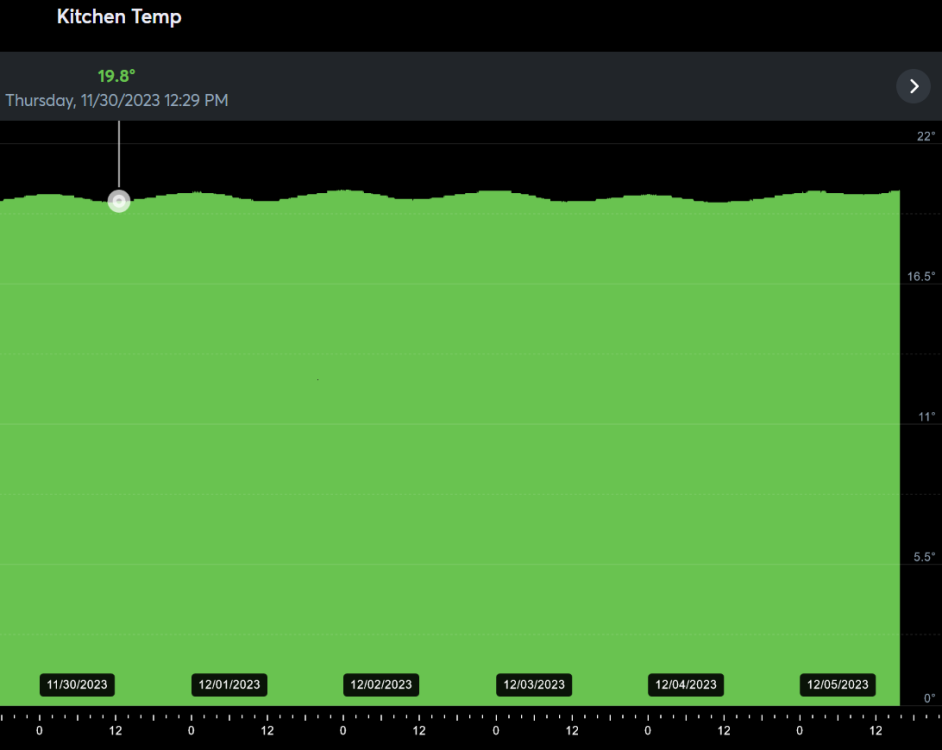
How thick is your screed (or slab, if the UFH pipes are in that)? Ours are in the slab underneath about 70 mm of polished concrete overlay, and it takes 3 hours for a change of 0.1 °C to be apparent at the floor surface. The floor surface takes about 12 hours to increase by 0.3-0.4 °C once it starts rising. Here's the slab temperature under the kitchen island over the last few days, with the ASHP running 12 hours a day. Lowest temp was 19.8 °C, highest was 20.2 °C: Admittedly this is an extreme case given we run our flows temps quite low (25-28 °C depending on outside temps), but UFH does react very differently to radiators.
-
It took me too many years to realise this. A 25 pack of DeWalt bits for a tenner last years, and I'm far less reticent to chuck one out when it starts to show wear.
-
You've been on the forum for a bit so it's fine to share suppliers you've used. That's particularly true given someone else asked for the info!
-
Not sure if you've considered it already, but what bit are they designed for? Could be an issue if they're a pozi bit and you're using Philips (or vice versa).
-
Didn't work for us. The most highly recommended guy - recommended by several friends - we had was average at best relative to the others we had onsite. Example: the guy he had in doing the plasterboards noticed that a piece of steel protection we had in place to protect a 240V blinds cable at the top of the window in my study was in the way, so he just unscrewed it and threw it in the middle of the floor. The only good thing is that he was that lazy, as otherwise we'd never have known.
-
Our window installers were the Irish distributors for the German company that made the windows. They didn't follow the manufacturer's installation drawings - which we gave them - and missed that the frames needed to be packed up by 15 mm. This led to the cills not fitting. I chamfered off an edge of the frame at each window so the cills would fit, then they realised that the blinds (again, supplied by the manufacturer for which they were a distributor) couldn't be attached through the vertical battens in the reveals that I'd confirmed with them were not going to be in the way. I also later learned that they should have lined the aperture with a DPM, but that didn't happen. And on roofing, I complained to the manufacturer about the poor adhesion of the membrane around the outlets through our parapet walls. They confirmed that all was fine and that the installation was to the "usual high standards we expect of our approved installers". Every one of those outlets leaked badly within a month of us moving in, all due to... poor adhesion of the membrane around the outlets. I should stay away from this thread, it's bringing back too many nasty memories! 😁
.jpg.c21f3ac78c9b7efd90cbdcb312744dc5.thumb.jpg.7adcad4c0e384f5ecd7d56b0618df6e5.jpg)