marshian
-
Posts
1495 -
Joined
-
Last visited
-
Days Won
5
Everything posted by marshian
-

Keep gas boiler or install heat pump?
marshian replied to Walshie's topic in Central Heating (Radiators)
It helps to describe why cycling is a waste Boiler fires up at between 70 and 80% of max output (so in the case of your boiler 24kWh) it only does that for a couple of mins before modulating down - but in that time it's impossible for all that energy to get into the heat exchanger water so a lot of energy ends up going out of the flue This loss is offset by the time the boiler actually runs and the level of modulation - a little loss at the beginning of the cycle is fine if the boiler then ticks along at minimum modulation Problem comes when those 2 mins of wasted energy is repeated every 5 or 10 mins - the loss is not offset by the time the boiler runs for To use a car related comparison Scenario A You are on a slip road at the bottom of the M1 - you need to be doing 70 mph to safely merge into the motorway traffic and getting the car from 0 to 80 mph is going to result in 7 mpg consumption - however you have 100 miles to cover at 80 mph and your fuel consumption is going to be 35 mpg at those speeds The fuel used in acceleration is offset by the cruising consumption Scenario B You are on a slip road at the bottom of the M1 - you need to be doing 80 mph to safely merge into the motorway traffic and getting the car from 0 to 80 mph is going to result in 7 mpg consumption - however you have 100 miles to cover and it's a bank holiday monday and a 80 mph cruise is impossible - your progress is sporadic and requires frequent acceleration and braking because of the numpties on the road don't understand keep left unless overtaking and don't bother to look in their mirrors before any change of lanes. Your fuel consumption at the end of the journey is 25 mpg even if you average speed and journey time isn't much different. -
Keep gas boiler or install heat pump?
marshian replied to Walshie's topic in Central Heating (Radiators)
It's not going to be optimal and that sometimes is a problem - boiler cycling is a huge hit to efficiency from memory you ideally don't want a boiler to cycle more than 5 times per hours (even that would be a bit shit) My old 24kW with 10kWh min output was cycling more than 10 times per hour in autumn and spring and at best 7 times per hour when house was up to temp in the winter and chewing thro gas My new boiler in winter is doing 22 to 24 cycles per day!!!! -
Keep gas boiler or install heat pump?
marshian replied to Walshie's topic in Central Heating (Radiators)
Quick search online seems to indicate that that boiler has 11.3 kW minimum (30% of max) It's also not compliant with low temp heating so in my opinion it's going to be in conflict with your rebuild/insulation improvement plans Whilst the boiler might only be 1 year old the install manuals were written in 2013/2016 so it's not a "latest" boiler -
Traditionally-styled low temp radiators?
marshian replied to YodhrinForge's topic in Central Heating (Radiators)
pretty sure I’m right @SteamyTea I can’t feel much convection above a radiator at a 30 deg flow temp and come to think of it does UFH convect or radiate 😉 re the OP happens occasionally 🙂 -
Traditionally-styled low temp radiators?
marshian replied to YodhrinForge's topic in Central Heating (Radiators)
I’m not actually sure why anyone would think a radiator is more or less suited to low flow temp I’m sure surface area is a factor for heat transfer but the lower the flow temps go the ratio of convection to radiation changes At a higher temp most radiators convect more than radiate At a lower flow temp the radiator may convect less than it radiates I know that from my perspective I’m more comfortable at a lower room temp with less convection creating air movement but that might just be me! -
Keep gas boiler or install heat pump?
marshian replied to Walshie's topic in Central Heating (Radiators)
Major renovation I assume is to a higher insulated standard than the house is currently - maybe with increased house footprint if boiler capacity has been assessed as good enough to support it and with limited space to site a AHSP unit As @JohnMo said the decision needs some data gathering or decent workings to make that decision. Current property heat loss calcs first - then with that as a baseline look at what the renovations are going to do to the heat loss - it could be that the renovations dramatically reduce your heat loss and as a result the current boiler is then oversized Taking my own example as an illustration of how quickly a suitable boiler can become unsuitable when house is upgraded 4 bed detached built in early 1980's - Single glazing with wooden windows, open cavity between inner and outer brick skins, suspended ground floor no insulation and 25mm of loft insulation = 25,000 kWh of gas per year (heat loss 10.5 kWh at -2.4 OAT) Throw in sealed unit double glazed windows and doors, CWI (cavity wall insulation) as well as 70mm of loft insulation and despite a two storey extension annual gas usage is down to 15,000 kWh and already the 24kW boiler is 3 x oversized for the new heat loss 7.5 kWh at -2.4 OAT Add in underfloor insulation, replacing all the rads for lower flow temps into the mix and annual gas usage is down to 8,500 kWh with a heat loss of 4.0 kWh at -2.4 OAT and the boiler is now 6 x oversized and worst still it's minimum modulation 10kW (output is 2.5 x the heat loss) I considered ASHP but it didn't fit well with the silly shaped house so I replaced the now totally unsuitable boiler with one that was only 16 kW but can modulate down to 3.2 kWh meaning when it's -2.4 or lower outside it happily runs 24/7 at close to min modulation. Probably help if we had make and model of the boiler to see what modulation or turndown ratio it has because if you are improving the house having one with a really good modulation would mitigate the improvements. -
Suspended Timber Floor insulation - critique my plans please.
marshian replied to SoliD's topic in Heat Insulation
not to take this thread off topic - I guess my next research job will be how many metres of pipe do I need to put down at 133mm centres with a flow temp of 32 deg at 0 deg OAT to match the heat loss of the room and can I fit that in the open area because I’m guessing no one puts it under units?? -
That sounds terrible - have you got a "heat geek" accredited heating engineer to do a survey and see if it can be improved - as @JohnMo frequently points out the best way to make them work well is keep the circuit simple - weather comp for the flow temp - ditch buffers - big zones and have minimal thermostat interventions I predict that poor installs of ASHP will be the next miss-selling scandal (Like PPI and Diesel cars)
-
Suspended Timber Floor insulation - critique my plans please.
marshian replied to SoliD's topic in Heat Insulation
First time I've seen UFH done in that way so it doesn't result in an increase in floor height - looks quite neat Given me an idea for when I redo the kitchen - unit space is at a premium and I would need to relocate the existing rad and so underfloor would be a much better solution - I now wondering if at my normal flow temps (32 Deg C at OAT of 0 Deg C) it would be enough to run underfloor at the same temp as the rest of the house rads Now googling Alu Spreader plates -
If I had my time again I'd definately sink an IBC (or two) into the ground - with probably a small moss/leaf litter catch tank before them If putting two I'd link them together so whilst the level might be lower in the summer the two would share the level But as I'm not digging up my patio to do that now I'm thinking of an alternative plan when I re-do the 16 year old decking - I'm pretty sure I could get three low profile 400 litre tanks under the decking and collect the rain water there without it even being on show (I'd still have to drain in winter which would be a pain but manageable)
-
I'm quite happy that you chose that direction Every m3 I purchase costs me £2.10 The water cost isn't bad but it's the 90% sewerage charge that kicks £2.14 for every m3 So the saving is £4.24 for every 1000 litres of rainwater harvested for watering the garden (I also steal a bit for rinsing the cars after washing them because I hate the water marks you get with hard water - but don't tell Mrs Alien 😉 )
-
As @Nickfromwales has said it's not unacceptable but it does come with some risk if water is able to get behind the tiles then the plasterboard can quickly become a saturated soggy mess and tiles then detach from the soggy mess - I have a false wall at the back of both showers (Hides pumps, controls and plumbing but I do have a process for access - back in 90's I did the false wall in marine ply, on a refurb 20 years later I used cement board as I found some deterioration of the ply as I gutted the bathroom In the other bathroom recently refurbished I used the jackoboard for the false wall - rest of the walls are all brick/plaster so no concerns there I don't think there is an easy/cheap way to rectify so live with it just bear in mind the concerns
-
Agree with you there - I'm getting all the potential major expenditure done now before I retire because I'm damn sure it'll be a squeeze to do any of that on my pension
-
I viewed it slightly differently - I'm damn sure that insulating under a concrete floor is a very good thing to do from an energy loss perspective but think about it - if you have an existing house and to dig out the floors means massive work - you certainly aren't going to be living in it - if you can get 500 % efficiency with leaving the floors alone just a UFH layout above and a screed over the pipes why would you bother about getting a higher efficiency which isn't going to pass any cost benefit analysis
-
self-build PhD Thesis Survey - Self-build Industry in UK
marshian replied to CemCet's topic in General Self Build & DIY Discussion
What sort of question is this? It's lacking context - per m3 - per m2
-
self-build PhD Thesis Survey - Self-build Industry in UK
marshian replied to CemCet's topic in General Self Build & DIY Discussion
Do you need people who have done self build or will people that are thinking about it help you reach the target? -
On the reliability of a drop in submersible pump - parents previous three houses have been septic tank - "marshian senior" who is now 86 has watered the garden of all three houses for many years with the same submersible pump - mains powered - hanging on a rope - drop it into the water and amazing green grass all summer. Current house is connected to main sewers and he's too tight to water the lawn with mains water and in the summer it's a shit show and it certainly isn't green.
-
I'm not actually saying that............. It's what I have sure but if I had my time again it's not what I'd do Brand new 1000 litre caged IBC £270 (+vat) https://itppackaging.com/product/1000-litre-ibc-new?gad_source=1&gclid=Cj0KCQiAq-u9BhCjARIsANLj-s0zrUXn4IWfVXPObi3tiDAikpXTf-O-aLbMp_R8XvQKxOnCwDcmc_oaArjBEALw_wcB You can get second hand ones for way cheaper than that but be careful what it was used to store there are a lot of really nasty chemicals that are shipped in IBC's - buying new means that's not an issue My 400 Litre above ground rainwater tank cost nearly as much and they are a lot more money now!!!! https://www.ebay.co.uk/itm/352521164934 Because it's above ground it goes green as hell and needs washing out every year I need to 1. empty it before winter (all that rain wasted) 2. make sure I don't start filling it before March because of the risk of a cold snap - April showers don't always get me to capacity 3. transfer from butts that fill quickly to butts that don't to maximise storage capacity when it rains in summer (the biggest butt is on the smallest roof but Mrs Alien doesn't want a 400 L butt on the outdoor entertaining area so the largest roof area has just 200 Litres and I was lucky to get away with that. None of those issues are a problem for below ground storage using cheap IBC's - you can't see it and if it's away from the house so no risk why spend a lot of money on fancy tanks and rainwater harvesting systems I live in what is statistically the driest region of the UK - I have 800 litres of above ground rain water storage and it is not enough in summer for me to not end up using mains water (Mrs Alien likes her veg patch and fruit trees well watered)
-
You are still trying to overcomplicate it - Stand alone submersible pump dropped down a hatch above the tank - transfer to above ground water butt - fill the butt when you need too
-
Good to hear that you can already tell the difference - with a CWT in the loft it took a little longer to notice the change Now one piece of advice @AdamD if the house has been running with hard water for a long time keep an eye out for leaks for the next few months - usual places toilet cisterns underneath taps under sinks all those sort of areas - if everywhere is mains pressure it will probably be fine but it's worth keeping an eye out. The reason is simple "Softened" water will take back into solution any limescale deposits that have built up over the years - I found two places where this resulted in a leak - one was the outlet on my CWT in the loft - the other a gravity fed toilet cistern where the flexi union started leaking.
-
correct me if I’m wrong but @Weebles was talking about harvesting water for the garden - he wants to do what I should have done when I finished the extension at the rear of my house. I was going to stick a couple of IBC’s under the ground and pipe them up - overflow goes to the soak-away but Mrs Alien wanted the garden back asap - so the soak-away got filled with rubble and covered up with brickweave We now have 800 litres of water in water butts - we always run out of water in the summer so have to resort to mains water between them getting refilled with rain - no room for any more It would avoid having to drain them down in the winter (water butts split when the contents freeze - unlikely to happen with underground storage
-
Boiler short cycling with low flow temperatures
marshian replied to seanblee's topic in Central Heating (Radiators)
if it feels like a lot it probably is but is house specific my daily for feb so far (4 bed detached heating 24/7 with room temps from 18 to 22) the minus overnight temps are the peak days (70 kWh ish)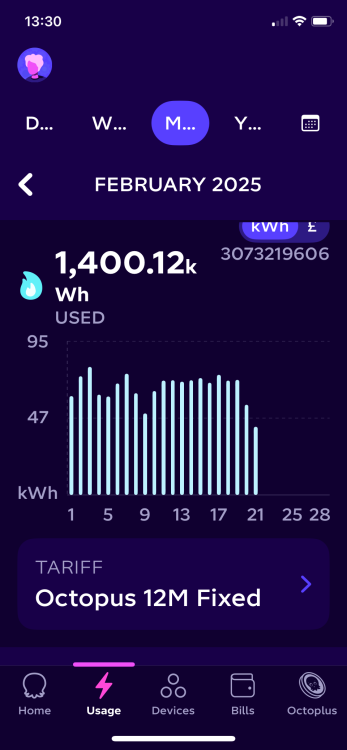
-
I don’t think I’d be entertaining using direct electric to heat rooms when I had a gas boiler and rads - the running costs are 3 x that of gas maybe for a bathroom floor thats intermittently heated for comfort factor I’d consider it but in that case it would be a luxury not a necessity
-
I'm with @JohnMo Heat loss is Heat Loss - doesn't really matter that much if you provide the heat with a radiator or underfloor The advantage of underfloor over a radiator is a large surface area to emit the heat so a lower temperature can be used to transfer the heat. However if your boiler cannot go down to that temperature then you need mixer manifold to drop the temp down to whatever the heat loss of the room requires If you have other floors with radiators that need higher temps you are very likely to be running the boiler at a higher temp anyway.
-
Boiler short cycling with low flow temperatures
marshian replied to seanblee's topic in Central Heating (Radiators)
Nope not on a gas boiler but these days they modulate better than they did