


marshian
-
Posts
1605 -
Joined
-
Last visited
-
Days Won
6
Everything posted by marshian
-
What about a "mouse trap" arrangement - drill holes in mortar and insert dowels to push insulation back under windows
-
OK just a suggestion from previous pictures I can see that removing a row or two of tiles means you can look down the cavities - can you not add suitable 2.4 m length of wood vertically down the cavity with a taper at the end to straighten/push the PIR back to being in contact with the internal wall face - then as they blow in beads pull out each length of wood knowing that the beads already in the cavity will keep the PIR in contact with the internal wall face. Insulation company would then be happy with the consistent gap from an infill perspective? Obviously if you can't push it back with 2.4m length from above then it's a bust from that perspective so a bit of wood
-

Private shared driveway being blocked by neighbour
marshian replied to qamar's topic in Party Wall & Property Legal Issues
Well good luck when you move back in - I hope it all goes well -
Private shared driveway being blocked by neighbour
marshian replied to qamar's topic in Party Wall & Property Legal Issues
Because they didn’t have a car or they parked outside the gated drive? -
Private shared driveway being blocked by neighbour
marshian replied to qamar's topic in Party Wall & Property Legal Issues
So more to the issue than originally explained. Your house and garage are not currently occupied so he's not causing any issue to you currently and he's not causing issue for 3 & 4 When you move back in the fun will start because effectively he has no-where he can park without causing issues Of you've been there 38 years where did the previous occupants of House number 2 park in the past? -
Private shared driveway being blocked by neighbour
marshian replied to qamar's topic in Party Wall & Property Legal Issues
Draw the whole site please including entrance gate etc no defending the person parking there but it maybe that if he parks outside his house he restricts access to another houseowner??? -
ASHP - how noisy are they in reality
marshian replied to Walshie's topic in Air Source Heat Pumps (ASHP)
How many rads? Heat loss of the house? Just for comparison and I know it's never going to be a valid comparison but 4 Bed Detached, 2 floors, 113m3 (stupid T shape so a bunch of rooms have 3 external walls) 13 Rads, circuit volume 130 L, Heat Loss 4.74 kWh - Pump Flow rate is between 300 and 600 L/Hr (former being heating circuit which has a lot more restriction and later being when on HW cyl reheat) -
ASHP - how noisy are they in reality
marshian replied to Walshie's topic in Air Source Heat Pumps (ASHP)
OK I don't have ASHP I have a Gas Boiler basically running ASHP flow temps. All rads no UFH. My pet hate is system noise (flow thro the rads) I've gone to a lot of effort to get the flow rates right for each individual room based on the target room temp - I don't run any set backs - heating is on 24/7. I am running a with weather compensated flow temp but it's been well worth the time invested in getting every room right. Highest flow temp I've seen over winter was 35 deg C. Right now the boiler is targeting 22 Deg Flow temp. Sitting in my living room right now all I can hear is the wall clock ticking no system noise at all. I think if your circuit is noisy you might have a little too much flow thro it. -
ASHP - how noisy are they in reality
marshian replied to Walshie's topic in Air Source Heat Pumps (ASHP)
houses are different - I won’t turn my heating off until mid may normally -
Razor wire and other serious deterrents
marshian replied to Adsibob's topic in Networks, AV, Security & Automation
Round my area wood panels in between concrete posts is std fencing - I've never liked it from a security perspective - you can lift a panel up, chock it and then gain access underneath it - I stick with cant and rail with a feather board front finish - neighbours * all have the "good side" that way no easy climb over from the other sides of the fencing * Unfortunately all the fences around the garden are marked on the deeds as mine (last house built in the first of two phases) as I stand in my garden the one to the right is mine - the one at the back is mine and the one to my left is mine............... -
Completed - one comment regarding the comments box - could do with being larger so you can easily review whats written - the thin small box makes review and editting quite difficult (might be because I did the survey on a phone but I think many responses will be done that way)
-
Yeah at a flow temp target of 28 it will keep the burn going until flow rises to 32 before shut off boiler seems happy with maintaining a 7 Degree delta between flow and return - it apparently doesn’t have a return temp sensor and all the firmware is based on flow temp during the coast after the burn return temp typically drops to around 8 deg below target temp
-
Top tip once you know what size copper pipe it is and you buy 4 suitable 1/4 turn full borr isolators - use two bits of pipe in one of the isolators to determine the length of cut section you need to remove always better than cutting out too much 😉
-
star wars reference - to you might need some serious jedi skills if you disturb that rats nest of pipework
-
I wouldn't be trying that - lets see if @Nickfromwales agrees
-
Just make sure that they are suitable for the flow temps and that they don't introduce any restriction to flow Isolator valves like the "screw driver" type isolation valves can be incredibly restrictive hence the need for "full bore" type
-
I think @Nickfromwales meant this style

-
My utility room has no extraction - it has an opening window (no trickle vent) that is never opened, there is a sink with H&C taps, freezer, fridge, washing machine, old school tumble dryer that is vented straight out thro the wall It's been like that for 34 years we have lived here - tumble drier was purchased in the 1980's We have zero mould, damp or any humidity issues so based on your statement I must be incredibly fortunate to have escaped this situation.
-
Enjoy the people watching 😉 Thank you if you do have chance
-
Probably one for @SteamyTea or @John Carroll If I have a fixed flow rate of 0.5 m3 / Hr thro a heating circuit A heat loss of 1.0 kWh shared across all the heat emitters in the circuit A boiler which (after initial fire and ramp down) is putting 4.0 kWh into the circuit The circuit starting temp of 20.5 deg C And when it reaches 32 Deg C (boiler overshoot temp) Just trying to get straight in my head what length of "run time" I should expect I know if I have a heat loss of 1.0 kWh and a heat input of 4.0 kWh then I should expect the boiler to run for less than 25% of the available time. So ideally 1 x 15 mins in an hour but I'm trying to work out if 15 mins in an hour is possible mathematically based on the ability of the circuit to take that heat or if mathematically the likelihood is two burns of 6 ish mins Circuit volume is 130 Litres if that helps?
-
Not quite sure what the question is but my experience with Wiser hubs is that the hub needs to be told what the heating supply is from memory options are direct electric boiler gas boiler (with or without opentherm) oil boiler ASHP not sure you can tell the hub you have two heating sources???
-
Great work - I like that idea a lot
-
Just to add before I had WC control of flow temps I was manually adjusting flow temps on the boiler - roughly in line with Autumn 45 - 50 Deg C Winter 50 - 60 Deg C (really cold days I'd have to bump it up to 65 Deg C) Spring 45 - 50 Deg C My old boiler min flow temp was 39 deg C but practically it was effectively 45 deg C as a lowest flow temp Occasional colder days in the shoulder seasons where I needed to put a bit of heat in the house I'd just boost the heating for an hour at 50 deg Despite insulation improvements parts of my house do need heating unless outside temps are consistently above 16.5 deg C South facing side is normally fine - sunshine on that side means living room, Dining room and two bedrooms will soak up some solar gain and need minimal contribution from CH circuit during daytime North side is not so good and temps in study, bedroom, kitchen, toilet, utility, front hall, both bathrooms and the hallway, stairs and landing all can be 4 to 5 deg lower in daylight hours.
-
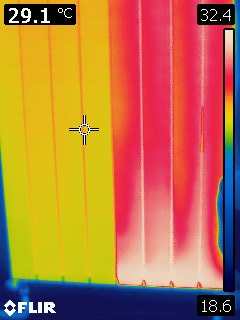
Not showing much of a temp gradient either.............. Not exactly what I would expect to see but they are heating up evenly and a vertical rad will do that at high temps even if there is no baffle/diverter - the hot water wants to rise above the cold so you'll get a very similar picture. It's exactly the problem I had with a couple of verticals - at 55 deg flow temps they heated up nicely but as I dropped the flow temps to 40 deg it became really clear that there was an issue with the baffle as the heat differential wasn't big enough and the flow to fast for the hotter water to have time to rise. Can you run the boiler at a lower flow temp and do the pictures again - maybe down at 40 deg - that should provide a better picture Now I know I'm using low flow temps to heat my house (32 deg C max) but the above is a large vertical and shows clearly the impact of the diverter. At this time of year your heat losses should be much lower so 73 deg flow temp is just going to drive room overheat or if TRV controlled rooms a circuit shrinking and boiler cycling (all of which is bad for energy consumption)
-
One thing I really admire about the French is if they don't like a rule or a law they don't take any notice of it They are also bloody good at making very effective protests where we just tut and carry on having been (expletive deleted)ed with no lube


