


Mike
-
Posts
1484 -
Joined
-
Last visited
-
Days Won
8
Everything posted by Mike
-
For those interested, the European Network Transmission System Operators for Electricity (ENTSO-E) is setting up an expert panel to investigate that - press release on their website.
-
It would increase price stability, but may not reduce bills. In last year's CfD auction (Allocation Round 6) the strike price for solar averaged £50.07 MWh and onshore wind £50.90/MWh (both at 2012 values); Hinkley Point C is £89.5 / MWh (also at 2012 values). The first of those links suggests a strike price for new gas of £82.83/MWh (at 2012 prices).
-
Good idea - Citiz have been growing a network similar to that in France for 20 years, mostly in cities and towns, but in some rural areas too (more, in English, here). While most of their vehicles aren't yet electric (and they don't include the Citroen Ami), they claim that every one of their vehicles removes 8 to 10 privately owned ones. That also means that people increases the number of trips they take by alternative means (e-bikes, public transport, walking, ride-sharing, etc.) so that each Citiz vehicle has the effect of reducing overall CO2 emissions by around 10 tonnes per year. I'm a member myself, so can reserve a vehicle anywhere in France within a couple of minutes from the app. There are also various smaller private sector schemes (Citiz is a network of 14 regional co-ops & public sector operators).
-
Combustible structural materials need to be 200mm away from the inner face of a masonry chimney flue in order to meet the requirements of Building Regs Part J. You'd therefore have to ensure that it can't be used as a chimney in future to avoid those requirements - for example by permanently blocking it with that padstone & considering how to avoid the potential for elevated moisture levels within the old flue. Provided you've done that, there's no need for further protection for the beam.
-
Roof insulation on the inside - quotes - discussion
Mike replied to Garald's topic in Heat Insulation
This bit does: votre toiture protège de la pluie et à moins de déposer la toiture, il n’est pas possible d’installer un pare pluie qui se situe au-dessus des liteaux But not the fist part: Nous veillons à bien calfeutrer partout avec l’isolant. You can't make a roof airtight using only wood fibre insulation. To do make it airtight from the inside requires a proper airtight layer. Pro Clima show one way of doing it on their website, using Mento, at https://fr.proclima.com/produits/etancheite-exterieur/solitex-mento-1000/mise-en-oeuvre#sub_navigation (see Pose ultérieure d’une sous-toiture par l’intérieur). If the tile already have a sarking membrane/felt beneath them that's in good enough condition to catch any rain that bypasses the tiles, then I'd omit the central batten that creates the V shape. And probably omit the other spacer battens if the sarking membrane is vapour-permiable; I guess yours may well be? Of course this requires doing with care, especially to make sure that the airtightness remains at the ridge, eaves, skylights, etc. It would, however, be much better (present fewer potential leakage paths) to use a continuous membrane instead of cutting & sealing it at each every rafter. In other words, very similar to installing a membrane when insulating a floor (but doing it overhead) - for example here (though, as above, potentially omitting the VCL): -
That type of vent will tend to blow the air vertically downward, so being close to the wall probably won't be a major problem (unless the installation instructions say otherwise). Though unless you have a tiny room I'd imagine that there are some other options.
-
Selecting the correct internal environment in WUFI to model that is not at all straightforward, as mentioned in my post on the topic from last year - there seems to be an absence of accurate information on which to calculate it. And, If they have erred too much on the side of caution (which I suspect), the results will be overly pessimistic. If you're able to post the details of the internal environment that they've used, that may give us a clue. if you don't have it, it would be worth asking for it. If that's what WUFI suggests, that increases my suspicion that it's inaccurate. I'm not a WUFI expert, but based on my own WUFI experiments, adding Intello membrane to a building that has WUFI is likley to make the moisture build-up within the wall somewhat worse (in winter), not better. That's because standard MVHR is likely to result in a lower internal relative humidity than would otherwise be the case, which, in turn, would remove moisture from the wall structure. A VCL, even a smart one such as Intello, will tend to block that drying action for part of the year. If that's also based on WUFI, that also seems counter-intuitive in view of the previous suggestion. Option 1 (Intello) suggest that slowing drying to the inside (in winter) is better; Option 2 (clayboard) suggests that increasing drying to the inside is better...
-
MVHR ? Who needs it? I don't.
Mike replied to ToughButterCup's topic in Mechanical Ventilation with Heat Recovery (MVHR)
Guilty as charged 😔 Sorry to those who fell for it. Seriously though, if anyone has read a recent scientific paper on domestic CO2 levels & mental / physical functioning (other than the serious one that I posted), I am interested. -
MVHR ? Who needs it? I don't.
Mike replied to ToughButterCup's topic in Mechanical Ventilation with Heat Recovery (MVHR)
There seems to be a lot. https://scholar.google.co.uk/scholar?q=effects+of+elevated+co2+concentration+on+sleep+cycle&hl=en&as_sdt=0&as_vis=1&oi=scholart Loads. This one seems particularly insightful: Effects on breathing in awake and sleeping goats of focal acidosis in the medullary raphe :) -
MVHR ? Who needs it? I don't.
Mike replied to ToughButterCup's topic in Mechanical Ventilation with Heat Recovery (MVHR)
If I was recording that frequently, I'd be increasing the ventilation rate to cap it around 900ppm. I've not come across extensive research on the topic, but the 2016 study 'The effects of bedroom air quality on sleep and next-day performance' by Strøm-Tejsen, Zukowska-Tejsen et. al. is one that uses it as a benchmark. -
If you can skip the smart hub and can make do with just the mobile phone notification, then the Cavius Hub + app can do that. It looks like it may be possible to link it to Home Assistant but I don't have the hub nor a working installation of Home Assistant (yet) to test it myself. If not, then maybe you can connect something to the Cavius CV9004 RF relay, I suspect that it may help (though the air volumes would be pretty low) but have seen no evidence either way.
-
Roof insulation on the inside - quotes - discussion
Mike replied to Garald's topic in Heat Insulation
Maybe. In my case I chose Pro Clima Mento 1000 as my airtightness layer partly for that reason (the slates on my mansard weren't entirely watertight at the time, though they have since been renewed above a new external sarking membrane). Although it is perfectly airtight ("windtight"), Mento is marketed as an advanced highly vapour-permiable sarking membrane, with a 'high' resistance to ageing & heat (provided it's not exposed to UV light for extended periods), and it's suitable for exposure to the elements for up to 3 months, which was perfect for during the re-roofing. An ideal choice in my case. Of course if it does catch any drips, the membrane needs to channel them to the outside, or at least somewhere that can cope with some intermittent wetting without creating a problem. -
Anything except wool, unless the new Ionic Protect treatment is as good as it claims.
-
Roof insulation on the inside - quotes - discussion
Mike replied to Garald's topic in Heat Insulation
Nothing wrong with that in principle. If it's somewhere it may get knocked then you may need to make some repairs in future, but that's easy enough if you keep a little spare. A sharpened carrot? A lobbed turnip? I've not heard of that being a problem, and some cork finishes are very smooth. Dust is also much less likely to accumulate on the underside of a sloping surface. They perform different roles. You always need an airtightness membrane (or some other material performing that function - such as a parge coat on masonry) on the outside of the insulation somewhere. Although cork can be airtight, the joints wouldn't be, and if it's on the internal surface it's probably not in the right place to serve that function Provided the airtightness membrane is properly airtight, then the air pressure inside the room and inside the insulation will be more-or-less identical, so there's nothing to drive warm moisture laden into the insulation. That limits moisture transfer to that caused by fluctuations in internal relative humidity, and you may need a vapour control membrane to limit that. You'd need WUFI modelling to know whether or not that is necessary. If / when you get MVHR the risk will go down significantly - quite likely to zero in the absence of external sources of moisture - as I'm sure we must have discussed before. -
Roof insulation on the inside - quotes - discussion
Mike replied to Garald's topic in Heat Insulation
Should have been clearer - that was what I was trying to say... Yes, cork would be good as one material - it all depends on how much space you have. -
I'd most likely foam it too, with Ilbruck FM330. If I really wanted tape, then I'd do as @Iceverge suggests and cut a strip of regular airtightness membrane, then fix it in place using Orcon F. I've used both techniques and they both work well.
-
Roof insulation on the inside - quotes - discussion
Mike replied to Garald's topic in Heat Insulation
Just a matter of doing what you can in the space you have available. Airtightness (membrane / tape / foam) + X layers of high density plasterboard + any insulation you can get in there. -
Roof insulation on the inside - quotes - discussion
Mike replied to Garald's topic in Heat Insulation
Then triple glazed with a spec focusing on sound insulation is likely your best option. Aha? What do you mean? I mean that where the window meets the reveal your 180mm of insulation between inside and outside falls to very little; you're potentially relying mostly on the thickness & density of the plasterboard (unless the plasterboard is right up against a 180mm deep rafter):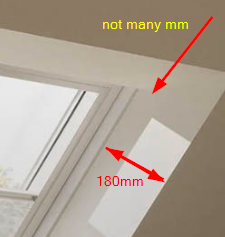
-
Roof insulation on the inside - quotes - discussion
Mike replied to Garald's topic in Heat Insulation
15mm perhaps? Maybe you have a small room that you could use as a test, now? -
Roof insulation on the inside - quotes - discussion
Mike replied to Garald's topic in Heat Insulation
Correct. Secondary glazing in English, but as French windows open inwards there's not a direct equivalent in France. The best solution I've seen were two sets of double windows in the same opening - 1 set opening out, the other in - which was very effective. I seem to recall secondary external sliding windows being used too, which is closest to the UK solution but exposed to the weather. Worth a try. Yes; the combination of glass panes makes a difference to the acoustic performance too; not all triple glazing is identical. Also consider the structure of the hole that they sit in, which may also be a weak point. At 13mm thick, regular plasterboard is typically between 7 & 9 kg/m². High density plasterboards such as SolidRoc and GypsoOmnia / GlypsoLignum are around 12.5kg/m². Fermacell is denser still at 15kg/m², but isn't a traditional plasterboard. -
Roof insulation on the inside - quotes - discussion
Mike replied to Garald's topic in Heat Insulation
I've no experience of MLV, but my hunch is that you'd be better off with that second layer of high-density plasterboard I suggested above, but your roof windows will be the weakest point. -
Your overall approach is good Then unless you are choosing external wall insulation, using the chimney isn't a good idea as they will be outside your thermal envelope. You'd be loosing the heat before the air was delivered - so cold supply air, and little heat to recover from the extract. Unless, that is, your chimneys are really big - big enough to install really well insulated ducting. I'd settle on the bunch of flowers. Or a TV screen the displays a roaring fire.
-
If I had the cash then I'd do it sooner to gain the benefits earlier. In which case yes, I'd firm up the verbal quote & seek at least one other for comparison.
-
Roof insulation on the inside - quotes - discussion
Mike replied to Garald's topic in Heat Insulation
I have - see me comments! -
Roof insulation on the inside - quotes - discussion
Mike replied to Garald's topic in Heat Insulation
Yes, you could do that. Though I'd spend the money on the MVHR instead!


