torre
-
Posts
451 -
Joined
-
Last visited
Everything posted by torre
-
Improving insulation to existing dormer conversion
torre replied to moonbug's topic in Lofts, Dormers & Loft Conversions
If you're renovating more than 50% of a thermal element (your roof) or 25% of the whole building envelope then yes, you do need building control, but as it's already a room then you won't be subject to other regs. An advantage of getting building control involved is that because there's an official record any improvement should be reflected in an EPC if you sell. If that's not important then a lot of people would just get on and make the improvement for their own benefit. -
Bonds like Flemish look beautiful and made a lot of sense when every wall was solid 9 inches a century ago as the visible headers tied through the internal and external brickwork. Today, with cavity walls the headers are purely cosmetic and add expense in two ways - 1/ there's more units for a bricklayer to pick up and lay, then 2/ every two headers are made from cutting or splitting a whole brick. So you'll likely pay around 25-33% more for the bricklaying, plus more for the cutting and splitting. Cutting is expensive, noisy, dirty even wet cutting. Splitting is slow and time consuming. We've done Flemish and while beautiful (but sorry no pics) the number of three quarters and quarters we wet cut plus the number of halves we split added lots of time and cost. It's a nice idea but not the way to go if you want to build fast or cheap. If you want to stand out it's easier to do that by picking a distinctive brick and carefully selecting a mortar that compliments well. Consider an imperial brick size perhaps if you want to stand out? Laying 80-85mm can work out cheaper than metric 75 but you're likely to pay more for the bricks
-
Looking again at your earlier suggestion @-rick- I think that's the easiest way to create 3 bedrooms at minimal cost and disruption without much impact to saleability or value. It's workable even if you don't move the existing wall between bedrooms and just divide bed 1 pretty evenly in two with a stud wall. Bed 2 becomes the 'main' bedroom but all 3 beds are upstairs with a decent bathroom.
-
I'm guessing the wall between beds 2&3 is brick and supporting the ceiling joists, maybe the roof, so you probably don't want to move that. It's tricky as a growing family means you have to prioritise what works for you above what might maximise returns of any refurb. Another possible idea.. Divide bed 2 so you have 1500-1700mm as a small but functional bathroom (no window unless you can add one that side) accessed through existing door and a 2000*2500 box room benefiting from the existing window accessed from a new door onto the landing. That's small for a bedroom (bit below minimum space standard) but okay for a child and a decent home office later thinking of resale. Personally I wouldn't give that much downstairs space to a bathroom esp as you already have a downstairs toilet. I'd rather keep a reception room downstairs and have a small upstairs bathroom than a large downstairs bathroom.
-
Longevity of a Victorian slate roof
torre replied to Tony Williams's topic in Roofing, Tiling & Slating
In your situation I'd only consider two options: 1/ do nothing and you may get another 10+ years just replacing the odd slate. Solar will be cheaper next year anyway 2/ do the job properly as @Conor described and end up with a new roof and better solar install Installing solar over the existing will inevitably cause a bit of damage and if the roof starts failing due to age anyway, all that solar may have to come off for proper repairs -
Bungalow Renovation/ extension! - Hoping for high efficiency build
torre replied to boxrick's topic in Introduce Yourself
Does your insurer know of your renovation plans? Are they happy to continue cover and do you know what the premiums will be like? You're substantially enlarging the property (and their risk). How much are you raising floor levels? Every little bit will help. You mention options like tanking - you might want to look closer at these before rushing into further work that may make some measures more difficult to achieve. If I were a future buyer I'd want to know every step had been taken to avoid future flood risk and even then, be mindful that inevitably a lot of buyers may be put off completely by previous flooding - that may limit future value and so (even if you plan to be there forever) perhaps bear that in mind when budgeting. On a cheap, practical level you can get toilet bungs to stop flooded drains overflowing inside. -
Give me your thoughts on window design
torre replied to flanagaj's topic in New House & Self Build Design
That's the essence of BuildHub for me - it's because you'll get input from a wide range of professionals and self builders with hands on experience applying similar designs to their own builds who can share that experience to help you avoid pitfalls either around the design, the construction or the likely costs of achieving something similar. Our architect's been great but isn't the single arbiter of design and while the client isn't always right, they will be paying for the end result and living in it. For example, @DownSouth sharing their own real world example of why a thin strip of cladding below the windows may not work well, or your own observation that, of course, EEW are simpler than the protected staircase this architect appeared to be relying on.. -
Is it worth having a gas connection for self build house?
torre replied to Wadrian's topic in Central Heating (Radiators)
It's hard to go much higher than a 20% hydrogen blend as that's what will work with the millions of old gas boilers that will still be around for decades to come. There's only one gas pipe down your street, you can't pipe a richer hydrogen mix down to just the newer boilers because it's not safe to fuel all the older boilers. (Most hydrogen is produced from gas anyway!) -
Give me your thoughts on window design
torre replied to flanagaj's topic in New House & Self Build Design
@ETC a protected stairway is described in approved doc B 2.5.a and may apply to a two storey design such as this as described in section 2.2.b, being an alternative to the escape windows described by 2.2.a -
Is it worth having a gas connection for self build house?
torre replied to Wadrian's topic in Central Heating (Radiators)
With a heat pump for water and heating and being happy with an electric hob (for aesthetics as much as how they cook - we'll miss a giant burner for a wok) we're not bothering with gas. As @JohnMo says, why pay the standing charge and more significantly, why pay the cost of getting a new gas connection in the first place - probably £2k and upwards? If you must have a gas hob then maybe, but I think in an efficient new build property it's hard to make much argument to use gas for heating over an ASHP. -
Give me your thoughts on window design
torre replied to flanagaj's topic in New House & Self Build Design
Probably that your bedrooms open directly to the landing and staircase, leading directly to an exit downstairs, and that area is protected by fire doors etc. That's how you'd escape, not through the windows -
I wonder if they've not laid them particularly straight and then knocked corners off to get them to sit flat? As @Mattg4321 says I'd expect an eaves tray no membrane showing, and I doubt that gutter's clipped in at the back. I suspect if nothing more is broken underneath they'll do the job. At the least get a hosepipe on it to check for obvious issues
-
You could ask their PWS in writing/email to clarify their comments whether the wall will be at the boundary and its capping overhang, I suspect they'll be less flippant then. This at least is somewhat promising. Honestly I think it's worth trying this approach again. You may want to read about this dispute and then have a chat with your neighbours whether it's in either of your interests to get into a formal dispute and court action over this. Put aside your concerns about their son as the builder in favour of asking for a small compromise to set the wall back slightly to avoid a dispute that costs you both money and devalues both properties because you're in a formal dispute, regardless of who is in the right.
-
The free online version of Sketchup is still quite capable and definitely worth giving a spin as you'll already be familiar with the UI. For basic modelling it does quite a lot but is missing third party plugins, the render quality is limited, but that doesn't sound like a deal breaker for you. You can import any existing models produced on desktop. I found the old free desktop app crashes a lot on modern Macs.
-
As mentioned earlier, the smaller your build, the more expensive per m2 as some costs are largely fixed. Is there any possibility of making the build 'one and a half' storey? Lose some space for stairs but gain another 15-20m2 upstairs, without making the profile of the property all that much more imposing and at pretty low extra cost.
-
Do you already have a copy of the planning officer's report? It didn't sound like you know their recommendation yet, so chase that. Your prior approval is a big plus and a recommendation for approval would be even more so. Have you read your local council's planning committee protocol? What are their rules for who can speak and do you need to register for this ahead of time? If there's a chance for a supporter to speak as well as you so much the better - could your planning consultant speak in support so they can emphasise the sound policy grounds for approval. Have you lobbied your local councillor for their views? We invited ours over to discuss the plans a few days before.
-
Percolation test. Draining too quickly
torre replied to flanagaj's topic in General Self Build & DIY Discussion
How many times did you fill and refill the holes when saturating? Rule out the chalk hole, then the big slowdown between tests for the second hole suggests that ground may not have been saturated enough to give a reliable reading. I'd fill and drain that a couple more times and then repeat the tests over a day or two -
I thought rubble filled was still allowed, but has to be about 3x larger than crates.
-
Is making the island 100mm deeper an option? You'll have end panels covering the sides of the back to back cupboards. Otherwise change the 2*900 wide cupboards at the back to 3*600 so you only lose space in the middle one?
-
Surface water flow attenuation problem.
torre replied to G and J's topic in Rainwater, Guttering & SuDS
Perhaps you could explore a 'blue roof' - could the tank go on the garage roof maybe? -
I think there's a lot to be said for this. While boarding out can be done very well it can also be done very badly for airtightness without that being obvious and post plaster is an expensive time to try and make improvements. Airtightness is an area it helps to be hands on to ensure it's done well, but if you can't give the time then at least aerobarrier sounds a reliable way of outsourcing for a good result @zagaboo I agree Plasmore have good compromise options. We used their Fibolite which are 0.28 and still readily take fixings, direct nailing compared to thermalite
-
I dislike Thermalites too. If it helps, for a new build the limiting value is actually only 0.26 (table 4.1 of Part L) which gives you flexibility to use a different block, as long as you make adjustments to improve efficiency elsewhere - it may be easy to add 10-20mm of PIR to your roof or floor, say, to achieve the same SAP score.
-
Vertical crack in extension through padstone under new steel
torre replied to lookseehear's topic in Brick & Block
Close ups at both ends would really help. Pausing the video it looked like the steel doesn't/didn't even bear entirely on the padstone. Can't tell if it's not quite level or just packed with something but if there's more load on the outside edge of the steel maybe that caused the crack? The other end of the steel looks to sit right at the opposite edge of its padstone too.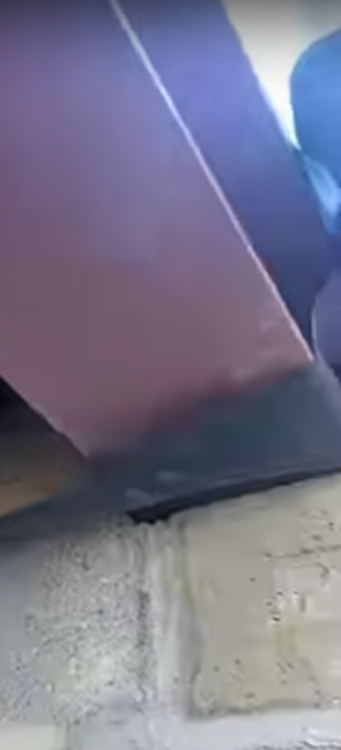
-
Point them towards VAT Notice 708 which covers this. Specifically section 3 about zero rating, then section 14 about building a dwelling which means that consequently they don't need to hold any certificate before zero rating. It's reasonable for them to request a copy of your planning permission as evidence they can zero rate. I can see why small businesses may struggle to get this right (the first couple of times they encounter it anyway) but that's no reason to expect you to pay 20% extra for something. If they've already issued an invoice, they may want to give you a credit note (for the 20% they've applied incorrectly) instead of modifying the original invoice, but then you'd still only pay the balance (being the zero rated cost)
-
This works really well for Dritherm and Isover https://www.amazon.co.uk/Bahco-PC-22-INS-22-inch-Insulation-Saw/dp/B003Y3SJMG the deep blade makes it easier to cut square. Compressing the batt with a plank on top helps too. Not tried it for woodfibre but have used a fine toothed handsaw which cuts really well. Lots of dust released doing this so wear a mask