


sharpener
-
Posts
1492 -
Joined
-
Last visited
-
Days Won
1
Everything posted by sharpener
-
Mains supply (water) distance from other services (electric)
sharpener replied to GaryChaplin's topic in General Plumbing
FWIW the IET On-site Guide says wiring must be separated by 25mm for gas pipes up to 35mm dia, and CUs by 150mm unless non-combustible insulation is interposed, but nothing at al about water installations. -
Speedfit pipes. What do I need to know?
sharpener replied to saveasteading's topic in General Plumbing
Am in a minority here but I like the Polyplumb pipe and fittings. We inherited a rainwater system which had PP fittings inside the plant cubicle but JG outside. Useless, I was never confident they were done up properly and one actually sprang off under pressure. OTOH the PP always inspired confidence. The grab ring is inside the seal ring so it doesn't scratch the seal area on the pipe. Can be push-assembled, and unscrewed again with bare hands. Have installed much pipe above ceilings with PP, only problem was where I didn't mark the correct insertion depth on the pipe end, you need to do that. -
Will try it. But I think the HW algorithm maximises flow temp as it tries to minimise the HW heatup time to avoid disrupting the heating schedule too much. So it might not help, and may actually make it worse (power = flow rate x dT and all that).
-
Vaillant Arotherm in open loop, with buffer
sharpener replied to Peter269's topic in Air Source Heat Pumps (ASHP)
See the Energy Integral thread. -
Vaillant Arotherm in open loop, with buffer
sharpener replied to Peter269's topic in Air Source Heat Pumps (ASHP)
Was referring to the external call for heat from the 3rd party controls like the Evohome the OP and I have got. Without that I think the Arotherm Plus internal pump will run all the time it is on a timed heating or HW schedule. So if you want it to shut off for more of the time you need to tighten the schedules. For instance assuming the heating circuit was set to OFF in the summer it sounds as if you might have the HW heatup enabled for an unnecessarily long time, many ppl find a defined 2 hr window during the night-time cheap rate is enough for their HW needs, the pump shouldn't run outside that. Not sure what you would connect to the EVU terminals, have you got any third party controls at all? A room thermostat or timer could be used but the effect would be pretty much the same as judicious setting of the time schedules on the SensoComfort and using its internal thermostat in Room Temp Mod = Expanded mode, this shuts off the whole system when the index room is up to temp. -
LG Therma V Monobloc CH14 flow error
sharpener replied to Tim Pearson's topic in Air Source Heat Pumps (ASHP)
Yes Wilo are quiet but I would be surprised if there was no detectable sensation when it was running. If changing the speed setting from I to III makes no perceptible difference I would guess it is probably seized, you might have to take it out (which is when you discover the valves do not shut off or the spindles leak). -
Vaillant Arotherm in open loop, with buffer
sharpener replied to Peter269's topic in Air Source Heat Pumps (ASHP)
If there is no call for heat the internal pump in the outdoor unit turns off when the compressor shuts down, you can see this as the flow rate on the VWZ AI falls to zero when the HP goes to Standby. If you have a VR71 Wiring Centre the way you can control this behavious is to wire an external enable contact closure acorss S6/S7/S8 for the 3 individual circuits. If you only have one circuit and hence no VR71 the same effect can be achieved with the EVU terminals in the VWZ AI or ?S20 on the outdoor unit itself. Like the OP I have Honeywell Evohome. In my case the BRD-91 Boiler Relay provides a mains voltage signal over pre-existing wiring, so this is interfaced by using a relay to provide a voltage-free signal. But with enough cores in the cable you don't need to do that. -
Thanks. The shoulder price at 13.37p is not much more than the Cosy cheap price of 12.11p. But the cheap period is all in one lump so I would not be able to round-trip the batteries 3x per day. Time for some serious modelling. Once I have the smart meter I will certainly ask Tomato for a quote. How have you found their customer service?
-
Yes. lacking the sophistication of @JamesPa when I want to charge the car I turn the diverter off manually until late in the afternoon when the PV generation has fallen below the 1.4 kW min the car needs. A bit of a gamble that there will still be enough sun for the hot water. Can you post a link? Tried to investigate this but they have an automatic lookup so I cannot see their smart meter tariffs as it's not going to be installed until tomorrow.
-
A pump specialist like anglia pumps will stock a wider range and perhaps be in a better position to give advice than a builders merchant methinks. As you had spoken about "the heating system" I had supposed it was a pre-existing wet heating system as in the UK.
-
Looked at several systems at the NEC last year. For bedrooms with 2 or more external walls it was difficult to get enough surface area to replace the rads on an oil boiler let alone an HP. Expensive, the straight runs are OK but the corners and end fittings up the cost considerably.
-
Not in the sense of planning permission! But yes, position over an internal wall if poss. Depends on size; traditionally houses were built with 50 gallon cold water tanks in the loft, usually mounted on a board spanning 3 - 4 joists, never heard of this being a problem. BTW your other post is here. Click on the chain link symbol in the header, insert the URL and the keyword, then Enter.
-
There is no intrinsic reason why it would not work but I would be nervous about putting yr spring water into the CH system directly without a detailed analysis of what else might be in the water, lots of iron if it is a chalybeate spring for example. At least use a fine inline strainer or Magnaclean. 25 ft would be a delivery head of only 1.7 bar (and of course the weight of the water in the descending leg of the circuit will help). Ordinary cast-iron bodied CH circulating pumps can achieve this and are designed to run non-stop for years, I would consider them first. Power consumption would be a lot less and lifetime a lot longer than a typical submersible or self-priming jet pump designed for intermittent use as dewatering or water supply pumps, they deliver much more than yr 4 l/min and usually draw many 100s of watts. Small centrifugal pumps e.g. for shower boosting are available as low voltage but again are not designed for continuous use. I would have thought 100V CH pumps would readily be available in the Japanese market, unless you want to source the kit in the UK and bring it over in which case a small (auto-)transformer will not be expensive. IIRC some parts of Japan are (or were) 60Hz though that may not matter much. HTH
-
45 l seems a very small HW demand for a 4 bed house, usual planning rule is 50 l x (# of bedrooms +1) per day. If you are medically fit and using a reasonable amount of HW say >50% of the tank per day then legionella cycle prob unnecessary but you can disable it later anyway. Heat load is <40W/ sq m, this is quite low, what is the age of the house? Have you got max loft insulation, if not this is a quick win. The key question though is what is the design flow temp at what OAT? This will determine the CoP you can achieve. As @Nickfromwales implies you may need bigger rads depending on what you had before. (I beat my installers down to changing only 6 of the 10 rads when moving from oil to HP.) Are you getting battery storage to go with the panels? Best to think about this while you are getting the electrics modified to take the HP and PV or you will end up with an unsightly maze of meter tails and Henley blocks.
-
The obvious way would be to run the HP on a mark-space ratio to give an average power defined by the WC algorithmn. You might want to fine tune it with room temperature feedback but it would surely be better than allowing it to just switch on and off as it oscillates about the room temp setting (bang-band servo mode).
-
Interesting idea but I think a lot of the heat would not be captured by the HP and wasted. As others have said it sounds as though there is something seriously non-optimal about your setup which needs identifying and fixing first. Buffer tanks reduce thermodynamic efficiency due to mixing and are to be avoided as they reduce CoP, though are necessary in some circs. If you need more volume for defrosting then configuring it in the return line as a volumiser is better. Thermal stores are fine. I have got a 270 litre TS which will hold up to 10kWh of usable heat. It gets charged up during off-peak rates (to a temp set by its own WC coefficient), and then discharged through the bedroom rads before we get up. It is early days as the heating season has barely started but indications are it is working as intended. If Octopus succeed in finally installing a smart meter next week I will be able to switch to their Cosy tariff so I will get a second bite of the cherry 1300 - 1600. The third period 2200 - 2400 is not a lot of use for directly charging the TS, but will enable me to run the bedroom rads cheaply in real time so I can instead use the TS to heat the living room during the expensive period 1600 - 1900. The house is long and thin so heating it all 24/7 except when we have visitors makes little sense. As @ProDave says, you should think about battery storage as well, we have 10kWh of that in addition. After taking account of the CoP the initial cost/kWh is broadly the same as a TS but deteriorates slowly in use and the eventual life is a lot less, so the two forms of storage are complementary.
-
The energy integral is the I part of a standard PID control loop (Proportional, Integral, Differential). Weather compensation is a feed-forward Proportional term. The closed-loop Integral term takes out any residual error and avoids long-term drift. I do not know if there is a differential term, this would be needed to cope with sudden changes of room temp or OAT which are unlikely - the classic theory was developed for radar tracking of fast-moving targets. It might though be included in the Room Temp mod settings (if used, I don't). @JamesPa Snap!
-
Used to be good for 13A and would run a 3kW fan heater for hours on end. Now downgraded and downrated so a granny lead will only charge a car at 2.2kW. Yet they are deemed a suitable way of conecting a permanently installed undercounter oven. Son recently had the plug melt and burn out completely and had to replace the socket as well. Cause seems to have been poor contact at one of the fuse clips. So I wouldn't want a permanently installed piece of kit like an HP wired in with a 13A plug and socket, 16A commando perhaps.
-
Yes, OFGEM have bowed to the inevitable and finally acknowledged that much old FIT eqpt is nearing the end of its life and the identical like-for-like replamements they used to insist on are simply not available any more. Current guidance is much more realistic including the apportionment rules if capacity is changed.
-
May also reduce the likelihood of slug damage(!)
-
I think 10kWh is probably the workable min for a 5 bed house cooking by electricity and 15kWh might be more useful. I originally fitted 2 x 3.55kWh Pylontech modules, in the winter it had run out by the time I wanted to cook supper so I added a third. Have now installed an HP as well so in winter I could probably use more but the economics don't really stack up unless you use all the capacity 365 days a year. The 270 litre thermal store can hold a further 10kWh and was cheaper than adding a fourth battery module for the HP. The extra, 3rd cheap window with Cosy will definitely be a help but I expect the next few months will be a voyage of discovery. Ultimately I will see if it is worth using the battery to arbitrage between Cosy tariffs, but the round trip efficiency calculated on the annual totals reported by the Victron inverter is only 70 - 75% so this factor will make quite a dent in the profitability of that.
-
Oil to ASHP decision - RHI and changes next year
sharpener replied to RichardL's topic in Air Source Heat Pumps (ASHP)
Do they have anything to say about an oil-fired AGA? Our Post Office insurance covers leaking oil so by implication oil c.h. (which has now been scrapped after 29 years) and the AGA. Good news is that there are no stipulations about PV, batteries or heat pumps. I guess they are an accepted part of the fabric now. Bad news is that premium has gone up this year by >50% and I have not been able to fiind a cheaper alternative. Confused.com could not offer any quote at all - no reason given. -
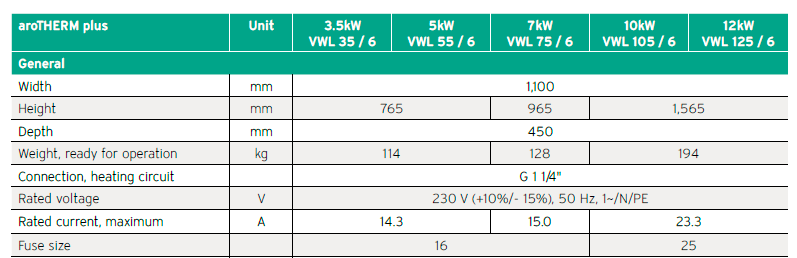
Unfortunately that seems to be the case, even the 3.5kW Vaillant can draw up to 14.3 amps (it is the same unit as the 5kW but with the output capped). However you would probably want a separate circuit, just as you should have for a boiler or an immersion heater. But an existing boiler radial circuit would do for an HP up to 7 kW. With inverter drives you do not need to allow anything more for inrush/motor start. A bigger problem though is that with an inverter drive you need to fit a Type B RCD and this is not allowed to be behind a Type A in your existing consumer unit, as discussed in an earlier thread. They are expensive and not available for all types of CU (and that includes Crabtree and Wylex until 2025). So in practice you may end up needing a new garage unit installed with Henley blocks. As I discovered, it becomes even more complicated with a battery setup as well.
-
BUS voucher and gas line
sharpener replied to allthatpebbledash's topic in Air Source Heat Pumps (ASHP)
Well done, bet you are over the moon over this. Hopefully it will also serve as a precedent which the muppets in yr LA will have to follow in future. -
They have taken their time! I saw the new R290 model on the Grant stand at the NEC in summer 2023, and was told like the R32 model it was made by Chofu and would be on the market winter 23/spring 24.

