


Crofter
-
Posts
3451 -
Joined
-
Last visited
-
Days Won
10
Everything posted by Crofter
-
I will need a 1.2m length for the hallway... so two 3m lengths would reduce wastage. But I'm a bit daunted at the idea of making a flawless joint and would frankly rather avoid it completely... plus I probably don't want the same style of worktop in the hallway anyway.
-
Thanks, that's good to hear! From what I've seen in the showroom it is a big step up from the B&Q kitchen I fitted to our last house. I wish we had more choice though, and one of my conclusions from today is that I don't really want to buy the kitchen off the internet unseen, or commit to vey lengthy multi day journeys to view, so that rules out Wren or IKEA...
-
Not on their website, but I'll give them a call- we've got a Howdens on Skye. Hadn't thought of Magnet, think there is one in Inverness. Thanks
-
Started kitchen shopping today, hurrah. We're not exactly blessed with an abundance of choice here- there used to be a place doing IKEA kitchens in Inverness but they appear to have disappeared, so we ended up going between Wickes and B&Q, the latter being quite unimpressive. Wickes have their sale on at the moment and whilst a smudge over budget we did very much like the one we saw and got a quote for. Anyway- the kitchen has a simple 4m run of units. Wickes only sell worktops in 3m lengths, so not only do we have to buy a big length of worktop to then throw away (OK, it would find a use somewhere as an expensive shelf) but more importantly we would end up with a join. I can find 4m laminate worktops at online retailers, but then delivery becomes an issue. Do any of the physical retailers sell worktops in this length? I've tried Howdens, anywhere else? Oh and any general kitchen tips, deals, etc much appreciated too...
-
Thanks all- I went into this assuming that all I was after was a sheet of plastic, but obviously there is a bit more to it than that! I hadn't even realised that you could get membranes with adhesive already on them. All the joints will be battened, although some of the detailing around windows and doors will probably rely on tape.
-
OK not the most exciting topic of discussion I admit! I've just about finished insulating the inside of the house and next step is the vapour barrier layer, which is also going to be the airtightness layer. Big range of stuff on offer from 150 to 1000 gauge, big range of prices too. Are any materials better than others when it comes to getting them stuck together? Anybody care to share what they've used? Don't want to spend hours looking this up if I can avoid it
-
Batten down the hatches.....
Crofter replied to ProDave's topic in General Self Build & DIY Discussion
I'm getting some water inside the house At the SW corner it's being driven up into the eaves. Need to get those soffits put in asap... -
Hmm, having had some time to look at these, I'm still not finding a simple tool to tally up different components. I don't really want to create a perfect kitchen for my lifestyle and family- I'm never going to use it! It seems most places give you a price based on some sort of 'average kitchen'. I'll need to do some digging and see if it bears any resemblance to what i actually want/need.
-
Discount Offers of the Week
Crofter replied to Ferdinand's topic in General Self Build & DIY Discussion
The thing I have found Wickes unbeatable for was cement. If you buy five bags the price is about £2/bag cheaper than my cheapest local BM. -
Just to add a wee question of my own to this thread... I'm in the process of lining out the inside of the house with 50mm PIR boards. This will then have a vapour barrier placed on top, and battens on top of that to secure it and also to create the service void. However at the window reveals I am planning on lapping the vapour barrier onto the frame directly, taping it onto the window frame, and then putting the PIR and plasterboard on top, with no battens and no void. The windows are set 150mm into the wall as viewed from inside (measured to finished wall surface). I think I will have to put the vapour barrier directly onto the frame as I need the depth of the PIR and plasterboard to hide the tape on the window frame. Just wanted to check that it's OK to put the plasterboard directly on top of the PIR without any additional support? And, is it best to use plasterboard here or would it be better for any reason to use ply? Finally- can I use the same method on the internal sill, i.e. it would end up supported on PIR (well the front edge could rest on a batten). My gut feeling is that if someone were to stand on the windowsill for some reason, their weight should be well enough spread so as not to crush the PIR, but then again some people are bigger and heavier than I am...
-
Nice! And open sides should let enough breeze through to keep the midgies away I wonder how that OS guy's machine works- GPS is only supposed to be accurate to ten metres (although in my experience it is definitely a bit better than that, maybe down to 5 or so).
-
boulder mvhr any good?
Crofter replied to Alexphd1's topic in Mechanical Ventilation with Heat Recovery (MVHR)
Just to bump this... I've noticed some discrepancies with the pricing of the Boulder MVHR units. Same unit at two different prices on eBay, and a third price on their website. Might give them a call... or might just not mention and buy the cheapest one Their DHV-15B is currently top of my list, as it is the lowest price that I can find for a high efficiency (90%) unit with auto bypass. I'm also investigating the use of one or more single-room units instead, as my small house is well within the floor area for some of these units. -
Now that's odd, I could swear I'd gone straight to IKEA thinking they would have something like this, but all I could get was a rather random assortment of different cabinets and doors and no idea whether they were even compatible. Will look again...
-
Time to start shopping for the kitchen. SWMBO has been looking forward to this part for a long time! Having visited a few of the usual suspects' websites, I'm a bit surprised that none of them seem to offer the ability to build a virtual kitchen and tally up the cost. Can't be beyond the wit of man to do that, surely? Perhaps they want to force you to use their own designers and therefore be charged for the privilege?
-
MVHR design for a small house
Crofter replied to Crofter's topic in Mechanical Ventilation with Heat Recovery (MVHR)
Ooh now that it tempting! Especially as I do not have to meet any regs. Sounds like a fun winter project On duct size, is it really feasible to run ducts inside stud partitions, that will be formed from 95mm timber? -
MVHR design for a small house
Crofter replied to Crofter's topic in Mechanical Ventilation with Heat Recovery (MVHR)
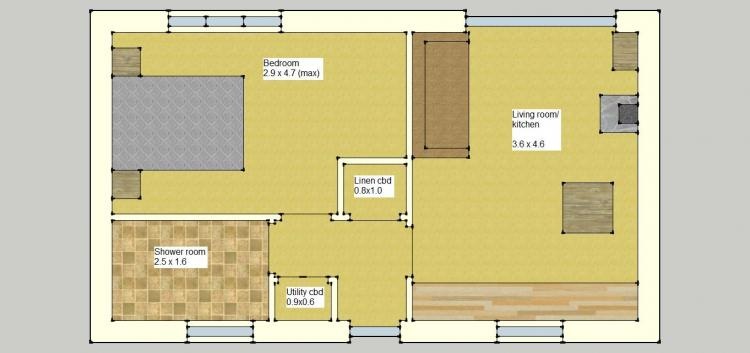
Thanks for all the replies! A lot to take in. I've read that the intake/outlet should be on the same wall of the building, so as not to unbalance the pressure. I could put one at each end of the east elevation if that helps, but presumably at some point the extra ducting causes more problems than it solves. Also I had read about the diagonal thing, which makes sense, but tricky to implement in rooms with vaulted ceilings. Do I extract at eaves level, i.e. in a corner, or at apex level, which is less 'diagonal' across the room? The main constraint on duct placement is that I am only planning a 25mm service void, and the slimmest flat ducting I have seen is 29mm. I can't imagine such contrived ducting is particularly efficient anyway, compared to nice smooth cylindrical stuff of equivalent cross sectional area. Thinking a bit outside the box (literally!) I could carry an insulated duct outside the thermal envelope, inside the sofft/fascia space, and route it to the gable end of the building that way. A lot of hassle, surely not worth it? The interior walls are stud, though, so I could run ducts down to floor level that way. Also the cupboards (and the walk in wardrobe, not shown on that plan) will easily allow this. On sizing, my only real concern about oversizing is that the minimum air change rate might be too high and cause draughts. One final thing- whilst googling all this I turned up some mention on GBF about using decent quality single room MVHR units to improve air quality in a whole house. It might not be the ideal solution but I am on a tight budget and this is looking quite appealing! Especially as a conventional unit with multiple vents in each room does seem rather overkill for a 43m2 house. -
Looking for some pointers/feedback on my MVHR system. My house is unusually small and, as I mentioned in the other thread, I'm struggling to find units of the appropriate capacity which aren't also very basic in performance and features. See attached image for the floorplan. This was an early draft- the kitchen/lounge has become slightly bigger, and the sofa will sit back into a slight recess, stealing a couple of feet from the bedroom, but otherwise it remains as drawn. The kitchen/lounge has a vaulted ceiling, the bedroom is vaulted to a false apex, and the vestibule and bathroom are normal height. The house is warm roof construction. The plan: - MVHR unit sited above the vestibule ceiling - Intake/outlet grilles in the soffit of the east wall (at bottom of sketch) - Two supply vents, one in bedroom and one above sofa - Two extract vents, one in bathroom ceiling and one in kitchen wall near the door from the vestibule Questions: - how far apart should the intake and outlet be? - Could I put the bedroom supply vent inside a walk in wardrobe, that will be on the dividing wall (i.e. through the wall from the sofa)? - At what height should vents be placed if the room has a vaulted ceiling? - Other than higher purchase and running costs, will an oversized MVHR unit cause any problems? Just asking in case something comes up on eBay. - Do I *really* need summer bypass? Thanks for any suggestions.
-
Funny, I was asking a similar thing a couple of days ago: http://forum.buildhub.org.uk/ipb/topic/1478-sourcing-collated-nails/ I got my nails from my local BM, but prices on eBay can be very good. I found that Screwfix etc weren't all that great in this department- very basic selection available.
-
Good that you've got a project to focus on. Agree re commercialisation etc. Buying an endless succession of unnecessary, short-lived tat to fill our houses and landfills. Bt that's economic growth I suppose. On fenceposts and concrete: Hydro boys have told me that their posts should never be concreted in because it causes faster deterioration (freeze/thaw damage where encased and unable to swell, water-logging of the encased timber which cannot dry out because there is no pathway) and they are forbidden from climbing concreted posts without the use of a cherry picker as they are all classed as dangerous, even if they were installed yesterday. But on the other hand, the crofting grant technical guidance allows you to use shorter strainer posts if you concrete them in. I tend to prefer surrounding posts by good hardcore, rotten rock if I have any, and pack it down hard. Not as strong as concrete but at let it can drain and allow the wood to breathe a bit.
-
What type of membrane is on there? They do come in different grades and weights. Mine is not the cheapest stuff as I knew it was likely to remain exposed for quite some time. The biggest problem I had was the south gable which faces into the weather, and which I had not battened; the membrane started to tear slightly around some of the nail holes. In the end i just slapped a whole second layer on top, and then stuck the battens on, and it's been absolutely perfect since. I've had my chipboard flooring down for several months now- no way that I could have done that if the membranes were leaking. Your flat roof might be difficult to keep waterproof though, I imagine the water will always pond and then seep through the nail/staple holes.
-
Surprised to hear that you've got water coming in past the felt. My build has been clad in only the membranes since the start of the summer, and apart from one small patch where there was wind damage, has not let in a drop for months. I've been quite impressed really, given how exposed it is here.
-
My PIR was all seconds, although none of this was insulated PB. A few boards were only 40mm, the vast majority were bang on 50mm though. I can get away with it because I am battening out a service void, but if using PB directly on top of the PIR I don't think you could guarantee an acceptable finish, unfortunately.
-
Yup, plenty of space in a crofter's coal bunker, cos they should be using peat anyway.
-
Well done, that's looking pretty good! And a shed that size wouldn't have been cheap to buy. I would get some guttering up, stop splashback from marking the cladding.
-
Up here it's not uncommon to nail an old microwave oven to a fence post. Postie will know what to do. Crofters are world leaders when it comes to recycling!

