


MikeSharp01
-
Posts
5693 -
Joined
-
Last visited
-
Days Won
16
Everything posted by MikeSharp01
-
 The Latham's door does have a passive house certificate, but it isn't clear to me that includes the lock: https://www.lathamtimber.co.uk/contentfiles/files/z_moralt_moralt-passiv-klima-klimasoft-firesafe-akustik_en_2015.pdf Interesting link, the certificate says is valid only until 2015 but it looks like a current product on their website, it must come with a lock and if it is a certified product then that's you sorted. Judging by the video on the web site about the Moralt system it look like you specify what you want and they build it.
 -
Couple of things. 1. The company selling the door should offer a U value for the door and frame including the lock and the package will be certified so no need to worry about that. 2. When we had our air test the leak through the mortise locks were vey noticeable so we will need to fit covers on then eventually. We still managed 0.2 on the Passive house scale but every little helps.
-
Ooooops - New windfarm cancelled.
MikeSharp01 replied to MikeSharp01's topic in Environmental Building Politics
Time we started a bit of gentle lobbying perhaps. Here is a note I have just sent to the BBC Today programme to ask them to ask an appropriate minister. "Here is a question you might like ask of an appropriate minister if they continue to say that the only route to cheaper electricity is to increase renewable generation. While I agree we should be increasing renewable generation there is a problem lurking at the core of this statement from government. The chart above is from this document (https://assets.publishing.service.gov.uk/media/675c0ca798302e574b915336/eep-report-2023-2050.pdf) published in December 2024 by Ed Miliband's department. It clearly shows that we will be using as much gas in 2050 as we are using now to generate electricity despite a massive increase in renewables. This means that unless the link between the gas price and the electricity price is broken the price for electricity will still be set by Gas. How does the minister square this circle? If we are going to delink why don't we do it now - perhaps it is because the renewable generators are getting a great price for their electricity. If we are not delinking how will the electricity prices not be tied back to a fossil fuel with all that entails. " Let's see if anything comes of it.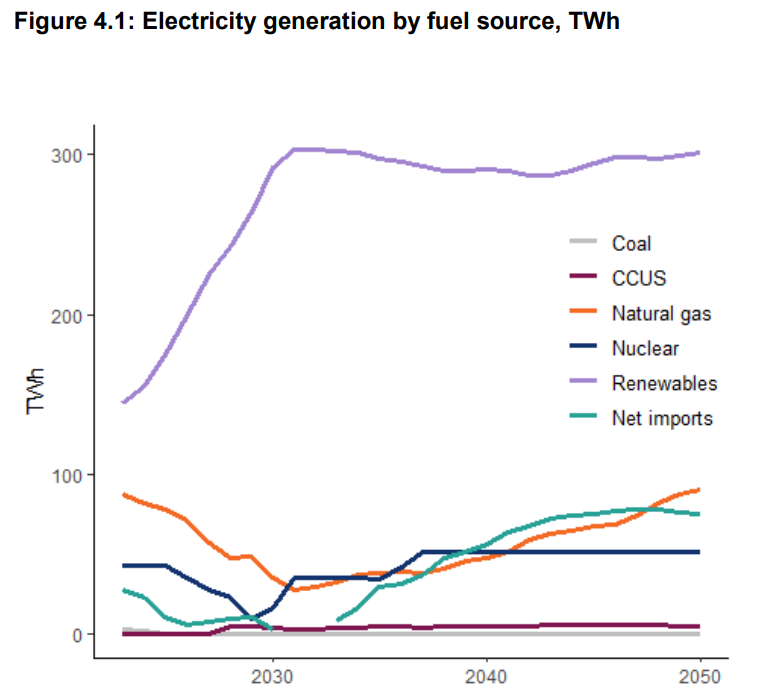
-
the menu will probably have a setting to fix the speed of the RS485 connection and get its address, if not use 9600 Bps and 1 and see what gives. You will need something like this (https://thepihut.com/products/rs232-rs485-to-rj45-ethernet-serial-server-poe-port) to talk to it and an ethernet connection to plug it into the RS485 wire can be as long as you need - even Buckingham palace does not extend so far that RS485 won't reach.
-
Ooooops - New windfarm cancelled.
MikeSharp01 replied to MikeSharp01's topic in Environmental Building Politics
It looks like something has got to give as things are unsustainable. That report from Mr Milibands department in December clearly shows that we will still be burning as much gas as we are today although as a smaller proportion of overall generation. So it follows that gas will still set the price unless it is delinked from doing so. Given we assume that the department knows what it is doing the calculation must be that at some point the link will need to be broken by some means as yet unknown. This brings us back to what @SteamyTea says might be a tactic in the minds of the windfarm builders to push this date back so they can make hay while the wind blows. -
Ooooops - New windfarm cancelled.
MikeSharp01 replied to MikeSharp01's topic in Environmental Building Politics
No Apparently you don't need any more up there. According to your man from Octopus the marginal cost of production up there is something silly like 7p kWh but the companies get paid something like 12p kWh just to keep them turned off. Its all madder than a mad things mad thing! -
https://www.bbc.co.uk/news/articles/ce848g8l8vro Looks like we won't get this wind farm after all. While I heard again today that the only way to get cheaper electricity is to get away from fossil fuels and I recall that graph referred to last week, https://assets.publishing.service.gov.uk/media/675c0ca798302e574b915336/eep-report-2023-2050.pdf, that says we will still be using gas in 2050! How can we square this circle.
-
Ah I forgot to say that it is a separate filtered tap. Cold only which we will use for kettle, food water etc. Otherwise two PRVs is not a problem?
- 51 replies
-
- 1
-

-
- cold mains
- bar
- (and 2 more)
-
It must be pain points.
-
Am trying to follow this for our G3 central plumbing install. In the recent thread on precharge for a uvc you have a few PRVs around the place so not sure quite why there are so many and how, if there is one, any water softener gets into the circuit. I was thinking: 1. Stop cock (25 to 22) 2. NON return valve 3. Drain cock 4. T to external tap 4. Prv to step down from 7 bar to 4. 5. Isolating valve. 6. T off to A. Water Softener B. To kitchen potable tap. A.1 Isolating valve. A.2 Softener A.3 Isolating valve. A.4 Multi Block set at 3 bar adjacent to UVC Then out to all cold feeds and on to UVC. Is that the right place for the Softener,? Will the the two PRVs fight each other - can't see how?
-
Starting a business helping Self-Builders, advice?
MikeSharp01 replied to LDNRennovation's topic in Surveyors & Architects
No they didn't - just good jobbing architects who had done three houses on our hill and we liked one of them very much so we included them in the list to be 'interviewed' as I mention there were places where they did not get the self build ideal but Buildhub has worked its magic on most of those questions already. -
Starting a business helping Self-Builders, advice?
MikeSharp01 replied to LDNRennovation's topic in Surveyors & Architects
We used an architect for our design upto building control (BC). We were very happy with the work they did and we had told them we would not be going past BC. This said they were not that aware of self building of our sort, as @nod has described, so some aspects got a bit lost. The main one being describing the details as they assumed a competent builder would just do it so leaving gaps which took us a long time to work out and still appear on occasions. So I get the impression there is a gap there. Also in our case the architects had not done a passive house (PH) beforehand so although they got the contract I did the PH courses so I could feed in the expertise so they did not design a house that could not be built to PH standards. So that is another gap worth looking at. -
Spain/Portugal blackout
MikeSharp01 replied to Beelbeebub's topic in General Alternative Energy Issues
Yes sorry another wrinkle in the unit's naming rules / conventions. M for Mega (1,000,000) as it distinguishes it from m for milli.... -
Spain/Portugal blackout
MikeSharp01 replied to Beelbeebub's topic in General Alternative Energy Issues
How do 2012 prices relate to today's prices? On Export Octopus you get £0.15 for each kWh of export so £150 for a mWh in today's money! -
Should we add this wrinkle, not the details but the fact of where the GSE account is, to the Git site?
-
Sounds like fun and a recipe for disaster unless you can seriously control that hole - pile round the internal perimeter, and so stop the scheme undermining your foundations. Still what do I know, a soil mechanic / ground works expert will be along shortly and will hopefully tell me I am talking tosh!
-
Running hep2O in insulation below screed?
MikeSharp01 replied to daunker's topic in General Plumbing
Yes thought that might have been the case, thanks for looking -
Running hep2O in insulation below screed?
MikeSharp01 replied to daunker's topic in General Plumbing
Any chance of seeing a schematic of that little lot as when you read this whole thread it's a lot to take in. -
Running hep2O in insulation below screed?
MikeSharp01 replied to daunker's topic in General Plumbing
Thanks Nick very comprehensive.... -
Running hep2O in insulation below screed?
MikeSharp01 replied to daunker's topic in General Plumbing
Can I ask when is it right to and not to lollypop the manifold as it you have it on the 7 way but not on the 2 and 3 way when would a 5 way need it or not or are there other factors? -
Our solar panels have been on the build roof 1 month, admit its been a good month, and we have exported 1133.2kWh at £0.15 or £169.98 which pays the electric bill on both properties, and some, so I love solar - not so much the seagulls who deposit excrement that reduces our output! It will be fun to find out if it was the renewables that tripped the Spanish / Portuguese & a bit of Frances grid yesterday though.
-
Spain/Portugal blackout
MikeSharp01 replied to Beelbeebub's topic in General Alternative Energy Issues
Just to add to the pot of 'issues' with green and power generation agenda's interesting report from the IET today that tells people how much more expensive it is to bury the grid (4.5 times overhead) or keep it under the ocean than it is to pop up pylons everywhere. https://www.theiet.org/media/press-releases/press-releases-2025/press-releases-2025-april-june/29-april-2025-rewiring-britains-future-iet-releases-key-report-in-helping-britain-s-power-grid-reach-net-zero so, as ever you can spend money going 'green' assuming you equate green with burying cables and that's not a done deal either, or not and put up with the pylons, can't see any other way around it unless we find a way of transmitting it about without wires or perhaps we could install Wind turbines locally if we don't want pylons. Direct link to the full report here: https://www.theiet.org/media/axwkktkb/100110238_001-rev-j-electricity-transmission-costs-and-characteristics_final-full.pdf -
Hey! New here, looking to do a self build around MK
MikeSharp01 replied to BHACHA16's topic in Introduce Yourself
3000 ft2 is roughly 280 m2 £600K divided by 280 gives you £2143 per meter2 which is a relatively low budget and you will need to do a good deal of it yourself to get to that. £3K m2 is more doable but won't be a very high end finish - unless you do even more yourself. So as ever you can spend money saving time or spend time saving money or make the house smaller and play with the ratio's that way. -
Kingston Efficient Homes Show 2025 Short Talks
MikeSharp01 replied to DamonHD's topic in Boffin's Corner
Looks like a great event - sadly I cannot make that day otherwise I would have attended - hope it all goes well. -
I thought the abstract said it all really - it says that someone just used Google to find some connection between C02 and brain activity and then just posted it to sharpen up the tone of the conversation / make their tribulations with MVHR appear somewhat technical - so probably a bit of wind up. In fact what these researchers did was to use a process called microdialysis which involved pushing tiny tubes into the brains of Goats and then injecting mock brain fluid mediated with CO2 , hence Google found it, to see what effect this had depending on what the goats were doing at the time - awake or sleeping. They found a number of effects during waking which were not there during sleeping and the common effect was that the goats brains worked really hard at keeping the brains chemistry balanced and that they were quite good at it. It is not obvious that the same effects might be connected to the concentrating of CO2 in the breathing atmosphere of the goats and they may or may not have developed insights into a number of other things but then I only read the abstract. There is, of course, an alternative explanation for the OP's highlighting this piece of research and that is that they are a retired vetenary brain surgeon masquerading as a self builder.

