


MikeSharp01
-
Posts
5693 -
Joined
-
Last visited
-
Days Won
16
Everything posted by MikeSharp01
-

The Optimum domestic hot water and heating system
MikeSharp01 replied to Triassic's topic in Other Heating Systems
Nothing in the regs, I don't think, to prevent you using a high pressure cylinder and venting it with a 60 foot length of pipe straight up. Bit of an eyesore but 2 bar and no restrictions. -
The tale of the sale of our old house
MikeSharp01 replied to Jeremy Harris's topic in General Self Build & DIY Discussion
Should be interesting to watch and I hope it goes well for you - certainty Purple bricks are getting loads of press and their MD (Founder) was on R4 the other day and he made some good points about the nature of the property market and his goals for the business. Did you look at any of the other on-line offerings? -
Welcome to THE forum. Good to have a CAD jockey on the strength. Look forward to hearing more of your project.
-
Approved Plans
MikeSharp01 replied to GrantMcscott's topic in Self Build VAT, Community Infrastructure Levy (CIL), S106 & Tax
Yep its the last set of approved planning drawings this can include changes that have gone through planning. So if you intent to change the cladding from painted render to painted gold best get a planning change done so you can claim the VAT back on the gold rather than the sand and cement. Does gold attract VAT I wonder? -
The answer is 0, Zero, Many modern screws have flashing and burs on them and you will end up with splinters in your mouth. I never walk with anything in my mouth after witnessing one of my school chums having a fountain pen removed from his cheek after he fell over in the playground while carrying his pen in his mouth. He was very lucky.
-
Sorry no - I just use a quick clamp with cardboard face around the hinge edge to hold it open.
-
We have rodding points at the ends of the runs so we can get all the way under the house from one side all the way down to the manhole.
-
How about this system as a way forward: https://8rivers.com/portfolio/allam-cycle/ Uses the Allam cycle to burn fossil and other fuels and produces only liquid water and pure carbon dioxide, bubbles pretty bubbles.
-
Curiously this is probably the answer to ALL our problems.
-
I discussed this problem with our BCO who helped out by saying that once you get above.the highest water+ flow point the stack can stop running straight and go where you like as after that point it is only gas venting. He did not exactly say but I think he hinted at the idea of reducing the diameter provided there were Air Admittance Valves (AAV) in the system as well. So my plan is to take the stack up in the internal walls and bring it out in a Cowell on the roof. Why can't you go direct into the 110mm pipe -what does the gully trap add if you have water traps under each sink and for things like disk washers?
-
There seems to be a spring somewhere
MikeSharp01 replied to recoveringbuilder's topic in Introduce Yourself
Is there perhaps a burst / leaky pipe somewhere? -
There you go thinking in straight lines again! If they put it where it needs to go why do they make you uncover it? Is it about size or could it be, for instance, to give the freedom to go elsewhere or, as on our kitchen sink, to have an addional tap for filtered water.
-
If the hole is basically pre formed with only a glaze skin over the hole then the Chisle method has merit but of course the hole has then to go where put by manufacturer.
-
One small hole with ceramic drill bit then use a diamond abrafile to cut the hole. IF there are any weaknesses in the manufacturing the Chisle method will find them spectacularly. The Diamond saw method is so much lower energy and controllable.
-
Welcome to THE forum.
-
Naaah mate, roofers round here don't use that....
MikeSharp01 replied to ToughButterCup's topic in Roofing, Tiling & Slating
Was it ever thus - one can imagine the flint nappers of the stone age when confronted with the bronze wielding hoards blindly carrying on napping flint while the world moved on.- 36 replies
-
- 1
-

-
- permo seal
- permo hd
- (and 2 more)
-
Naaah mate, roofers round here don't use that....
MikeSharp01 replied to ToughButterCup's topic in Roofing, Tiling & Slating
Not happy about the WC then? -
You could fool the eye and perhaps add a little dry storage by putting a narrow pull out larder next to a 60cm fridge. Everything you need in one place.
-
Ours is a NEFF too and we think its great it can be every type of oven (fan / upper / lower etc) and a pretty clever microwave as well it does not have a rotating plate it swirls the MWaves around at the top, you can use metal utensils in it and it will grill as well. Its only limitation is size anything bigger than a large chicken and its stuffed. PS its the previous version of this one: https://www.johnlewis.com/neff-c17mr02n0b-built-in-combination-microwave-oven-stainless-steel/p1937166
-
Where and how best to install temperature sensor in UFH screed
MikeSharp01 replied to readiescards's topic in Boffin's Corner
I don't actually know is the easy answer as the drawing says I need 380m of 16mm and I have brought 400m so I am hopeful that I will have enough for the sensors otherwise I will just use HEP2 (10mm or some such) to place the sensors. I have 10 sensors and they are all calibrating on the desk beside me as I type they are all reading 26.18 +/- 0.12 as the temp of the room, the room thermometer says it 25.4 I guess I need the temperature calibrator out! Once I get my WEMOS board up and running I will do some graphing. -
Where and how best to install temperature sensor in UFH screed
MikeSharp01 replied to readiescards's topic in Boffin's Corner
You definition of loads is? As I may have a use. -
Are you out there Terry? Just got sorted on the sensors and the Wemos D1 Pro board is on its way, which Arduino IDE / bolt on do I need?
-
Where and how best to install temperature sensor in UFH screed
MikeSharp01 replied to readiescards's topic in Boffin's Corner
Yes I guess so, I was going to use your Pex-Al-Pex idea and go straight (line) to the sensor points, so I can pull them out for replacements etc, I will fix the runs to the upper R193 mesh. -
Where and how best to install temperature sensor in UFH screed
MikeSharp01 replied to readiescards's topic in Boffin's Corner
Just planning my sensor locations and after going through all the treads here have come up with my plan. I will have four sensors across / in the slab. The slab has three UFH zones two which get full sun via the windows and one, at the north end, which does not. I plan to monitor the surface temperatures in the three zones, basic layout as attached, and have a fourth sensor in a no UFH area under one of the internal walls which itself is out of the reach of the sun. Another four sensors will monitor the main flow and each return UFH temperature. There are also several air temperature sensors in the scheme to control the UFH and the summer ventilation strategy with the roof vents. I think this layout will give me enough telemetry to enable me to play with things around detecting solar gain happening at the front of the building while also having control of the heating via the under wall / air temperature sensors as @JSHarris suggests. Have I got my locations right I wonder? Air temps can go in later with the frame build but the slab pour must go ahead in 10 days time.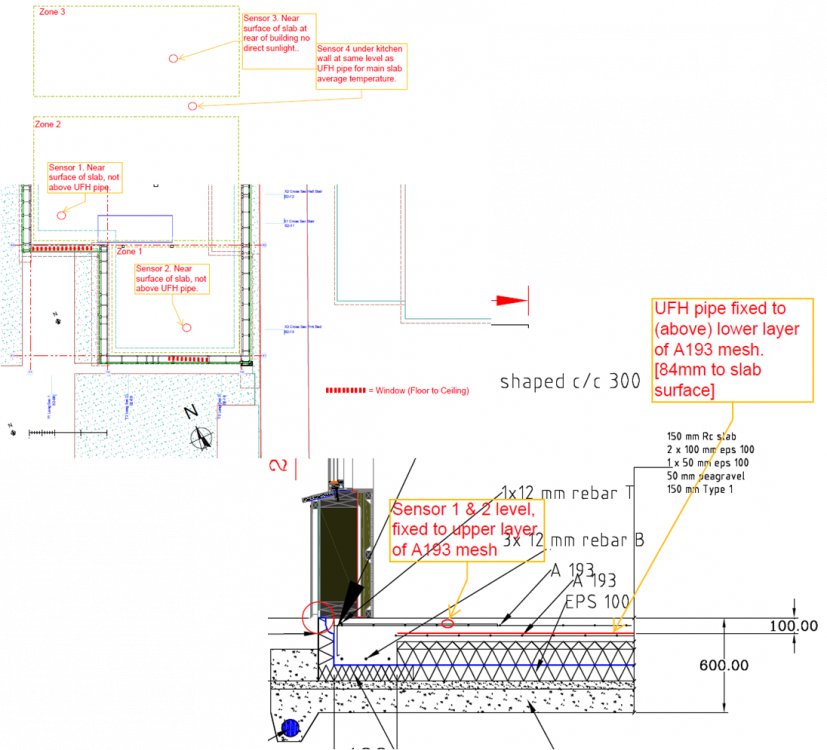
-
Probably cos they would be in the insulated part of the building, If cold roof then its a better idea I guess, you can get to them but the standard connectors / cables probably won't run that far.


